A framework describing electronic ground-state properties using the electron density. Practical approximations require an exchange-correlation functional; this does not mean that explicit electrons have been replaced by a classical atom-only force field.
The part of the exact density functional left after subtracting the auxiliary noninteracting kinetic energy and classical Hartree electrostatic energy. It includes fermionic exchange, correlation and the difference between interacting and noninteracting kinetic energies. Its functional derivative enters the Kohn-Sham equations. Practical approximations to this functional, rather than the existence of a density description itself, are a central source of error.
The constrained-search functional is universal for a fixed interaction. Minimization of over admissible densities with the correct electron number gives the ground-state energy. Each trial density represents a constrained set of antisymmetric states, so minimizing over densities and their representing states recovers the ordinary variational principle. The admissible domain and possible degeneracy must be handled explicitly.
Effective one-electron equations for orbitals whose density represents that of the interacting electronic system. The effective potential contains nuclear attraction, Hartree repulsion and an exchange-correlation contribution.
Summing the Kohn-Sham equations over occupied normalized orbitals yields . The exact ground-state energy functional is , so subtraction proves the correction in the title. Nuclear or lattice source self-energies must be added consistently. This accounting does not turn all auxiliary orbital eigenvalues into physical excitation energies.
A variational expansion over Slater determinants or spin-adapted configuration functions in a fixed orbital basis. Truncating the configurations restricts the correlation described.
configuration interaction retaining a reference determinant and its single and double excitations. Conventional matrix-vector iterations have leading work for occupied and virtual dimensions , hence when both grow with system size. Truncated CI is not generally size extensive.
An iterative orbital calculation in which the effective one-electron operator depends on the density built from its own occupied orbitals. Self-consistency is a stationarity condition, not a guarantee that the solution is the lowest-energy one.
A variational approximation restricting a many-electron wavefunction to one Slater determinant. Minimizing its energy gives self-consistent one-electron equations with Coulomb and exchange operators. It includes exchange from antisymmetry but omits correlation beyond the determinant.
The self-consistent one-electron operator obtained by varying a Slater determinant. It contains a local hartree potential and a nonlocal exchange action. Its occupied eigenfunctions define a stationary determinant; its eigenvalues are Lagrange multipliers and are not by themselves the total many-electron energy.
A variational single-Slater-determinant treatment of interacting electrons and a neutralizing positive background. For uniform plane-wave occupations the direct background and electron terms cancel, leaving kinetic and same-spin exchange energy. Allowing spin polarization or spatially modulated orbitals enlarges the variational class.
In a uniform three-dimensional Hartree-Fock electron gas with repulsive contact coupling , a spin-independent neutralizing background can cancel the Hartree energy. The remaining same-spin exchange term is negative and quadratic in each spin density. Integrating the filled single-spin Fermi sphere gives . At fixed total density the exchange term favors spin polarization, whereas the kinetic term opposes it.
Let and . In units the spin-dependent energy is . Comparing only and gives the endpoint crossing . Expanding near gives a quadratic coefficient , so the unpolarized state first loses local stability at . The endpoint crossing is therefore not the actual continuous onset; intermediate polarizations matter.
The uniform paramagnetic three-dimensional electron-gas determinant is unstable within Hartree-Fock theory to a spin-density-wave deformation, even at high density. Comparing only spatially uniform polarized and unpolarized determinants therefore does not find the unrestricted Hartree-Fock ground state.[ref]
In a three-dimensional unpolarized gas, exchange energy per particle is , with Coulomb convention . It scales as minus the inverse dimensionless spacing radius, while kinetic energy scales as its inverse square. Exchange acts only between equal-spin occupied orbitals.
For number densities , . Uniform spin polarization raises kinetic energy by concentrating occupation in one Fermi sphere, while lowering exchange energy.
For real spatial orbitals, in atomic units. It enters the energy of a Slater determinant through antisymmetry and becomes small for well-separated localized orbitals.
The electrostatic repulsion integral in atomic units. For a normalized hydrogenic 1s orbital of exponent , the same-orbital value is . It is a two-electron integral, unlike a diagonal Hückel one-electron parameter.
In frozen-orbital Hartree-Fock theory, removing an electron from occupied orbital changes the energy by approximately . Orbital relaxation and correlation are omitted, so a measured ionization energy is not an exact orbital-energy measurement.
A Hartree-Fock ansatz allowing different spatial orbitals for alpha and beta spin. This can lower the energy of a stretched bond, but the determinant need not be an eigenstate of total spin squared.
A Hartree-Fock ansatz in which opposite-spin electrons in a doubly occupied orbital share the same spatial function. The closed-shell determinant is spin-pure but can dissociate incorrectly when a bond requires several determinants.
For two orthonormal spatial atomic orbitals, the normalized symmetric and antisymmetric two-particle factors have Coulomb energies and . With common orbitals, the fermionic singlet state and triplet state therefore differ by . This is an exchange interaction resulting from the state symmetry and the Coulomb operator, rather than a separate classical force.
In atomic units, the displayed integral is the direct electrostatic contribution between two normalized atomic orbitals . It enters a two-electron energy expectation together with the exchange integral.
The electron density describes the expected number of electrons per unit volume at position . For a system with a fixed number of electrons, . A Lewis structure allocates electron counts without specifying this spatial density.
An electron configuration records the occupation of electron shells and electron subshells by electrons. For neutral sodium in its ground state, gives electrons; adding the occupations within each electron shell gives . A superscript counts electrons, rather than multiplying the preceding labels. Removing the outer electron gives the sodium ion with , or . See Flowers et al., Chemistry 2e, electron configurations of atoms and ions.
A filled electronic shell has all its orbital and spin states occupied. Its total orbital and spin angular momenta cancel, so a closed core does not supply the valence angular momentum in an elementary alkali-atom term assignment.
An approximate scheme for constructing an atomic electron configuration by filling lower-energy atomic orbitals before higher-energy ones, subject to the Pauli exclusion principle. Orbital ordering can change on ionization and has exceptions in interacting chemical atoms. Selecting the free-ion ground term within a specified open-shell configuration additionally requires Hund's rules or a more detailed interaction calculation.
Atoms, molecules or ions with the same electron count, often compared because their orbital occupations or bonding patterns are related. Equal electron counts do not guarantee identical energies or geometry.
An orbital- and model-dependent parameter representing nuclear attraction after electronic screening. A screening construction writes ; a binding-energy construction requires an additional orbital-energy model.
Probability density within the inner electron shells. Greater penetration can reduce screening and lower an orbital energy; this helps distinguish many-electron s and p levels with the same principal quantum number.
An empirical orbital-screening prescription. Other electrons in an group count each; electrons in shell count , deeper electrons , and outer electrons zero. For , the partner contributes . d and f groups use separate rules.[ref]
Atomic Shielding Constants by John C. Slater. 1930, printed pp. 58–59
Friedrich Hund's rules describe the usual ground-term ordering within an atomic electron configuration in the LS coupling regime. First maximize the total spin subject to the Pauli exclusion principle. Among the terms with that spin, maximize total orbital angular momentum . Within the resulting term, the lowest level has for a less-than-half-filled open subshell and for a more-than-half-filled one. These are ordering rules, not universal replacements for diagonalizing an arbitrary atomic Hamiltonian operator.
For two equivalent electrons, parallel spins give . Their spatial wavefunction must be antisymmetric; the highest allowed orbital projection with parallel spins is , giving . A subshell is less than half filled, so its lowest term symbol is , followed within that term by and . Closed subshells contribute zero total and .
An effective local exchange coupling can favor parallel electron spins in different orbitals on the same atom. The displayed sign convention represents that preference. It underlies the high-spin tendency in Hund's rules and the alignment of itinerant and core spins used in double exchange. The coupling is an effective description of intra-atomic Coulomb and exchange energies, rather than a separate classical magnetic force.
An electron shell collects the allowed electronic quantum states sharing a principal quantum number . Its occupancy is the number of electrons assigned to those states in an electron configuration. An electron shell is not a material surface or a prescribed orbit.
The innermost atomic electron shell, with principal quantum number . Its orbital has nonzero nuclear overlap, making its electrons important in electron capture.
An electron subshell groups the allowed electronic quantum states within an electron shell by their orbital angular momentum quantum number . Labels and mean and , respectively; their capacities are two and six electrons. The leading number in identifies the electron shell, while identifies the electron subshell.
An atomic orbital is a one-electron spatial wavefunction used to describe an electron's state in a chemical atom. For a one-electron hydrogen atom, orbitals can be exact energy eigenstates; descriptions of many-electron atoms instead use an orbital approximation. A normalized atomic orbital has , and the Born rule gives the position probability density . It is a function extending through space, not a prescribed classical orbit. [ref]
https://openstax.org/books/chemistry-2e/pages/6-3-development-of-quantum-theory. Flowers et al., Chemistry 2e, 6.3: atomic orbitals and the wavefunction description
The linear combination of atomic orbitals combines these single-centre functions to approximate a molecular orbital. The orbital overlap measures their inner product, and their relative quantum phase controls the interference shown in molecular orbital theory.
For a normalized spatial wavefunction, . Its square root is the root-mean-square radius, which differs from the exponential decay length. A spherical hydrogenic donor state with has , obtained by dividing the radial integrals of and .
A radial position at which an orbital radial wavefunction vanishes. A hydrogen-like orbital has radial nodes; has one and none.
An atomic orbital with orbital angular momentum quantum number zero. Its angular part is spherically symmetric; higher principal shells can have radial nodes.
An atomic orbital with orbital angular momentum quantum number . Five angular functions span the subshell; a ligand field can split their energies.
A plane on which an atomic orbital wavefunction vanishes. For a real p orbital oriented along , it is the plane . The probability density also vanishes on that plane.
An atomic orbital with orbital angular momentum quantum number . Real combinations have opposite quantum phases in their two lobes and a nodal plane through the atomic nucleus. An orbital phase is not an electric charge.
A change of atomic-orbital basis used to construct directed local bonding orbitals. , and describe idealized combinations; they are model descriptions rather than unique experimental labels for every bonded atom.
A linear combination of atomic orbitals used in a localized description of directional bonding or lone pairs. Hybrid labels are models rather than directly observable fixed atomic states.
Molecular orbital theory describes the electronic arrangement of a molecule using molecular orbitals: one-electron spatial wavefunctions extending over the combined atomic nuclei. Filling bonding molecular orbitals can stabilize a chemical bond; filling antibonding molecular orbitals opposes that stabilization. A molecular orbital is a building block of a many-electron description, rather than the entire many-electron wavefunction. See Robert W. Field, MIT 5.61, lecture 24, pp. 1–4: molecular orbitals and the LCAO approximation.
First make the interference visible with an exactly normalized one-dimensional toy. Replace the three-dimensional atomic orbitals of the hydrogen atom by two Gaussian functions centred at , with dimensionless and :The normalized sum and difference are , following the same linear combination of atomic orbitals algebra. At , the orbital overlap is . At the midpoint, , givingBoth probability densities have total integral one: interference redistributes probability, rather than creating an extra electron. These are toy wavefunctions, not actual hydrogen atom orbitals or predictions of molecular hydrogen energies.
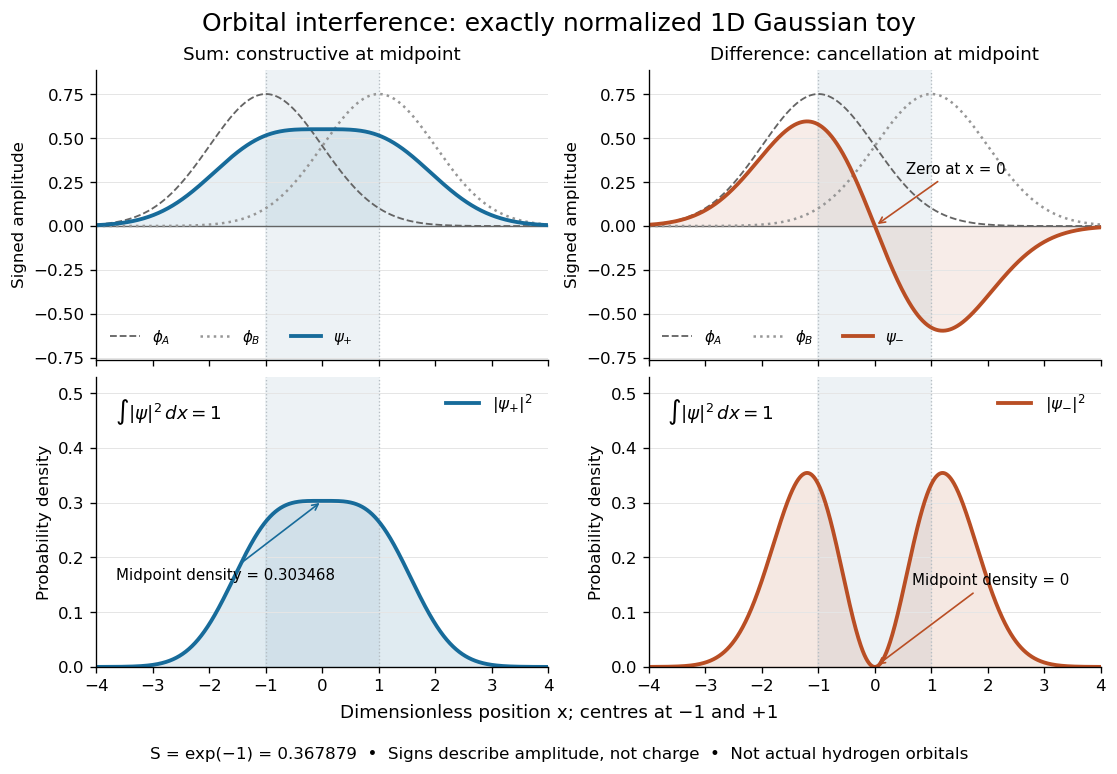
Normalized one-dimensional Gaussian function toy: signed probability amplitudes add or cancel before their squares give probability densities
. Centres at and give orbital overlap . The difference has a zero at the midpoint; its negative lobe does not carry positive electric charge. All density curves shown are normalized on the line, rather than in three-dimensional space. Details.Now fill the two -derived molecular orbitals in the minimal model. The lower bonding molecular orbital is labelled ; the upper antibonding molecular orbital is . The Pauli exclusion principle permits at most two electrons in each spatial molecular orbital, with opposite spin projections along a chosen axis. For the lowest electron configuration in this model, fill first. The subscripts and denote even and odd behaviour under inversion through the midpoint; the star marks an antibonding molecular orbital. See Flowers et al., Chemistry 2e, 8.4: occupancy and bond order and Field, MIT 5.61, lecture 25, pp. 1–3: bonding, antibonding, and symmetry labels.
With electrons in bonding molecular orbitals and in antibonding molecular orbitals, the model's bond order is . The three elementary counts are:
- Molecular hydrogen, : two electrons give and .
- The hydrogen molecular ion : one electron gives and .
- Two neutral helium chemical atoms, : four electrons give and in this minimal model.
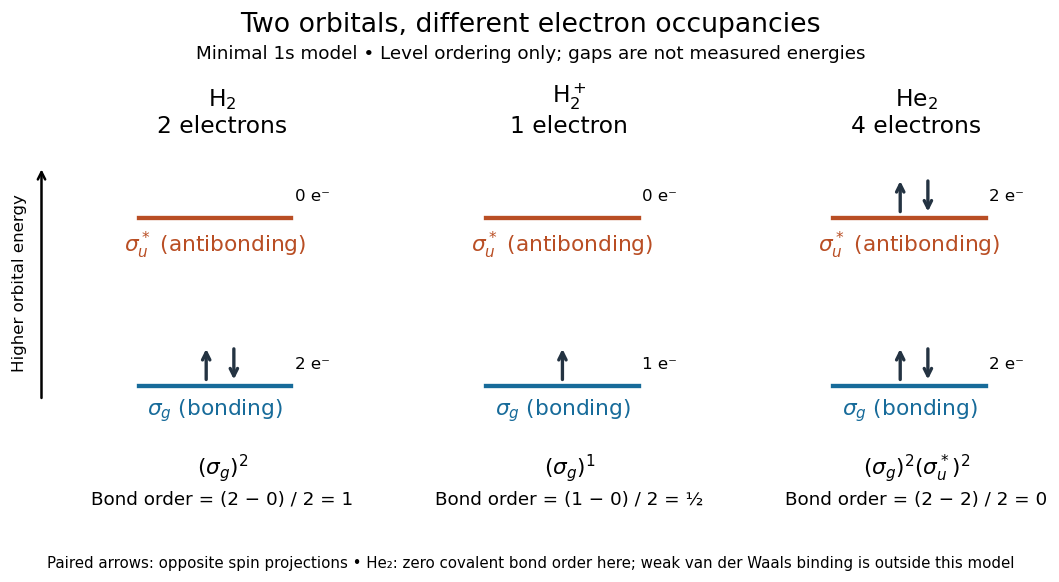
The zero bond order says this minimal model gives no net covalent bond for . It does not rule out every bound pair of helium chemical atoms: a very weak Van der Waals force can bind a neutral helium dimer, which has been observed experimentally. See Zeller et al., Imaging the He2 quantum halo state using a free electron laser, PNAS 113, 14651–14655 (2016), p. 14651: van der Waals binding and Luo et al., The weakest bond: Experimental observation of helium dimer, Journal of Chemical Physics 98, 3564–3567 (1993). The bond order count does not include that weak binding mechanism.
The useful surprise is that sharing alone does not determine a chemical bond: the relative quantum phase and the occupancy matter together. The same two shapes explain why adding an electron to a bonding molecular orbital increases the model's bond order, while adding one to an antibonding molecular orbital decreases it. Molecular orbital theory also accounts for the unpaired electrons and paramagnetism of molecular oxygen, which its all-paired Lewis structure misses. See Chemistry 2e, 8.4: the molecular orbital description of oxygen.
A correspondence between molecular fragments based on the number, approximate symmetry, shape, energy and occupation of frontier orbitals. Equal total electron count alone is insufficient; the comparison predicts transferable bonding possibilities rather than identical chemistry.
A diagram linking reactant and product orbitals by a symmetry conserved along a stipulated reaction path. Orbitals of the same symmetry avoid crossing in a generic one-parameter problem; orbitals of different symmetry can cross. Correlation constrains connectivity, not quantitative barrier heights.
Mixing between symmetry-compatible s-derived and p-derived orbital combinations. It shifts energies and changes orbital shapes; in a centrosymmetric diatomic, gerade and ungerade combinations do not mix with one another.
A model of conjugated molecular orbitals with an orthonormal atomic basis, one-centre energies , and resonance matrix elements between selected neighbouring sites. Solving gives orbital energies and coefficients. Its simplicity makes symmetry and electron filling explicit, but quantitative charge predictions can depend strongly on the chosen parameters and omitted orbital relaxation.
With one orthonormal site orbital per cube vertex, common site energy , and coupling along every edge, the one-electron Hamiltonian is , where is the cube adjacency matrix. Its eigenvalues are with multiplicities .
One proof labels each vertex by three signs. The adjacency operator flips one sign at a time, so a product of coordinate signs is an eigenfunction of with eigenvalue . There are such products. For , eight electrons fill the lowest four spatial molecular orbitals, yielding total one-electron energy .
For a four-site cycle with site energy , three resonance integrals and one weakened integral , , put . In the independent-electron Hückel method, filling the two or four lowest spin orbitals gives total electronic energies and . At the square limit , these become and . The weakened-edge distortion raises the two-electron sum but lowers the four-electron sum. Near the latter change is , so its first-order term cancels. This electronic comparison omits structural repulsion and other restoring forces, and does not determine the open-shell spin at the square limit.
For a bipartite pi system with a common diagonal energy , the orbital spectrum is paired about . If and changes the sign on one sublattice, then ; an eigenvector of energy is mapped to one of energy . Their site-probability magnitudes are equal.
For real orthonormal site functions, , where is orbital occupation. It measures the off-diagonal pi density matrix; a complete C–C bond also contains a sigma contribution.
The diagonal one-centre energy assigned to a pi-basis orbital. This one-electron parameter is distinct from a two-electron Coulomb repulsion integral in Hartree-Fock theory.
An off-diagonal Hamiltonian matrix element between selected neighbouring pi-basis functions. The usual bonding convention has ; non-neighbour matrix elements are neglected.
With equal on-site energy and equal pair interaction , the three-site Hamiltonian has one eigenvalue and a degenerate pair . This model explains symmetry and filling but omits ingredients needed for a quantitative dissociation energy.
The change in energy on allowing a specified localized orbital reference to delocalize across a conjugated system. In a Hückel method calculation, the reference must use the same one-centre parameters and bond types as the delocalized molecule. With the signed convention , stabilization is negative; its positive magnitude is often also called the delocalization energy, so the sign convention must be stated.
In an orthonormal Hückel method basis, an occupied molecular orbital with occupancy contributes electrons to site . Adding one electron to a fixed orbital changes the site population by . A coefficient sign indicates orbital phase, not charge sign. A net atomic charge also needs a reference population and treatment of the electrons outside the model.
A molecular orbital is a one-electron spatial wavefunction for the combined atomic nuclei of a molecule. For a normalized molecular orbital, the Born rule gives the position probability density , with . The molecular orbital is the amplitude, rather than its squared modulus or a classical trajectory.
In the independent-orbital approximation, a doubly occupied molecular orbital contributes to the electron number density, whose integral is two. An empty molecular orbital contributes zero, even though its shape is still part of the model. The molecular hydrogen example therefore uses one occupied spatial molecular orbital for two electrons, distinguished by their spins. A negative real probability amplitude means a relative quantum phase of , not positive electric charge; multiplying the whole wavefunction by changes only its global phase.
A molecular orbital near the boundary between occupied and unoccupied levels. The highest occupied molecular orbital and LUMO are central examples. Their energies, occupancies, spatial form and symmetry help predict which new chemical bonds can form when fragments approach.
A molecular orbital whose occupation changes bonding between the selected centres relatively little. In a real complex, weak bonding or antibonding contributions may replace exact nonbonding character.
For an open-shell species, distinguish a singly occupied spatial orbital from a vacant spin orbital. Adding an electron to an oxygen molecule can fill the opposite-spin vacancy in a pi-star singly occupied molecular orbital even though the next completely empty spatial orbital is sigma-star.
A spatial molecular orbital occupied by one electron. In an open-shell molecule, its empty opposite-spin slot can accept another electron even though the spatial orbital is occupied.
A molecular orbital with little or no net bonding interaction between the atoms in the stated orbital model. A symmetry-isolated atomic orbital can be exactly nonbonding in a minimal basis: the out-of-plane nitrogen orbital in planar Ammonia has no matching hydrogen symmetry orbital. A mainly localized lone pair can acquire bonding admixture when a distortion permits additional mixing.
An energy-level scheme showing the occupied molecular orbitals and their relation to atomic orbitals. Occupancies must account for degeneracy and spin.
In pyramidal Ammonia, the hydrogen symmetry orbitals span of the C3v molecular point group. Nitrogen and both have symmetry and span . In the planar D3h molecular point group, these become , and , respectively, while the hydrogen combinations span . Thus the planar out-of-plane lone pair is a symmetry-isolated nonbonding orbital; pyramidalization permits mixing with the other functions.[ref]
The occupied molecular orbital of greatest energy in a specified reference electron configuration. A fixed-orbital model removes an electron from this level first; relaxation and electron correlation can modify the resulting energy.
Orbital degeneracy means distinct spatial orbitals have equal energy within the specified model or symmetry. Two electrons in degenerate orbitals need not pair; exchange can favor a triplet state.
The lowest-energy unoccupied orbital of a specified reference electron configuration. In a fixed-orbital approximation, adding one electron occupies this orbital; orbital relaxation and electron correlation can alter that picture.
Occupying a bonding molecular orbital favours a chemical bond. For the two equivalent atomic orbitals of the hydrogen atom, the sum has constructive interference between the protons. The resulting electron density in that region helps stabilize the combined system. Its lower energy in this model follows from the Quantum Hamiltonian, not from the plus sign alone; see Field, MIT 5.61, lecture 25, pp. 1–2.
For example, in molecular hydrogen supplies , hence bond order one when . The sum in the molecular orbital theory toy has midpoint probability density , whereas the difference has zero there. The normalization factors must be included in this comparison.
Occupying an antibonding molecular orbital opposes a chemical bond. For equivalent atomic orbitals of the hydrogen atom, the difference vanishes on the plane halfway between the protons: every point there is equally far from both centres, so the amplitudes cancel. This nodal plane removes the contribution of this molecular orbital to electron density on that plane; it does not make an entire finite region empty. The -derived antibonding molecular orbital lies above its bonding molecular orbital partner in energy. See Field, MIT 5.61, lecture 25, pp. 1–2.
In the minimal model, adds and cancels the bond order contribution of . Opposite signs on the two lobes describe probability amplitudes, while both lobes have nonnegative probability density after squaring. The star is an orbital label, not an extra electron or an electric charge.
The LCAO approximation builds a molecular orbital as a linear combination of single-centre atomic orbitals. For two equivalent normalized real functions and , choose their signs positive and define their orbital overlap . At nonzero separation, , and the normalized combinations areHere and . Equal coefficients use the equivalence of the two centres; a general LCAO need not have equal coefficients. See Field, MIT 5.61, lecture 24, pp. 3–6: LCAO coefficients and overlap integrals.
For the Gaussian function toy's , the two denominators are and . To check wavefunction normalization, expand the square: . Dividing by gives one. The local probability density isThe cross term is the interference; adding the separate densities first would lose it. These formulas normalize the chosen linear combination exactly, while the restricted choice of atomic orbitals remains an approximation to an actual molecular orbital.
A linear combination of atomic orbitals chosen to transform under an irreducible representation of the molecular point group. Relative orbital signs must be transformed as well as the positions of their centres. Such combinations organize a Hamiltonian operator into symmetry blocks; combinations of the same symmetry generally still mix and need not themselves be molecular orbitals.
Four equivalent atomic orbitals at the vertices of a regular tetrahedron carry the tetrahedral symmetry representation . The normalized equal sum is ; three coordinate-sign combinations span . Every normalized coefficient vector has entries in a suitable orthonormal real basis. These functions simplify a Hamiltonian invariant under the tetrahedral operations, but equivalent symmetry copies on other sites may still mix.
The orbital overlap of normalized real atomic orbitals is their inner product . It is a dimensionless measure of their common amplitude, not an electron count. For the Gaussian function toy, increasing from to reduces from to . As tends to zero, both LCAO normalization denominators tend to .
In the elementary molecular orbital theory count, bond order is half the excess of electrons in bonding molecular orbitals over those in antibonding molecular orbitals. Thus adding one electron to a bonding molecular orbital raises by , while adding one to an antibonding molecular orbital lowers it by . The configurations drawn above give , , and . This count summarizes net covalent bond occupancy; it is neither a measured energy nor a universal test for every kind of binding. See Chemistry 2e, 8.4: molecular orbital bond order.
Articles by others on the same topic

Quantum chemistry is a branch of chemistry that applies the principles of quantum mechanics to study the behavior of atoms and molecules. It seeks to understand how quantum effects influence chemical properties and reactions. Here are some key aspects of quantum chemistry: 1. **Wave-Particle Duality**: Quantum chemistry leverages the concept that particles, such as electrons, exhibit both wave-like and particle-like properties, which is fundamental in explaining their behavior in atomic and molecular systems.



Ah, the jewel of computational physics.
Also known as an ab initio method: no experimental measurement is taken as input, QED is all you need.
But since QED is thought to fully describe all relevant aspects molecules, it could be called "the" ab initio method.
For one, if we were able to predict protein molecule interactions, our understanding of molecular biology technologies would be solved.
No more ultra expensive and complicated X-ray crystallography or cryogenic electron microscopy.
And the fact that quantum computers are one of the most promising advances to this field, is also very very exciting: Section "Quantum algorithm".