Respiratory control links mitochondrial oxygen consumption to demand for ATP. When ADP permits faster ATP synthase turnover, proton return lowers the opposing electrochemical gradient, permitting faster Electron transport.[ref]
Molecular Biology of the Cell, 4th edition by Bruce Alberts and others. Chapter 14, Electron-Transport Chains and Their Proton Pumps, Respiratory Control Normally Restrains Electron Flow Through the Chain
The mitochondrial oxygen electrode assay tests this connection by changing ADP availability while observing oxygen. A slowed reaction rate alone cannot locate the cause: depleted substrate, scarce oxygen, impaired enzymes and a strong opposing electrochemical gradient can all restrict turnover. A renewed response to ADP helps distinguish these possibilities.
In Respiratory enzymes in oxidative phosphorylation. I. Kinetics of oxygen utilization (1955), Britton Chance and G. R. Williams examined isolated liver mitochondria in isotonic medium with substrate and inorganic phosphate. A one-millilitre optical cuvette held the suspension. A vibrating platinum electrode lay outside the light path; calibrated electric current followed dissolved oxygen, with rapid changes recorded by a galvanometer oscillograph. Air-saturated and oxygen-depleted readings checked sensitivity. Their Figure 2 shows ADP additions accelerating oxygen consumption, followed by return to slow respiration; repeated additions restored acceleration. Figure 4B compares delayed substrate addition after ADP incubation with the reverse order, supporting little unrelated ADP loss in that preparation. These comparisons support coupling to ADP utilization. The authors discuss dilution, sensitivity changes and atmospheric oxygen entry, which especially biases slow respiration. The readout did not directly measure the membrane potential or prove the later chemiosmosis mechanism.[ref]
Respiratory enzymes in oxidative phosphorylation. I. Kinetics of oxygen utilization by Britton Chance and G. R. Williams. pp. 383–386, Preparations and Method, Figures 1–2; pp. 387–389, Endogenous Substrate and Figure 4B; Figure 5: rapid recording
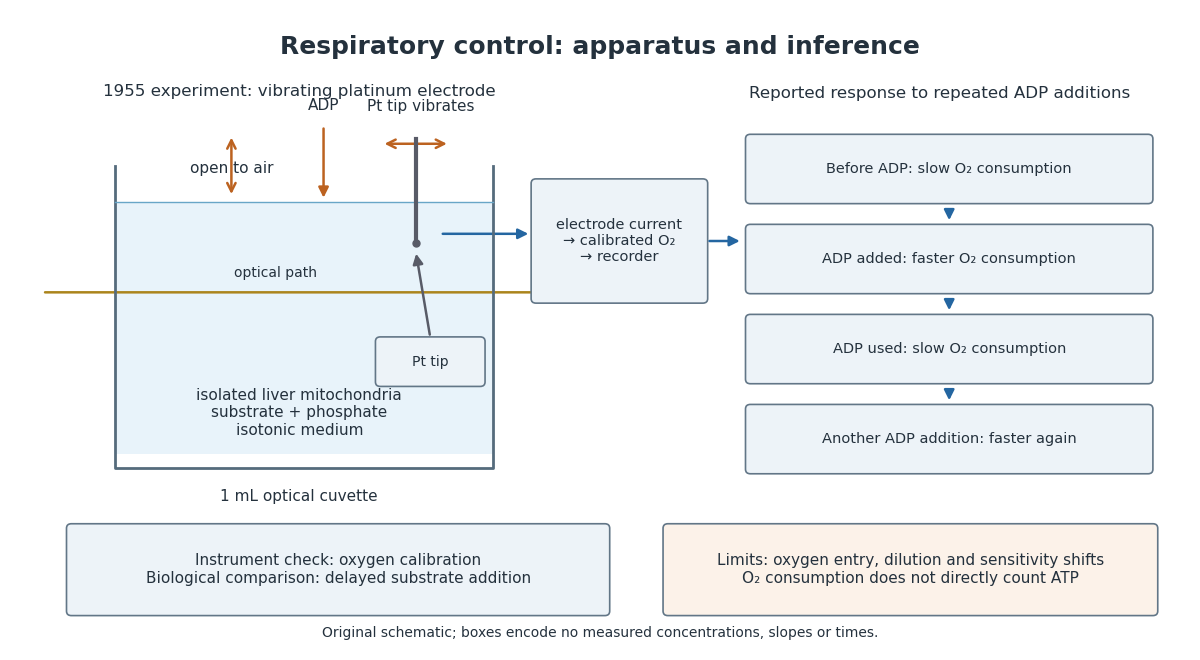

A control can test either the instrument or the biology. Calibrating electric current against oxygen checks the former; comparing responses before and after an ADP addition checks the latter. A valid calibration cannot by itself establish ATP formation, and a repeatable biological response cannot by itself fix an instrument's sensitivity.
The respiratory control ratio divides the oxygen consumption rate during ADP-stimulated respiration by that after supplied ADP has been used. It compares reaction rates, not ATP formed per oxygen.[ref]
Respiratory enzymes in oxidative phosphorylation. I. Kinetics of oxygen utilization by Britton Chance and G. R. Williams. pp. 386–387, Figure 2 and discussion of the ratio of respiration rates with and without ADP
A large ratio means strong stimulation under the comparison's conditions; it is not a universal measure of all mitochondrial functions.
For a constructed example, choose constant suspension volume and oxygen concentration declines of and during the two comparison windows. Assume no gas exchange or dilution and a correctly calibrated readout. A derivative converts each concentration slope into an amount of substance consumption rate:The common volume cancels in the ratio, so dividing the positive slope magnitudes gives the same answer. These are chosen inputs, not the 1955 observations. If an uncorrected influx of of oxygen occurred in both windows, the apparent rates would instead be and , giving . The same absolute error can inflate a ratio because it removes a larger fraction of its smaller denominator.
Articles by others on the same topic
There are currently no matching articles.