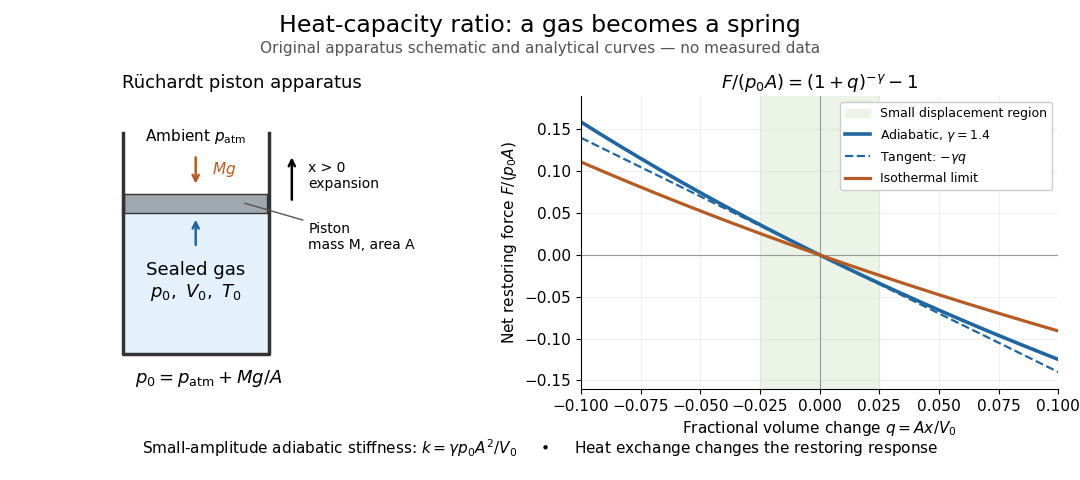
The Rüchardt experiment infers heat capacity ratio from the period of an oscillation of a piston supported by trapped gas. Use a vertical precision cylinder with a close-fitting movable piston, known moving mass , face area , trapped equilibrium volume , and local atmospheric pressure . With negligible static friction, force balance gives the absolute gas pressure , where is gravitational acceleration. Displace the piston slightly and release it: compression raises pressure, and expansion lowers it, producing a restoring force. The oscillation is a mechanical probe of thermal response, without separately measuring two heat inputs. [ref]
https://groups.ist.utl.pt/wwwelab/wiki/index.php?title=Determination_of_the_Adiabatic_Constant. Instituto Superior Técnico e-lab, Determination of the Adiabatic Constant: piston apparatus and period model
Let be upward displacement from equilibrium, so . For constant heat capacity ratio and a reversible adiabatic process, the net upward force, including the ambient load and weight, isThe linear approximation requires . Applying Newton's second law gives simple harmonic motion withHere is the undamped angular frequency and the undamped oscillation period, rather than temperature. Record repeated cycles, measure independently, and include all connected trapped volume. An illustrative model with , , , , and gives and . These stipulated values are not measurements.
In Shearwood and Sloan's implementation, piston-mounted magnets induce an electromotive force in a stationary coil through Faraday's law of induction; an oscilloscope records the signal. They observed faster oscillations at smaller trapped volume values and stronger damping at small cylinder volume values. The signal tracks velocity locally, so its amplitude is not directly piston displacement. Calibration also identified inlet dead space beyond the graduated cylinder volume. [ref]
https://arxiv.org/html/2209.03323v1. Chris Shearwood and Peter A. Sloan, The Rüchardt experiment revisited, §§3–4: signal, dead volume and observations
Repeat at smaller initial amplitudes to test the linear approximation, and compare several values. Heat transfer weakens the restoring force toward the isothermal process limit, biasing the inference toward . Check leakage through resting-piston drift and before-and-after trapped volume readings. For viscous damping with envelope , the measured angular frequency obeys ; this correction does not remove thermal leakage. Internal equilibration must be faster than an oscillation period, with heat transfer and leakage slow over a run. Large amplitude or sticking friction require a richer model. [ref]
Articles by others on the same topic


The Rüchardt experiment, conducted by physicist Walter Rüchardt in the early 20th century, is a significant demonstration in the field of experimental physics, particularly in the study of the properties of gases and kinetic theory. The experiment focuses on the measurement of gas diffusion and the determination of the gas constant through an apparatus that allows for the observation of the molecular behavior of gases under different conditions.