Sagittarius A* is the compact radio source at the centre of the Milky Way. Nearby infrared stars allow its central mass concentration to be studied through their orbits.[ref]
The useful idea is to weigh an unseen object through its effect on a visible tracer. A curved stellar orbit carries more information than a single fast-moving star: its changing position and velocity constrain a common centre, a length scale and a clock. The Galactic-centre stellar-orbit experiments combine astrometry with Doppler spectroscopy; the Galactic-centre point-mass orbit model below shows how the two measurements complement one another.
Consider a negligible-mass star moving in the stationary Newtonian gravitational potential of a point mass. Let its semi-major axis be , orbital eccentricity , and orbital period . Write for the gravitational parameter. The eccentric anomaly is determined by Kepler's equation,where is the time of periapsis. Coordinates in the orbital plane, with the point mass at the origin, areThe focus is the central mass; the ellipse's geometric centre is displaced by along the first coordinate. The varying denominator makes the star move faster near periapsis, even though the mean anomaly increases uniformly.
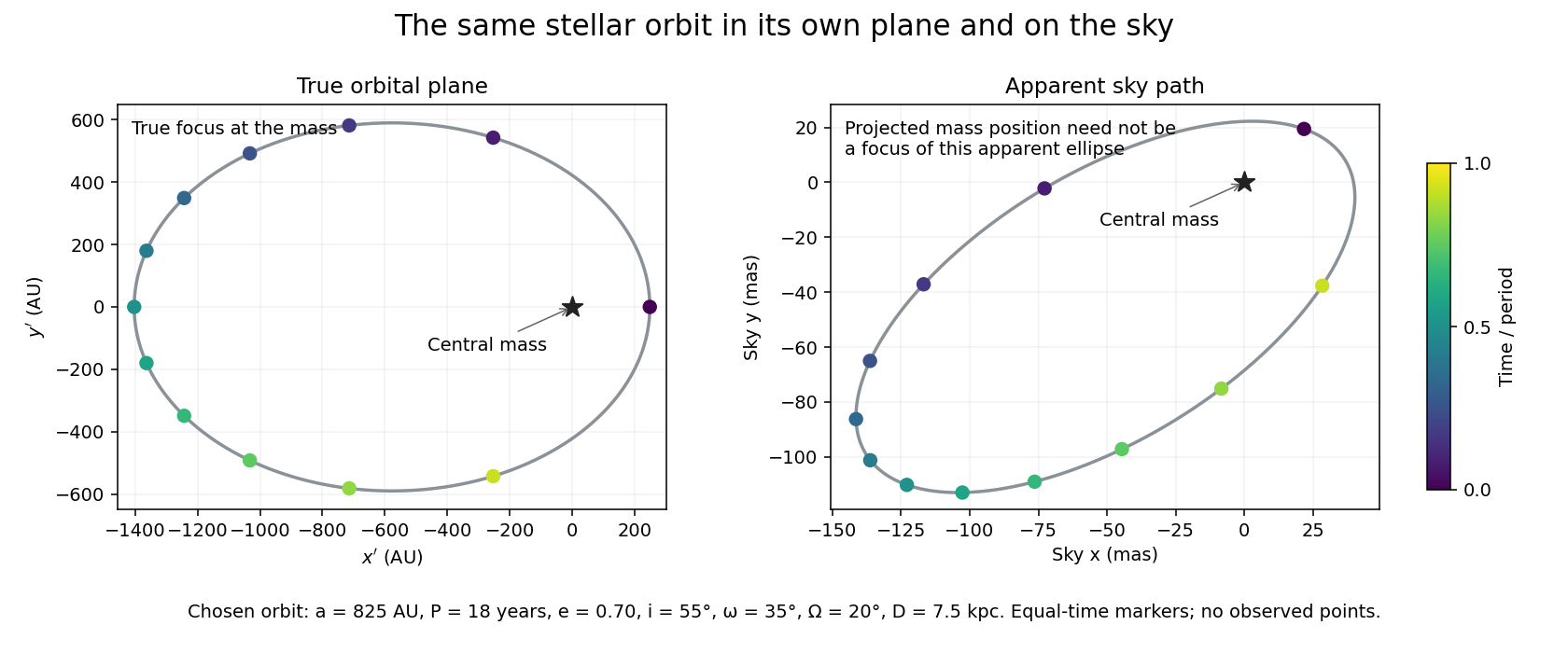
Let increase away from the observer, with spanning the sky plane. A rotation sends the orbital-plane coordinates to . Here is orbital inclination, the longitude of ascending node, and the argument of periapsis. For distance , the small-angle model gives angular positions , in radians. Doppler spectroscopy instead supplies the line-of-sight velocity , with a fitted systemic offset .
Define , the angular scale of the deprojected fitted orbit. It is not generally the semi-major axis of the apparent ellipse on the sky. Projection also need not send a true focus to a focus of the apparent ellipse. Fitting the rotated orbit preserves that distinction; measuring a bounding ellipse alone loses it.
Angular astrometry determines the combination displayed by substituting into Kepler's third law. Keeping the fitted shape, orientation and orbital period fixed, the rescalingleaves the entire angular time series unchanged. A longer physical orbit around a larger mass can trace precisely the same angular path. More angular samples improve the fitted combination; by themselves they cannot break this scaling symmetry of the model.
The radial-velocity semi-amplitude isFor , combining it with the angular fit gives the orbital parallax distanceThe spectral velocity scale supplies the missing physical ruler. For a face-on orbit, , this radial signal vanishes and that method cannot supply a distance. In a partial or noisy data set, fitted orientation and systemic motion also correlate with the inferred scale.
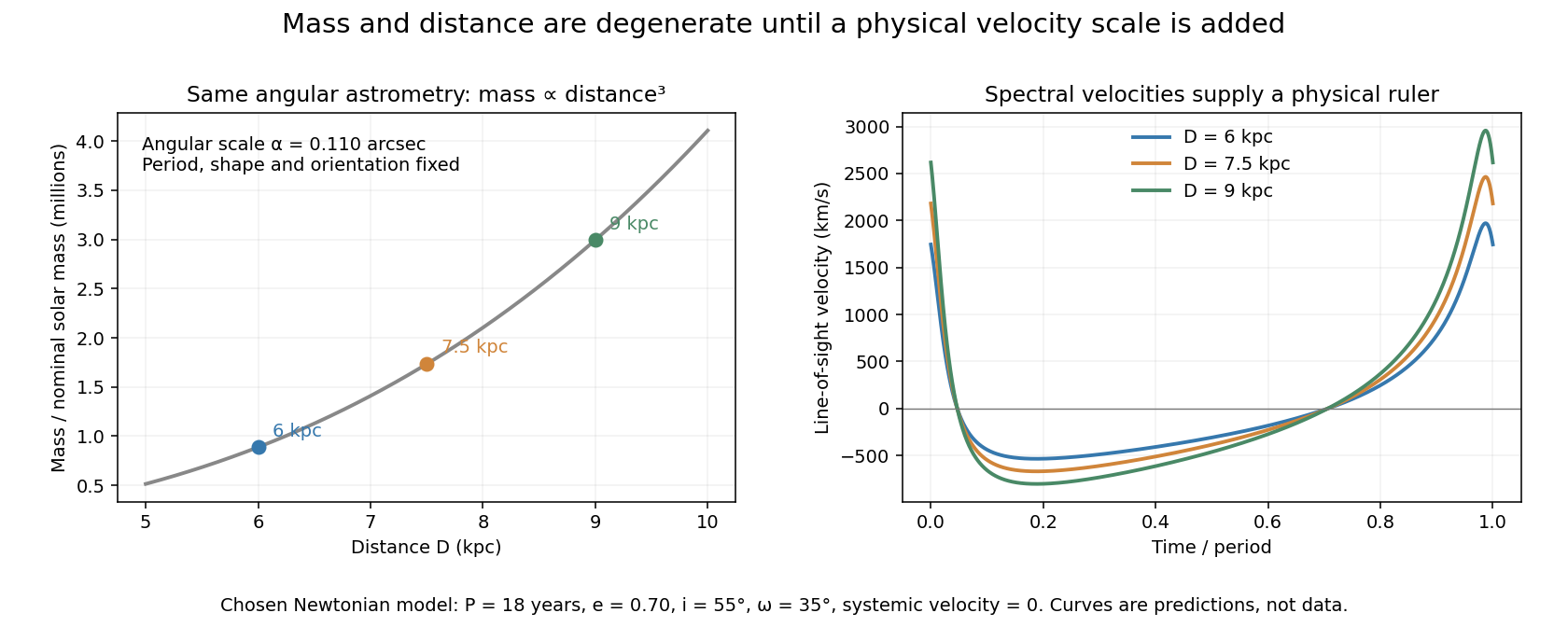
Choose , arcseconds, years, and degrees. The small-angle conversion gives . Taking one model year as days gives and .
Dividing by the nominal solar mass parameter, , gives nominal solar masses. The nominal parameter is an exact conversion convention, rather than an assertion that the Sun's measured mass is exact.[ref]
Resolution B3 on recommended nominal conversion constants for selected solar and planetary properties by International Astronomical Union. PDF pp.2–3, exact nominal solar mass parameter and conversion recommendation
The chosen periapsis radius is . Its corresponding Schwarzschild radius, , is about . Thus this illustrative orbit remains roughly Schwarzschild radii from the centre at closest approach. Inferring a very concentrated mass from such an orbit is different from directly resolving its event horizon. Every number here follows from the chosen orbit, not from a fit to the actual Galactic-centre measurements.
For a bound Kepler orbit, specific orbital energy is negative. Therefore . A projected separation and a systemic-motion-corrected line-of-sight speed give the displayed lower bound. One position and one spectral velocity already constrain the mass in this model; a fitted orbit gives much more. The bound assumes a bound orbit in a point-mass potential; it is not an unrestricted enclosed-mass formula for an arbitrary extended potential.
Rainer Schödel, Reinhard Genzel and collaborators combined NTT imaging with VLT adaptive-optics infrared observations. Silicon-monoxide masers registered stellar images to the radio position of Sagittarius A*. Their 2002 observations included S2's closest approach; a fitted Kepler orbit constrained a concentrated central mass. Rejecting a particular extended cluster also required its density and survival assumptions.[ref]
Andrea Ghez and collaborators combined Keck speckle imaging and laser-guide-star adaptive optics with infrared spectra. Image fitting supplied angular positions; spectral lines supplied velocities. The 2008 analysis treated optical distortion, coordinate alignment and blended sources: a shifting photocentre can imitate motion. Joint angular and spectral fitting constrained both distance and mass, with assumptions about central radial motion affecting the result. Apparatus calibration and confusion tests are therefore part of the dynamical inference.[ref]
Measuring Distance and Properties of the Milky Way's Central Supermassive Black Hole with Stellar Orbits by Andrea M. Ghez and others. PDF §§2–4 and Appendices A–C: imaging, spectroscopy, source confusion and orbital fit
A star used in the Galactic-centre stellar-orbit experiments. The two designations refer to the same object in the SIMBAD catalogue.[ref]
S2 in SIMBAD by Centre de données astronomiques de Strasbourg. Identifiers EG97 S2 and GKM98 S0-2


