
Direction arises from switching between mutually incompatible states, with feedback providing memory and regulated destruction resetting the system. Different transitions use related logic, but a steep response, a bistable switch and an irreversible molecular event are not identical. The cell cycle also requires checkpoints and once-per-cycle licensing so that the ordered biochemical states produce a correct sequence of physical events.
At the G1/S transition, growth signals promote cyclin-dependent kinase activity and relieve RB-mediated restraint on E2F. E2F-dependent expression of additional cell-cycle components can reinforce the transition. More generally, activation of a kinase together with removal of its inhibitor creates positive feedback. In yeast, multisite phosphorylation of Sic1 permits recognition by the Cdc4 ubiquitin-ligase system and degradation of an inhibitor of S-phase kinase. This supplies a threshold that prevents weak or premature signals from launching the next programme.[ref]
Multisite phosphorylation of a CDK inhibitor sets a threshold for the onset of DNA replication by Piers Nash and others. Phosphorylation-dependent Sic1 recognition and timing
The detailed regulators vary across organisms and biological cell types; the conserved point is a coordinated transition from an inhibited state to one that reinforces its own activation.Mitotic entry gives an experimentally accessible example of bistability. cyclin B binding increases the available CDK1 complex, but Wee1-dependent inhibitory phosphorylation can keep it inactive. Cdc25 removes the inhibitory phosphate. Active CDK1 promotes Cdc25 activity and suppresses Wee1, giving a positive-feedback loop and a double-negative loop. Over a suitable input range, both a low-activity and a high-activity state can be stable. If cyclin input rises from interphase, activation occurs at a higher threshold than the input required to maintain a pre-existing mitotic state. These distinct thresholds constitute hysteresis and prevent small fluctuations from repeatedly reversing a committed transition.
In egg extracts, nondegradable cyclin could be supplied while CDK activity was approached from different initial states. The same cyclin input then supported different persistent activities depending on history, directly distinguishing hysteresis from a single steep but history-independent response.[ref]
Building a cell cycle oscillator: hysteresis and bistability in the activation of Cdc2 by Joseph R. Pomerening and others. History-dependent activity at matched nondegradable cyclin input
These are extract measurements, not universal numerical thresholds for every intact biological cell. A useful conceptual representation iswhere represents effective activating input. hysteresis supplies memory within this interval; it does not mean that the switch can never be reset.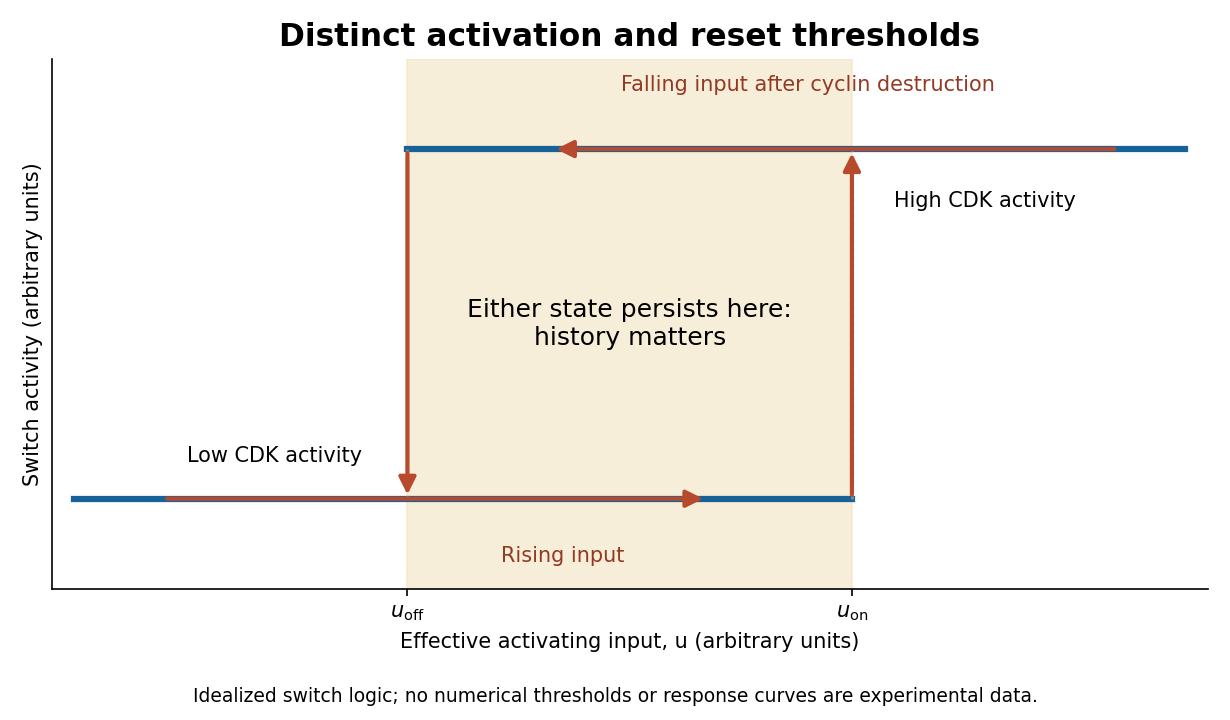
Hysteretic activation preserves state until a separate reset crosses the lower threshold
. Details. 
Reset is achieved by coupling activation to delayed negative feedback and proteolysis. Mitotic kinase activity helps prepare activation of the anaphase-promoting complex with Cdc20, while the spindle checkpoint prevents productive progression until attachment conditions are met. Once this restraint is satisfied, APC/C-dependent ubiquitination promotes destruction of securin and cyclin B. securin loss allows separase to cleave cohesin, making sister-chromatid separation possible. Experiments identifying cohesin cleavage connected regulated proteolysis to a physical transition that simple reversal of a phosphorylation state cannot undo.[ref]
Sister-chromatid separation at anaphase onset is promoted by cleavage of the cohesin subunit Scc1 by Frank Uhlmann and others. Cohesin cleavage and anaphase onset
Chromatids cannot be returned to a pre-anaphase chromosome merely by reducing separase activity.cyclin B destruction lowers CDK1 activity, allowing phosphatases to reverse mitotic phosphorylation and promoting an interphase state. Activation of anaphase-promoting complex with Cdh1 at low kinase activity can help keep cyclins low, while high kinase activity opposes that state. Thus low-CDK and high-CDK programmes are mutually antagonistic. Cyclin synthesis eventually provides a new activating input. Early experiments in extracts showed the importance of cyclin synthesis and destruction, including failure of normal exit with nondegradable cyclin.[ref]
The role of cyclin synthesis and degradation in the control of maturation promoting factor activity by Andrew W. Murray and others. Cyclin synthesis, degradation and nondegradable variants
A bistable activation module combined with an appropriate delayed reset can generate an ordered oscillation; a bistable module held at constant input need not oscillate on its own.replication licensing enforces another essential directionality. At low CDK activity, origin recognition complex with Cdc6 and Cdt1 loads MCM2-7 double hexamers, establishing competence to replicate. In S phase, activating kinases promote origin firing while high CDK activity and additional controls prevent renewed licensing. In animal biological cells, geminin inhibition of Cdt1 and regulated degradation help separate these states. Purified-protein reconstitution demonstrated loading of the replication-helicase precursor as a distinct biochemical event.[ref]
Concerted loading of Mcm2-7 double hexamers around DNA during DNA replication origin licensing by Dirk Remus and others. Origin licensing by double-hexamer loading
Separating licensing from firing allows many origins to be prepared but prevents fired regions from being copied repeatedly during the same cycle. Lowering mitotic kinase activity must eventually restore licensing competence for the next cycle, rather than permit uncontrolled rereplication during the current S phase.Checkpoint pathways modify or hold these switches when DNA is unreplicated, damaged or chromosomes are improperly attached; they do not supply the entire oscillator. Energy-consuming phosphorylation cycles, ubiquitination, proteolysis and resynthesis make the system a driven process, while feedback stabilizes distinct states. Thresholds provide commitment, hysteresis provides memory, destruction and cleavage enforce selected transitions, and licensing/checkpoints couple those transitions to one correct round of replication and segregation.
A common transition into anaphase both releases chromosomes for separation and permits the spindle to organise cytokinesis; later safeguards delay final separation when segregation remains incomplete. Temporal coordination makes the events occur in the right order, while spatial coordination positions division between the separating chromosome sets. The two forms of control interact but are experimentally distinguishable.
S phase establishes sister chromatids and their association through cohesin. During mitosis, chromosome condensation and DNA topoisomerase II activity help prepare the copies for separation. Each sister's kinetochore should attach to the opposite spindle pole, producing biorientation. Aurora B contributes to error correction by destabilising inappropriate attachments. Attachment and tension affect this process, but the spindle checkpoint should not be described simply as a direct meter of equal tension on every chromosome.
Unattached kinetochores catalyse formation of the mitotic checkpoint complex, involving Mad2, BubR1, Bub3 and Cdc20. This inhibits productive anaphase-promoting complex activity toward key substrates. In a classic causal experiment, destruction of the last unattached kinetochore allowed anaphase to proceed, with chromosome-arm damage providing an important control. It was the inhibitory signalling structure, rather than the physical presence of one unaligned chromosome somewhere in the biological cell, that maintained the delay.[ref]
The checkpoint delaying anaphase in response to chromosome monoorientation is mediated by an inhibitory signal produced by unattached kinetochores by Conly L. Rieder and others. Journal of Cell Biology 130, pp. 941–948; laser ablation of the last unattached kinetochore and chromosome-arm controls
Once attachment-associated checkpoint signalling is silenced and inhibitory complexes are dismantled, anaphase-promoting complex with Cdc20 promotes ubiquitin-dependent destruction of securin and mitotic cyclin B. securin destruction permits separase activity, which cleaves the remaining cohesion-bearing kleisin subunit. Non-cleavable Scc1 blocked sister separation in budding yeast, directly linking regulated proteolysis to the loss of chromosome cohesion.[ref]
Sister-chromatid separation at anaphase onset is promoted by cleavage of the cohesin subunit Scc1 by Frank Uhlmann and others. Nature 400, pp. 37–42; cleavage-resistant Scc1 and failure of sister-chromatid separation
Chromosome movement can then proceed through shortening of kinetochore-associated microtubules and separation of the spindle poles.Destruction of cyclin B also lowers CDK1 activity. This changes the phosphorylation balance, allowing protein phosphatases to reverse mitotic modifications and permitting chromosome decondensation, nuclear reassembly and cytokinetic organisation. Thus regulated proteolysis produces two coordinated outputs: removal of a physical chromosome linkage and removal of the mitotic kinase state. Their sharing of a controller improves ordering, but it does not mean that cytokinesis physically waits for a sensor to count every chromosome at its destination.
For animal cytokinesis, overlapping microtubules of the central spindle and signals associated with astral microtubules specify an equatorial cortical region. centralspindlin recruits and regulates the guanine-nucleotide exchange factor ECT2, which promotes local RhoA activation. RhoA stimulates actin assembly and myosin II activity, organising the actomyosin ring that drives furrow ingression. This geometry aligns the division plane between the segregating chromosome masses. Spindle position can itself be set by cortical cell polarity cues, explaining how the same machinery supports either approximately symmetric or asymmetric division.
Depletion and localisation experiments distinguish the biochemical signal from a simple structural scaffold. Experiments in human biological cells showed that ECT2 is required for cortical RhoA and furrow assembly, and that different centralspindlin subunits have distinguishable consequences for these events. Loss of central-spindle localisation need not abolish every equatorial signal, because additional spatial inputs can persist.[ref]
An ECT2-centralspindlin complex regulates the localization and function of RhoA by Özlem Yüce and others. Journal of Cell Biology 170, pp. 571–582; ECT2 and centralspindlin depletion, interaction and cortical RhoA assays
Accordingly, central-spindle disruption should be assessed alongside astral signals, spindle orientation and direct measurements of the cortical activity zone.Furrow ingression leaves an intercellular bridge with a midbody. Final abscission involves ESCRT-III-dependent membrane-remodelling machinery and must be distinguished from the earlier contractile event. Chromatin trapped in the bridge can sustain Aurora B-dependent signalling and delay abscission. Human-cell experiments connected persistent chromosome bridges with continued kinase activity and delayed final separation, reducing the risk of unsuccessful division and furrow regression.[ref]
Aurora B-mediated abscission checkpoint protects against tetraploidization by Patrick Steigemann and others. Cell 136, pp. 473–484; chromosome bridges, persistent Aurora B activity and delayed abscission
This safeguard can provide time to resolve a problem; persistent bridges can still lead to breakage, regression or abnormal descendants.A decisive experimental series would image labelled chromosomes, microtubules, cyclin B, active RhoA and the biological cell boundary in the same biological cells. Acute checkpoint inhibition predicts premature anaphase and increased segregation errors. Stabilised securin or cleavage-resistant cohesion should obstruct separation; persistent cyclin B should obstruct normal mitotic exit. Acute ECT2 loss can impair cytokinesis even when chromosome segregation proceeds, demonstrating separable downstream machinery. Use timed interventions after spindle assembly, independent depletion reagents, appropriately expressed rescue constructs and controls for global biological cell damage. Count chromosome allocation, furrow initiation, ingression and abscission separately; a binucleate endpoint does not reveal which step failed.
The checkpoint also has blind spots. A merotelic attachment, where one kinetochore binds microtubules from both poles, may evade an unattached-kinetochore signal and generate a lagging chromosome. Coordination is therefore layered rather than absolute: attachment surveillance, a shared proteolytic transition, spindle-directed cortical signalling and a late abscission checkpoint jointly reduce the chance of partitioning the genome incorrectly. The detailed geometry differs in organisms that divide with a cell plate or other cytokinetic mechanisms.