Counterrotating Electron and Positron beams at SPEAR collided inside the Mark I magnetic particle detector. Lead–scintillator scintillation counters identified Electrons through large shower pulses; small pulses plus hits beyond the iron return identified muons.[ref]
The selection required opposite-charge Electron–muon tracks, no detected photons, momenta above , and transverse noncoplanarity above . Multitrack hadron samples calibrated momentum-dependent misidentification; collinear lepton pairs checked identification losses. Photon and charge control samples tested backgrounds. Acceptance corrections depended on the proposed signal.[ref]
Evidence for Anomalous Lepton Production in e+ e- Annihilation by Martin Lewis Perl and others. SLAC-PUB-1626, pp. 3–5, Table I
The 1975 claim was anomalous events without a conventional explanation; new-particle pair production was a possible interpretation.[ref]
Evidence for Anomalous Lepton Production in e+ e- Annihilation by Martin Lewis Perl and others. Abstract; SLAC-PUB-1626, pp. 5–6
Martin Lewis Perl's lecture describes subsequent evidence for a charged lepton.[ref]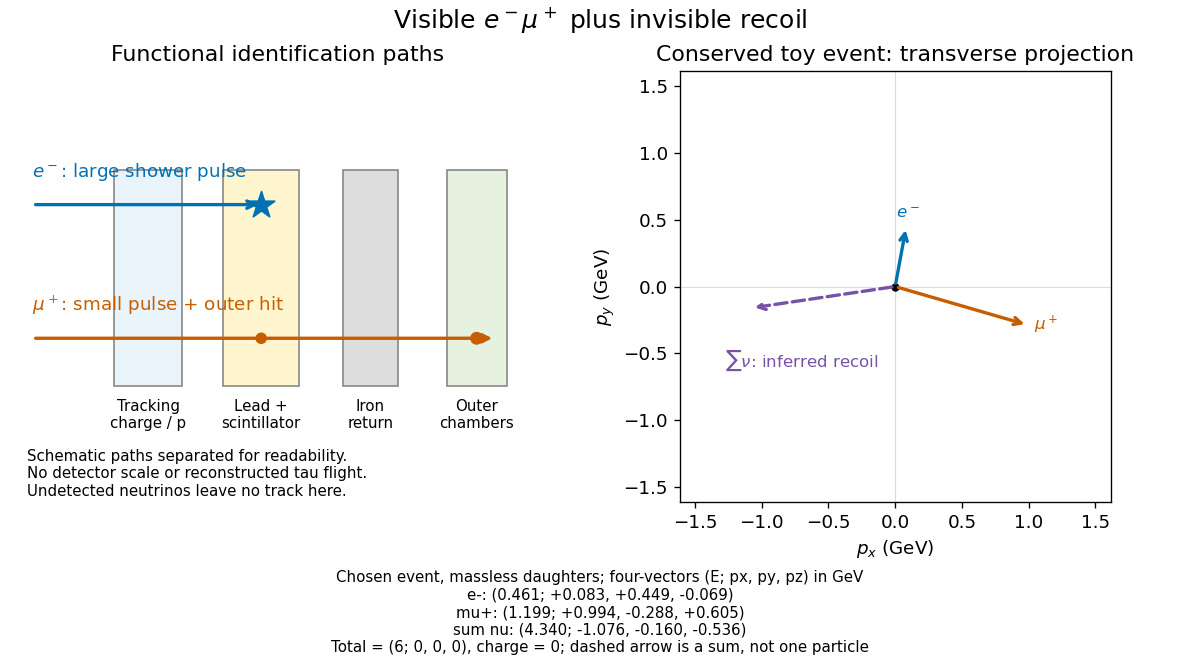

The particle identification problem matters as much as the apparent missing four-momentum in electron-positron collisions. A penetrating hadron can imitate a muon; a particle shower can imitate an Electron; an undetected photon or a detector gap can imitate invisible recoil. An absence of additional recorded signals is conditional on detection efficiency. In a proposed signal model, the selected count has the schematic formwhere is integrated collider luminosity, a cross section, and the combined acceptance and detection efficiency. A single count cannot determine all three factors. A control sample must probe the relevant momentum and angular range; its abundant events do not automatically calibrate a differently distributed signal.
The beam-overlap factor relating a reaction's cross section to its ideal production rate . Integrated collider luminosity has units of inverse area and gives the expected production count when is constant.
In the modern weak charged current interpretation, one allowed assignment isThe electron antineutrino, tau neutrino, muon neutrino and antineutrino of the tau neutrino carry away energy and momentum. There are four undetected particles in this decay assignment. Interchanging which parent decays electronically gives the opposite electric charge assignment. Each parent conserves electric charge and, in this approximation, total lepton number; four-momentum conservation applies separately to production and to each particle decay.
If and denote the corresponding branching fractions, independent parent decays give an inclusive mixed-flavour fraction . The factor two counts the two assignments to opposite parent charges. For chosen , the mixed fraction is , before acceptance and detection efficiency. Correlations between the parents' spins can affect angular selection even when the fully inclusive branching fractions factorize.
The neutrinos in that equation are a physical interpretation to test. Neither a deficit in visible energy nor two unusual tracks alone establishes their identities or uniquely counts them. Even a compatible invariant mass and an angular distribution require particle identification, background checks and agreement across further particle decay channels. The direct detection milestone for the tau neutrino was in 2000, separate from the charged tau lepton discovery.
Combine the two massless neutrinos in into . In the parent rest frame, four-momentum conservation givesThe lower bound follows from the nonnegative Minkowski norm of the sum of two future-directed null four-vectors; the upper bound follows from . Substituting gives the displayed energy bounds. They are kinematic: they do not specify the weak interaction decay amplitude or the probability density function inside the interval.
If the charged daughter is also massless, put . A parent with Lorentz factor and speed in natural units producesHere is the daughter angle relative to the boost direction in the parent rest frame. Two opposite parent momenta therefore need not produce two opposite visible daughter momenta: the invisible system can recoil differently in each particle decay.
Choose and purely for illustration. Then each parent has , and . Treat all six daughters as massless, including the charged Electron and antimuon, and generate each three-body particle decay with constant squared decay amplitude. Choose the parent direction isotropically and the two decays independently; this omits the physical production angular law and spin correlations.
The Lorentz-invariant phase space factorizes through into a two-body decay to , followed by a two-body decay of :After angular integration the first factor contributes , while the massless second factor is constant. Since , the normalized chosen density is . Drawing with uniform on implements this density. Isotropic directions, followed by a Lorentz boost for the invisible pair and another for the parent, conserve the complete four-momentum of each generated event.
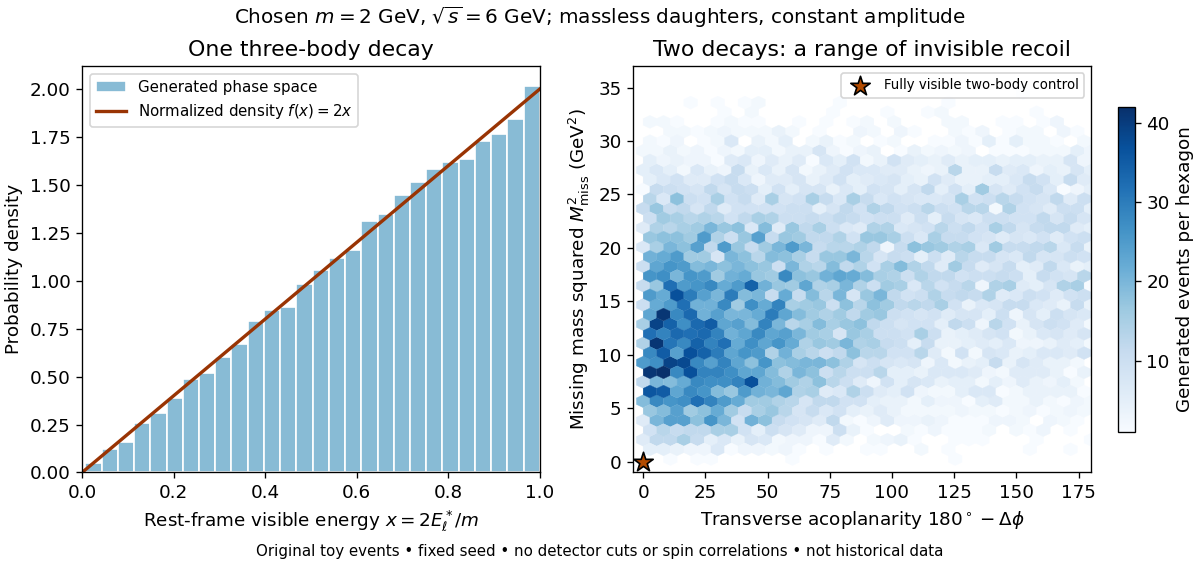

Define transverse acoplanarity by , where is the angle between the two visible momentum projections perpendicular to the beam. A fully visible two-body event with zero initial transverse momentum has and . The toy tau lepton events spread away from that point. These observables are complementary: an angular imbalance asks about directions, while the missing invariant mass also uses the visible energies and longitudinal momenta.
A Lorentz-invariant phase space density supplies allowed configurations and their geometric measure. A physical weak interaction decay amplitude reweights them and correlates spins. Consequently the plotted density is a lesson about conservation and available configurations, not a predicted experimental rate or a fit to the discovery sample. The massless charged-daughter approximation is also unsuitable near the muon rest-energy threshold.
Use natural units and the Minkowski metric with signs . In the ideal centre-of-momentum frame, assume a known initial four-momentum , no unaccounted radiation and exact visible reconstruction. DefineThe missing four-momentum in electron-positron collisions is a subtraction of measured quantities. It is not itself a particle detector hit. With , expansion gives the useful identityFor any collection of future-directed massless invisible four-momenta ,Thus a positive missing invariant mass excludes exactly one massless invisible particle under the stated assumptions. It does not exclude one massive invisible particle, identify a neutrino flavor, or determine the number of massless invisible particles beyond that lower bound. Several collinear massless particles can even have zero combined invariant mass. Detector resolution and unaccounted radiation invalidate a literal event-by-event interpretation of these ideal inequalities.
For an original exact example in natural units, choose total energy and visible massless four-momenta, in ,Two possible invisible massless four-momenta are and . Splitting either into two positive collinear parts gives a three-particle interpretation with identical recoil. Alternatively, one invisible particle of mass has that recoil. This example tests the ambiguity of the subtraction, without asserting any of these alternatives is a tau lepton decay.
The invariant mass of the inferred invisible system, obtained from its four-momentum. It is generally different from the mass of each invisible constituent.
Articles by others on the same topic
There are currently no matching articles.