Hopf bifurcation Created 2026-09-24 Updated 2026-10-13
A Hopf bifurcation creates or destroys a small periodic orbit near an equilibrium point as a pair of complex conjugate eigenvalues crosses the imaginary axis. It explains how a resting state can give way to sustained oscillations: the linearization of a dynamical system supplies rotation and growth, while a nonlinear term can saturate that growth at a nonzero amplitude.
The simplest supercritical Hopf bifurcation is the exact Hopf normal form
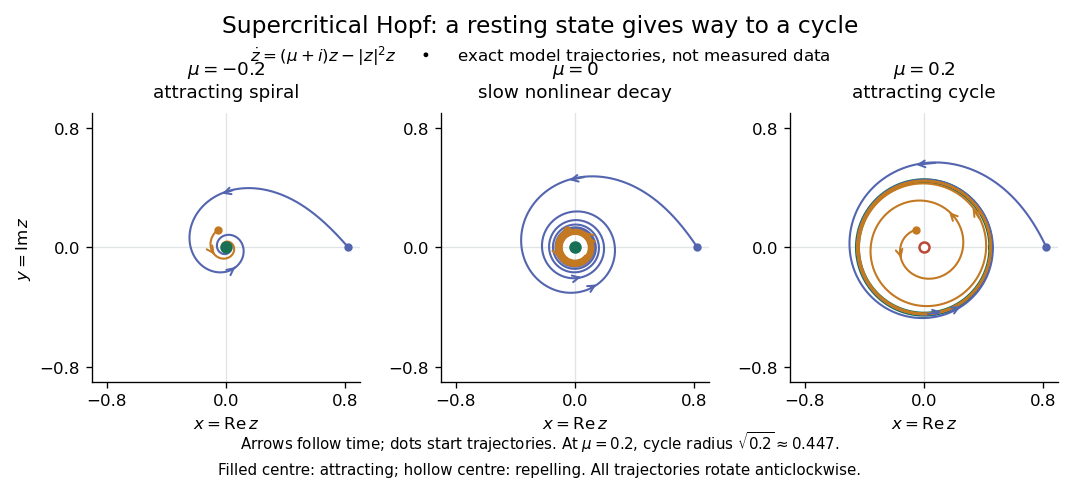
Here is a complex number, is the bifurcation parameter, and is the angular frequency. In polar coordinates , the equations become and for . At , each turn shrinks towards the equilibrium point. At , small radii grow and large radii shrink towards , producing a limit cycle. For example, and give radius , period , and frequency cycles per unit time. The limiting angular frequency stays nonzero while the amplitude tends to zero: a tiny newborn oscillation can still repeat at a finite rate.
Figure 1.
Computed phase portraits across a supercritical Hopf bifurcation
. Exact orbits of the displayed Hopf normal form with , at . Arrows follow increasing time; the two starting radii are and . The green circle at has radius . At , nonlinear decay still attracts orbits, despite purely imaginary linear eigenvalues. These are dimensionless model calculations, not measured data. Details.
For a precise generic statement, consider a smooth function defining an autonomous differential equation on , with a smooth branch of equilibrium points and critical parameter . Require:
Then a locally unique branch of small periodic orbits, up to phase, emerges on the side . On the two-dimensional centre manifold, the branch attracts for and repels for . Attraction in the full phase space additionally requires all remaining eigenvalues to have negative real part; any transverse unstable direction makes the periodic orbit unstable there.[ref]
An eigenvalue-crossing bifurcation test alone cannot establish these nonlinear conclusions. For example, the purely linear equation has the same crossing but no isolated periodic orbit: at every nonzero radius is constant, and at none is. If the cubic coefficient vanishes, higher-order terms must be examined; a generalized Hopf bifurcation is one possible degeneracy. The usefulness of the generic theorem is that a large system can have its small oscillatory onset understood through one Hopf normal form, subject to these hypotheses and local limits.
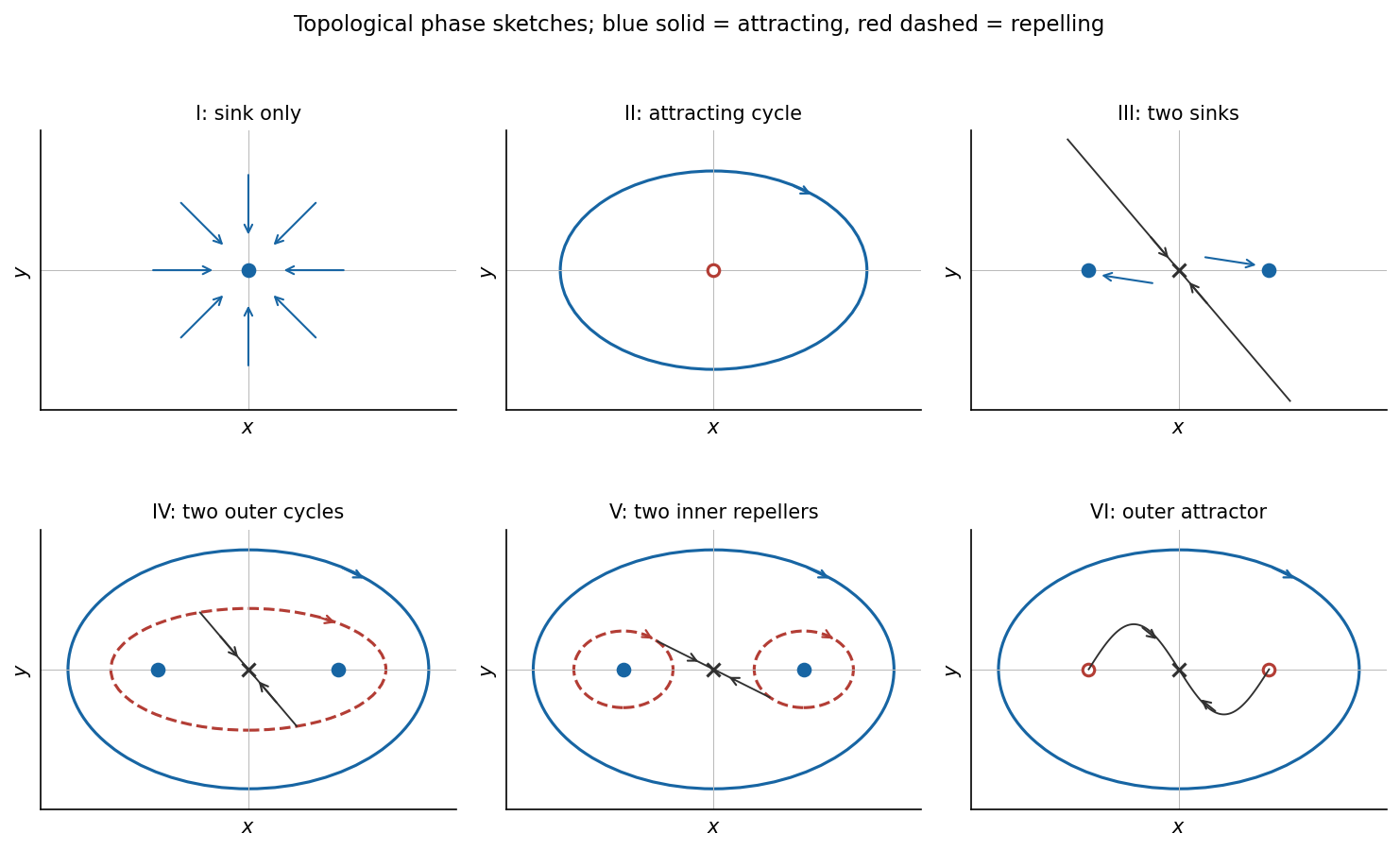
Write , and for , so near the double-zero point. The six open regions are:
The changes III–IV, IV–V and V–VI are respectively a fold of periodic orbits, the double homoclinic event, and the two subcritical Hopf bifurcations. Thus the unstable periodic orbits from the subcritical Hopf bifurcations, the expanding saddle equilibrium passage, and the attracting periodic orbit from the other Hopf bifurcation fit into one consistent portrait.
Figure 1.
The six local phase-portrait types; solid cycles attract and dashed cycles repel
. Details.
Only the upper equilibrium can have zero trace with positive determinant. Setting gives
At this point the determinant is , so the angular frequency is . Moreover , so the trace crosses zero transversely as increases. The stipulated supercritical Hopf bifurcation creates a stable periodic orbit on the side where the upper equilibrium becomes unstable.
The steady-state curves are the vertical lines and in the plane. The Hopf parabola has its endpoint at
There the Jacobian has trace and determinant zero but is not the zero matrix: it has a nilpotent Jordan block. This is the codimension-two Takens-Bogdanov point. The intersection of the Hopf curve with at concerns a different equilibrium from the transcritical crossing at the origin; it is not another double-zero equilibrium.
The global curve is a homoclinic connection to the lower positive equilibrium, which is the saddle equilibrium created at the saddle-node bifurcation. Near on the side , place it at
tangent to at the double-zero point. The stable periodic orbit occupies the strip and approaches the saddle equilibrium on the upper boundary. The dashed curve in the two-parameter figure indicates this local placement; its drawn numerical coefficient is schematic, not a computed global-bifurcation formula.
This placement is consistent with the supplied normal form. Its centre equilibrium has a supercritical Hopf bifurcation, and its saddle equilibrium has negative trace on the relevant loop branch, allowing a stable periodic orbit to disappear in the saddle equilibrium loop. No global-curve calculation is required here.
Use a real physical field, so the three positive wavevectors are accompanied by their complex-conjugate modes. Modulo lattice translations, the effective symmetry group is . Its translation group action is
A rotation cyclically permutes the amplitudes; a half-turn acts by simultaneous complex conjugation. Together these generate the sixfold rotation group. These formulas specify the group action independently of the choice of orientation of the three wavevectors.
For a nonzero real hexagon , its stabilizer subgroup is the rotation group . A translation fixes it only when all three phase factors equal one. Cyclic permutation forces a fixed vector to have equal components, and the half-turn forces those components to be real. Therefore . For a roll with nonzero real , the stabilizer subgroup consists of the translations and the half-turn, with . It is , isomorphic to as an abstract group even though spatial reflections are absent. The circle eliminates from its fixed-point subspace of a group action, and the half-turn makes real. Thus
If unreduced physical translations are used, the full lattice kernel is included in both stabilizer subgroups. The real representation on the six critical components is absolutely irreducible: translations distinguish the three Fourier pairs, rotations permute them, and the half-turn rules out a complex scalar in the commutant. The equivariant branching lemma consequently supplies generic steady branches of both axial types at a transverse crossing of the common linear eigenvalue. It guarantees existence, not stability or exhaustiveness of the possible branches.
Translation equivariance severely restricts the monomials in . Through cubic order they are , , , and : each has the same translation weight as , using . The half-turn forces their coefficients to be real; the rotation gives the two cyclic counterpart equations. A spatial reflection would interchange and require equal cross-couplings, but it is not a symmetry here. After a real amplitude rescaling makes the generic nonzero quadratic coefficient one, the rotational hexagon amplitude equations are
with the other two equations obtained by cyclic permutation. All four coefficients are real; records the absence of spatial reflection. The normalization assumes the resonant quadratic coefficient is nonzero; its vanishing would be an additional degeneracy.
For the roll, . The radial eigenvalue is and the phase of the active mode is a neutral translation. The transverse variables have matrix
Its two real eigenvalues, each occurring twice in the full real linearization, are . Define and . Strict attraction modulo translation is therefore equivalent to
Indeed the larger transverse eigenvalue is negative precisely when , and squaring is legitimate only after requiring . If , that inequality is impossible. Equality is also insufficient because of the additional positive term . Any nonzero roll that exists with already has a positive radial eigenvalue; the degenerate case has no ordinary isolated nonzero roll branch.
For hexagons put . A nonzero real amplitude satisfies , or when . Separate real and imaginary disturbances. The real Jacobian matrix is cyclic, with diagonal and off-diagonal entries . Its eigenvalues are
The imaginary Jacobian matrix has every entry equal to , giving eigenvalues . The two zero modes translate the hexagonal pattern. Thus the general strict stability conditions for any nonzero root are
These conditions state orbital stability transverse to translations, not asymptotic convergence to one prescribed spatial phase. Equalities require a nonlinear bifurcation calculation.
When , both are positive. The upper positive hexagon branch is radially stable after its saddle-node bifurcation at , ; it remains stable until . At this second threshold the pair crosses the imaginary axis with nonzero frequency if . The crossing is transverse, since and the derivative of with respect to is two there. Hence, subject to the usual nonzero cubic coefficient, this is a Hopf bifurcation:
For the same threshold has two zero real eigenvalues, so it is not a Hopf bifurcation.
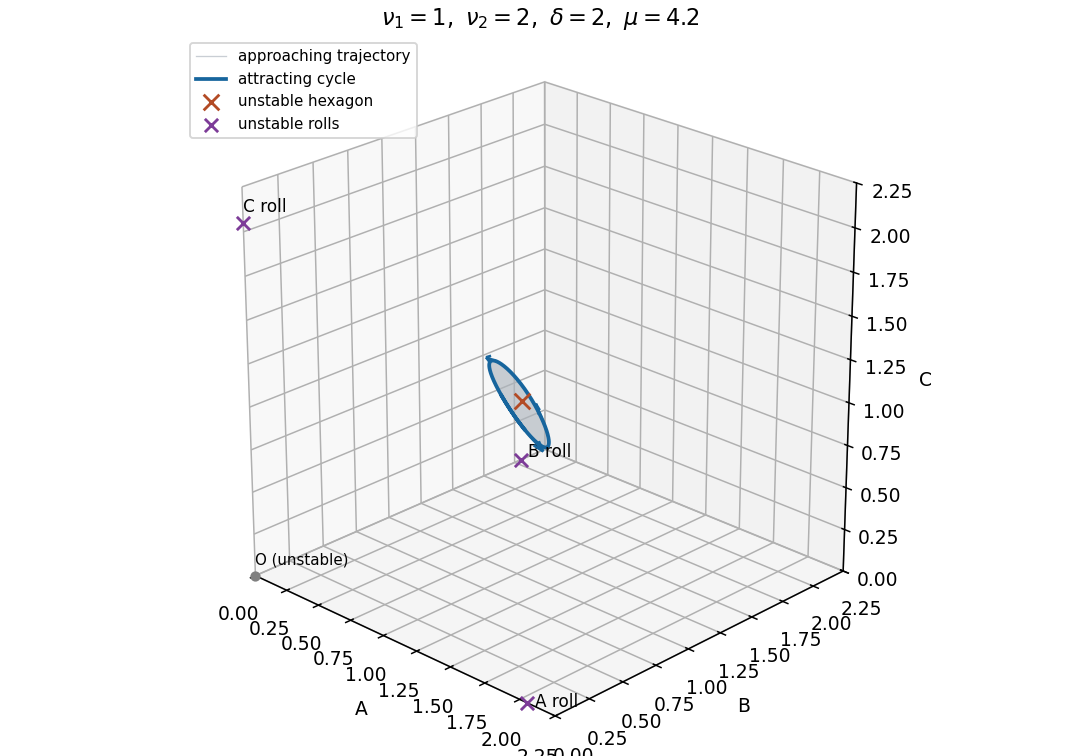
A possible phase portrait when neither steady branch is stable has an attracting periodic oscillation surrounding the unstable hexagon, with the three amplitudes waxing and waning cyclically. This is realized, for example, by , , just above . Rolls are unstable for every positive because . At the hexagon Hopf point , the real spectrum is . Evaluation of the cubic Hopf normal form with a unit-norm critical eigenvector gives , so this example has a supercritical Hopf bifurcation and an attracting small limit cycle in the real invariant subspace. The figure shows such a cycle at and an approaching trajectory; the positive octant is forward invariant because an amplitude's derivative at zero is the product of the other two. This is a possible portrait, rather than a claim that every parameter set with unstable rolls and hexagons has the same attractor. Stability asserted for the periodic orbit here is within the stipulated real subspace.
Figure 1.
A possible real-amplitude phase portrait: an attracting oscillating hexagon with unstable steady hexagon and roll states
. Details.
Put . The planar vector field and its equilibrium eigenvalue data are
For a nonzero equilibrium, use to rewrite the determinant as . These formulas determine the local bifurcations of the imperfect soft Duffing-van der Pol oscillator directly.
When , the origin is a saddle equilibrium for and has determinant for ; the two equilibria are saddle equilibria. They meet the origin in a symmetry-protected pitchfork bifurcation at for . At the origin undergoes a supercritical Hopf bifurcation. To determine criticality, take : averaging gives , so the stable small limit cycle has .
The potential energy of the conservative part and the exact energy balance are
At zero imperfection the stable limit cycle grows to a heteroclinic cycle connecting the two outer saddle equilibria. Near the double-zero point its leading connection curve can be calculated, rather than inferred just from symmetry. In the Hamiltonian system limit the heteroclinic orbit is , and
The weak-damping persistence condition is therefore , not an exact formula at order-one parameters.
Now take ; negative imperfection reflects the phase portrait. The pitchfork bifurcation unfolds into a transcritical bifurcation crossing at and a saddle-node bifurcation at . The latter occurs at . Between those values the origin and are saddle equilibria, while lies in and is a sink or source according to the trace. At , exchanges its saddle equilibrium/non-saddle character with the origin. The double-zero points are now at and .
The original Hopf bifurcation line remains, still supercritical. A second Hopf bifurcation curve occurs on the intermediate nonzero equilibrium:
It is important not to assign the same criticality to its entire length. Write , so . Around that center the restoring quadratic coefficient is , the damping linear coefficient is , and . The Hopf criticality for an asymmetric Lienard center calculation gives cubic amplitude coefficient
Hence it is supercritical for and subcritical for , with a generalized Hopf bifurcation point at . Higher-order terms are needed exactly there. For small imperfection the leading quintic coefficient is positive: writing and using the coordinate that normalizes the potential energy, , with and , the coefficient of in at vanishing cubic coefficient is . Weak-damping averaging therefore supplies the nearby saddle-node bifurcation of stable and unstable limit cycles in the generalized Hopf bifurcation unfolding. None of these small features intersects either requested parameter line.
Globally, the two saddle equilibrium barriers are no longer equal. Their leading energy difference is . The two one-way connections consequently separate; matching their energy differences with the connection integral gives
These weak-damping heteroclinic splitting of a tilted quartic oscillator formulas apply for small with . Between the separated connection curves, the central stable limit cycle terminates in a homoclinic orbit to the lower-barrier saddle equilibrium, for positive imperfection. The simultaneous symmetric heteroclinic-cycle destruction is therefore replaced by two basin-changing one-way connections and a distinct homoclinic orbit loss of the limit cycle. Its period diverges at that loss.
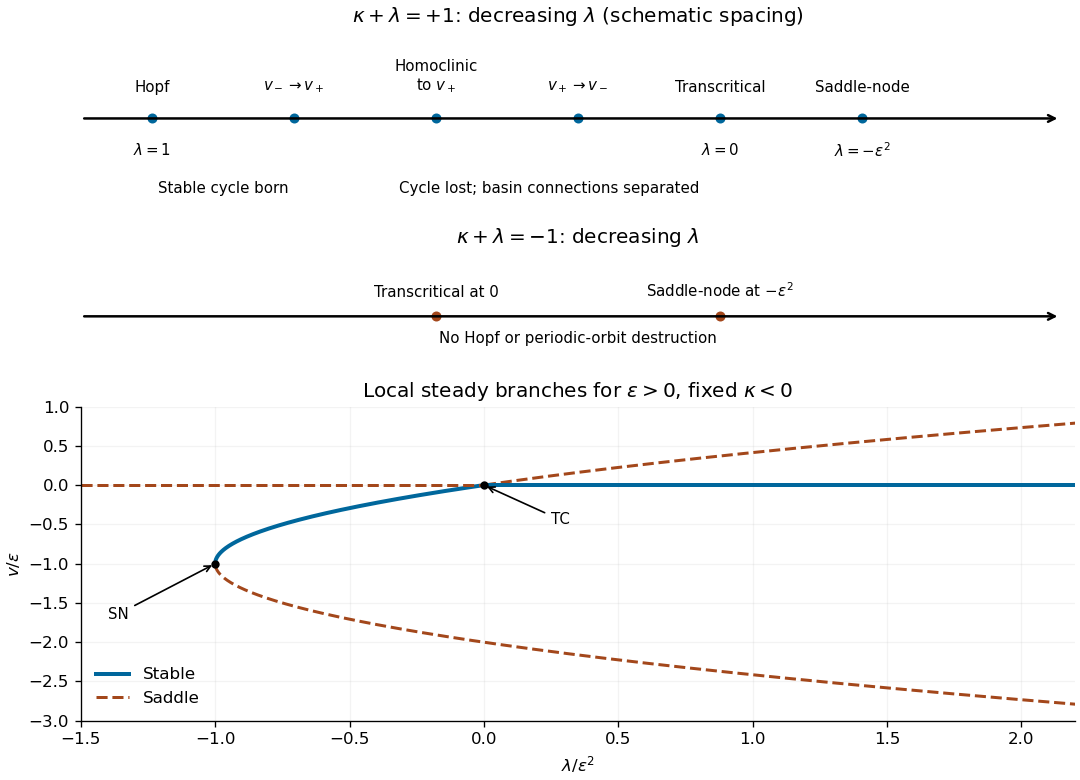
Along , decrease from above one. The sequence is supercritical Hopf bifurcation at ; first heteroclinic orbit; homoclinic orbit loss of the stable limit cycle; second heteroclinic orbit; transcritical bifurcation crossing at zero; saddle-node bifurcation at . The connection locations are global, not obtained by treating the Melnikov approximation as exact. For illustration, direct stable/unstable manifold matching at places them at approximately , respectively. The diagram below gives the qualitative ordering without prescribing those example values for arbitrary imperfection.
Along , the sequence is simply transcritical bifurcation crossing at zero, followed by saddle-node bifurcation at . Before the latter, in the relevant region, so decreases strictly on nonstationary trajectories and there is no periodic orbit or saddle equilibrium loop. After it only a saddle equilibrium remains, which cannot be enclosed by a periodic orbit by the Poincare-index obstruction to a periodic orbit. The origin does not undergo a Hopf bifurcation at , since its determinant there is negative.
Figure 1.
Bifurcation sequences along the two diagonal parameter lines after a small positive reflection-symmetry imperfection; arrows indicate decreasing lambda
. Details.
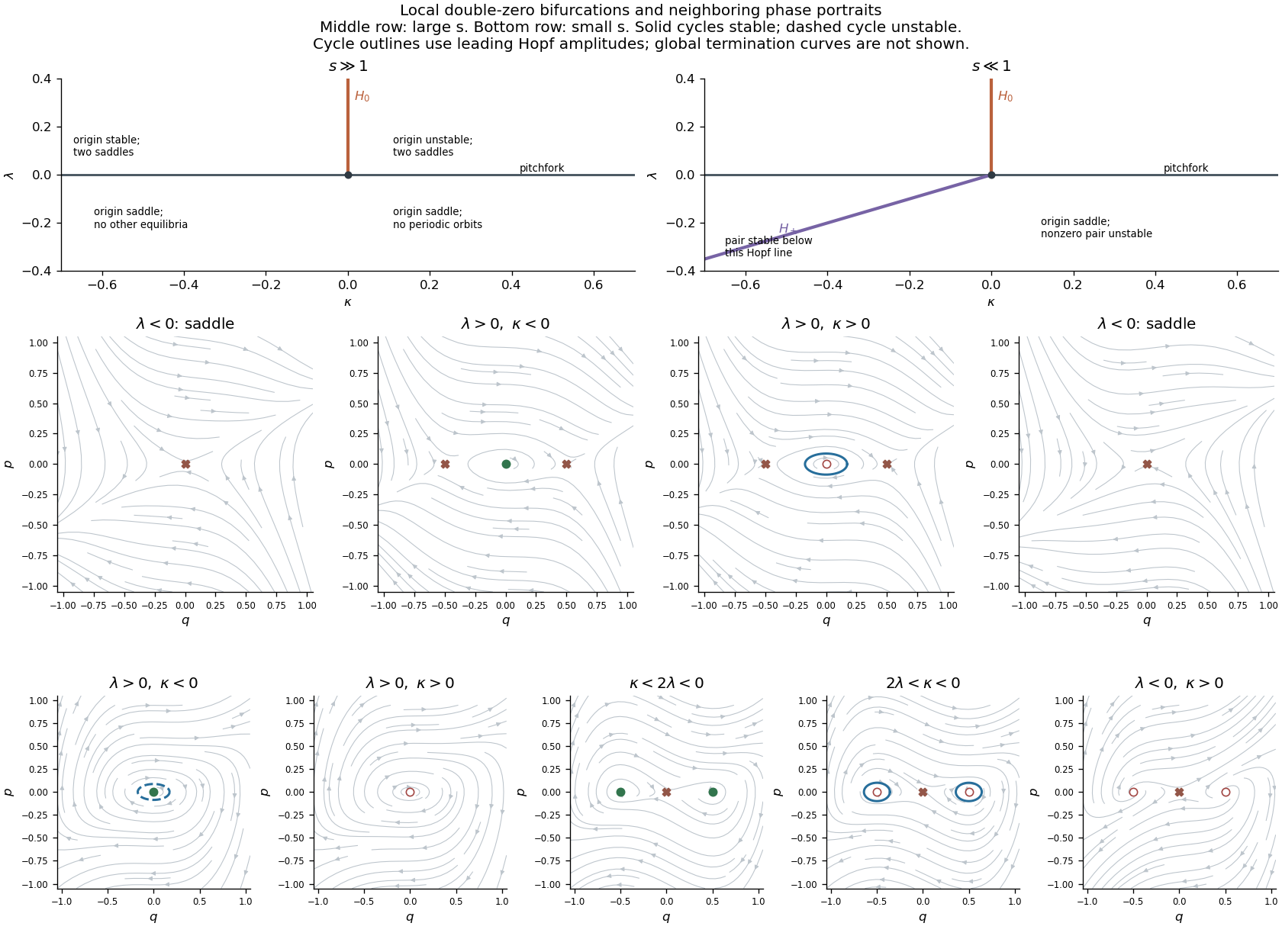
Set and rescale , . The reflection-symmetric cubic double-zero normal form becomes
It is invariant under . Thus the large- case has and the small- case . At the origin the Jacobian matrix has determinant and trace : it is a saddle for , stable for , and unstable for . In the latter two cases the discriminant distinguishes nodes from foci; its zero is not an equilibrium-creation bifurcation.
The nonzero equilibria satisfy , . At either of them the determinant is and the trace is . Therefore for , a pair of saddles exists when , while for , a pair of attracting equilibria exists when , and a repelling pair when . The repelling or attracting points may be nodes or foci. Their origin collision occurs on the pitchfork bifurcation line , away from . For fixed , the scalar centre equation there begins
For , the large- case is a subcritical pitchfork and the small- case a supercritical pitchfork. For , the scalar criticality reverses, but there is already an unstable transverse eigenvalue, so the full-plane branches have the stability just listed.
At the origin, , is a Hopf bifurcation with frequency . Averaging the leading weakly nonlinear oscillator gives the amplitude equation
Consequently
These are respectively a supercritical Hopf bifurcation and a subcritical Hopf bifurcation, with fixed and the cycle sufficiently small. The portraits change from a stable focus to an unstable focus surrounded by a stable cycle in the first case; in the second, a stable focus is surrounded by an unstable cycle before the focus becomes unstable and that cycle disappears.
The small- case has an additional pair of Hopf bifurcations at the nonzero equilibria:
Their criticality includes quadratic terms and is not read off from the positive term alone. Set , , and . Then
For an oscillator , the cubic radial coefficient is . Here it is . Thus both nonzero Hopf bifurcations are supercritical: for small , each newly unstable well equilibrium is surrounded by a stable small cycle with .
To constrain periodic orbits, use either the divergence or the energy
For , the divergence has one strict sign except on a line, and the Bendixson-Dulac criterion excludes every nonconstant periodic orbit. For , the same reasoning excludes every periodic orbit. When the divergence changes sign, this criterion makes no such exclusion; the Hopf cycles above are consistent with that restriction. In the large- case a periodic orbit also requires : if , a positive maximum of would have , or a negative minimum would have negative acceleration, both impossible. For the same extremum argument confines a cycle to , between the two saddle locations. The local bifurcation lines and representative portraits on both sides are summarized below; their global completion requires part (c).
Figure 1.
Local bifurcation lines and representative phase portraits for the two signs of the cubic double-zero normal form
. Details.
Subcritical Hopf bifurcation Created 2026-09-24 Updated 2026-10-14
In a subcritical Hopf bifurcation, the small periodic orbit repels within the critical centre manifold and lies on the side where the equilibrium point attracts within that manifold. With the critical eigenvalue real part increasing through zero, the positive cubic sign gives the exact radial Hopf normal form
For , the nonzero radius is . Radii below shrink to zero, whereas radii above it grow. The radial derivative at the cycle is , proving that the periodic orbit repels. For example, gives an unstable circle of radius : a radius of decays while one of grows. The unstable circle shrinks into zero as ; at , already drives every small positive radius outward.

For there is no nonzero constant radius in this cubic model, and zero repels. In a general dynamical system, this says only that the nearby orbits leave the local neighbourhood. It does not guarantee a distant attracting limit cycle, a jump to a particular amplitude, or hysteresis. Additional nonlinear or global information is needed; the quintic radial Hopf equation illustrates one possible stabilizing extension. Reversing the parameter orientation reverses which numerical side contains the branch, so the defining distinction between supercritical Hopf bifurcation and subcritical Hopf bifurcation is their reduced stability and their relation to the equilibrium point, rather than the bare sign of an arbitrarily named parameter.
For a directed three-neuron rate ring , the linearization has characteristic equation , where . Positive loop gain has strict linear asymptotic stability for . Negative loop gain has it for ; at a complex pair crosses the imaginary axis at frequency . The saturating cubic gives a supercritical Hopf bifurcation under an ordinary loop-gain variation. This directed system does not inherit the energy-descent property of a symmetric Hopfield network.