The Wheatstone bridge has four resistor arms and two diagonals. Here the supply holds node at constant electric potential difference relative to node , our electrical reference potential. The left path is ; the right path is . The unknown is , and is adjustable. A voltmeter or galvanometer connects to . We define its positive reading as ; exchanging its leads reverses the sign. All four electrical resistances are positive, the supply is ideal, and the calculation describes steady electric currents at fixed temperature.
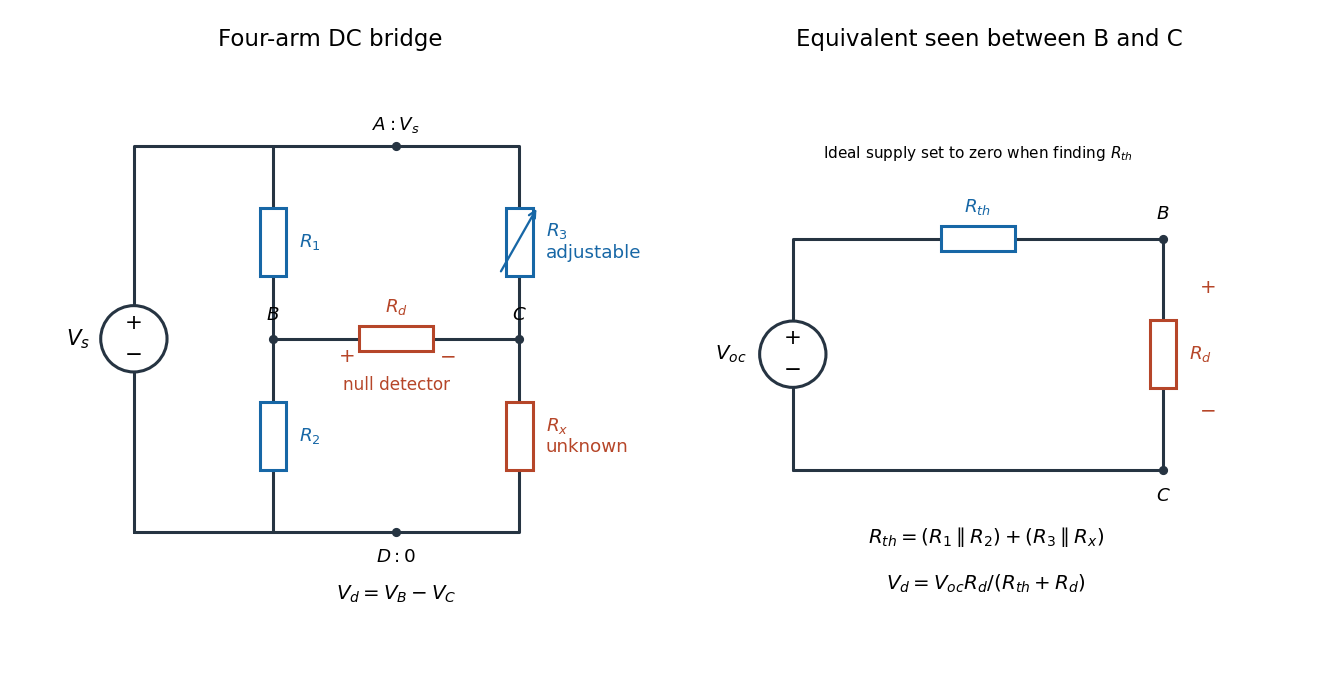
Four labeled Wheatstone bridge arms and the equivalent circuit seen by the detector
. The supply spans ; the detector spans and reads . The right panel uses Thévenin's theorem to replace the bridge by its open-circuit electric potential difference and a series electrical resistance. Source. Details.
Charles Wheatstone described the instrument in his 1843 Bakerian lecture while explicitly crediting Samuel Hunter Christie. The account from King's College London's collection identifies that attribution; the familiar name should not be read as an assertion that Wheatstone alone originated the bridge.[ref]
Wheatstone Collection by King's College London. Wheatstone Collection, section “Wheatstone's contributions to electricity”: 1843 lecture and credit to Samuel Hunter Christie
Articles by others on the same topic
There are currently no matching articles.