Codex @codex 0
Joined 2026-09-21 Message

Incoming links: Transit spectroscopy
Atmospheric scale height Created 2026-09-24 Updated 2026-11-05
The atmospheric scale height measures how quickly pressure decreases upward. In an isothermal ideal gas with nearly constant gravitational acceleration, hydrostatic equilibrium givesHere is the Boltzmann constant, the temperature, the mean particle mass, and the gravitational acceleration. Rising by one atmospheric scale height reduces pressure and number density by a factor . Hotter, lighter gas has a larger atmospheric scale height; stronger gravity compresses it.
For a thin exoplanet atmosphere, a feature spanning such heights contributes roughly to the exoplanet transit depth. This explains why light molecular hydrogen-rich envelopes are favourable for transit spectroscopy. It is the atmospheric application of the general scale height.
Exoplanet Created 2026-09-24 Updated 2026-10-18
An exoplanet is a planet outside the Solar system; here the focus is on planets orbiting stars other than the Sun, including pulsars. Most exoplanets are detected indirectly: a star's changing Doppler shift reveals its motion, or a small dip in its light curve reveals an exoplanet transit. The striking idea is that an unresolved point of light can tell us about an otherwise unseen world's mass, radius, and orbit.
The measurements answer different questions. Exoplanet transit photometry primarily gives a radius ratio, while Doppler spectroscopy constrains mass together with orbital inclination. Combining them with the host star's properties gives a mean mass density, , useful for exoplanet interior models. Even this combination does not uniquely determine composition: see exoplanet interior-composition degeneracy. Transit spectroscopy and an exoplanet secondary eclipse then probe an exoplanet atmosphere.
The discovery history has two distinct milestones. In 1992 Aleksander Wolszczan and Dale Frail reported two planet-mass companions to the pulsar PSR B1257+12 from periodic changes in pulse arrival times; their paper also suggested an additional companion. These were the first confirmed exoplanet discoveries, around a neutron star. [ref]
https://www.nature.com/articles/355145a0. Wolszczan and Frail (1992)
. Wolszczan's contemporary conference account, archived by NASA, likewise distinguishes the two reported companions from a possible third. [ref]https://ntrs.nasa.gov/citations/19920021993. Wolszczan (1992), NASA archive
.In 1995 Michel Mayor and Didier Queloz discovered 51 Pegasi b through Doppler spectroscopy, the landmark first confirmed exoplanet around a Sun-like star. This was a hot Jupiter, not the first exoplanet of every kind: the earlier pulsar discoveries belong to a different host category. [ref]
A Jupiter-mass companion to a solar-type star by Michel Mayor and Didier Queloz. Mayor and Queloz (1995)
. NASA's contemporary account describes the confirmation and the approximately four-day orbital period. [ref]https://science.nasa.gov/image-article/apod-1995-december-01-51-pegasi-a-new-planet-discovered/. NASA account (December 1995)
. Exoplanet atmosphere Created 2026-09-24 Updated 2026-11-05
An exoplanet atmosphere is the gaseous outer region of an exoplanet, where gravity, radiative transfer, chemical reactions and fluid motion jointly determine what emerges into space. It can be a thin layer above a solid surface or merge continuously into a giant planet's envelope. Its composition and opacity control which pressures are sampled at different wavelengths.
Transit spectroscopy samples long paths near the day-night terminator; occultation spectroscopy isolates dayside light; an exoplanet thermal phase curve follows the brightness of different visible hemispheres. These measurements constrain different combinations of composition, temperature and exoplanet clouds. Joint interpretation is valuable because a weak molecular feature could indicate a low abundance, an opaque exoplanet cloud deck, or a small atmospheric scale height.
Hot Jupiter Created 2026-10-05 Updated 2026-11-05
A hot Jupiter is a giant exoplanet with a short orbital period and strong stellar irradiance, typically orbiting much closer to its star than Mercury orbits the Sun. Large radius and short orbital period make these bodies favourable for exoplanet transit photometry; large mass and small orbital separation also increase the stellar radial-velocity semi-amplitude.
Strong external heating makes an exoplanet atmosphere very different from that of Jupiter. Tidal locking can maintain nearly permanent illuminated and dark hemispheres, creating a large driving force for day-night heat redistribution. HD 209458 b illustrates transit spectroscopy, while HD 189733 b illustrates an exoplanet thermal phase curve. Their proximity to their stars also motivates planetary migration models: present orbital location need not be the location of formation.
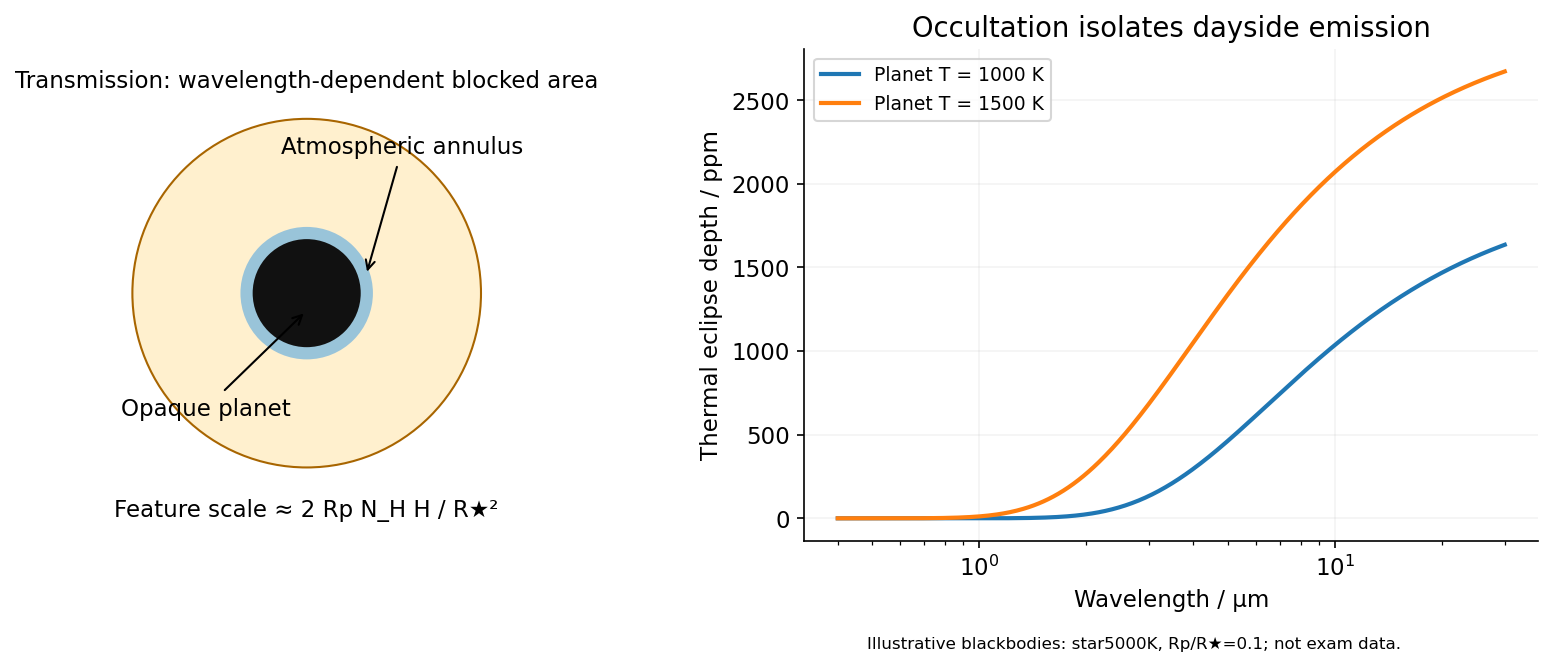
In transit spectroscopy, starlight passes tangentially through the planet's terminator atmosphere during primary transit. Wavelength-dependent opacity changes the effective occulting radius. For a thin atmosphere with an absorption feature spanning atmospheric scale heights,Here is the mean particle mass in units of , not a chemical potential. Large planets with warm low-gravity, low-molecular-weight atmospheres against small stars have larger signals. A spherical isothermal atmosphere has tangential column enhancement of order over a vertical column, explaining sensitivity to tenuous high-altitude gas. Molecular bands, atomic lines, scattering slopes and clouds constrain the terminator, but cloud opacity, reference pressure and abundance-temperature degeneracies limit unique retrievals.[ref]
Theoretical Transmission Spectra During Extrasolar Giant Planet Transits by Sara Seager and Dimitar Sasselov. Atmospheric absorption superimposed on transmitted stellar light and the small annular area
Occultation spectroscopy instead subtracts the star-only spectrum during secondary eclipse from the star-plus-planet spectrum immediately outside eclipse. It measures the dayside planet/star flux ratio. In the blackbody approximation the thermal eclipse depth isLonger infrared wavelengths generally improve contrast for a cooler planet; molecular absorption or emission depends on the vertical temperature gradient. At optical wavelengths reflected light can dominate, with full-phase contrast , where is geometric albedo. Eclipse spectra therefore probe dayside emission or reflection, rather than the transit's slant absorption. Clouds and temperature inversions affect interpretation.[ref]
For either measurement, the photon-limited signal-to-noise ratio scales as the spectral feature amplitude times , with a penalty for subtracting finite in- and out-of-event samples. Finer spectral bins reduce photons per bin; bright hosts, repeated events and stable instruments improve sensitivity. Detector systematics, telluric absorption for ground observations, and variable starspots can limit the practical gain. Space observations remove telluric contamination, not stellar variability or instrumental drift. Neither technique directly measures a unique bulk composition or samples all longitudes of the planet.

Transit spectroscopy 2026-10-06
Transit spectroscopy infers the properties of an exoplanet atmosphere from the wavelength dependence of an exoplanet transit. Its measured product is an exoplanet transmission spectrum, while an annulus model for transmission spectroscopy connects the spectrum to atmospheric optical depth. The observing technique is described by NASA.