Prepare two uniform specimens with the same material, direction and , but different deforming lengths . Keep grip engagement, adapters, loading window and measurement configuration equivalent. Determine separately by linear regression with its own displacement intercept. Subtracting the two series equations eliminates the common machine compliance:This is an inverse problem: one length supplies only one equation for two unknowns, while two distinct lengths separate the length-dependent specimen contribution from the constant contribution. In a graph of compliance against length, the slope is and the vertical intercept is . It is the compliance, not , that is linear in .
The dimensional analysis is revealing: , so . For , the ideal model requires . A negative fitted challenges the common-intercept assumptions or the measurements. Two lengths determine two parameters exactly, so they cannot test the assumed straight line; three or more lengths allow regression residuals to reveal departures. Nearly equal lengths amplify slope errors through the small difference . If the actual apparatus compliances differ by , the inferred length slope becomes .
The following values are stipulated arithmetic inputs, not measurements of a material. Take and lengths , . At forces , stipulate crosshead displacementsThe two different initial offsets deliberately test the use of intercepts. Linear regression of gives , andTheir reciprocal spring constants are and . The compliance-versus-length slope isso the recovered Young's modulus and machine compliance areThe corresponding apparatus spring constant is .
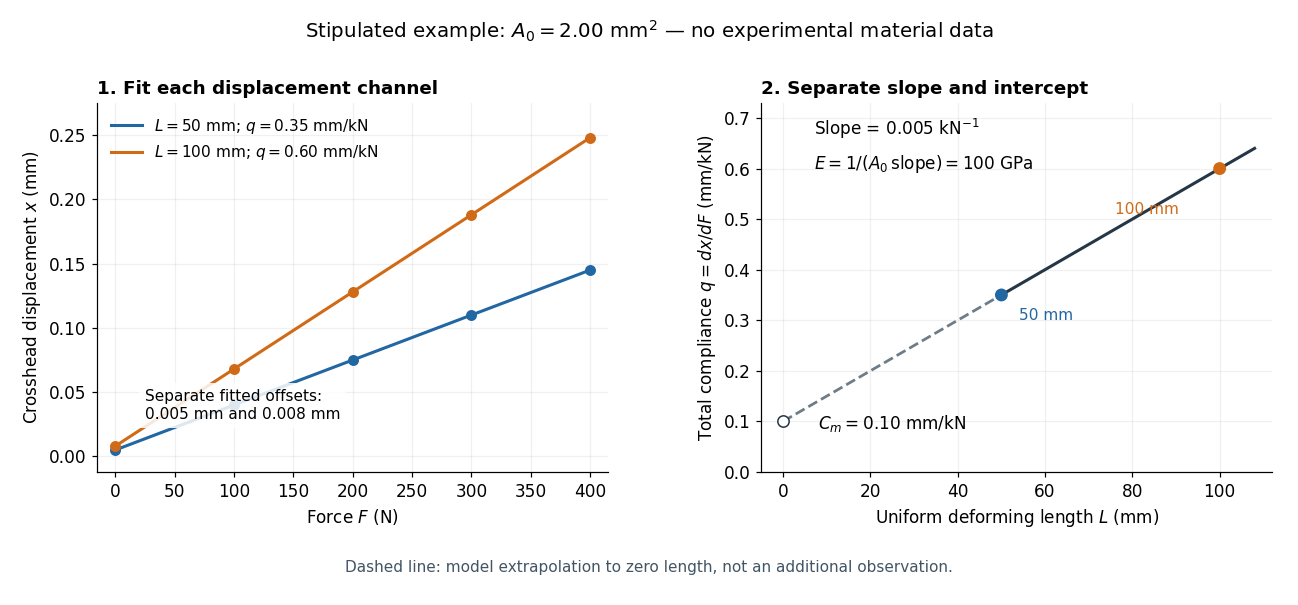
Stipulated displacement fits separate length-dependent compliance from apparatus compliance
. Original calculated example, not experimental material data. Left: independent linear displacement fits at lengths 50 and 100 millimetres retain their different offsets. Right: the line through the two compliance values has slope 1/(EA0) and intercept Cm. The dashed segment extrapolates the model to zero length; it is not a third observation. Details.
Check the reconstruction at . The machine contribution is , and the two specimen contributions are and . Adding the respective offsets gives the stipulated and . An extensometer spanning on either ideal uniform specimen would instead read extension: engineering strain , at engineering stress . Their ratio is again . Ignoring machine compliance gives apparent moduli and even after removing the offsets. No yield point or real material identity is implied by these stipulated linear inputs.
Articles by others on the same topic
There are currently no matching articles.