A pair potential assigns interaction potential energy to two particles as a function of their separation, for example for an isotropic interaction. A pairwise-additive model then has , counting each unordered pair once. This reduces a many-particle energy calculation to repeated evaluation of one two-particle law.
A hard sphere model takes below the core diameter and zero outside it, forbidding overlap without adding attraction. A more general pair potential can contain both repulsion and attraction, producing competition between packing and binding. The associated radial force is where the derivative exists. Pairwise additivity is a modeling assumption: the interaction between two particles can be modified by their environment, requiring effective state-dependent interactions or explicit many-particle terms. Knowing supplies an input to statistical mechanics, not an immediate solution for every collective phase.
The Mayer f-function measures how a pair potential changes a pair's Boltzmann factor relative to the noninteracting value one:It vanishes where , lies between and for repulsion, and is positive for attraction. Even an infinite hard-core potential energy produces the finite value . This is why expanding in Mayer f-functions handles a hard-sphere gas more naturally than a Taylor series in . [ref]
For pairwise-additive potential energy , the exact identityturns the configurational part of the canonical partition function into a sum of products associated with pairs. Drawing one edge for each chosen factor gives the graphs used in the cluster expansion. The second virial coefficient uses just one pair's relative-position integral, .
For the square-well toy pair potential in second virial coefficient, in the core, in the attractive shell, and beyond it. Its positive plateau need not be small: low number density, rather than small at every separation, controls the dilute-gas approximation. The integral weights each plateau by spherical-shell volume; equal-looking unweighted areas on a plot of versus need not cancel in .
A hard-sphere gas is a classical model of identical impenetrable spheres, each of diameter and radius . Its pair potential is for centre separation and for ; the convention at exact contact has no effect on the integral. It isolates the effect of particle size without an attractive potential energy.
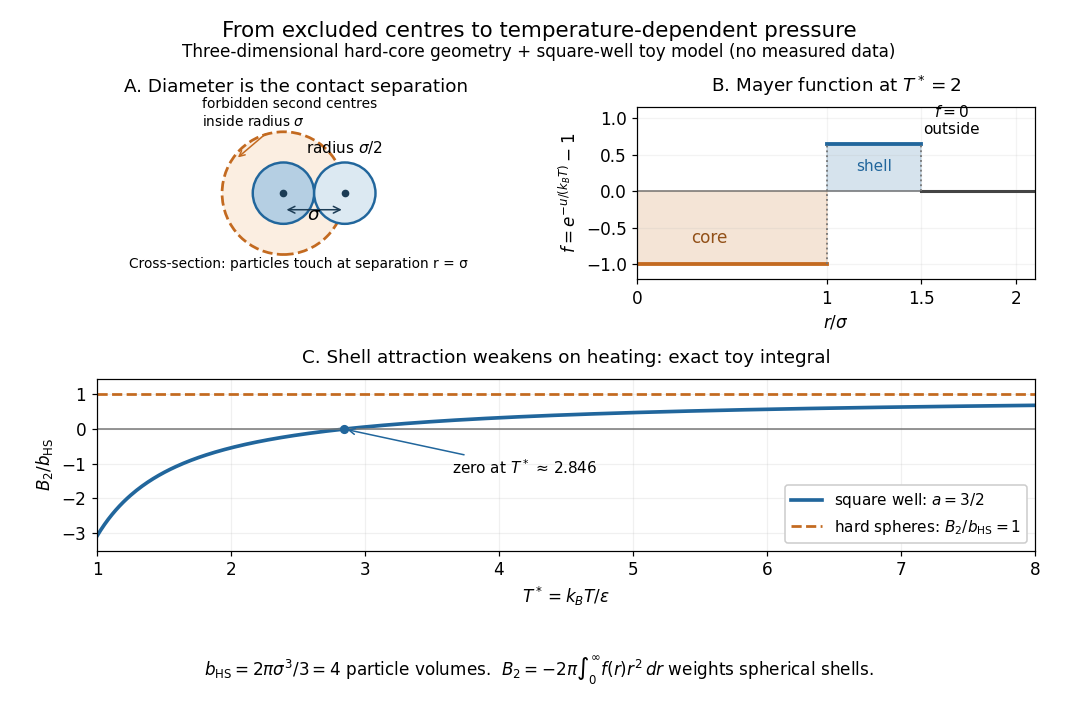
Hard-sphere centre exclusion, the square-well Mayer f-function, and the exact temperature dependence of the toy second virial coefficient
. Details. The upper-left panel is a cross-section of a three-dimensional forbidden region: the second centre cannot enter a sphere of radius around the first centre. The particles themselves have radius . Consequently, with particle volume and pair excluded volume ,The last equality follows directly from the Mayer f-function: throughout the forbidden volume and zero outside it. Confusing particle radius with contact separation changes the answer by a factor of eight; omitting the unordered-pair factor changes it by a further factor of two.
Define the packing fraction , where is number density. Then the virial expansion beginsFor example, at the toy value , the leading correction predicts ; the omitted terms still matter if accuracy beyond this approximation is needed. The classical second virial coefficient is independent of temperature because the geometry of forbidden configurations does not change when the gas is warmed. The pressure itself still scales with temperature at fixed number density.
This model makes the positive correction particularly clear: eliminating overlapping configurations changes the dependence of the available configuration space on volume, even though the allowed configurations all have zero interaction energy. The figure's other panels add a toy attractive shell and show how its Boltzmann factor competes with that geometry. The hard-sphere gas is a useful reference model, while a low-order virial expansion remains a dilute-gas approximation rather than a dense sphere packing formula.
The excluded volume is the region of relative positions unavailable to a second particle because it would overlap the first. For equal hard spheres of radius , their centres must remain at least apart. The forbidden region for the second centre therefore has volume , eight times the physical volume of one sphere.
The second second virial coefficient is half that pair-excluded volume for hard spheres, because an unordered pair must not be counted twice. Thus , four single-particle volumes. This distinction explains why the excluded-volume parameter entering a dilute equation of state need not equal either the physical occupied volume or the entire forbidden region around one fixed centre. At high density, overlaps among exclusion regions and collective packing make independent-pair counting insufficient.
For one mole, a simple repulsive-volume model uses with and domain . The Maxwell relation and first law of thermodynamics give , so . If its molar heat capacity at constant volume is temperature independent, it is constant, and . Reversible adiabatic processes obey or . All positive-temperature isotherms are strictly decreasing and convex; this single-phase model contains no attractive liquid-gas coexistence mechanism. The parameter is an effective unavailable molar volume, not automatically the literal geometric volume of the molecules.
Articles by others on the same topic


Pair potential refers to a mathematical function used in computational physics and chemistry to describe the interaction energy between two particles as a function of their separation distance. It is commonly employed in molecular dynamics simulations and statistical mechanics to model systems at the atomic and molecular level. The pair potential is often denoted as \(V(r)\), where \(r\) is the distance between two interacting particles.