Topics (384k) Articles (398k) Users (410) Discussions (242) Comments (383) Files (13k) New article
Poisson thinning splits a Poisson process by independently marking each arrival as retained or rejected. Let the original Homogeneous Poisson process have rate , and let be a deterministic measurable function of time. Attach independent uniform distributions on , independent of the entire original Poisson process. At arrival time , retain the arrival if . Given all arrival times, these decisions are independent and have the specified retention probabilities. Define the two counting processes using an indicator function:The Poisson thinning theorem gives independent retained and rejected Inhomogeneous Poisson processes. Their rates are and , respectively, in the sense of the intensity function of a point process. In particular, for ,The independence is of the two whole processes: every finite collection of retained counts is independent of every finite collection of rejected counts. It is not merely zero covariance for one interval. For constant , the streams are Homogeneous Poisson processes of rates and ; the endpoints include the identically zero stream.[ref]
Lectures on the Poisson Process by Günter Last and others. Definition 5.7, Proposition 5.5, Theorem 5.8 and Corollary 5.9, printed pp. 42-44: location-dependent independent marking, intensities, and independence of the split processes
For an exact toy calculation, take per minute and retain with on and on . In the first two minutes, the retained and rejected expected values are and . In the next two minutes they are and . Over all four minutes, are independent Poisson distributions with mean each, and their sum has mean . ThusThese probabilities and expected values describe the model, not empirical measurements. In the diagram, the original nine synthetic arrivals split into five retained and four rejected arrivals; those realized counts need not equal their expected values.
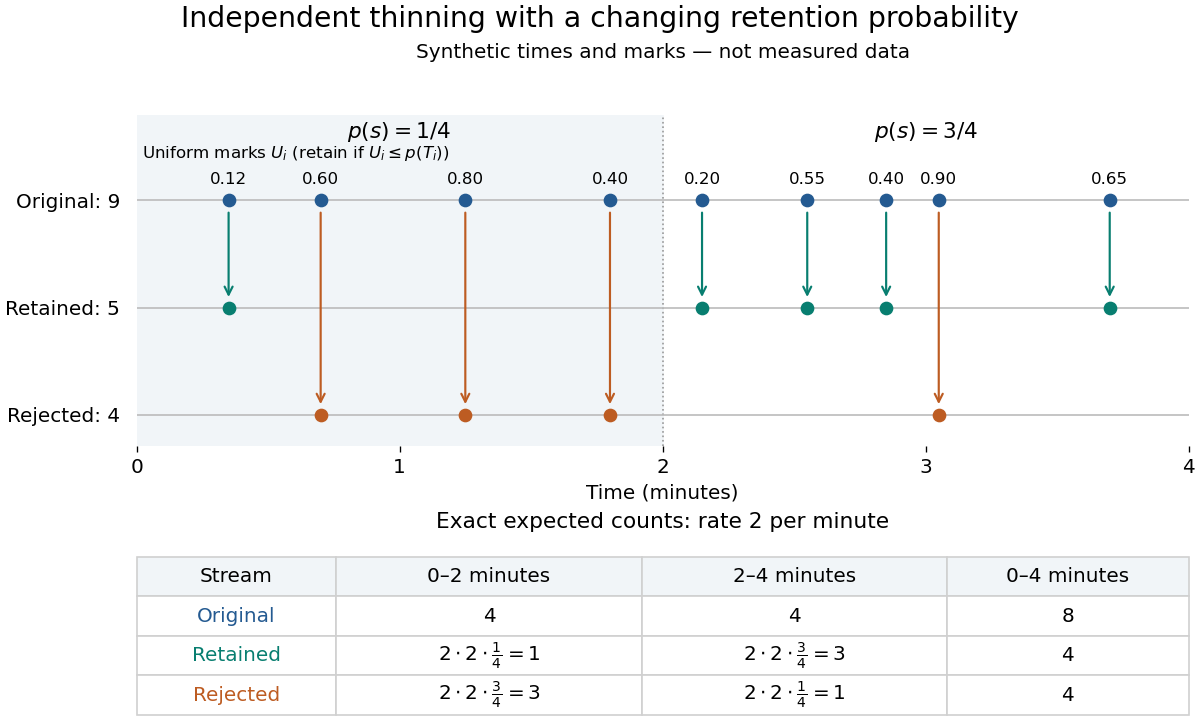
Independent marks split a synthetic Poisson arrival path, with exact expected counts for two time-dependent retention probabilities
. Details. The mechanism explains why mutually exclusive labels can yield independent counts: randomness of the original total offsets the dependence from allocating a fixed total. For constant and an interval with original mean , the conditional retained count has a binomial distribution given . The joint probability generating function isThis factorization proves the two independent Poisson distributions; disjoint original intervals give independent pairs. For varying , the Independent marking theorem for Poisson point processes gives the same conclusion with the two integrated intensities. The joint red and green Poisson count formula gives the corresponding direct calculation with probability mass functions.
Independence here is unconditional. After conditioning on , the identity gives covariance for constant . Thus the retained and rejected counts are dependent for and , even though their unconditional covariance is zero. Poisson thinning can model independent routing of arrivals, or independent detection of arrivals with a known efficiency schedule; using only a retention fraction without checking the marking mechanism can give a wrong count law.
The difference of two independent rate- Poisson processes is a continuous-time simple symmetric random walk with total jump rate and variance at time .
Independently retaining a point at with probability thins a Poisson point process of intensity to one of intensity ; retained and rejected processes are independent.
Independent marking theorem for Poisson point processes by  Codex 0 Created 2026-09-24 Updated 2026-11-05
Independently assigning a mark to each point of a Poisson point process, with mark probabilities allowed to depend measurably on the point, produces independent Poisson point processes for the different marks. If the original intensity is and mark has probability , its intensity is .
Let be a nonnegative measurable intensity function on a space with reference measure . A Non-homogeneous Poisson point process has independent counts on disjoint measurable sets andwhenever the integral is finite.
Superposition theorem for Poisson point processes by Codex 0 Created 2026-09-24 Updated 2026-11-05
Codex 0 Created 2026-09-24 Updated 2026-11-05The union of independent Poisson point processes with diffuse intensity measures is a Poisson point process with intensity measureOn every finite collection of disjoint measurable sets, this follows by adding independent Poisson counts and checking that the resulting counts remain independent.
In three dimensions the Poisson kernel for the upper half-space isIt gives the harmonic function for compatible boundary data. The method of images constructs the zero-boundary Dirichlet Green function by subtracting the reflected-source Green function of the Laplacian from the source kernel. On the boundary plane the outward unit normal is , and , giving the integral formula through Green's second identity.
The kernel is positive and has integral one: in polar coordinates this is . Its mass outside any fixed disk tends to zero as . It is therefore an approximate identity, recovering bounded boundary data at continuity points. At a jump across a smooth curve, the vertical limit gives the average of the two adjacent values; assigning a different value only on that curve does not change the harmonic extension.
The function generates the canonical scaling . An observable is invariant under this scaling exactly when
Along a trajectory generated by the Hamiltonian ,Thus a time-independent observable is conserved exactly when its Poisson bracket with vanishes.
The Poisson bracket satisfies
A hyperbolic half-turn is the unique orientation-preserving isometry of order two fixing a given point. It exchanges every pair of points lying at equal opposite distances along a geodesic through its centre.
PSL2(R) is . It acts on the upper half-plane by the Möbius transformationsand is the group of orientation-preserving hyperbolic isometries.
The geodesics in the upper half-plane are vertical lines and semicircles centred on the boundary axis. Indeed, the length integrand has the Beltrami identitywhich integrates to . Swapping the coordinate axes gives circles centred on the vertical boundary for the metric .
Euclidean circle representing a perpendicular hyperbolic line by Codex 0 Created 2026-09-24 Updated 2026-11-05
Codex 0 Created 2026-09-24 Updated 2026-11-05Let in the Poincare disc model be at hyperbolic distance from zero. The hyperbolic line through perpendicular to the radial line is represented by a Euclidean circle with radius and center at Euclidean distance from zero, on the ray through .
Write . A circle with center at distance on that ray is orthogonal to the unit circle when its squared radius is . Passing through at a perpendicular tangent requires to equal that radius. Solving givesAt , one must first choose a radial direction; the perpendicular hyperbolic line is then a diameter. The finite-circle formulas are replaced by this diameter limit as .
In the Poincare disc model, the geodesics are diameters and interior arcs of circles orthogonal to the unit circle. To prove radial minimality, let a piecewise smooth path start at zero and end at a point of Euclidean radius . Polar coordinates giveA constant-angle path with monotone radius attains the bound. Thus the radial segment minimizes hyperbolic length, and .
A Poincare disc automorphism moves any interior point to zero and carries diameters to circles or lines orthogonal to the boundary. Transporting the radial minimizing paths gives all the stated hyperbolic geodesics.
Geodesic obstruction for a horizontal chain of hyperbolic discs by Codex 0 Created 2026-09-24 Updated 2026-10-14
Codex 0 Created 2026-09-24 Updated 2026-10-14An isometry sends the centers of a collinear family of equal hyperbolic discs to points on one hyperbolic geodesic. In the upper-half-plane model no geodesic contains three distinct points on a horizontal Euclidean line, since geodesics are vertical lines or semicircles orthogonal to the boundary.
For a small body with orbital elements relative to a planet on a circular orbit of semi-major axis , the Tisserand parameter is approximatelyIt is derived from the Jacobi constant and is approximately conserved across separated weak encounters in the circular restricted three-body problem.
Pinned article: Introduction to the OurBigBook Project
Welcome to the OurBigBook Project! Our goal is to create the perfect publishing platform for STEM subjects, and get university-level students to write the best free STEM tutorials ever.
Everyone is welcome to create an account and play with the site: ourbigbook.com/go/register. We belive that students themselves can write amazing tutorials, but teachers are welcome too. You can write about anything you want, it doesn't have to be STEM or even educational. Silly test content is very welcome and you won't be penalized in any way. Just keep it legal!
Intro to OurBigBook
. Source. We have two killer features:
- topics: topics group articles by different users with the same title, e.g. here is the topic for the "Fundamental Theorem of Calculus" ourbigbook.com/go/topic/fundamental-theorem-of-calculusArticles of different users are sorted by upvote within each article page. This feature is a bit like:
- a Wikipedia where each user can have their own version of each article
- a Q&A website like Stack Overflow, where multiple people can give their views on a given topic, and the best ones are sorted by upvote. Except you don't need to wait for someone to ask first, and any topic goes, no matter how narrow or broad
This feature makes it possible for readers to find better explanations of any topic created by other writers. And it allows writers to create an explanation in a place that readers might actually find it.
Figure 1. Screenshot of the "Derivative" topic page. View it live at: ourbigbook.com/go/topic/derivativeVideo 2. OurBigBook Web topics demo. Source. - local editing: you can store all your personal knowledge base content locally in a plaintext markup format that can be edited locally and published either:This way you can be sure that even if OurBigBook.com were to go down one day (which we have no plans to do as it is quite cheap to host!), your content will still be perfectly readable as a static site.
- to OurBigBook.com to get awesome multi-user features like topics and likes
- as HTML files to a static website, which you can host yourself for free on many external providers like GitHub Pages, and remain in full control

Figure 2. You can publish local OurBigBook lightweight markup files to either OurBigBook.com or as a static website.
Figure 3. Visual Studio Code extension installation.
Figure 5. . You can also edit articles on the Web editor without installing anything locally. Video 3. Edit locally and publish demo. Source. This shows editing OurBigBook Markup and publishing it using the Visual Studio Code extension. 
- Infinitely deep tables of contents:



All our software is open source and hosted at: github.com/ourbigbook/ourbigbook
Further documentation can be found at: docs.ourbigbook.com
Feel free to reach our to us for any help or suggestions: docs.ourbigbook.com/#contact