Poisson thinning splits a Poisson process by independently marking each arrival as retained or rejected. Let the original Homogeneous Poisson process have rate , and let be a deterministic measurable function of time. Attach independent uniform distributions on , independent of the entire original Poisson process. At arrival time , retain the arrival if . Given all arrival times, these decisions are independent and have the specified retention probabilities. Define the two counting processes using an indicator function:The Poisson thinning theorem gives independent retained and rejected Inhomogeneous Poisson processes. Their rates are and , respectively, in the sense of the intensity function of a point process. In particular, for ,The independence is of the two whole processes: every finite collection of retained counts is independent of every finite collection of rejected counts. It is not merely zero covariance for one interval. For constant , the streams are Homogeneous Poisson processes of rates and ; the endpoints include the identically zero stream.[ref]
Lectures on the Poisson Process by Günter Last and others. Definition 5.7, Proposition 5.5, Theorem 5.8 and Corollary 5.9, printed pp. 42-44: location-dependent independent marking, intensities, and independence of the split processes
For an exact toy calculation, take per minute and retain with on and on . In the first two minutes, the retained and rejected expected values are and . In the next two minutes they are and . Over all four minutes, are independent Poisson distributions with mean each, and their sum has mean . ThusThese probabilities and expected values describe the model, not empirical measurements. In the diagram, the original nine synthetic arrivals split into five retained and four rejected arrivals; those realized counts need not equal their expected values.
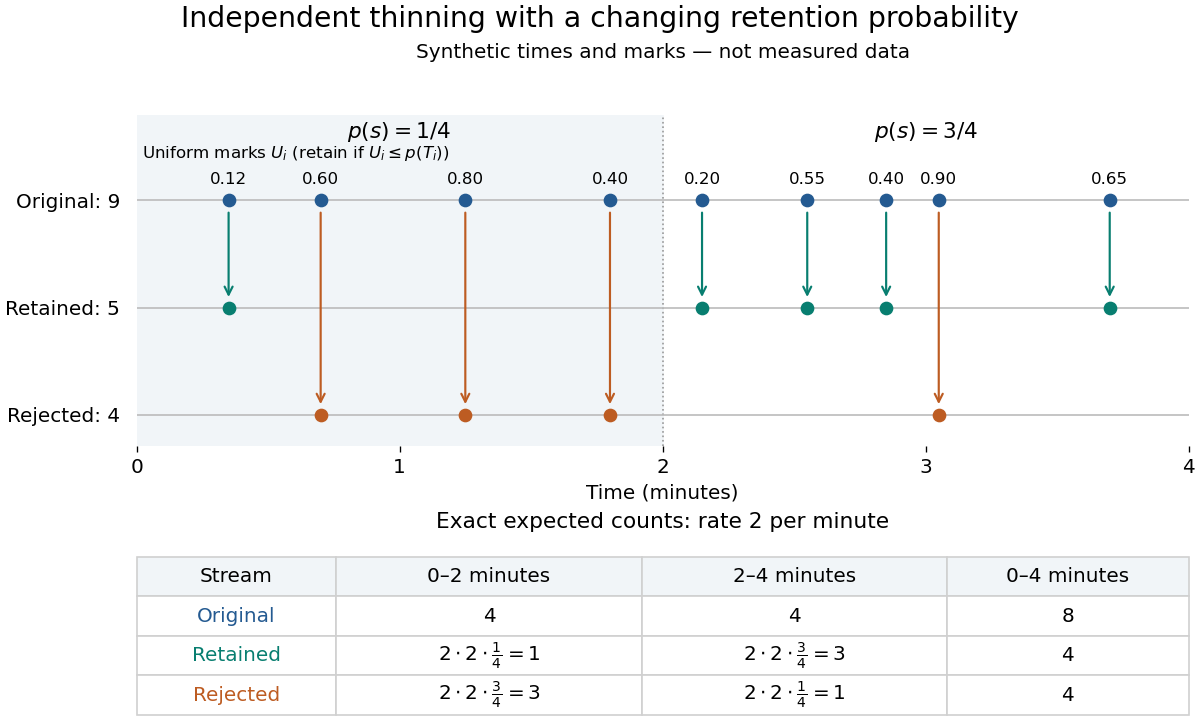
Independent marks split a synthetic Poisson arrival path, with exact expected counts for two time-dependent retention probabilities
. Details. 
The mechanism explains why mutually exclusive labels can yield independent counts: randomness of the original total offsets the dependence from allocating a fixed total. For constant and an interval with original mean , the conditional retained count has a binomial distribution given . The joint probability generating function isThis factorization proves the two independent Poisson distributions; disjoint original intervals give independent pairs. For varying , the Independent marking theorem for Poisson point processes gives the same conclusion with the two integrated intensities. The joint red and green Poisson count formula gives the corresponding direct calculation with probability mass functions.
Independence here is unconditional. After conditioning on , the identity gives covariance for constant . Thus the retained and rejected counts are dependent for and , even though their unconditional covariance is zero. Poisson thinning can model independent routing of arrivals, or independent detection of arrivals with a known efficiency schedule; using only a retention fraction without checking the marking mechanism can give a wrong count law.
Independent marking is the hypothesis that guarantees the Poisson thinning theorem. Equal marginal retention probabilities do not guarantee it. Consider one Bernoulli random variable with success probability , independent of a Poisson process, and retain every arrival when and none when . Each arrival is retained with probability , but the marks share the same coin. In an interval whose original count has Poisson distribution of mean , the retained count is and the rejected count is , soThe extra variance shows that is not Poisson distributed; the negative covariance proves dependence. Its no-arrival probability is , rather than . For the toy values , both rules have retained mean , but the common-coin rule has variance and no-arrival probability , compared with variance and no-arrival probability for independent marking. These formulas follow by conditioning on and using the law of total variance.
An arrival-dependent or adversarial retention rule can change the law just as strongly. Keeping every second arrival gives . Its successive retained gaps are sums of two independent exponential random variables, hence have the Erlang distribution of shape two and rate , not an exponential distribution. The resulting renewal process and its count variance are analyzed in Every second Poisson arrival has underdispersed counts, and the two dependent streams in alternating split of a Poisson process. As an even more restrictive rule, keeping only the first arrival ever gives , a Bernoulli distribution at each , so it cannot have a positive-mean Poisson distribution. A thinning rule must specify how decisions depend on arrivals and on one another; the independent-marking conclusion cannot be applied automatically to arbitrary deletion.
Let be a nonnegative integer-valued random variable with finite expected value , and independently label each of its items with either of two equally likely labels. If the two resulting counts are independent random variables, then has a Poisson distribution. Indeed, its probability generating function obeys . With , iteration gives . Finite expected value gives , hence and . Conversely, Poisson thinning produces independent Poisson distributions for the two counts.
Assign each of claims with independent category labels to one of finitely many categories with probabilities . Conditional counts have a multinomial distribution with probability generating function . Averaging over gives . This proves independent category counts and supports discrete-severity compound Poisson distribution representations.
Mark each member of an independent Poisson infection cohort by its symptom-onset interval, using independent delays. Poisson thinning gives independent onset-bin counts, and sums over independent cohorts remain independent Poisson counts. Fixed cohort totals instead induce multinomial dependence. The marking assumptions are essential.
For an M-M-infinity queue with empty initial state, Poisson arrivals of rate and exponential lifetimes of rate produce a Poisson occupancy of mean at time .
Articles by others on the same topic
There are currently no matching articles.