At late times and thermal equilibration requires . Hence . Both and ensure that the exchange and thermal transients have decayed.
Temperature is continuous through an instantaneous carbon injection. With and , . Its initial slope is finite; the emission pulse makes the carbon burden jump but does not give this first-order thermal model an instantaneous temperature jump.
For an infinitely deep isothermal atmosphere the bounded solution is . A more general formal solution contains , excluded by the bounded deep boundary condition. Emission exactly replenishes absorption, so the emergent spectrum is blackbody in this idealized wavelength-by-wavelength thermal model.
With negligible atmospheric emission, . If the warm surface is at , . Irradiance decreases as the beam travels upward to smaller , and . The positive derivative with respect to downward optical depth is consistent with attenuation, not amplification along propagation.
Positronium has and half the hydrogen reduced-mass energy scale, so . The large contrast with lithium is mainly Coulomb scaling, with an additional factor two from the moving positron's equal mass. It is not explained by a different photon propagation law.
The Lyman-alpha gap is , giving . For heavy lithium nucleus and , . A specified lithium isotope would permit the small reduced-mass correction; no isotope is supplied.
Jupiter emits at about 130 K rather than the solar-only estimate around 111 K. Intrinsic heat contributes additional outgoing flux, so . The difference of fourth powers is the relevant energy excess, not their direct temperature difference. Cooling and contraction of the interior provide the main physical motivation for including this extra term.
The Moon's mean equatorial temperature near 206 K is well below the approximately 270 K global effective radiative temperature. The surface has a large day-night range and finite thermal inertia; exceeds , so comparing those two differently averaged quantities as though they were equal is invalid. The discrepancy need not imply a missing atmospheric greenhouse effect on an airless Moon.
Cool faint stars lie toward the lower right. Redder color and larger magnitude identify that corner, subject to common extinction and the atmospheric color-temperature relation. A color-magnitude diagram is not a geometrical map of where the stars are located within the cluster.
Hot bright stars lie toward the upper left: smaller means bluer/hotter, and smaller numerical means brighter. The vertical axis is inverted in the original diagram. The plot shows apparent magnitudes, but cluster members at a common distance permit relative luminosity comparisons.
The finite singularities are square-root branch points at . Choose the cut between them and the branch at infinity. The two banks then have values above and below. A counterclockwise loop around the cut traverses its upper bank right-to-left, so its integral is , where is the required real integral. At large radius,
Therefore . Infinity is not another square-root branch point: this branch has an ordinary pole there on its sheet. Small detours about the finite endpoints vanish as their radius to power .
Cauchy's theorem says that a holomorphic function integrates to zero around a closed contour homologous to zero in its domain. Thus deforming one contour into another without crossing a singularity preserves the integral. More generally for a meromorphic , the exact condition is
Equal winding numbers about every singularity are sufficient. They are not necessary for one particular function because residues can cancel; even arbitrary contours have equal integrals for . A topological deformation criterion must not be confused with a necessary condition for accidental equality.
For ultrarelativistic particles with fixed magnet settings, and . Hence the half-trace is
Off-energy motion is stable when , separately in each transverse plane. Where , its first-order phase shift is
For equal opposite strengths,
Thus positive momentum error reduces the focusing and phase advance; negative error moves toward the overfocused unstable boundary. The unexpanded symmetric stability condition is , with , within the ultrarelativistic energy scaling. Its natural chromaticity per cell is . Away from the ultrarelativistic limit replace the displayed first-order energy error by . Linearizing at a stability boundary is singular and needs separate treatment.
For a real uncoupled, lossless transverse map, . Bounded nondegenerate oscillatory motion requires complex-conjugate eigenvalues , equivalently
Its Courant-Snyder parameters give
The positive quadratic form is invariant, so repeating the cell cannot produce secular growth. At trace a nontrivial Jordan block instead produces linear growth; only the exceptional maps remain bounded at those exact boundaries. The criterion must hold in both transverse planes. For the symmetric FODO cell, both traces are , giving
At fixed gradient and magnet length, . If is total energy,
Here , not one of the Courant-Snyder parameters. For ultrarelativistic electrons this becomes , or : higher-energy particles are bent and focused less strongly. If the symbol instead denotes kinetic energy , the coefficient is , approaching in the nonrelativistic limit. Stating the energy convention avoids applying the ultrarelativistic result to a slow beam.
Use transverse coordinates and define a positive signed focal length as focusing in that plane. A thin quadrupole magnet of length and signed gradient has integrated strength ; the electron charge and chosen field orientation are absorbed into the sign of . Its beam transfer matrix is
For total electron energy , , so in the ultrarelativistic limit. The other transverse plane has the opposite signed focal length. A quadrupole magnet therefore focuses one plane while defocusing the other; the longitudinal magnetic field component is negligible in this paraxial idealization.
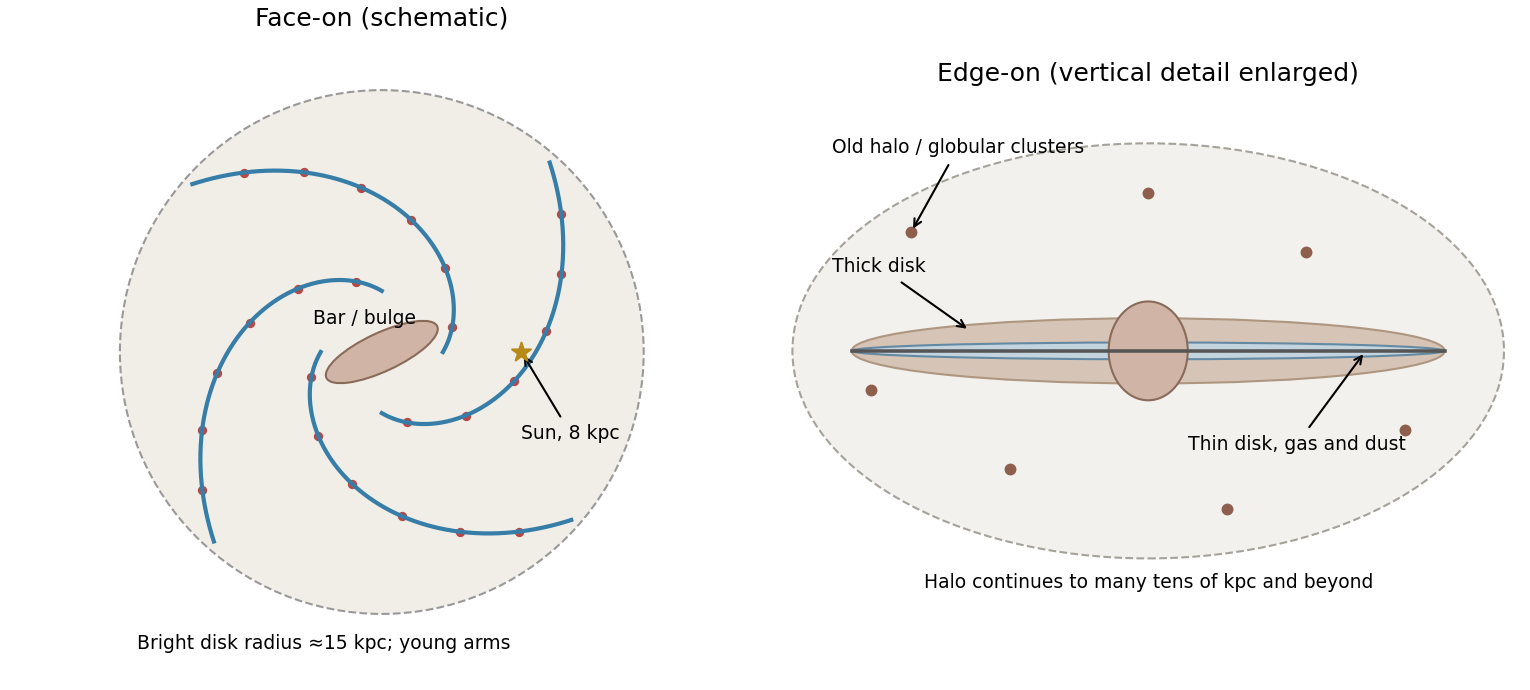
Edge-on, the bright thin galactic disk forms a narrow band, with a central bulge protruding above and below it and a thinner gas-and-dust lane along the midplane. Young stars and H II regions occupy a vertical scale of a few tenths of a kiloparsec or less; a broader old thick disk has scale of order a kiloparsec. These are approximate scale heights, not sharp boundaries. The old stellar halo and globular clusters form a much larger, low-surface-brightness spheroidal component, extending to many tens of kiloparsecs or more. The dark matter halo is inferred dynamically rather than directly visible in such a sketch. The preceding figure is a structural diagram, not an external photograph or a reconstruction of a particular survey.
Face-on, the Milky Way is a barred spiral galaxy: a central bulge and bar of scale a few kiloparsecs lie inside a disk of stellar radius roughly , with spiral arms containing gas, dust, H II regions and young stars. Recent star formation is concentrated in molecular clouds and arm complexes. The Sun lies in the disk about from the centre in the source's convention. Old stars are also present throughout the disk, while the bulge, thick disk and extended stellar halo contain important old populations. Globular clusters occupy a roughly spheroidal halo extending well beyond the bright disk.
Figure 1.
Original schematic face-on and edge-on views of the Milky Way
. The face-on panel labels a barred centre, spiral star-forming regions, the Sun and an approximate 15 kpc bright-disk radius. The edge-on panel separates the thin dusty disk, thick disk, bulge and old halo/globular-cluster population. Halo extent is indicated schematically beyond the plotted field. Details.
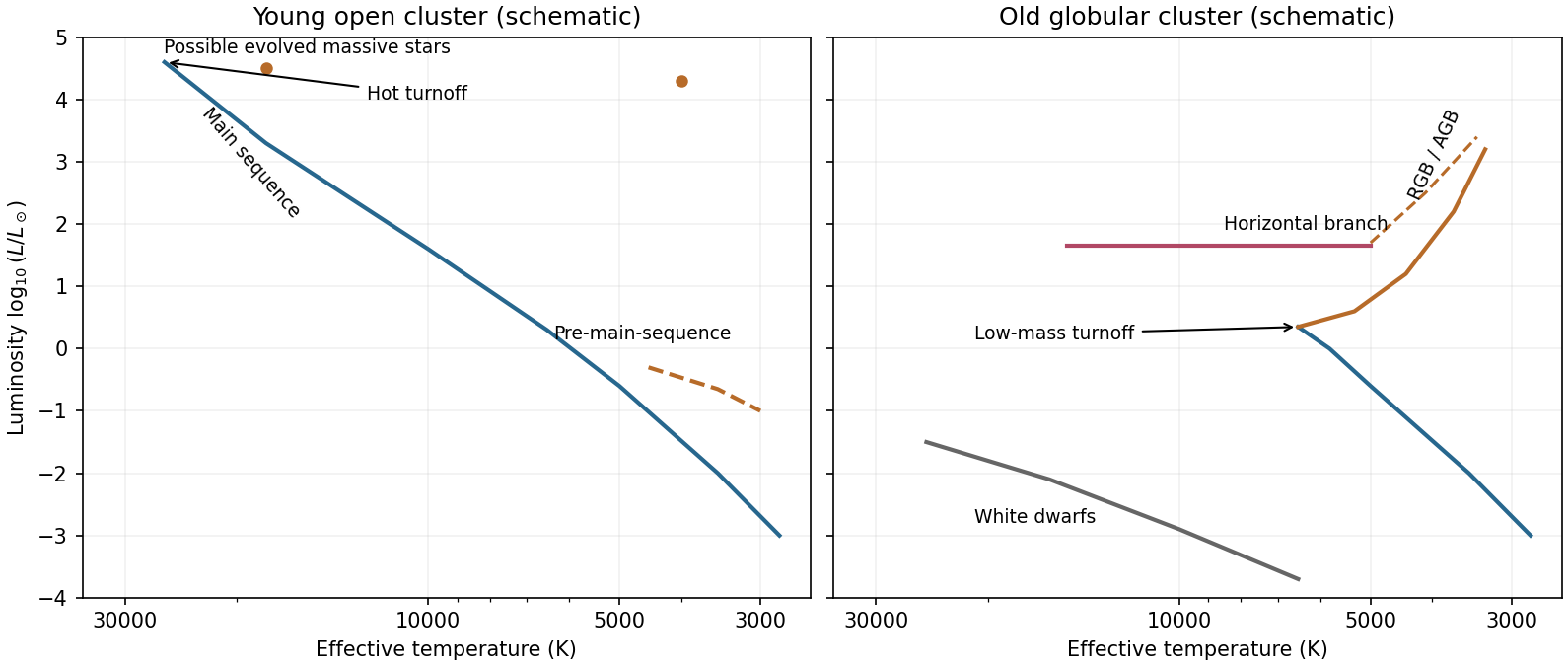
An old globular cluster has lost its original massive main-sequence members. Its main-sequence turnoff lies near a low stellar mass, typically around for an age of order years. The diagram shows a lower main sequence, a subgiant branch, a prominent red giant branch, a horizontal branch of core-helium-burning stars, an Asymptotic giant branch and a faint white dwarf cooling sequence. The preceding schematic labels these features. A few blue stragglers may lie above the old turnoff because interaction or merger rejuvenated them; they do not imply a young age for the bulk population.
For a young open cluster, the Hertzsprung-Russell diagram contains a populated main sequence reaching hot, luminous, high-mass stars, with a high-mass main-sequence turnoff determined by its age. Cool low-mass members may still lie on tracks of pre-main-sequence stars above the lower main sequence. Depending on how young the cluster is, a few evolved blue or red supergiants may already be present; an extremely young cluster need not have any. It lacks the dominant old low-mass red-giant and horizontal-branch populations of an old globular cluster.
Figure 1.
Schematic temperature-luminosity diagrams of young and old star clusters
. Temperature decreases to the right. The young cluster reaches a hot luminous turnoff and contains possible pre-main-sequence stars; the old cluster has a cool low-mass turnoff, red giant and horizontal branches, and a white-dwarf sequence. Curves are illustrative population sketches, not fitted isochrones. Details.

Pinned article: Introduction to the OurBigBook Project

Welcome to the OurBigBook Project! Our goal is to create the perfect publishing platform for STEM subjects, and get university-level students to write the best free STEM tutorials ever.
Everyone is welcome to create an account and play with the site: ourbigbook.com/go/register. We belive that students themselves can write amazing tutorials, but teachers are welcome too. You can write about anything you want, it doesn't have to be STEM or even educational. Silly test content is very welcome and you won't be penalized in any way. Just keep it legal!
We have two killer features:
  1. topics: topics group articles by different users with the same title, e.g. here is the topic for the "Fundamental Theorem of Calculus" ourbigbook.com/go/topic/fundamental-theorem-of-calculus
    Articles of different users are sorted by upvote within each article page. This feature is a bit like:
    • a Wikipedia where each user can have their own version of each article
    • a Q&A website like Stack Overflow, where multiple people can give their views on a given topic, and the best ones are sorted by upvote. Except you don't need to wait for someone to ask first, and any topic goes, no matter how narrow or broad
    This feature makes it possible for readers to find better explanations of any topic created by other writers. And it allows writers to create an explanation in a place that readers might actually find it.

    Figure 1.
    Screenshot of the "Derivative" topic page
    . View it live at: ourbigbook.com/go/topic/derivative
  2. local editing: you can store all your personal knowledge base content locally in a plaintext markup format that can be edited locally and published either:
    This way you can be sure that even if OurBigBook.com were to go down one day (which we have no plans to do as it is quite cheap to host!), your content will still be perfectly readable as a static site.
    Figure 5. . You can also edit articles on the Web editor without installing anything locally.
    Video 3.
    Edit locally and publish demo
    . Source. This shows editing OurBigBook Markup and publishing it using the Visual Studio Code extension.

  3. https://raw.githubusercontent.com/ourbigbook/ourbigbook-media/master/feature/x/hilbert-space-arrow.png
  4. Infinitely deep tables of contents:
    Figure 6.
    Dynamic article tree with infinitely deep table of contents
    .
    Descendant pages can also show up as toplevel e.g.: ourbigbook.com/cirosantilli/chordate-subclade
All our software is open source and hosted at: github.com/ourbigbook/ourbigbook
Further documentation can be found at: docs.ourbigbook.com
Feel free to reach our to us for any help or suggestions: docs.ourbigbook.com/#contact