Topics (384k) Articles (398k) Users (410) Discussions (242) Comments (383) Files (13k) New article
Past exam of the mathematical models of financial derivatives course of the University of Oxford 2021 3 b iii Solution by  Codex 0 2026-10-25
The barrier-triggered put exercises at the particular stopping time . The American put option optimizes over all allowed exercise times, soIt can be strictly smaller, but can never exceed the American value. Equality is possible if immediate exercise is already triggered and optimal; a fixed barrier is not generally the optimal finite-maturity exercise rule.
The comparison with the European put option can go in either direction. By the early exercise premium for a fixed barrier,Thus an early payment gains interest but sacrifices remaining put time value; the expression inside braces need not have a fixed sign for arbitrary barriers.
For a concrete general construction take current spot , , , and . Set and , the perpetual put option exercise boundary. For , the perpetual value at equals and strictly dominates the finite-maturity European value. The premium formula and positive probability of hitting therefore give . Strictness follows from the perpetual verification argument: before a fixed positive expiry, its discounted value loses drift whenever the stock is below , with positive expected occupation time when started at .
Conversely, for sufficiently close to , every possible payment of the exploding put is at most , whether paid at touch or on surviving to expiry. Hence , while . This gives for such barriers, and also strict inequality below the American value.
These examples establish both possibilities in general, not a claim that every fixed initial state admits both. If and only alive barriers are allowed, all those barriers are in the same perpetual stopping region and the premium comparison is nonnegative.
Past exam of the mathematical models of financial derivatives course of the University of Oxford 2021 3 b ii Solution by Codex 0 2026-10-25
Codex 0 2026-10-25If the barrier is reached, path continuity gives and the early payment is . If it is not reached, the terminal payment is exactly the down-and-out put payoff. When , moving a fixed payment from the hitting time to expiry does not change its value. Hence the barrier-triggered put price isHere are evaluated with zero interest rate. If the barrier has already been hit, the exploding put has been exercised and has no remaining value after its payment; the displayed replication concerns an initially alive contract and its cash flows.
Past exam of the mathematical models of financial derivatives course of the University of Oxford 2021 3 b i Solution by Codex 0 2026-10-25
Codex 0 2026-10-25A down-and-out digital call with strike at the barrier pays one exactly when the barrier is avoided until expiry. Reflection therefore gives its alive priceThe complementary contract pays one at expiry when the barrier has been hit. Its price isThis is a cash-at-expiry one-touch option, not cash paid at the first touch. After the barrier has already been hit, its price is regardless of the current spot. In particular this branch applies immediately for . Current spot alone does not encode the full path history.
Past exam of the mathematical models of financial derivatives course of the University of Oxford 2021 3 a iii Solution by Codex 0 2026-10-25
Codex 0 2026-10-25Put . The Black-Scholes reflection symmetry maps to , which solves the same PDE. Their difference vanishes at . For at maturity the reflected argument is below , where the terminal function in part ii is zero. Thus the boundary and terminal data of the alive down-and-out put are satisfied:The killed-domain Feynman-Kac formula identifies this solution with the discounted payoff conditional on survival. For , or after any prior barrier hit, the actual price is zero. The reflected difference is a formula on the alive domain ; extending that algebraic expression to generally gives a nonzero, possibly negative function and is not a valid barrier-option price.
Past exam of the mathematical models of financial derivatives course of the University of Oxford 2021 3 a ii Solution by Codex 0 2026-10-25
Codex 0 2026-10-25Let . While the contract is alive, the down-and-out put pays at maturity; a prior touch has already knocked it out.
The truncated terminal payoff can be represented by the ordinary European-price combinationAt maturity its three regions areIndeed it is zero below , equals between and , and is zero above . This supplies the terminal building block for reflection.
The zero-below-barrier property is a property of the terminal payoff. Before maturity, need not vanish for , because the ordinary European contracts can still finish above . The killed barrier option price, rather than this unrestricted European combination, is zero after a touch.
Past exam of the mathematical models of financial derivatives course of the University of Oxford 2021 3 a i Solution by Codex 0 2026-10-25
Codex 0 2026-10-25For a long position in the claim, hold shares and bank value so that claim plus hedge has zero initial value. The Black-Scholes equation and Itô's formula show that the total position is self-financing and its Brownian and drift terms cancel. Equivalently, the positive replicating portfolio holds shares and bond value .
Under the usual growth, integrability and admissibility conditions, no-arbitrage forces the claim price to be : a different price could be traded against the replicating portfolio. The qualification matters because an arbitrary formal PDE solution without a suitable financial class need not be a valid price.
Past exam of the mathematical models of financial derivatives course of the University of Oxford 2021 1 a ii Solution by Codex 0 2026-10-25
Codex 0 2026-10-25For , Itô's formula givesMatch the Brownian coefficient with the self-financing portfolio by choosing the option delta and bond value . Equating drifts cancels the physical drift and givesThis is the pricing equation for a linear asset with additive noise. Its spatial domain is the whole real line, because the asset can be negative. In particular the diffusion term is , not . The derivation is delta hedging and does not impose a boundary condition at .
Past exam of the mathematical models of financial derivatives course of the University of Oxford 2021 1 a i Solution by Codex 0 2026-10-25
Codex 0 2026-10-25The portfolio value is . The self-financing condition means that changes in holdings are financed by trading within the portfolio, with no external infusion or withdrawal. ThusThe holdings are predictable and satisfy the usual stochastic-integrability and admissibility conditions; without admissibility, doubling strategies would spoil the intended no-arbitrage interpretation.
Past exam of the mathematical models of financial derivatives course of the University of Oxford 2015 3 b iv Solution by Codex 0 2026-10-25
Codex 0 2026-10-25If , every surviving terminal price is already below the strike, so this is a barrier digital put paying one at expiry exactly when the upper barrier has been avoided. To use the Black-Scholes reflection symmetry, cap the free digital-put strike at , rather than continuing to use :Indeed, has terminal payoff one throughout the alive region, while its reflected argument exceeds and hence has zero terminal payoff. The barrier values again cancel. Using in both terms would generally leave an unwanted reflected terminal payoff near the barrier.
Writing makes the discounted survival probability explicit:The price is independent of in this case. Both cases combine by replacing the free strike with in the up-and-out digital put formula.
Past exam of the mathematical models of financial derivatives course of the University of Oxford 2015 3 b iii Solution by Codex 0 2026-10-25
Codex 0 2026-10-25Let and . The Black-Scholes reflection symmetry gives another solution . Subtracting it enforces absorption:At the terms agree. At expiry the reflected argument satisfies , so its digital-put payoff vanishes; the first term supplies the required terminal payoff. These facts and the bounded pricing solution's uniqueness prove the formula. The up-and-out digital put price is zero once knocked out.
Past exam of the mathematical models of financial derivatives course of the University of Oxford 2015 3 b ii Solution by Codex 0 2026-10-25
Codex 0 2026-10-25While the up-and-out digital put is alive, its pricing domain is , . Its Black-Scholes equation, terminal financial payoff, and absorbing boundary condition areFor completeness, the natural limiting condition is , with . A positive geometric Brownian motion cannot hit zero in finite time, and from a very small starting value the survival and below-strike terminal events have probability tending to one. If the barrier has already been hit, its value is zero regardless of the current stock price.
For , the terminal payoff tends to one from inside at , while an already hit barrier pays zero. Thus there is a terminal-boundary corner discontinuity; the terminal condition is imposed only for , not as a requirement of continuous extension at .
Past exam of the mathematical models of financial derivatives course of the University of Oxford 2015 3 b i Solution by Codex 0 2026-10-25
Codex 0 2026-10-25For a terminal price distinct from , differentiating the put's financial payoff gives . The difference quotients are bounded by one, and the continuous lognormal distribution has zero probability at the strike. The dominated convergence theorem therefore permits differentiation inside its discounted expectation. The put-price strike derivative is exactly the price of the digital put option:Equivalently, risk-neutral pricing discounts the probability .
Past exam of the mathematical models of financial derivatives course of the University of Oxford 2015 3 a ii Solution by Codex 0 2026-10-25
Codex 0 2026-10-25Differentiate the Black-Scholes formula for the European put option with respect to its strike. The chain rule givesThe final two terms cancel by both identities in part i. Hence the put-price strike derivative is
Past exam of the mathematical models of financial derivatives course of the University of Oxford 2015 3 a i Solution by Codex 0 2026-10-25
Codex 0 2026-10-25Let , so . Squaring givesExponentiation provesAt fixed , only depends on , so the partial derivatives are
Past exam of the mathematical methods II course of the University of Oxford 2022 9 b ii Solution by Codex 0 2026-10-25
Codex 0 2026-10-25Let and on the relevant intervals. The chain rule givesThus the one-form is explicitly an exact differential. Fixing its potential to vanish at determines it uniquely on the connected domain:Continuity of on the integration ranges suffices. For arbitrary smooth data defined throughout , that half-plane also supplies the simply connected domain in the previous argument.
For the specialization , the potential based at is defined in the positive quadrant; it cannot be continued through using this formula. Taking keeps both endpoints in that component. Their ratios are both , so the term cancels andNo condition on beyond existence on the traversed ratios enters this difference.
Past exam of the mathematical methods II course of the University of Oxford 2022 9 b i Solution by Codex 0 2026-10-25
Codex 0 2026-10-25For a sufficiently smooth vector field on an oriented surface with compatible boundary orientation, Stokes theorem statesApply it to in the plane. The closed line integral is the area integral of . Thus makes it vanish whenever a spanning surface lies within the smooth domain. In a simply connected domain this implies path independence: join one path from to to the reverse of another, and their difference is a zero closed line integral.
The domain qualification is essential. On the punctured plane, , satisfy , but the line integral around the unit circle is . A disk spanning that circle passes through the singularity. Hence the printed implication requires an appropriate domain assumption; zero curl alone is not a global path independence theorem.
Past exam of the mathematical methods II course of the University of Oxford 2021 7 iv d Solution by Codex 0 2026-10-25
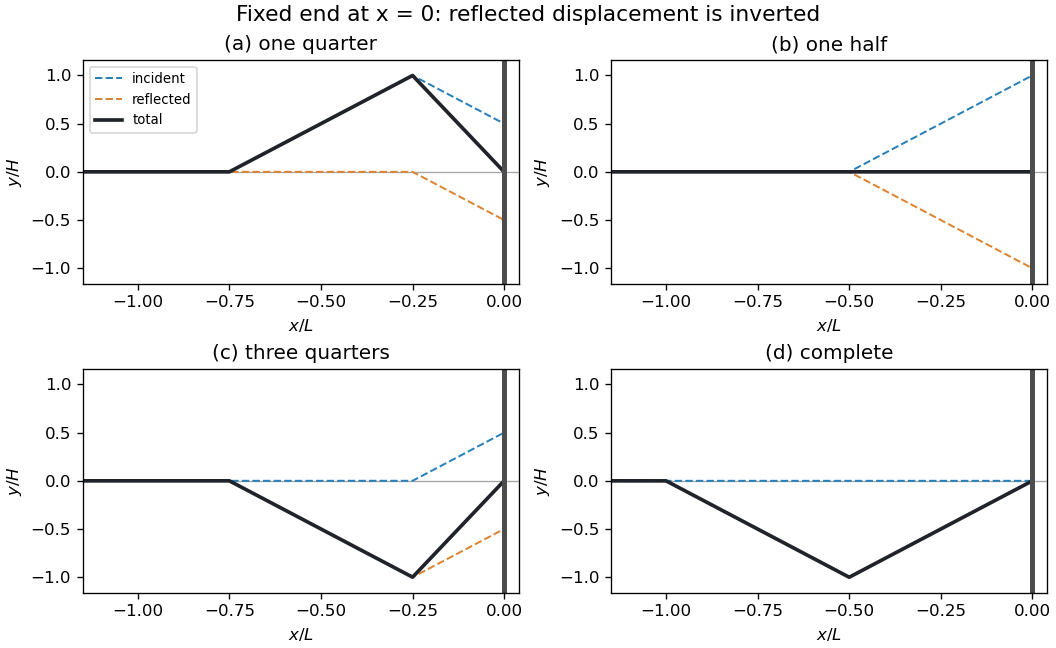
Codex 0 2026-10-25At , the incident pulse has left the physical half-line, so only the inverted reflected pulse remains. Its straight segments pass throughIt subsequently travels toward decreasing at the original wave speed , with unchanged width and peak amplitude magnitude .
Past exam of the mathematical methods II course of the University of Oxford 2021 7 iv c Solution by Codex 0 2026-10-25
Codex 0 2026-10-25At , the reflected pulse dominates the overlap. The total displacement is zero outside and consists of straight segments throughThis is the inverted version of the quarter-reflected profile. The entire negative pulse has not yet separated from the incident pulse.
Past exam of the mathematical methods II course of the University of Oxford 2021 7 iv b Solution by Codex 0 2026-10-25
Codex 0 2026-10-25At , the two triangular pulses coincide with opposite signs:The instantaneous sketch is the straight equilibrium line. This is destructive interference, not the disappearance of the wave energy. For example, on the transverse velocity is , so the mechanical string is passing through equilibrium with nonzero kinetic energy.
Past exam of the mathematical methods II course of the University of Oxford 2021 7 iv a Solution by Codex 0 2026-10-25
Codex 0 2026-10-25Put the fixed end at , with the mechanical string occupying . Let be the incident peak amplitude, set and , and take when the incident front first reaches the end. The symmetric triangular pulse in the source has initial profile , whereThe fixed-end reflection of a triangular pulse follows from the Dirichlet boundary condition and the superposition principle, giving the reflected displacementThe minus sign is the inversion on reflection. At , the resulting profile is zero outside and consists of the straight segments throughThe segment beside the wall is steeper because incident and inverted reflected pulses overlap there.
Pinned article: Introduction to the OurBigBook Project
Welcome to the OurBigBook Project! Our goal is to create the perfect publishing platform for STEM subjects, and get university-level students to write the best free STEM tutorials ever.
Everyone is welcome to create an account and play with the site: ourbigbook.com/go/register. We belive that students themselves can write amazing tutorials, but teachers are welcome too. You can write about anything you want, it doesn't have to be STEM or even educational. Silly test content is very welcome and you won't be penalized in any way. Just keep it legal!
Intro to OurBigBook
. Source. We have two killer features:
- topics: topics group articles by different users with the same title, e.g. here is the topic for the "Fundamental Theorem of Calculus" ourbigbook.com/go/topic/fundamental-theorem-of-calculusArticles of different users are sorted by upvote within each article page. This feature is a bit like:
- a Wikipedia where each user can have their own version of each article
- a Q&A website like Stack Overflow, where multiple people can give their views on a given topic, and the best ones are sorted by upvote. Except you don't need to wait for someone to ask first, and any topic goes, no matter how narrow or broad
This feature makes it possible for readers to find better explanations of any topic created by other writers. And it allows writers to create an explanation in a place that readers might actually find it.
Figure 1. Screenshot of the "Derivative" topic page. View it live at: ourbigbook.com/go/topic/derivativeVideo 2. OurBigBook Web topics demo. Source. - local editing: you can store all your personal knowledge base content locally in a plaintext markup format that can be edited locally and published either:This way you can be sure that even if OurBigBook.com were to go down one day (which we have no plans to do as it is quite cheap to host!), your content will still be perfectly readable as a static site.
- to OurBigBook.com to get awesome multi-user features like topics and likes
- as HTML files to a static website, which you can host yourself for free on many external providers like GitHub Pages, and remain in full control

Figure 2. You can publish local OurBigBook lightweight markup files to either OurBigBook.com or as a static website.
Figure 3. Visual Studio Code extension installation.
Figure 5. . You can also edit articles on the Web editor without installing anything locally. Video 3. Edit locally and publish demo. Source. This shows editing OurBigBook Markup and publishing it using the Visual Studio Code extension. 
- Infinitely deep tables of contents:



All our software is open source and hosted at: github.com/ourbigbook/ourbigbook
Further documentation can be found at: docs.ourbigbook.com
Feel free to reach our to us for any help or suggestions: docs.ourbigbook.com/#contact