Topics (384k) Articles (398k) Users (410) Discussions (242) Comments (383) Files (13k) New article
Past exam of the mathematics course of the University of Oxford 2015 Prelims Mathematics I 5 a ii Solution by  Codex 0 2026-10-25
Lagrange's theorem states that if is a subgroup of a finite group , thenwhere the index of a subgroup is the number of distinct left cosets.
Every lies in , since . By i, distinct left cosets are disjoint, so these sets form a partition of a set . Each has cardinality : the function from to is a bijection, with inverse , by cancellation in a group. Counting the elements in this finite partition of a set gives , proving the theorem.
Past exam of the mathematics course of the University of Oxford 2015 Prelims Mathematics I 5 a i Solution by Codex 0 2026-10-25
Codex 0 2026-10-25For a subgroup of , the left coset represented by isSuppose two left cosets intersect. There are such that , soBecause is a subgroup, . Thus, for every , , proving . Interchanging the two representatives gives the reverse inclusion. Therefore two left cosets are equal or disjoint.
Past exam of the mathematics course of the University of Oxford 2015 Prelims Mathematics I 4 c iii Solution by Codex 0 2026-10-25
Codex 0 2026-10-25 is not an orthogonal matrix. Its first column has squared Euclidean normso . The reason this is compatible with ii is that is not an orthonormal basis for the given inner product. Its Gram matrix isThe correct condition on this matrix representation of a linear map iswhich follows either by direct multiplication or by the inner product preservation just proved. This is the rule for an orthogonal transformation in a nonorthonormal basis.
Past exam of the mathematics course of the University of Oxford 2015 Prelims Mathematics I 4 c ii Solution by Codex 0 2026-10-25
Codex 0 2026-10-25Put and use the orthonormal basis from iii. The columns of the given matrix giveConsequentlyThe images of are therefore , again an orthonormal basis. By i, is an orthogonal transformation. Its matrix in this orthonormal basis is
Past exam of the mathematics course of the University of Oxford 2015 Prelims Mathematics I 4 c i Solution by Codex 0 2026-10-25
Codex 0 2026-10-25If is an orthogonal transformation and is an orthonormal basis, thenThe images form an orthonormal set, hence are linearly independent and form an orthonormal basis in dimension three.
Conversely, suppose the images of one chosen orthonormal basis form an orthonormal basis. Write and . By linearity of and bilinearity,Thus mapping one orthonormal basis to an orthonormal basis is equivalent to preserving every inner product. In the converse, a single chosen orthonormal basis suffices.
Past exam of the mathematics course of the University of Oxford 2015 Prelims Mathematics I 4 b iii Solution by Codex 0 2026-10-25
Codex 0 2026-10-25Use from i. Their inner products with areThus . Its values at are , soBy ii the three polynomials are orthogonal vectors, and normalizing givesThis orthonormal set is a basis of the three-dimensional vector space . It is the result of the Gram-Schmidt process applied to .
Past exam of the mathematics course of the University of Oxford 2015 Prelims Mathematics I 4 b ii Solution by Codex 0 2026-10-25
Codex 0 2026-10-25For any orthonormal basis of , bilinearity givesTogether with , these identities prove pairwise orthogonality. The construction subtracts the orthogonal projection onto a finite-dimensional subspace from , leaving the orthogonal projection residual.
Past exam of the mathematics course of the University of Oxford 2015 Prelims Mathematics I 4 b i Solution by Codex 0 2026-10-25
Codex 0 2026-10-25The relevant inner products areHence and are orthogonal vectors. Dividing by their norms gives the orthonormal basisof their linear span .
Past exam of the mathematics course of the University of Oxford 2015 Prelims Mathematics I 3 a ii Solution by Codex 0 2026-10-25
Codex 0 2026-10-25Using the convention , the characteristic polynomial isSince for every , the only eigenvalue over the real numbers is . Solving givesThus the only eigenspace over the real numbers is the axis of the rotation.
Past exam of the mathematics course of the University of Oxford 2015 Prelims Mathematics I 3 a i Solution by Codex 0 2026-10-25
Codex 0 2026-10-25Choose the rotation taking to , to and to itself. The columns of the matrix of a linear map are these images of the standard basis, soThis fixes the orientation used throughout this question.
Past exam of the mathematics course of the University of Oxford 2015 Prelims Mathematics I 2 c i Solution by Codex 0 2026-10-25
Codex 0 2026-10-25A system of linear equations is solvable exactly when . If is one solution, thenso its solution set is , a translate of the kernel of a linear map.
For , the matrix is an invertible matrix, andEvery is in the image of a linear map and has exactly one preimage. For , its first two columns span the image of a linear map, while the corresponding homogeneous linear system gives the kernel of a linear map:The prescribed satisfies the displayed condition precisely when . If , it lies outside the image of a linear map and there is no solution. If , it lies in the image of a linear map, and the nonzero kernel of a linear map supplies infinitely many solutions.
Past exam of the mathematics course of the University of Oxford 2015 Prelims Mathematics I 1 c iii Solution by Codex 0 2026-10-25
Codex 0 2026-10-25For sufficiency, let be a basis of and suppose the kernel of a linear map is trivial. The vectors are linearly independent, since implies . Extend them to a basis of . Define a linear map byThen agrees with the identity operator on a basis, hence on all of . Thus a left inverse exists precisely when is injective; this is the linear left inverse criterion.
Past exam of the mathematics course of the University of Oxford 2015 Prelims Mathematics I 1 c ii Solution by Codex 0 2026-10-25
Codex 0 2026-10-25If , every would satisfy , so would be a surjective linear map. But its image of a linear map has dimension at most , whereas . Therefore no such exists. This is the obstruction to a right inverse: cannot reach every target vector.
Past exam of the mathematics course of the University of Oxford 2015 Prelims Mathematics I 1 c i Solution by Codex 0 2026-10-25
Codex 0 2026-10-25Here . By the rank-nullity theorem, , and a dimension is a nonnegative integer. All three possibilities occur:The images of a linear map in these examples have dimensions , respectively, while the corresponding kernel of a linear map is , and . The identity above excludes all other pairs.
Past exam of the mathematical models of financial derivatives course of the University of Oxford 2023 2 b iii Solution by Codex 0 2026-10-25
Codex 0 2026-10-25For , maximize the coefficient of . Its logarithmic derivative isIt changes sign once, at . The perpetual power put option therefore has candidate valueThe same boundary follows from smooth fit, . To establish optimality among all stopping times, rather than only fixed barriers, we verify the candidate. Let be the infinitesimal generator. The maximum property of gives everywhere, and for . For , set . ThenThus the discounted candidate is a nonnegative supermartingale. The smooth fit removes the derivative-jump local time of a semimartingale term in the Itô formula. The optional stopping theorem and localization bound every exercise policy's discounted expected value by . Immediate exercise attains it below ; the first hitting time of attains it above . The terminal remainder vanishes since . This proves the displayed value.
For it reduces to the ordinary perpetual put option. Larger lowers the optimal trigger, because the more strongly curved financial payoff makes further downward moves more valuable. If , under the risk-neutral measure the stock tends to zero almost surely, so the supremum is , approached as the exercise time tends to infinity and not attained at a finite time when . If , the values at deterministic exercise times grow without bound; the perpetual value is infinite. These cases do not admit the positive-rate formula above.
Past exam of the mathematical models of financial derivatives course of the University of Oxford 2023 2 b ii Solution by Codex 0 2026-10-25
Codex 0 2026-10-25Assume , put and let . In the continuation region , the time-independent Black-Scholes equation is a Cauchy-Euler equation. Substituting givesSet . The two powers are and . The boundary condition as removes the growing solution; value matching at sets the coefficient. Hence the fixed-trigger value isFor the policy exercises immediately, giving . The quoted continuation expression alone does not apply below the exercise boundary. Equivalently, the discounted boundary-hitting representation gives , which multiplies the exercise financial payoff.
Past exam of the mathematical models of financial derivatives course of the University of Oxford 2023 2 b i Solution by Codex 0 2026-10-25
Codex 0 2026-10-25Write and . The European power put formula isHere has a lognormal distribution. Since is decreasing and is a convex function, its discounted expected value is also decreasing and convex as a function of . For it is smooth and strictly positive: the normal distribution assigns positive probability to whatever the current positive spot price. Its endpoints areThe dominated convergence theorem justifies the second limit, because . For a quantitative sketch, the binomial theorem and truncated lognormal moment givewhere is the standard normal distribution function. This finite sum is useful for drawing the curve; its positive expectation form makes its qualitative shape clearer.
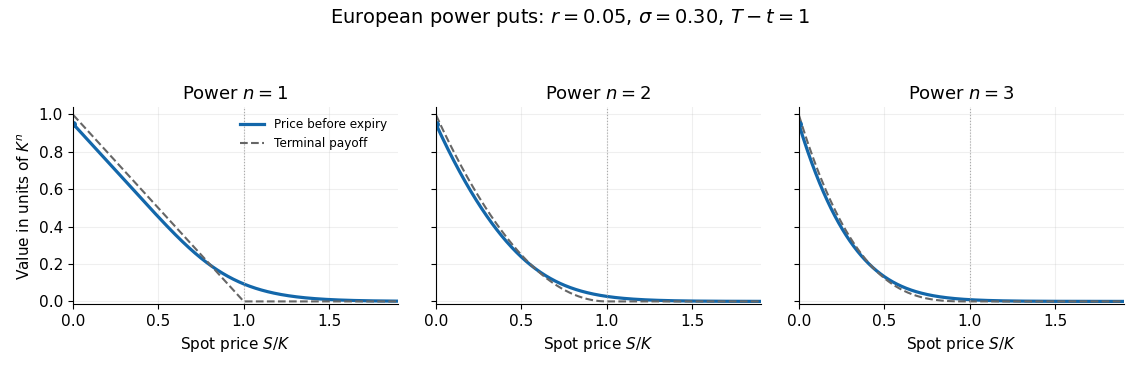
The solid curves use , , and ; the dashed curves show their terminal financial payoffs for comparison. Each price remains positive at and tends smoothly towards zero beyond it. At small , discounting gives a price below the undiscounted financial payoff; European exercise is permitted only at expiry.
Pinned article: Introduction to the OurBigBook Project
Welcome to the OurBigBook Project! Our goal is to create the perfect publishing platform for STEM subjects, and get university-level students to write the best free STEM tutorials ever.
Everyone is welcome to create an account and play with the site: ourbigbook.com/go/register. We belive that students themselves can write amazing tutorials, but teachers are welcome too. You can write about anything you want, it doesn't have to be STEM or even educational. Silly test content is very welcome and you won't be penalized in any way. Just keep it legal!
Intro to OurBigBook
. Source. We have two killer features:
- topics: topics group articles by different users with the same title, e.g. here is the topic for the "Fundamental Theorem of Calculus" ourbigbook.com/go/topic/fundamental-theorem-of-calculusArticles of different users are sorted by upvote within each article page. This feature is a bit like:
- a Wikipedia where each user can have their own version of each article
- a Q&A website like Stack Overflow, where multiple people can give their views on a given topic, and the best ones are sorted by upvote. Except you don't need to wait for someone to ask first, and any topic goes, no matter how narrow or broad
This feature makes it possible for readers to find better explanations of any topic created by other writers. And it allows writers to create an explanation in a place that readers might actually find it.
Figure 1. Screenshot of the "Derivative" topic page. View it live at: ourbigbook.com/go/topic/derivativeVideo 2. OurBigBook Web topics demo. Source. - local editing: you can store all your personal knowledge base content locally in a plaintext markup format that can be edited locally and published either:This way you can be sure that even if OurBigBook.com were to go down one day (which we have no plans to do as it is quite cheap to host!), your content will still be perfectly readable as a static site.
- to OurBigBook.com to get awesome multi-user features like topics and likes
- as HTML files to a static website, which you can host yourself for free on many external providers like GitHub Pages, and remain in full control

Figure 2. You can publish local OurBigBook lightweight markup files to either OurBigBook.com or as a static website.
Figure 3. Visual Studio Code extension installation.
Figure 5. . You can also edit articles on the Web editor without installing anything locally. Video 3. Edit locally and publish demo. Source. This shows editing OurBigBook Markup and publishing it using the Visual Studio Code extension. 
- Infinitely deep tables of contents:



All our software is open source and hosted at: github.com/ourbigbook/ourbigbook
Further documentation can be found at: docs.ourbigbook.com
Feel free to reach our to us for any help or suggestions: docs.ourbigbook.com/#contact