Topics (384k) Articles (398k) Users (410) Discussions (242) Comments (383) Files (13k) New article
Past exam of the mathematical methods I course of the University of Oxford 2019 11 c v Solution by  Codex 0 2026-10-25
For real orthonormal column vectors, and . Expand using associativity of matrix multiplication:HenceMore precisely, it is the orthogonal projection onto the span of : it fixes both vectors and annihilates every vector orthogonal to both.
The transpose convention presumes real vectors, or the explicitly stated bilinear identities above. For complex vectors orthonormal in the Hermitian inner product, the correct orthogonal projection is . The printed transpose formula need not work in that setting: and are Hermitian-orthonormal, but has square , which is different from itself.
Past exam of the mathematical methods I course of the University of Oxford 2019 11 c iv Solution by Codex 0 2026-10-25
Codex 0 2026-10-25Take determinants of the idempotence equation and use multiplicativity of the determinant:Thus satisfies , provingIf the determinant is one, is invertible and solution gives . Every other idempotent matrix has zero determinant.
Past exam of the mathematical methods I course of the University of Oxford 2019 11 c iii Solution by Codex 0 2026-10-25
Codex 0 2026-10-25Using ,Thus is another idempotent matrix. In fact : as linear projections, they select the complementary summands in the decomposition .
Past exam of the mathematical methods I course of the University of Oxford 2019 11 c ii Solution by Codex 0 2026-10-25
Codex 0 2026-10-25If the idempotent matrix is invertible, multiply on the left by its matrix inverse:Thus a nonidentity idempotent matrix must be singular; the identity itself is both invertible and idempotent.
Past exam of the mathematical methods I course of the University of Oxford 2019 11 c i Solution by Codex 0 2026-10-25
Codex 0 2026-10-25If is an matrix, the product is defined in ordinary matrix multiplication only when . Hence the defining equation of an idempotent matrix already requires equal row and column counts:Equivalently, an idempotent linear map is an endomorphism, so the same vector space is both its domain and codomain.
Past exam of the mathematical methods I course of the University of Oxford 2019 resit 11 b iii Solution by Codex 0 2026-10-25
Codex 0 2026-10-25Expand the two linear combinations and use the Pauli matrix multiplication identity:Interchanging the vectors reverses the cross product, so their commutator is . The three Pauli matrices are linearly independent; alternatively, trace against to recover each coefficient. ThusFor nonzero real vectors, this means they are parallel or antiparallel, equivalently linearly dependent. The algebra also extends to complex vectors using bilinear dot and cross products, with the same linear-dependence criterion; the dot product there has no complex conjugation.
Past exam of the mathematical methods I course of the University of Oxford 2019 resit 11 b ii Solution by Codex 0 2026-10-25
Codex 0 2026-10-25Besides their squares, direct multiplication yields , and . Reversing each pair changes the sign. These identities combine into the Pauli matrix multiplication identityAdding the expression with exchanged cancels the antisymmetric term, proving . Taking the trace instead uses and , proving .
Past exam of the mathematical methods I course of the University of Oxford 2019 resit 11 b i Solution by Codex 0 2026-10-25
Codex 0 2026-10-25Each displayed Pauli matrix has zero trace and determinant . Direct multiplication gives , henceTheir two eigenvalues are therefore and .
Past exam of the mathematical methods I course of the University of Oxford 2019 resit 11 a iv Solution by Codex 0 2026-10-25
Codex 0 2026-10-25One has , with no requirement that itself be Hermitian. Moreover,Thus is Hermitian and positive semidefinite. The positive semidefinite property is stronger than the Hermitian conclusion alone.
Past exam of the mathematical methods I course of the University of Oxford 2019 resit 11 a iii Solution by Codex 0 2026-10-25
Codex 0 2026-10-25Taking the Hermitian adjoint reverses the products and leaves their sum unchanged:Thus the symmetrized product is Hermitian, whether or not and commute. This is the Hermitian anticommutator divided by two.
Past exam of the mathematical methods I course of the University of Oxford 2019 resit 11 a ii Solution by Codex 0 2026-10-25
Codex 0 2026-10-25The commutator is anti-Hermitian: . It is also Hermitian precisely when it is zero, so it is not Hermitian in general; it is Hermitian if and only if and commute. For example, for the Pauli matrices.
Past exam of the mathematical methods I course of the University of Oxford 2019 resit 11 a i Solution by Codex 0 2026-10-25
Codex 0 2026-10-25For finite-dimensional operators, use and the Hermitian assumptions. The commutator satisfies , soThus is Hermitian. These adjoint identities are the intended matrix-level setting; for unbounded operators, domains and self-adjointness require additional analysis.
Past exam of the mathematical methods I course of the University of Oxford 2017 8 b iv Solution by Codex 0 2026-10-25
Codex 0 2026-10-25Substituting and using the diagonalization givesFor and energy level one in the chosen units, its ellipse equation isThe major semiaxis has length along ; the minor semiaxis has length along . The full axis lengths are and . The original-coordinate curve is the same ellipse tilted by , elongated along ; an orthogonal coordinate change preserves lengths and does not change the ellipse itself.
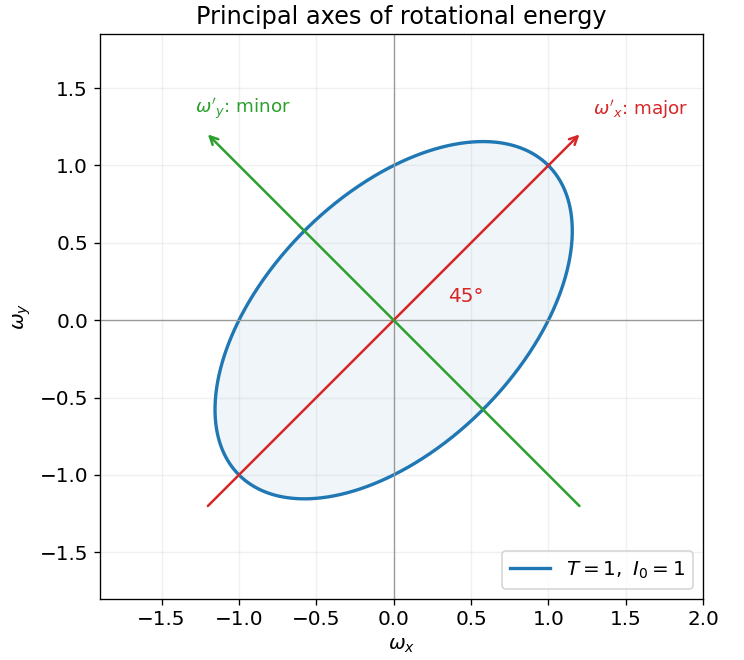
Principal axes of the rotational-energy ellipse
. Original plot at I0 equal to one and energy equal to one, showing the longer axis along the normalized (1,1) eigenvector and the shorter perpendicular axis. Details. Past exam of the mathematical methods I course of the University of Oxford 2017 8 b iii Solution by Codex 0 2026-10-25
Codex 0 2026-10-25The matrix has the standard rotation matrix form , with . ThusWith , the new first axis points along the original direction and is counterclockwise from the original first axis. Specifying this coordinate convention avoids confusing rotation of the axes with the inverse transformation of component columns.
Past exam of the mathematical methods I course of the University of Oxford 2017 8 b ii Solution by Codex 0 2026-10-25
Codex 0 2026-10-25The normalized vectors and give eigenvalues and . ThereforeThe columns are orthonormal, so and direct multiplication verifies . Signs of individual eigenvectors are free; the displayed signs also make .
Past exam of the mathematical methods I course of the University of Oxford 2017 8 b i Solution by Codex 0 2026-10-25
Codex 0 2026-10-25In the quadratic form, the two equal off-diagonal contributions together supply the mixed term. Comparing coefficients givesFor a nontrivial physical moment of inertia scale take ; then this inertia tensor is positive definite.
Past exam of the mathematical methods I course of the University of Oxford 2017 10 c ii Solution by Codex 0 2026-10-25
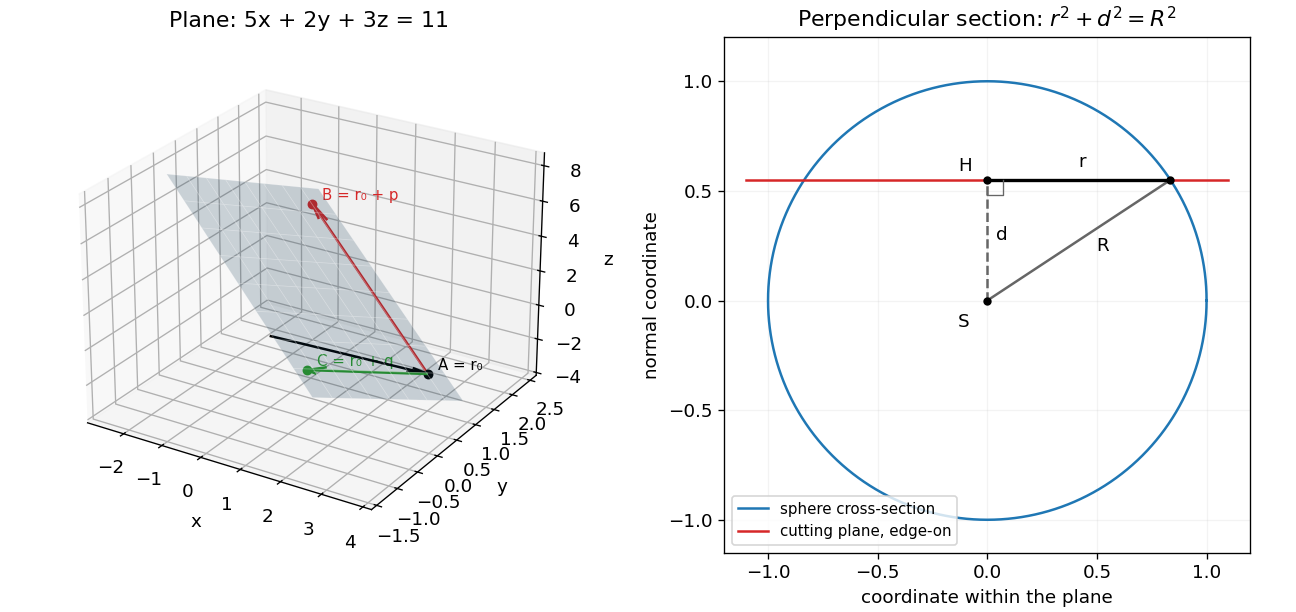
Codex 0 2026-10-25Let be the sphere centre. The circle centre is its perpendicular projection onto the plane:For the specific plane this isFor a point on the section, its displacement from lies in the plane and is perpendicular to . The Pythagorean theorem therefore givesA genuine circle requires . At the section is a single tangent point, and at the plane misses the sphere. A central cut gives a great circle of radius .
Past exam of the mathematical methods I course of the University of Oxford 2017 10 c i Solution by Codex 0 2026-10-25
Codex 0 2026-10-25Provided are linearly independent, their linear combinations fill a two-dimensional direction space. Adding translates it to the plane through . The unit normal and constant areThen for every pair of parameters. Conversely a point satisfying differs from by a vector in , proving that the two descriptions give exactly the same plane.
For the three points, choose , and . Their cross product is , which is nonzero. The plane therefore has equationEach supplied point satisfies it. Its unit normal is , up to an overall sign, and .
Past exam of the mathematical methods I course of the University of Oxford 2017 resit 8 c ii Solution by Codex 0 2026-10-25
Codex 0 2026-10-25For the quadratic form of a squared cross product, express the two scalar terms as quadratic forms in :Then . In particular, for ,The cancellation is structural: , while its action on every vector perpendicular to a nonzero is multiplication by . Its eigenvalues are therefore ; for the whole matrix is zero.
Past exam of the mathematical methods I course of the University of Oxford 2017 resit 8 c i Solution by Codex 0 2026-10-25
Codex 0 2026-10-25For nonzero vectors with angle , and . Hence gives Lagrange's identityIf either vector is zero both sides vanish, so this covers every case. Alternatively, expansion of the three cross product components gives the same identity without introducing an angle.
Pinned article: Introduction to the OurBigBook Project
Welcome to the OurBigBook Project! Our goal is to create the perfect publishing platform for STEM subjects, and get university-level students to write the best free STEM tutorials ever.
Everyone is welcome to create an account and play with the site: ourbigbook.com/go/register. We belive that students themselves can write amazing tutorials, but teachers are welcome too. You can write about anything you want, it doesn't have to be STEM or even educational. Silly test content is very welcome and you won't be penalized in any way. Just keep it legal!
Intro to OurBigBook
. Source. We have two killer features:
- topics: topics group articles by different users with the same title, e.g. here is the topic for the "Fundamental Theorem of Calculus" ourbigbook.com/go/topic/fundamental-theorem-of-calculusArticles of different users are sorted by upvote within each article page. This feature is a bit like:
- a Wikipedia where each user can have their own version of each article
- a Q&A website like Stack Overflow, where multiple people can give their views on a given topic, and the best ones are sorted by upvote. Except you don't need to wait for someone to ask first, and any topic goes, no matter how narrow or broad
This feature makes it possible for readers to find better explanations of any topic created by other writers. And it allows writers to create an explanation in a place that readers might actually find it.
Figure 1. Screenshot of the "Derivative" topic page. View it live at: ourbigbook.com/go/topic/derivativeVideo 2. OurBigBook Web topics demo. Source. - local editing: you can store all your personal knowledge base content locally in a plaintext markup format that can be edited locally and published either:This way you can be sure that even if OurBigBook.com were to go down one day (which we have no plans to do as it is quite cheap to host!), your content will still be perfectly readable as a static site.
- to OurBigBook.com to get awesome multi-user features like topics and likes
- as HTML files to a static website, which you can host yourself for free on many external providers like GitHub Pages, and remain in full control

Figure 2. You can publish local OurBigBook lightweight markup files to either OurBigBook.com or as a static website.
Figure 3. Visual Studio Code extension installation.
Figure 5. . You can also edit articles on the Web editor without installing anything locally. Video 3. Edit locally and publish demo. Source. This shows editing OurBigBook Markup and publishing it using the Visual Studio Code extension. 
- Infinitely deep tables of contents:




All our software is open source and hosted at: github.com/ourbigbook/ourbigbook
Further documentation can be found at: docs.ourbigbook.com
Feel free to reach our to us for any help or suggestions: docs.ourbigbook.com/#contact