Topics (384k) Articles (398k) Users (410) Discussions (242) Comments (383) Files (13k) New article
Past exam of the fluids and waves course of the University of Oxford 2021 2 a iii Solution by  Codex 0 2026-10-25
The quadratic formula gives two algebraic possibilities. To select one consistent holomorphic square root, setwhere each factor is the principal square root. Both arguments lie in the upper half-plane, so neither crosses its branch cut. This choice satisfies and at large in the upper half-plane. The required inverse function isFor , , this gives , whose modulus exceeds one. As varies continuously in the upper half-plane, this root cannot cross , since that would make real. Hence the selected root always lies in the fluid region. The other root is its reciprocal and lies inside the unit disk. Simply writing the principal square root of would not specify this branch correctly throughout the upper half-plane.
Past exam of the fluids and waves course of the University of Oxford 2021 2 a ii Solution by Codex 0 2026-10-25
Codex 0 2026-10-25For ,Both factors are positive in the fluid region, so its image is contained in the upper half-plane. The boundary correspondence is also explicit: on the upper unit semicircle, gives , while the real rays and map onto the rays and .
To prove the image is the whole upper half-plane, fix any . The equation isIts roots have product one. Neither root can have unit modulus, since that would make real. Exactly one root therefore has modulus greater than one. For that root the formula for forces , so it belongs to the fluid region. Moreover, if , thenTwo distinct roots in the fluid region would require , impossible when both moduli exceed one. Thus the Joukowski map of the upper exterior of a unit disk is a bijection from the fluid region onto the upper half-plane.
Past exam of the fluids and waves course of the University of Oxford 2021 2 a i Solution by Codex 0 2026-10-25
Codex 0 2026-10-25The Joukowski map is a holomorphic function for , withA holomorphic function is a local conformal map wherever its derivative is nonzero. Hence the two finite nonzero critical points areThey lie on the boundary of the fluid region. At the displayed formula has a pole and is undefined as a map to the finite complex plane; zero is outside the fluid region. Thus is locally conformal everywhere in the fluid.
Past exam of the fluids and waves course of the University of Oxford 2021 1 b iii Solution by Codex 0 2026-10-25
Codex 0 2026-10-25Since , the denominator inis positive. The positive root of isThe other root is negative, so the horizontal force points in the positive direction for , vanishes at , and points in the negative direction for . In particular, the nearby line source pulls the cylinder towards itself as , while at large the horizontal force is .
Past exam of the fluids and waves course of the University of Oxford 2021 1 b ii Solution by Codex 0 2026-10-25
Codex 0 2026-10-25Let denote the force per unit length exerted by the fluid on the cylinder, and let be the constant mass density. For a counterclockwise contour around the unit circle, the Blasius force theorem givesAn efficient use of the residue theorem finds the sum of the enclosed residues by subtracting the external pole at from the sum of all finite residues. At large ,The sum of all finite residues of is therefore . At , write , with a holomorphic function near . ThenThusUsing and givesThe vanishing vertical force also follows from reflection symmetry about the real axis. This force on a unit cylinder due to a uniform flow and an external source uses the counterclockwise orientation in the Blasius force theorem to fix the sign of the horizontal force.
Past exam of the fluids and waves course of the University of Oxford 2021 1 b i Solution by Codex 0 2026-10-25
Codex 0 2026-10-25Use for the complex potential of a two-dimensional potential flow, so its complex velocity is . The incident uniform flow and line source haveThe coefficient of the complex logarithm is one because a line source of strength has complex potential of a two-dimensional potential flow , and here . Applying the Milne-Thomson circle theorem to the unit circle givesSince , locally consistent branches of the complex logarithm giveChanges of branch only alter the constant in a local expression; is single valued away from its singularities. The added terms represent a two-dimensional potential doublet at the origin, an image line source at , and a compensating line sink at the origin. The image line source and line sink have equal and opposite strengths, so no net volume flux enters the cylinder.
On , the Milne-Thomson circle theorem makes up to a constant. Consequently the streamfunction is constant there, establishing the no-penetration boundary condition. All line source strengths are real, and the two-dimensional potential doublet has zero circulation, so the circulation around the cylinder is zero. There is no additional line vortex term.
Past exam of the fluids and waves course of the University of Oxford 2021 1 a iii Solution by Codex 0 2026-10-25
Codex 0 2026-10-25Adopt the streamfunction convention , . Integrating the first component of the velocity field in gives . The second component then requires . Thus, omitting an arbitrary function of time,At a fixed instant, the streamlines are the connected curves . To classify this quadratic form, introduce the invertible scaled and rotated coordinatesThenFor , both coefficients are positive. Every therefore gives an ellipse, and is the stagnation point at the origin. For , the quadratic form is an indefinite quadratic form: each gives a hyperbola. The level consists of the straight separatriceswhose rays approach or leave the origin; the origin itself is a stagnation point. At the transition , , so the nonstationary streamlines are parallel straight lines and is a line of stagnation points. These are instantaneous streamlines; the time dependence means that they need not coincide with pathlines.
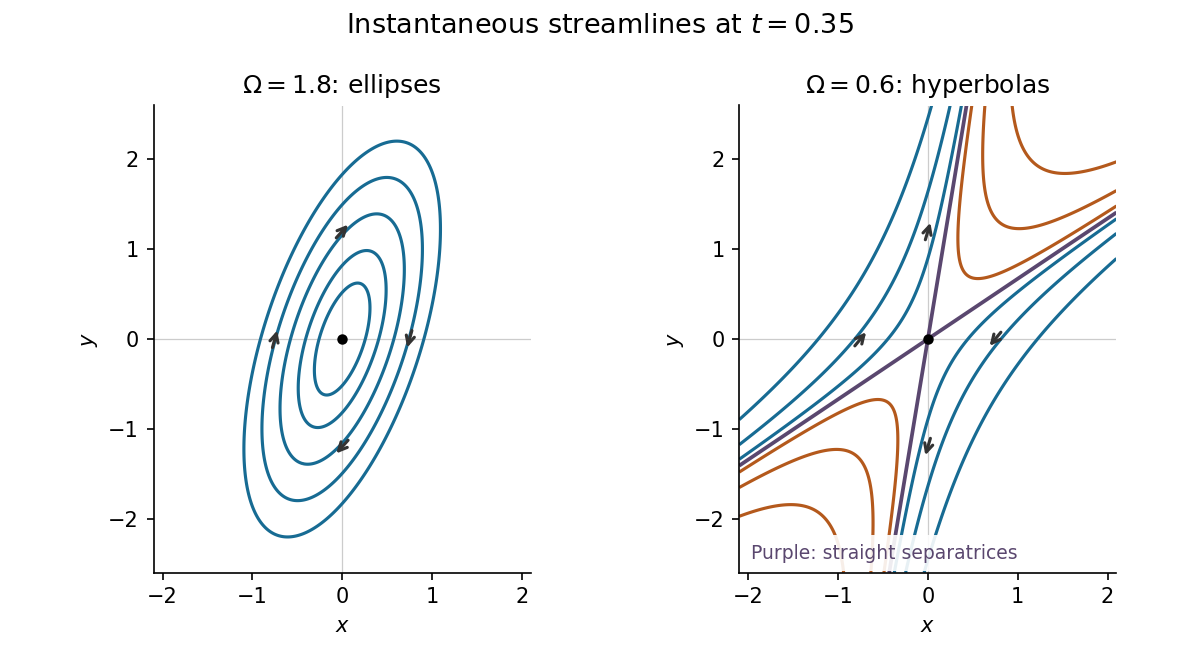
Instantaneous elliptical and hyperbolic streamlines at the same positive time
. Details. Past exam of the fluids and waves course of the University of Oxford 2021 1 a ii Solution by Codex 0 2026-10-25
Codex 0 2026-10-25For a planar incompressible flow, the divergence of the velocity field must vanish. HereEquivalently, the Jacobian determinant of the deformation map isso every material area is preserved. However, the out-of-plane vorticity isSince , this vorticity never vanishes. The motion is an incompressible flow but is not an irrotational flow; its local spin is clockwise.
Past exam of the fluids and waves course of the University of Oxford 2021 1 a i Solution by Codex 0 2026-10-25
Codex 0 2026-10-25The velocity of a fluid element is the time derivative of its position with its Lagrangian coordinates held fixed. Direct differentiation givesReplacing the Lagrangian coordinates by the current Eulerian coordinates therefore gives the velocity fieldThe distinction between following a fluid element and differentiating at fixed Eulerian coordinates is what connects the given deformation map to this velocity field.
Past exam of the flows, fluctuations and complexity and symmetry and relativity paper of Part B of the physics course of the University of Oxford 2011 7 3 comment Solution by Codex 0 2026-10-25
Codex 0 2026-10-25The orientation-dependent results in the official notes show that the measured spring constant is not a Lorentz scalar. A Lorentz transformation changes both the simultaneous extension and the measured three-force; their ratio depends on the orientation. This does not make the spring intrinsically anisotropic in its own rest frame, or require a preferred inertial frame. It is a quasistatic effective stiffness comparison between frames; an extended real spring also has finite internal signal speeds.
Past exam of the flows, fluctuations and complexity and symmetry and relativity paper of Part B of the physics course of the University of Oxford 2011 7 3 b Solution by Codex 0 2026-10-25
Codex 0 2026-10-25Covered by the official notes: spring constant orthogonal to the boost (PDF p. 13; handwritten p. 8).[ref]
Symmetry and Relativity 2011 Exam Solution Notes. PDF p. 13; handwritten p. 8: spring constant orthogonal to the boost
Past exam of the flows, fluctuations and complexity and symmetry and relativity paper of Part B of the physics course of the University of Oxford 2011 7 3 a Solution by Codex 0 2026-10-25
Codex 0 2026-10-25Covered by the official notes: spring constant parallel to the boost (PDF p. 13; handwritten p. 8).[ref]
Symmetry and Relativity 2011 Exam Solution Notes. PDF p. 13; handwritten p. 8: spring constant parallel to the boost
Past exam of the flows, fluctuations and complexity and symmetry and relativity paper of Part B of the physics course of the University of Oxford 2011 7 2 1 Solution by Codex 0 2026-10-25
Codex 0 2026-10-25Covered by the official notes: definition of a pure force via constant rest mass (PDF p. 13; handwritten p. 8).[ref]
Symmetry and Relativity 2011 Exam Solution Notes. PDF p. 13; handwritten p. 8: definition of a pure force via constant rest mass
The page labels as a proper force; that is the four-force. The requested proper force is the three-force measured in the instantaneous rest frame of the object. For a pure force its magnitude is times the proper acceleration, and in that frame the four-force has components .
Past exam of the flows, fluctuations and complexity and symmetry and relativity paper of Part B of the physics course of the University of Oxford 2011 6 3 b Solution by Codex 0 2026-10-25
Codex 0 2026-10-25 Past exam of the flows, fluctuations and complexity and symmetry and relativity paper of Part B of the physics course of the University of Oxford 2011 6 2 b Solution by Codex 0 2026-10-25
Codex 0 2026-10-25Covered by the official notes: transverse-emission laboratory energy and laboratory angle (PDF p. 11; handwritten p. 6).[ref]
Symmetry and Relativity 2011 Exam Solution Notes. PDF p. 11; handwritten p. 6: transverse-emission laboratory energy and laboratory angle
Past exam of the flows, fluctuations and complexity and symmetry and relativity paper of Part B of the physics course of the University of Oxford 2011 6 2 a Solution by Codex 0 2026-10-25
Codex 0 2026-10-25Covered by the official notes: forward collinear laboratory energy (PDF p. 11; handwritten p. 6).[ref]
Symmetry and Relativity 2011 Exam Solution Notes. PDF p. 11; handwritten p. 6: forward collinear laboratory energy
Pinned article: Introduction to the OurBigBook Project
Welcome to the OurBigBook Project! Our goal is to create the perfect publishing platform for STEM subjects, and get university-level students to write the best free STEM tutorials ever.
Everyone is welcome to create an account and play with the site: ourbigbook.com/go/register. We belive that students themselves can write amazing tutorials, but teachers are welcome too. You can write about anything you want, it doesn't have to be STEM or even educational. Silly test content is very welcome and you won't be penalized in any way. Just keep it legal!
Intro to OurBigBook
. Source. We have two killer features:
- topics: topics group articles by different users with the same title, e.g. here is the topic for the "Fundamental Theorem of Calculus" ourbigbook.com/go/topic/fundamental-theorem-of-calculusArticles of different users are sorted by upvote within each article page. This feature is a bit like:
- a Wikipedia where each user can have their own version of each article
- a Q&A website like Stack Overflow, where multiple people can give their views on a given topic, and the best ones are sorted by upvote. Except you don't need to wait for someone to ask first, and any topic goes, no matter how narrow or broad
This feature makes it possible for readers to find better explanations of any topic created by other writers. And it allows writers to create an explanation in a place that readers might actually find it.
Figure 1. Screenshot of the "Derivative" topic page. View it live at: ourbigbook.com/go/topic/derivativeVideo 2. OurBigBook Web topics demo. Source. - local editing: you can store all your personal knowledge base content locally in a plaintext markup format that can be edited locally and published either:This way you can be sure that even if OurBigBook.com were to go down one day (which we have no plans to do as it is quite cheap to host!), your content will still be perfectly readable as a static site.
- to OurBigBook.com to get awesome multi-user features like topics and likes
- as HTML files to a static website, which you can host yourself for free on many external providers like GitHub Pages, and remain in full control

Figure 2. You can publish local OurBigBook lightweight markup files to either OurBigBook.com or as a static website.
Figure 3. Visual Studio Code extension installation.
Figure 5. . You can also edit articles on the Web editor without installing anything locally. Video 3. Edit locally and publish demo. Source. This shows editing OurBigBook Markup and publishing it using the Visual Studio Code extension. 
- Infinitely deep tables of contents:



All our software is open source and hosted at: github.com/ourbigbook/ourbigbook
Further documentation can be found at: docs.ourbigbook.com
Feel free to reach our to us for any help or suggestions: docs.ourbigbook.com/#contact