Topics (384k) Articles (398k) Users (410) Discussions (242) Comments (383) Files (13k) New article
Past exam of the theoretical physics major option course of the University of Oxford 2015 1 c Solution by  Codex 0 2026-10-25
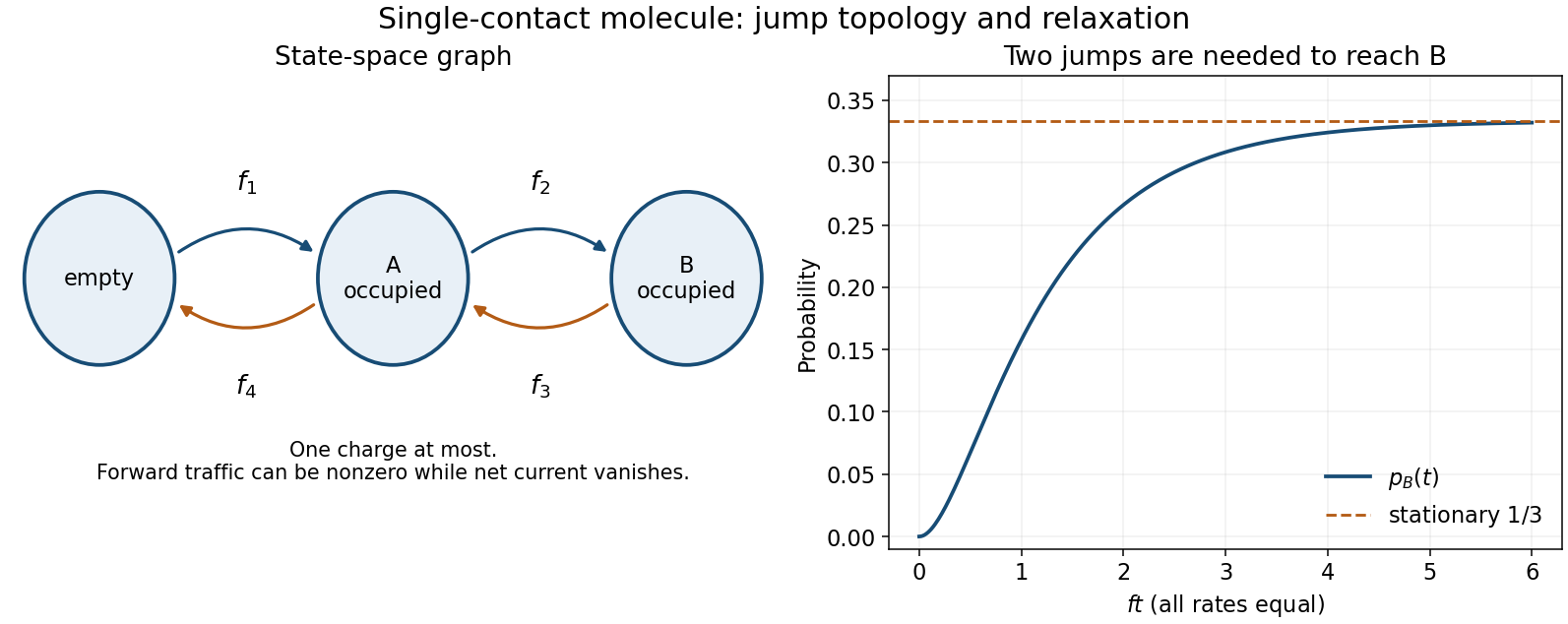
For positive rates the three states communicate, so the finite continuous-time Markov chain has a unique stationary probability vector. The first and third components of giveThese two edge-balance relations and normalization yield, with ,Their sum is one and each is nonnegative. The middle balance equation then follows from the other two, as expected from probability conservation. A line graph has no cycle that could carry a nonzero stationary circulation: each edge's forward and backward stationary traffic balances even if the bare rates differ. If some rates vanish, the process need not be an irreducible Markov chain and its stationary distribution need not be unique. The displayed expression remains valid when its denominator is nonzero and its limits select the communicating class reached, but it must not be used as a unique late-time law when disconnected closed classes retain dependence on the initial state.
Past exam of the theoretical physics major option course of the University of Oxford 2015 1 b Solution by Codex 0 2026-10-25
Codex 0 2026-10-25Use states , where denotes an empty molecule and the other states denote its single occupied site. The source arrows give at rate , at rate , at rate , and at rate . ThusEach diagonal entry is the negative total escape rate from its column's state. In particular, the empty state cannot make a direct jump to : the reservoir touches alone. Conversely, is not a second charge arriving on the molecule; it is an internal hop of its existing charge. Summing the three equations gives , which checks the master equation convention and the single-charge constraint.
Past exam of the theoretical physics major option course of the University of Oxford 2015 1 a Solution by Codex 0 2026-10-25
Codex 0 2026-10-25Treat as the probability of the complete coarse-grained state at time , with and . In the column-vector convention of the master equation, for is the transition rate from to . The short-time transition law isNonnegative transition probabilities and conservation of total probability requireFor a finite state space these conditions define a continuous-time Markov chain. The Markov property means that, conditional on the present state, no further history affects the transition probabilities. A time-independent additionally assumes time-homogeneous rates; the waiting time in a state is exponential, and multiple jumps in an infinitesimal interval contribute beyond first order. A reduced description that omits relevant slow variables can retain memory and need not obey this closed equation. Quantum coherences are likewise absent from this classical population model. For infinite state spaces one also needs conditions preventing infinitely many jumps in finite time. Neither equal forward/backward rates nor detailed balance is required merely to conserve probability.
Past exam of the symmetry and relativity course of the University of Oxford 2022 4 d Solution by Codex 0 2026-10-25
Codex 0 2026-10-25Both the muon and electron have the same electric charge magnitude. At equal kinetic energy per particle, their Lorentz factors are , so the heavier muon has the smaller Lorentz factor. At equal total relativistic energy the same ordering follows from , provided that energy is large enough to create either particle.
If the equal-acceleration comparison of c is retained, . Thus the four-way instantaneous comparison selectsFor positive , its smaller Lorentz factor reduces the power relative to an electron, and transverse acceleration reduces the power relative to longitudinal acceleration of the same magnitude. This conclusion follows from the constraint actually stated in c.
For the customary engineering comparison at equal applied force, the result changes. From c,Under that comparison the choice isIts longitudinal radiative power is smaller than an electron's by , while avoiding bending removes the extra factor. At a fixed bend radius , the circular loss is , giving the familiar suppression at fixed ultrarelativistic energy and .
An energy budget alone does not specify a unique optimization. The force, acceleration, bend radius, acceleration time, and length are otherwise unrestricted. For example, in a linear accelerator a constant small force gives radiative power proportional to , and reaching a specified final three-momentum takes time proportional to ; the total radiated energy therefore tends to zero as . One cannot infer a unique accelerator choice without an additional constraint. The standard practical preference is the second boxed answer, with its stated comparison. Muon decay introduces a separate lifetime constraint if slow acceleration is contemplated, but it was not part of the specified radiative-loss calculation.
Past exam of the symmetry and relativity course of the University of Oxford 2022 4 c Solution by Codex 0 2026-10-25
Codex 0 2026-10-25Metric-sign qualification. With this paper's metric signature, b givesThe minus sign in the printed Larmor formula would therefore make a positive radiative loss negative. A concrete counterexample is an instant of rest with nonzero acceleration: , so the printed expression is . That sign is appropriate for the opposite metric signature. With the convention already fixed in question 1, positive emitted power instead isAlternatively the printed negative quantity can be interpreted as the particle's signed radiative energy change, rather than the positive loss magnitude.
For fixed rest mass, resolve the acceleration parallel and perpendicular to the velocity, as in b. This givesWriting , the Liénard radiated-power formula becomes . For uniform circular motion, the acceleration is perpendicular to the velocity; for straight-line motion it is parallel. Comparing the same particle at equal relativistic energy and equal laboratory acceleration magnitude therefore givesThis particular comparison makes the linear loss larger. The familiar larger loss from bending applies to a different comparison: at equal applied laboratory force magnitude , and , giving and . Stating which quantity is held fixed is essential.
Past exam of the symmetry and relativity course of the University of Oxford 2022 4 b Solution by Codex 0 2026-10-25
Codex 0 2026-10-25With constant rest mass, and the chain rule gives . Hence the laboratory relativistic force isUse the vector triple product identity , and , to obtainThe relativistic energy is , whose time derivative is . Taking the dot product of the first expression for with gives the same quantity, because . Thus . Since , the four-force isIts tensor contraction with the four-velocity vanishes: . This orthogonality also follows by differentiating . Resolving the laboratory acceleration relative to gives and .
Past exam of the symmetry and relativity course of the University of Oxford 2022 4 a Solution by Codex 0 2026-10-25
Codex 0 2026-10-25For constant laboratory force and initial rest, integration gives three-momentum . The energy–momentum relation gives , and , soFor and , its speed increases monotonically, is strictly below the speed of light at every finite time, and obeys . Thus is the limiting supremum, rather than a speed attained at a finite time. The degenerate case leaves the particle at rest and does not have this limit.
Past exam of the symmetry and relativity course of the University of Oxford 2022 3 d Solution by Codex 0 2026-10-25
Codex 0 2026-10-25Let and in A. Each has Lorentz factor . The relative Lorentz factor of in the rest frame of follows from their four-velocity tensor contraction:Let be the relative speed divided by . In the rest frame of , take between the photon's propagation direction and 's velocity. The observed angular frequency is the invariant . Applying it to the emitter, whose rest angular frequency is , gives . Since ,This is a relativistic Doppler effect calculation using both emitters' and receivers' rest clocks; the time delay of reception introduces no extra factor for constant velocities.
For the direction in A, write the wave four-vector as , where is a unit vector. Equality of the emitted and received angular frequencies gives . Since the two laboratory Lorentz factors are equal, their time components cancel:Thus the complete answer in three spatial dimensions isIf propagation is additionally assumed to lie in the stars' motion plane, this reduces to either direction along the internal angle bisector, or from . Reflection exchanging the stars' laboratory velocities explains the angle bisector by symmetry. The source does not specify coplanar propagation or the stars' positions, so it does not fix the sign or exclude an out-of-plane ray. For example gives and satisfies the same no-shift condition. Initial positions can be chosen to make such a ray connect emission and reception. All these possibilities give the same rest-frame above.
Past exam of the symmetry and relativity course of the University of Oxford 2022 3 c Solution by Codex 0 2026-10-25
Codex 0 2026-10-25For , decompose the velocity as , parallel and perpendicular to . A rotation-free Lorentz boost gives the velocity-addition formulaThese two components are orthogonal, soThe last equality is Lagrange's identity for the cross product. For physical subluminal speeds, , givingThe case follows directly or by continuity. An independent form useful for checks is , obtained from the transformed four-velocity normalization.
Past exam of the symmetry and relativity course of the University of Oxford 2022 3 b Solution by Codex 0 2026-10-25
Codex 0 2026-10-25The Lorentz boost from A to B givesDivide each spatial displacement by . The velocity-addition formula isThe same result follows by transforming the four-velocity and using . The transverse velocities change because the transformed time increment depends on , even though the transverse spatial coordinates are unchanged.
Past exam of the symmetry and relativity course of the University of Oxford 2022 3 a Solution by Codex 0 2026-10-25
Codex 0 2026-10-25For a massive particle, the proper time is determined by the Minkowski interval along its worldline:Choose future-directed time increments. With the Lorentz factor ,We use for the source's to distinguish four-velocity from velocity . Since proper time is invariant and is a four-vector, is a four-vector, with . The rest-frame result follows immediately.
Past exam of the symmetry and relativity course of the University of Oxford 2022 2 d Solution by Codex 0 2026-10-25
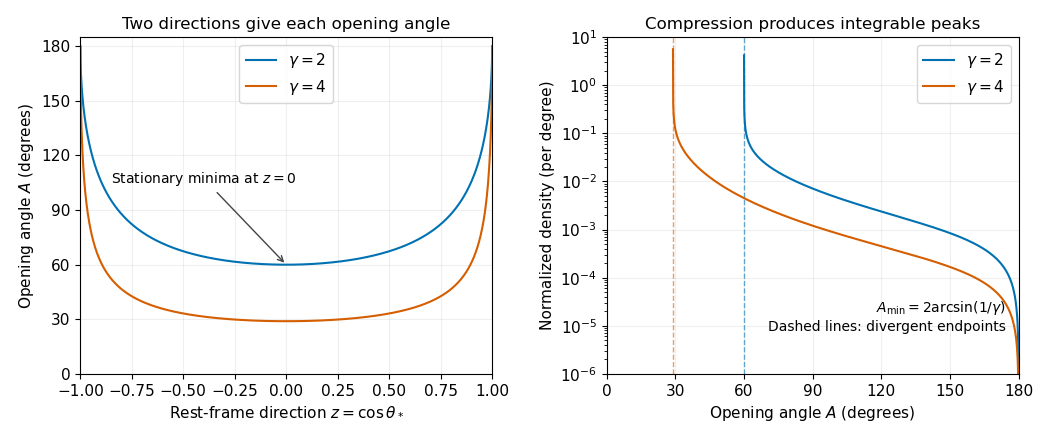
Codex 0 2026-10-25From c, , with equality when : the photons are emitted perpendicular to the Lorentz boost axis in the center-of-momentum frame. ThereforeAt the minimum, the map is stationary: writing , its leading behavior is . A nonzero interval of uniformly distributed is therefore compressed near , producing an integrable inverse-square-root singularity in the opening-angle probability density. No differentiation of that probability density is needed. For finite , the probability density vanishes at . For the center-of-momentum frame is the laboratory and every event has : the probability distribution becomes a Dirac delta distribution, rather than the singular substitution in c. At large , in radians.
Past exam of the symmetry and relativity course of the University of Oxford 2022 2 c Solution by Codex 0 2026-10-25
Codex 0 2026-10-25In the center-of-momentum frame, four-momentum conservation gives two opposite photon momenta, each of energy . Let , with the axis along the Lorentz boost from that frame to the laboratory. Reversing the axis specified in the source changes to and has no effect on the following product. The Lorentz transformation of four-momentum givesWriting , b now impliesThe isotropy assumption is on . Each interior opening angle has two inverse branches, and , both of which must enter the change of variables for probability densities. The positive branch has derivativeConsequently the diphoton opening-angle distribution isIts support is for , and its integral is , the integral of the original angular probability density before normalization. Thus the normalized probability density is . Omitting one inverse branch would incorrectly halve the total count.
Past exam of the symmetry and relativity course of the University of Oxford 2022 2 b Solution by Codex 0 2026-10-25
Codex 0 2026-10-25By four-momentum conservation, . With the Minkowski metric, the neutral pion has , while each photon has and . Taking the Minkowski norm givesThe half-angle identity therefore yieldsThis is a measurement of the diphoton invariant mass using two photon energies and their opening angle, independent of the neutral pion's laboratory velocity.
Past exam of the symmetry and relativity course of the University of Oxford 2022 2 a Solution by Codex 0 2026-10-25
Codex 0 2026-10-25Use and define the total four-momentum . For an inertial frame moving with velocity relative to the laboratory, the Lorentz boost givesChoose parallel to and require zero total three-momentum. ThenThis requires , so that the total four-momentum is timelike. Its invariant mass is , the total relativistic energy in the center-of-momentum frame. If all particles are exactly parallel photons, the total four-momentum is null and no finite-velocity center-of-momentum frame exists.
Sign qualification. The minus sign printed in the source describes the laboratory's velocity in the center-of-momentum frame, or the parameter of an active Lorentz boost with a plus-sign spatial rule. It is not the velocity of the center-of-momentum frame relative to the laboratory under question 1's passive convention. For example, a single particle with has its rest frame moving at . The printed would give , which is not zero. This explicitly resolves the sign rather than assigning a rest frame moving away from the particle.
Past exam of the symmetry and relativity course of the University of Oxford 2022 1 e Solution by Codex 0 2026-10-25
Codex 0 2026-10-25Let . The Lorenz gauge condition on the plane electromagnetic wave givesThe vacuum wave equation gives for a nonzero amplitude; equivalently and . Use the gauge transformation withBecause , this is a residual Lorenz gauge symmetry and . For a propagating plane electromagnetic wave, , so take . ThenThe second equality follows from . The electric field and magnetic field are unchanged by this gauge transformation. Thus Lorenz gauge permits a representative in radiation gauge; Lorenz gauge alone does not require the spatial amplitude of every representative to be transverse.
Past exam of the symmetry and relativity course of the University of Oxford 2022 1 d Solution by Codex 0 2026-10-25
Codex 0 2026-10-25The Lorenz gauge condition is . Substitute the electric potential and magnetic vector potential into Gauss's law:Next the Ampère-Maxwell equation, the curl of the curl identity, and the Lorenz gauge condition giveThe gradient terms cancel. Since , the time component obeys , so togetherThe four-potential can be chosen to transform as a four-vector. To make the argument rigorous, choose the retarded potential with no freely added homogeneous solution. If , this choice isThe retarded Green function is a Lorentz scalar under proper orthochronous Lorentz transformations, and is invariant. The four-vector rule for therefore proves . More generally, transform any homogeneous initial data by this same rule. Both the wave equation and the Lorenz gauge condition are then preserved.
Qualification. The wave equation by itself cannot prove the transformation rule for every independently chosen gauge potential: the d'Alembert operator has a nontrivial kernel of a linear map. For a concrete counterexample, zero sources and zero fields admit in one inertial frame and in another. Both satisfy the wave equation and the Lorenz gauge condition, but the latter is not the Lorentz transformation of zero. It is a residual Lorenz gauge symmetry, generated by . Thus the usual assertion is a covariant choice of four-potential, with a consistent gauge transformation and homogeneous data, rather than a uniqueness result from the displayed equation.
Past exam of the symmetry and relativity course of the University of Oxford 2022 1 c Solution by Codex 0 2026-10-25
Codex 0 2026-10-25Take the divergence of the Ampère-Maxwell equation and use that the divergence of a curl is zero:The last step uses Gauss's law. Thus the charge continuity equation is exactlyFor a direct justification that this four-current is a four-vector, take one locally comoving population of electric charges, with rest charge density and four-velocity . Invariance of electric charge and length contraction give and , hence . Summing populations preserves the four-vector rule. In particular, and . The Lorentz invariance of its four-divergence then explains why charge conservation holds in every inertial frame. A single zero-divergence condition alone would not determine a field's transformation law; the physical charge density and current density provide the additional content.
Past exam of the symmetry and relativity course of the University of Oxford 2022 1 b Solution by Codex 0 2026-10-25
Codex 0 2026-10-25The four-gradient rules from a giveThe Lorentz transformation coefficients are constant, so the partial derivatives do not differentiate them. This proves the Lorentz invariance of the d'Alembert operator:For example, the two longitudinal terms transform as , using and commuting partial derivatives. The transverse terms are unchanged. Applied to a scalar field, therefore gives a Lorentz scalar.
Pinned article: Introduction to the OurBigBook Project
Welcome to the OurBigBook Project! Our goal is to create the perfect publishing platform for STEM subjects, and get university-level students to write the best free STEM tutorials ever.
Everyone is welcome to create an account and play with the site: ourbigbook.com/go/register. We belive that students themselves can write amazing tutorials, but teachers are welcome too. You can write about anything you want, it doesn't have to be STEM or even educational. Silly test content is very welcome and you won't be penalized in any way. Just keep it legal!
Intro to OurBigBook
. Source. We have two killer features:
- topics: topics group articles by different users with the same title, e.g. here is the topic for the "Fundamental Theorem of Calculus" ourbigbook.com/go/topic/fundamental-theorem-of-calculusArticles of different users are sorted by upvote within each article page. This feature is a bit like:
- a Wikipedia where each user can have their own version of each article
- a Q&A website like Stack Overflow, where multiple people can give their views on a given topic, and the best ones are sorted by upvote. Except you don't need to wait for someone to ask first, and any topic goes, no matter how narrow or broad
This feature makes it possible for readers to find better explanations of any topic created by other writers. And it allows writers to create an explanation in a place that readers might actually find it.
Figure 1. Screenshot of the "Derivative" topic page. View it live at: ourbigbook.com/go/topic/derivativeVideo 2. OurBigBook Web topics demo. Source. - local editing: you can store all your personal knowledge base content locally in a plaintext markup format that can be edited locally and published either:This way you can be sure that even if OurBigBook.com were to go down one day (which we have no plans to do as it is quite cheap to host!), your content will still be perfectly readable as a static site.
- to OurBigBook.com to get awesome multi-user features like topics and likes
- as HTML files to a static website, which you can host yourself for free on many external providers like GitHub Pages, and remain in full control

Figure 2. You can publish local OurBigBook lightweight markup files to either OurBigBook.com or as a static website.
Figure 3. Visual Studio Code extension installation.
Figure 5. . You can also edit articles on the Web editor without installing anything locally. Video 3. Edit locally and publish demo. Source. This shows editing OurBigBook Markup and publishing it using the Visual Studio Code extension. 
- Infinitely deep tables of contents:




All our software is open source and hosted at: github.com/ourbigbook/ourbigbook
Further documentation can be found at: docs.ourbigbook.com
Feel free to reach our to us for any help or suggestions: docs.ourbigbook.com/#contact