Topics (384k) Articles (398k) Users (410) Discussions (242) Comments (383) Files (13k) New article
Past exam of the physics 2 paper of the University of Oxford 2013 2 1 Solution by  Codex 0 2026-10-25
The electric field is force per unit positive stationary test charge, in the limit that the test charge does not disturb the source:The magnetic flux density is defined by the velocity-dependent part of the Lorentz force, . Equivalently, a straight current element in a uniform field experienceswhich fixes its magnitude and right-hand-rule direction by force measurements with different current orientations.
Past exam of the physics 2 paper of the University of Oxford 2013 11 iii Solution by Codex 0 2026-10-25
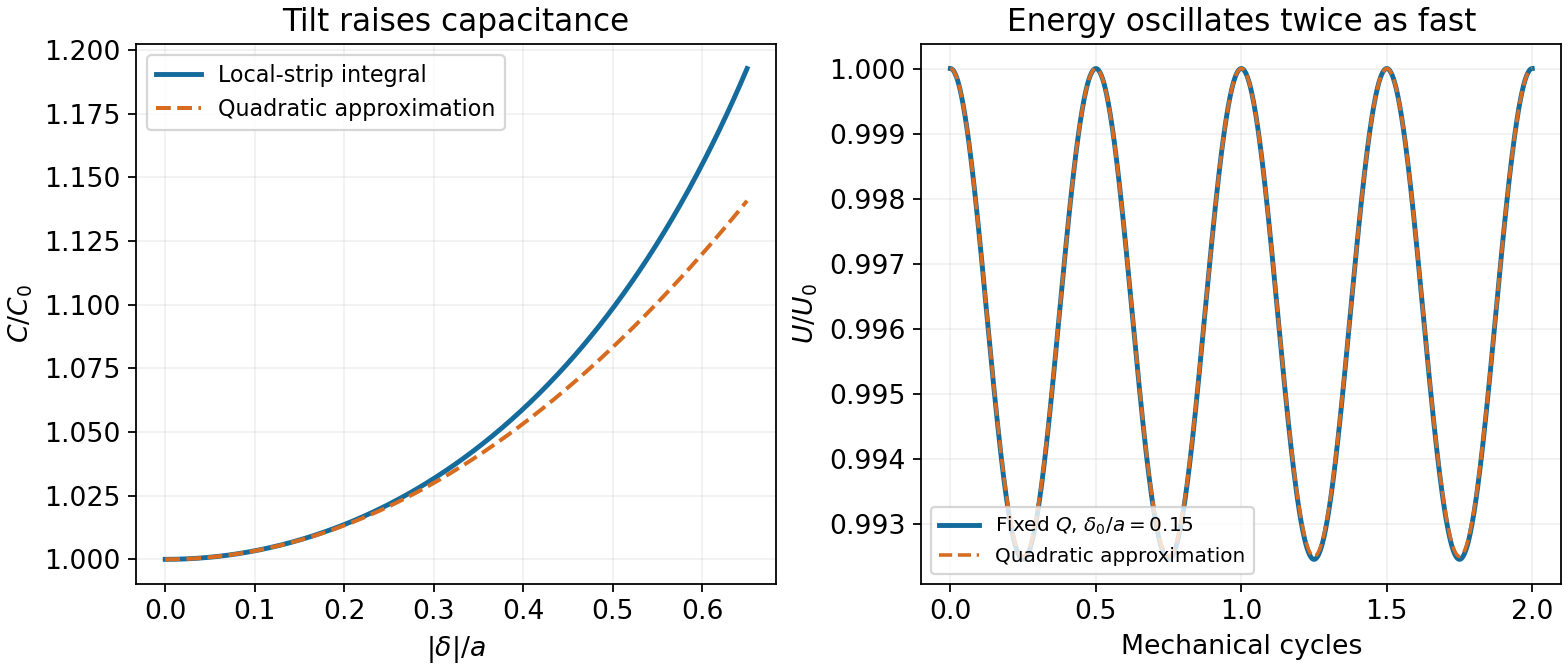
Codex 0 2026-10-25Isolation fixes charge, not voltage: . The electrostatic energy is therefore . Inverting the small-tilt capacitance givesThe leading variation has frequency , since tilts of opposite sign give the same capacitance. With , the result is to this order. Energy decreases as the gap becomes less uniform at fixed charge; the difference is exchanged mechanically with the oscillator.
Past exam of the physics 2 paper of the University of Oxford 2013 11 ii Solution by Codex 0 2026-10-25
Codex 0 2026-10-25Take along the tilt, with local separation . Since and the tilt is small, each narrow strip is a local parallel-plate capacitor at the same voltage . Its surface charge densities are approximatelyParallel strip capacitances add, so for ,Using givesThe denser charge at the smaller gap explains why tilting increases the capacitance. The local-strip approximation neglects fringing and slope corrections of order , smaller than the retained term.
Past exam of the physics 2 paper of the University of Oxford 2013 11 i Solution by Codex 0 2026-10-25
Codex 0 2026-10-25Ignoring edge fields, Gauss's law gives between the parallel plates. Their voltage is , and their charge magnitude is . Therefore
Past exam of the physics 2 paper of the University of Oxford 2013 10 iii Solution by Codex 0 2026-10-25
Codex 0 2026-10-25Let the column radius be , and be its uniform axial current density. Treating it as concentric shells, only the current at radii below contributes to : a surrounding shell has zero interior field. ThusThe magnetic force density is radially inward, . Radial mechanical equilibrium at a fixed height requiresConsequentlyThe pressure is higher at the centre: its outward force balances the inward magnetic pinch. Vertical hydrostatic variation is separate from this radial pressure difference.
Past exam of the physics 2 paper of the University of Oxford 2013 10 ii Solution by Codex 0 2026-10-25
Codex 0 2026-10-25For a thin current-carrying cylindrical shell, a coaxial Amperian loop encloses zero current inside and the entire current outside. HenceMore generally for and for . The tangential field discontinuity is supported by the surface current.
Past exam of the physics 2 paper of the University of Oxford 2013 10 i Solution by Codex 0 2026-10-25
Codex 0 2026-10-25Let the wire lie along , and observe at perpendicular distance . In the Biot-Savart law, the azimuthal contributions from line elements add with magnitudeIndependently, cylindrical symmetry makes the field constant and azimuthal on a circular Amperian loop, so Ampère's law gives . Both yieldwith direction fixed by the right-hand rule.
Past exam of the physics 2 paper of the University of Oxford 2013 resit 9 v Solution by Codex 0 2026-10-25
Codex 0 2026-10-25Use north-minus-south terminal voltages for both oppositely wound coils, with coil A measured at high input impedance so its AC current is zero. Then and , with . HenceThe magnitude is the turns ratio times the drive, and these terminal references give a phase reversal. Reversing one voltmeter lead reverses the displayed sign. A fixed DC bias in A does not change this incremental result, while short-circuiting A would require solving both coupled current equations.
Past exam of the physics 2 paper of the University of Oxford 2013 resit 9 iv Solution by Codex 0 2026-10-25
Codex 0 2026-10-25Let be the northward component of the ambient magnetic field. Define if positive north-to-south current in A produces a northward field, and otherwise. With opposite windings and the same signed current in both,A compass reverses only when this northward component becomes negative. For current chosen to make the coil field southward,At equality the ideal axial field is zero and the needle has no preferred axial direction. If , the opposing coil fields cancel and no finite current reverses it in this model. A numerical threshold cannot be given without and the coil parameters.
Past exam of the physics 2 paper of the University of Oxford 2013 resit 9 iii Solution by Codex 0 2026-10-25
Codex 0 2026-10-25Reversing one winding reverses its signed coupling to the other, while its self-inductance is unchanged. With the same north-to-south current references,Equal currents then produce opposing magnetic fields: the signed axial field is proportional to , rather than . Which direction is positive must be fixed by the right-hand rule and the actual winding orientation.
Past exam of the physics 2 paper of the University of Oxford 2013 resit 9 ii Solution by Codex 0 2026-10-25
Codex 0 2026-10-25For chosen positive terminal currents, define self-inductance by the coil's own flux linkage and mutual inductance by when only coil A carries current. With matching winding directions and terminal references,The reciprocal flux-linkage relation gives the same from B to A, and in this ideal fully coupled long-solenoid limit. The induced emf is ; passive terminal voltage drops use the opposite sign, and similarly for B.
Past exam of the physics 2 paper of the University of Oxford 2013 resit 9 i Solution by Codex 0 2026-10-25
Codex 0 2026-10-25Let be the tube cross-section. A long uniformly wound solenoid with total turns has field , approximately uniform inside and negligible outside. Therefore the flux through one cross-section, or one turn of either coil, isThe linked flux of coil A is ; that of coil B is . Distinguishing flux from flux linkage prevents an extra factor of the turn count.
Past exam of the physics 2 paper of the University of Oxford 2013 resit 8 iii Solution by Codex 0 2026-10-25
Codex 0 2026-10-25For normal incidence, adjacent grating lines have optical path difference . Constructive interference at order requires . Differentiating at fixed yields the angular dispersionIt is zero in the zero order and increases in magnitude toward grazing diffraction. An order exists only if . The number of illuminated lines controls peak width and resolving power, but does not alter this angle-versus-wavelength relation.
Past exam of the physics 2 paper of the University of Oxford 2013 resit 8 ii Solution by Codex 0 2026-10-25
Codex 0 2026-10-25The first single-slit minimum is at , so the characteristic angular resolution of an aperture of width is of order . With m, nm, and distance m, this slit-based estimate isFor the actual circular lens, the Rayleigh criterion uses the first zero of the Airy disk, . It gives rad and a resolved separation of about m. The factor belongs to the circular aperture, not to the one-dimensional slit derivation.
Past exam of the physics 2 paper of the University of Oxford 2013 resit 8 i Solution by Codex 0 2026-10-25
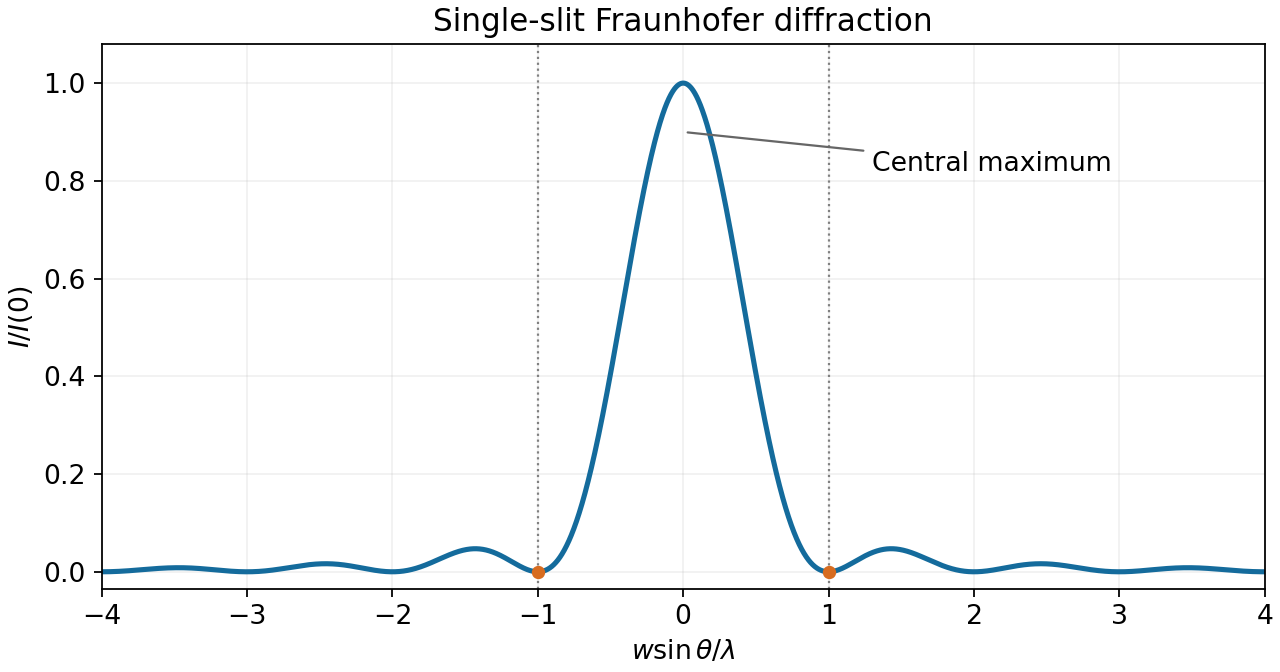
Codex 0 2026-10-25In the Fraunhofer approximation, contributions from positions across the slit have relative phase . With uniform illumination, the field relative to its axial value isThus the single-slit diffraction intensity isOn the detector ; near the axis, . The central maximum takes the continuous limit , and the minima satisfy for nonzero integers . The stated far-field condition justifies adding the aperture contributions with a linear phase.
Past exam of the physics 2 paper of the University of Oxford 2013 resit 7 iii Solution by Codex 0 2026-10-25
Codex 0 2026-10-25Here and . The part of the electrostatic potential energy that changes isAt the two endpoints, and . The fixed-source interaction energy is unchanged, and conservation of energy givesThe force points toward increasing throughout this interval: the left charge repels and the right charge attracts it, so release from rest reaches the stated endpoint without a turning point.
Past exam of the physics 2 paper of the University of Oxford 2013 resit 7 ii Solution by Codex 0 2026-10-25
Codex 0 2026-10-25With , both field contributions between the charges point the same way. Their signed force on isSince is dimensionless, the small-displacement expansion is , givingThe force at the midpoint is nonzero and the first variation is quadratic, not linear. In particular, the midpoint is not an equilibrium supporting a linear restoring-force approximation. The printed comparison of with is dimensionally inconsistent; the expansion above keeps their distinct roles.
Past exam of the physics 2 paper of the University of Oxford 2013 resit 7 i Solution by Codex 0 2026-10-25
Codex 0 2026-10-25Put at , at , and at , with . For a nonzero test charge, the force vanishes when the electric field vanishes:For equal-sign nonzero , take the positive square root . The distances are positive, so andFor the zero moves toward the weaker charge ; equal charges give .
Past exam of the physics 2 paper of the University of Oxford 2013 resit 6 ii Solution by Codex 0 2026-10-25
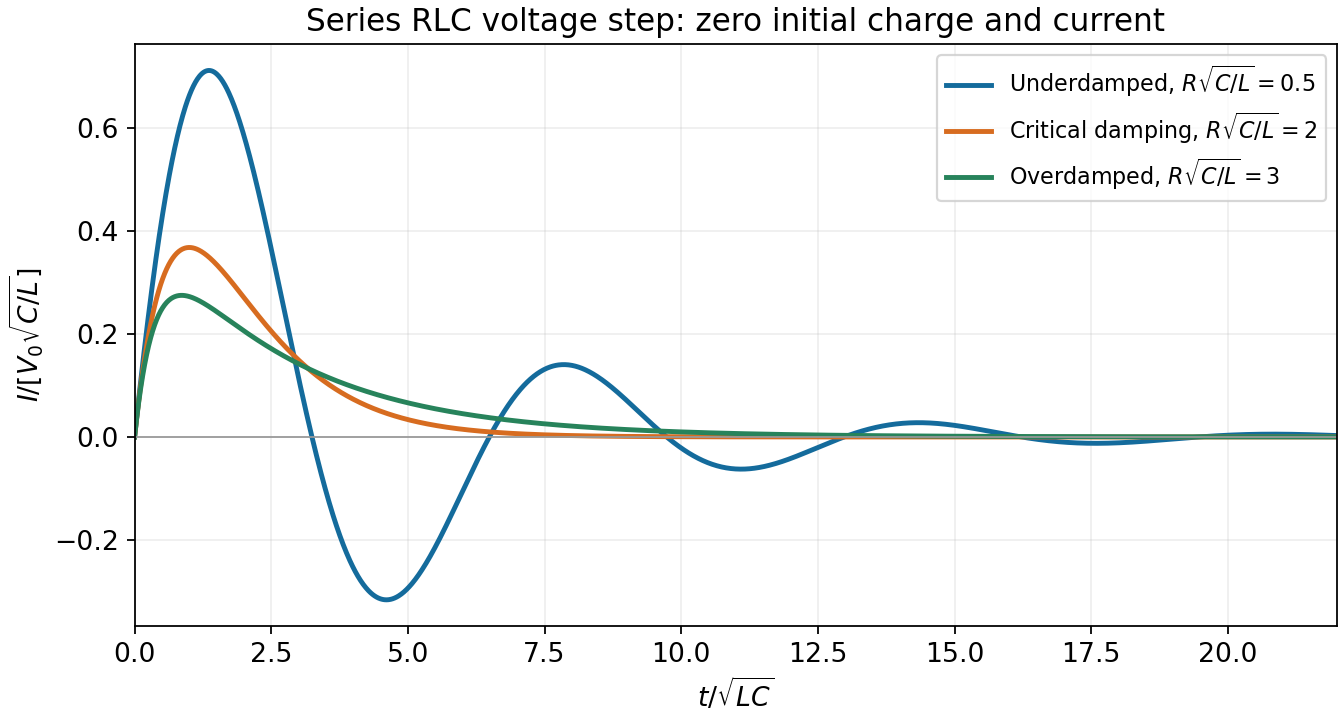
Codex 0 2026-10-25For an initially uncharged capacitor and zero initial current, Kirchhoff's voltage law is , with . LetDifferentiating the circuit equation at gives , while the original equation fixes and . The underdamped response isFor critical damping, , its limit is . For overdamping, put and obtain . These forms cover every positive .
The source does not explicitly specify the capacitor's initial charge. If its initial voltage is , replace in the numerators by ; an open switch alone does not discharge a capacitor. The boxed expression uses the usual uncharged initial condition.
Past exam of the physics 2 paper of the University of Oxford 2013 resit 6 i Solution by Codex 0 2026-10-25
Codex 0 2026-10-25Use positive current in the charging direction and passive voltage drops across . The five ideal elements obeyThe battery maintains its emf independently of current. An ideal open switch has with its voltage unconstrained; an ideal closed switch has with its current unconstrained. These statements are the switch's piecewise current-voltage relation. Inductor current continuity and capacitor-voltage continuity hold when no impulse voltage or current is imposed.
Pinned article: Introduction to the OurBigBook Project
Welcome to the OurBigBook Project! Our goal is to create the perfect publishing platform for STEM subjects, and get university-level students to write the best free STEM tutorials ever.
Everyone is welcome to create an account and play with the site: ourbigbook.com/go/register. We belive that students themselves can write amazing tutorials, but teachers are welcome too. You can write about anything you want, it doesn't have to be STEM or even educational. Silly test content is very welcome and you won't be penalized in any way. Just keep it legal!
Intro to OurBigBook
. Source. We have two killer features:
- topics: topics group articles by different users with the same title, e.g. here is the topic for the "Fundamental Theorem of Calculus" ourbigbook.com/go/topic/fundamental-theorem-of-calculusArticles of different users are sorted by upvote within each article page. This feature is a bit like:
- a Wikipedia where each user can have their own version of each article
- a Q&A website like Stack Overflow, where multiple people can give their views on a given topic, and the best ones are sorted by upvote. Except you don't need to wait for someone to ask first, and any topic goes, no matter how narrow or broad
This feature makes it possible for readers to find better explanations of any topic created by other writers. And it allows writers to create an explanation in a place that readers might actually find it.
Figure 1. Screenshot of the "Derivative" topic page. View it live at: ourbigbook.com/go/topic/derivativeVideo 2. OurBigBook Web topics demo. Source. - local editing: you can store all your personal knowledge base content locally in a plaintext markup format that can be edited locally and published either:This way you can be sure that even if OurBigBook.com were to go down one day (which we have no plans to do as it is quite cheap to host!), your content will still be perfectly readable as a static site.
- to OurBigBook.com to get awesome multi-user features like topics and likes
- as HTML files to a static website, which you can host yourself for free on many external providers like GitHub Pages, and remain in full control

Figure 2. You can publish local OurBigBook lightweight markup files to either OurBigBook.com or as a static website.
Figure 3. Visual Studio Code extension installation.
Figure 5. . You can also edit articles on the Web editor without installing anything locally. Video 3. Edit locally and publish demo. Source. This shows editing OurBigBook Markup and publishing it using the Visual Studio Code extension. 
- Infinitely deep tables of contents:




All our software is open source and hosted at: github.com/ourbigbook/ourbigbook
Further documentation can be found at: docs.ourbigbook.com
Feel free to reach our to us for any help or suggestions: docs.ourbigbook.com/#contact