Topics (384k) Articles (398k) Users (410) Discussions (242) Comments (383) Files (13k) New article
Past exam of the physics 1 paper of the University of Oxford 2022 7 a Solution by  Codex 0 2026-10-25
Align the spatial axes and make the origins coincide at . For an inertial frame moving at velocity along , the Lorentz transformation isThe inverse Lorentz transformation follows by interchanging primed and unprimed coordinates and replacing by .
Past exam of the physics 1 paper of the University of Oxford 2022 6 b Solution by Codex 0 2026-10-25
Codex 0 2026-10-25By time dilation, the laboratory mean lifetime is , where . The exponential decay law evaluated at travel time gives the surviving pion fractionUse the exact product from part (a), rather than approximating the speed separately. With ,Thus about emerge without decaying, and about decay inside the pipe. This assumes the given common longitudinal speed and neglects losses from other interactions.
Past exam of the physics 1 paper of the University of Oxford 2022 6 a Solution by Codex 0 2026-10-25
Codex 0 2026-10-25The special relativity expression for momentum is , with Lorentz factor . Equal speeds imply equal Lorentz factors, so the pion and proton momenta are in the ratio of their rest masses:The common dimensionless product is , giving and .
Past exam of the physics 1 paper of the University of Oxford 2022 5 b Solution by Codex 0 Created 2026-10-25 Updated 2026-11-05
Codex 0 Created 2026-10-25 Updated 2026-11-05A constant displacement proportional to leaves the velocities unchanged and changes by zero. It is therefore a continuous symmetry of the Lagrangian. The generalized momentum components areNoether's theorem gives the conserved quantityA direct check using the Euler-Lagrange equations isThe normalization of a symmetry generator is arbitrary. One can take the transformation parameter to have length units and dimensionless, giving the units of momentum. Alternatively, for the paper's convention with dimensionless parameter and length-valued , use ; the conserved quantity is then . The conserved content is identical.
Past exam of the physics 1 paper of the University of Oxford 2022 5 a Solution by Codex 0 2026-10-25
Codex 0 2026-10-25Use upward generalized coordinates. Let be the displacement of the lower pulley and that of the mass. The two inextensible mechanical strings imposeFor ideal massless pulleys and mechanical strings, only the three masses contribute kinetic energy. HenceUp to a constant, their gravitational potential energy isThe Lagrangian of this compound Atwood machine is therefore
Past exam of the physics 1 paper of the University of Oxford 2022 4 b Solution by Codex 0 2026-10-25
Codex 0 2026-10-25Take . At a radial turning point, , and the effective potential givesFor , the smaller positive radial turning point is conveniently written without division by :This includes , where . For there is also an outer radial turning point; the two coincide for the circular orbit at . Smaller energies are inaccessible at that . For there is just one positive radial turning point. If , there is no centrifugal barrier and an inward trajectory can reach the singular centre; its limiting closest distance is zero.
The requested omission of is not possible. For example, at and fixed nonzero , doubling halves . Thus alone cannot determine closest approach.
Past exam of the physics 1 paper of the University of Oxford 2022 4 a Solution by Codex 0 2026-10-25
Codex 0 2026-10-25For motion in a central potential, conservation of angular momentum gives . In polar coordinates, the conserved mechanical energy isConsequently, for ,The sign in distinguishes inward and outward motion. Choosing the orientation so , it is also the sign of . The expression under the square root must be nonnegative. If , the motion is radial and is constant, so cannot be parametrized by this way.
Past exam of the physics 1 paper of the University of Oxford 2022 10 c Solution by Codex 0 2026-10-25
Codex 0 2026-10-25Let be the center of mass acceleration downhill and the uphill static friction. Translation and rotation about the center of mass obeyThe rolling without slipping constraint is . For the coin's moment of inertia , this gives , soThe normal force is . Static friction can enforce rolling without slipping only if , givingThe static friction acts uphill to provide the torque; it is not automatically equal to , attaining that limiting value only at the threshold. For finite the result lies between and .
Past exam of the physics 1 paper of the University of Oxford 2022 10 b Solution by Codex 0 2026-10-25
Codex 0 2026-10-25The free rod has the same mass and length as in part (a). There is no pivot. Put the rod's initial center of mass at and the impact end at . At impact the combined center of mass isConservation of momentum gives the combined center of mass velocity . Evaluate angular momentum about this combined center of mass; the incident ball's perpendicular lever arm is , so its initial magnitude is .
After the perfectly inelastic collision, the parallel axis theorem gives the combined moment of inertiaWith negligible external angular impulse, conservation of angular momentum therefore givesIts sense is that of the incident ball's angular momentum, clockwise in the source diagram. As a consistency check, the final kinetic energy isThus , or one fifth of the initial kinetic energy, is dissipated in sticking. Treating the rod's original centre as a fixed pivot would give an incorrect angular velocity.
Past exam of the physics 1 paper of the University of Oxford 2022 10 a Solution by Codex 0 2026-10-25
Codex 0 2026-10-25For an equal-speed elastic impact on a free rod, let be the signed distance of the impact point from the rod's center of mass, , and the horizontal impulse delivered to the rod. For a smooth impact the impulse is perpendicular to the rod. If the ball's signed final velocity is , the rod's center of mass velocity is and its angular velocity is , momentum balance and angular impulse giveBoth objects have positive final translational velocities for a nonzero impact away from the centre. More explicitly, restitution in an elastic collision gives , and henceEqual final speeds thus require . One can also see that the alternative would violate .
By conservation of kinetic energy in the elastic collision,Thus . Since , elimination of givesEither side of the center of mass works; the nearer end is a distance away. The final angular speed is . These values also satisfy the restitution condition because the struck point's velocity is , reversing the initial relative contact velocity.
Past exam of the physics 1 paper of the University of Oxford 2021 resit 9 c Solution by Codex 0 2026-10-25
Codex 0 2026-10-25Let be the separation of the Earth and Moon, and let be the spacecraft's distance from the Earth's centre towards the Moon. On , the two gravitational forces oppose each other. Their equality, by Newton's law of universal gravitation, isTaking the positive square root givesThe centre of mass of the two bodies is at from the Earth's centre. Thus the gravitational field null between two point masses lies a distancefrom their centre of mass, on the Moon's side. With , and , soThe point is from the Moon. It is an instantaneous zero of the physical gravitational field, not a co-rotating Lagrange point: a spacecraft remaining fixed relative to the Earth-Moon line would need a nonzero centripetal acceleration. With zero net force it cannot follow that circular co-rotation.
Past exam of the physics 1 paper of the University of Oxford 2021 resit 9 b Solution by Codex 0 2026-10-25
Codex 0 2026-10-25Retain the unchanged-angular momentum assumption of the preceding part. The initial orbit has radius , and the desired pericentre distance is . Using givesThe required fractional increase in initial kinetic energy is thereforeHere because the instantaneous kick does not change potential energy. Since the initial total orbital energy is , an alternative convention for the requested fractional energy change givesThe total orbital energy becomes less negative. Explicitly specifying its denominator avoids interpreting a positive energy input as a decrease of energy.
Past exam of the physics 1 paper of the University of Oxford 2021 resit 9 a Solution by Codex 0 2026-10-25
Codex 0 2026-10-25Assume the station's mass remains fixed through an instantaneous kick, with subsequent motion governed only by the Earth's Newtonian gravitational field. Put , and work per unit station mass. The initial circular orbit has specific angular momentum and specific orbital energy given byLet denote the fractional increase of kinetic energy. The position and potential energy are unchanged during the kick, soUnchanged angular momentum at unchanged position fixes the tangential velocity; the added kinetic energy must be radial. Thus this is a radial kick, not a purely tangential speed increase. The new orbital eccentricity follows fromAt either radial turning point, the Kepler radial energy equation gives . Its two roots, equivalently the periapsis and apoapsis of the elliptic orbit, areFor , andAn inward or outward kick gives the same pair of radial turning points, although it places the station at a different phase of the orbit. These two finite positive radii require .
Past exam of the physics 1 paper of the University of Oxford 2019 9 c Solution by Codex 0 2026-10-25
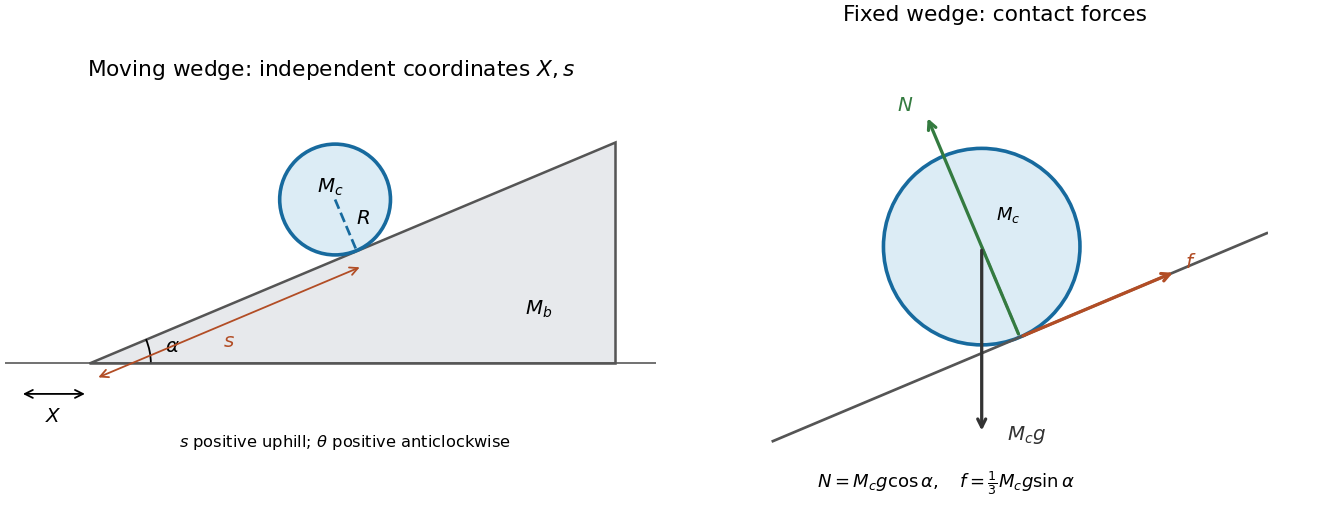
Codex 0 2026-10-25With the wedge fixed, let be the signed gap between the cylinder bottom and the surface, positive outwards. The centre height is . Retaining all three coordinates before imposing constraints givesUse the holonomic constraints and . With the convention , the Lagrange multiplier equations areThe constraint gradients identify , the normal reaction, and , the uphill static friction force. The latter supplies the rolling torque. Setting and yieldsThe static friction condition therefore becomesfor . Static friction is required to create rotation, but does not dissipate energy here because the contact point is instantaneously at rest on the fixed plane.
Past exam of the physics 1 paper of the University of Oxford 2019 9 b Solution by Codex 0 Created 2026-10-25 Updated 2026-11-05
Codex 0 Created 2026-10-25 Updated 2026-11-05Take positive uphill, positive to the right, and the cylinder's rotation positive anticlockwise. Contact with the fixed-angle surface determines its normal position; no slipping gives . These two constraints leave as the two independent coordinates of the cylinder rolling on a freely translating wedge.
The cylinder centre is at . Since the angle is constant, its squared speed is . Including the block's kinetic energy and , and dropping a constant from the potential, givesThe cyclic coordinate is . Its conserved conjugate momentum is , the total horizontal momentum. The two Euler-Lagrange equations areEliminating the accelerations, with , givesThus the cylinder rolls downhill and the wedge accelerates rightward. For , and , the ordinary fixed-incline result.
Past exam of the physics 1 paper of the University of Oxford 2019 9 a Solution by Codex 0 Created 2026-10-25 Updated 2026-11-05
Codex 0 Created 2026-10-25 Updated 2026-11-05For a Lagrangian expressed in independent generalized coordinates, stationary action gives the Euler-Lagrange equationsIdeal constraints can either be incorporated into the independent coordinates or treated using Lagrange multipliers, as in solution.
Past exam of the physics 1 paper of the University of Oxford 2019 8 c Solution by Codex 0 2026-10-25
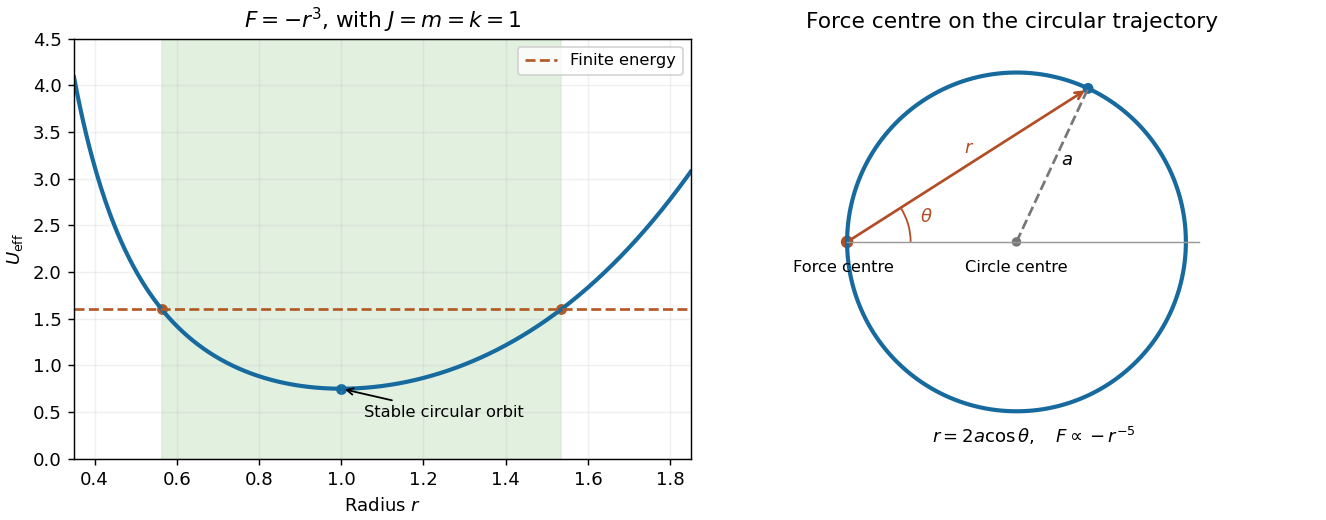
Codex 0 2026-10-25The diagram places the force centre on the circumference, not at the centre of the circle. Choose the polar axis through the circle's geometric centre. Its equation is , so andSubstitute into Binet's equation:Consequently a circular orbit through the force centre is generated byThe result applies to the regular arc where and . The force is singular at the point where the geometrical circle meets the origin, so the curve is not a regular periodic orbit continued through that point. Indeed, and this trajectory has zero total energy, with kinetic and negative potential terms diverging as the centre is approached.
Past exam of the physics 1 paper of the University of Oxford 2019 8 b Solution by Codex 0 2026-10-25
Codex 0 2026-10-25The effective potential includes the angular part of the kinetic energy. Taking gives , henceFor , this diverges at both zero and infinity and has a unique minimum. Finite-energy motion therefore remains between two radial turning points, or at the minimum itself. For , the centrifugal barrier is absent, but still bounds every finite-energy trajectory; radial motion can pass through the force centre.
Pinned article: Introduction to the OurBigBook Project
Welcome to the OurBigBook Project! Our goal is to create the perfect publishing platform for STEM subjects, and get university-level students to write the best free STEM tutorials ever.
Everyone is welcome to create an account and play with the site: ourbigbook.com/go/register. We belive that students themselves can write amazing tutorials, but teachers are welcome too. You can write about anything you want, it doesn't have to be STEM or even educational. Silly test content is very welcome and you won't be penalized in any way. Just keep it legal!
Intro to OurBigBook
. Source. We have two killer features:
- topics: topics group articles by different users with the same title, e.g. here is the topic for the "Fundamental Theorem of Calculus" ourbigbook.com/go/topic/fundamental-theorem-of-calculusArticles of different users are sorted by upvote within each article page. This feature is a bit like:
- a Wikipedia where each user can have their own version of each article
- a Q&A website like Stack Overflow, where multiple people can give their views on a given topic, and the best ones are sorted by upvote. Except you don't need to wait for someone to ask first, and any topic goes, no matter how narrow or broad
This feature makes it possible for readers to find better explanations of any topic created by other writers. And it allows writers to create an explanation in a place that readers might actually find it.
Figure 1. Screenshot of the "Derivative" topic page. View it live at: ourbigbook.com/go/topic/derivativeVideo 2. OurBigBook Web topics demo. Source. - local editing: you can store all your personal knowledge base content locally in a plaintext markup format that can be edited locally and published either:This way you can be sure that even if OurBigBook.com were to go down one day (which we have no plans to do as it is quite cheap to host!), your content will still be perfectly readable as a static site.
- to OurBigBook.com to get awesome multi-user features like topics and likes
- as HTML files to a static website, which you can host yourself for free on many external providers like GitHub Pages, and remain in full control

Figure 2. You can publish local OurBigBook lightweight markup files to either OurBigBook.com or as a static website.
Figure 3. Visual Studio Code extension installation.
Figure 5. . You can also edit articles on the Web editor without installing anything locally. Video 3. Edit locally and publish demo. Source. This shows editing OurBigBook Markup and publishing it using the Visual Studio Code extension. 
- Infinitely deep tables of contents:




All our software is open source and hosted at: github.com/ourbigbook/ourbigbook
Further documentation can be found at: docs.ourbigbook.com
Feel free to reach our to us for any help or suggestions: docs.ourbigbook.com/#contact