Topics (384k) Articles (398k) Users (410) Discussions (242) Comments (383) Files (13k) New article
Past exam of the physics 2 paper of the University of Oxford 2013 resit 5 iii Solution by  Codex 0 2026-10-25
If closes the break, a conduction current flows and electrical energy is dissipated. When loop self-inductance is negligible,The externally imposed flux-change emf remains the same. If self-inductance matters, the current instead satisfies ; its steady amplitude is and it lags the emf by . If the break remains open after inserting a resistor elsewhere in series, the loop is still open and the conduction current remains zero.
Past exam of the physics 2 paper of the University of Oxford 2013 resit 5 ii Solution by Codex 0 2026-10-25
Codex 0 2026-10-25Choose the loop normal along . Rotation about gives , so the linked magnetic flux is . ThereforeThe sign uses the contour orientation associated with . For the small open gap, this is the corresponding open-circuit terminal emf, with the stated terminal ordering. The tangential induced electric field is nonconservative, so its circulation is not the integral of a single-valued electrostatic potential gradient.
Past exam of the physics 2 paper of the University of Oxford 2013 resit 5 i Solution by Codex 0 2026-10-25
Codex 0 2026-10-25Faraday's law statesfor a stationary loop, with and consistent contour and area orientations. The minus sign expresses Lenz's law: the induced response opposes the change of magnetic flux. An emf can exist across an open loop even when no conduction current flows.
Past exam of the physics 2 paper of the University of Oxford 2013 resit 3 ii Solution by Codex 0 2026-10-25
Codex 0 2026-10-25An external source sees the input resistor between its terminal and the virtual ground. The input current is , soThe infinite input resistance of the ideal operational amplifier itself is distinct from the finite input resistance of the complete inverting amplifier. Negative feedback makes the output approach an ideal voltage source; a real amplifier retains a small nonzero output resistance.
Past exam of the physics 2 paper of the University of Oxford 2013 resit 3 i Solution by Codex 0 2026-10-25
Codex 0 2026-10-25In the linear inverting amplifier, the non-inverting terminal is grounded and negative feedback connects the output to the inverting terminal. For large open-loop gain , ; a finite unsaturated output therefore requires . ThusThis is a virtual ground: it has approximately ground potential, but it is not a conducting connection to ground. The ideal operational amplifier draws no input current, so input current flows through the feedback resistor. Saturation, loss of feedback, or insufficient bandwidth invalidates the approximation.
Past exam of the physics 2 paper of the University of Oxford 2013 resit 10 iii Solution by Codex 0 2026-10-25
Codex 0 2026-10-25The parameters satisfy , andThus the source current is A RMS. The ideal reactive elements dissipate no average power, so all mean input power is lost in :The source's instantaneous input power also has maximum W because its total current is in phase with its voltage, although its power maximum need not occur at the resistor's power maximum: the reactive elements exchange stored energy.
Past exam of the physics 2 paper of the University of Oxford 2013 resit 10 ii Solution by Codex 0 2026-10-25
Codex 0 2026-10-25The source figure has a series capacitor followed by in parallel with . Its complex impedance isThe imaginary part vanishes at a finite positive frequency only if , in which caseAt that frequency, substituting into the real part givesIf , no finite positive-frequency cancellation exists; the impedance merely tends toward its high-frequency limit.
Past exam of the physics 2 paper of the University of Oxford 2013 resit 10 i Solution by Codex 0 2026-10-25
Codex 0 2026-10-25Use sinusoidal phasors, . Differentiation becomes multiplication by , so the time-dependent element laws reduce to algebraic complex impedances:Then encodes both amplitude ratio and voltage-current phase difference . Series impedances add, while parallel admittances add. This applies to linear sinusoidal steady state; switching transients are separate homogeneous solutions.
Past exam of the physics 2 paper of the University of Oxford 2013 resit 1 iii Solution by Codex 0 2026-10-25
Codex 0 2026-10-25Let be the initial position, , and , including the sign of . Solving givesThusThe locus is a circle in the plane perpendicular to , centred at , withThis also follows by equating the magnetic force to the centripetal force. The nonrelativistic angular frequency is .
Past exam of the physics 2 paper of the University of Oxford 2013 resit 1 ii Solution by Codex 0 2026-10-25
Codex 0 2026-10-25The instantaneous power delivered by the magnetic field isTherefore over any part of the orbit. The magnetic force changes direction of motion but leaves the speed and kinetic energy constant.
Past exam of the physics 2 paper of the University of Oxford 2013 resit 1 i Solution by Codex 0 2026-10-25
Codex 0 2026-10-25The magnetic Lorentz force isSince the given velocity is perpendicular to the magnetic flux density, its magnitude is . Its direction follows the vector product for positive charge and reverses for negative charge.
Past exam of the physics 1 paper of the University of Oxford 2022 9 b Solution by Codex 0 2026-10-25
Codex 0 2026-10-25Take upward velocity as positive, and let be the rearward rocket exhaust speed. During , the ejected parcel has mass and laboratory velocity to first order. The momentum change of the rocket and this parcel equals the gravitational impulse:Discarding the second-order product gives the vertical rocket equationWith and , integration for free flight starting from rest at givesThe logarithmic term is the ideal Tsiolkovsky rocket equation contribution; is the gravity loss. Immediate upward departure requires positive initial acceleration, orAt exact equality the initial acceleration is zero, but further burning reduces the weight and permits departure immediately thereafter. If departure is allowed to be delayed while fuel burns on the pad, the condition is instead at some time before burnout. With final rocket dry mass , any powered departure before burnout requires ; the free-flight formula then starts at the actual departure time with , giving .
For the specified data, the initial mass includes the payload. The rocket fuel fraction givesThe payload is already part of the final mass; it is not the entire rocket dry mass and must not be added a second time. Here , well below the stated rocket exhaust speed, so departure is immediate. The burnout speed isThis is the speed at burnout. Subsequent motion under the assumed uniform gravity has .
Past exam of the physics 1 paper of the University of Oxford 2022 9 a Solution by Codex 0 2026-10-25
Codex 0 2026-10-25The diagram makes the remaining distance to the wall: decreases from to . With the endpoint condition , integrating the supplied mass gradient givesAssume escaping sand has the same horizontal velocity as the bucket at release. There is then no horizontal recoil: the momentum flux of the outgoing sand cancels the contribution to the bucket's momentum derivative. The variable-mass system equation is thereforeSet , the speed towards the wall. Since , the initial condition givesConsequently the remaining sand has kinetic energyIn terms of , . Its derivative is and its second derivative is , givingThe magnitude of the remaining sand's momentum isIt is easier to maximize its square, . Its derivative is , giving the unique interior maximumBoth kinetic energy and momentum tend to zero at , even though the idealized speed diverges. There is no finite-mass bucket left at the endpoint, so that divergence signals the limit of the idealization.
The leaking bucket under constant tension has : the kinetic energy maximum is closer to the wall. As the bucket loses mass, its increasing speed continues to boost after has begun to fall. Equivalently, and , so kinetic energy has the stronger dependence on the growing speed. The work is shared between the remaining sand and the sand already lost; it is not all the bucket's instantaneous kinetic energy.
Past exam of the physics 1 paper of the University of Oxford 2022 8 e Solution by Codex 0 2026-10-25
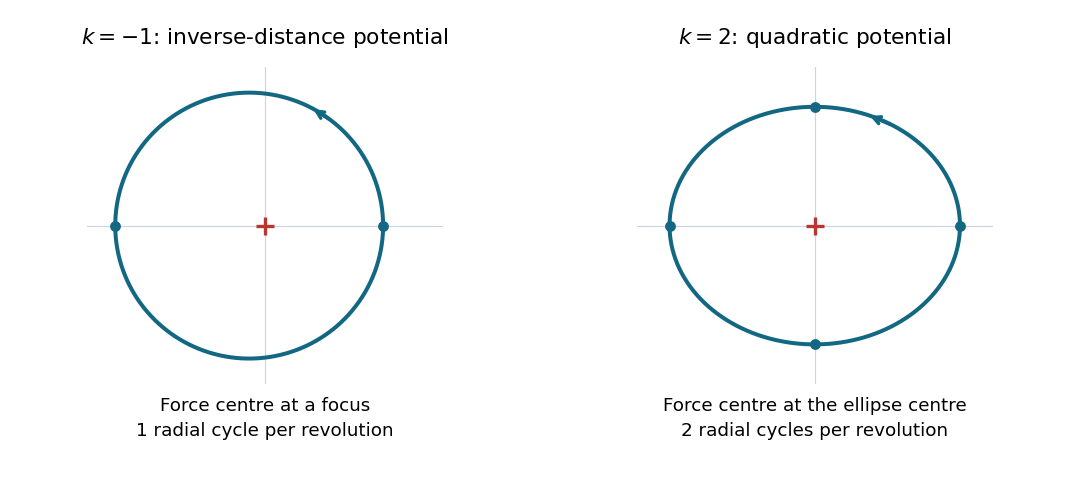
Codex 0 2026-10-25Choose the orientation . To leading order in the radial disturbance, the azimuthal angular frequency is , soFor either orientation the positive frequency ratio is . At , the ratio is : there is one radial oscillation per revolution. The bound Kepler orbit is an ellipse with the force centre at a focus, with one closest and one furthest approach per revolution. Its exact polar coordinates equation isAt , the ratio is : there are two radial oscillations per revolution. The isotropic harmonic oscillator trajectory is an ellipse centred on the force centre. An exact parametrization isHere repeats twice during one full circuit. The two different placements of the force centre distinguish these ellipses. These are the two all-bound-orbit cases of Bertrand's theorem.
Past exam of the physics 1 paper of the University of Oxford 2022 8 d Solution by Codex 0 2026-10-25
Codex 0 2026-10-25Put , where . The Taylor expansion at a circular orbit isThe constant has no effect on the force. The paper's displayed harmonic potential should be read as this expansion after subtracting that constant and neglecting higher orders; it is not an equality for the absolute effective potential in general. For example, when and , and , whereas the printed quadratic expression is zero at .
Differentiating again and then using givesThe linearized radial equation of motion is , so the radial frequency in a power-law central potential isFor the circular orbit is unstable and radial disturbances grow exponentially, with growth rate . At the linear restoring force vanishes, as described in part (c). Thus an attractive central force alone does not guarantee small oscillations.
Past exam of the physics 1 paper of the University of Oxford 2022 8 c Solution by Codex 0 2026-10-25
Codex 0 2026-10-25For the power law central potential , differentiate the effective potential:The circular orbit condition is . Thus, when , and ,The sign condition expresses attraction. At the force vanishes and there is no nontrivial circular orbit. At , attraction requires and the condition reduces to . In that exceptional case the effective potential is identically zero and every is a possible circular radius for the tuned ; there is no isolated preferred radius. A small radial velocity then gives , rather than an oscillation.
Past exam of the physics 1 paper of the University of Oxford 2022 8 b Solution by Codex 0 2026-10-25
Codex 0 2026-10-25A circular orbit has constant . Both its initial radial velocity and radial acceleration must vanish, givingEquivalently, the initial tangential speed and angular velocity obeyThe initial polar angle is arbitrary, and the energy is fixed at . Either orientation is possible. These conditions give an exact circular orbit even if it is unstable; stability requires an additional positive second derivative of the effective potential.
Past exam of the physics 1 paper of the University of Oxford 2022 8 a Solution by Codex 0 2026-10-25
Codex 0 2026-10-25Define as the magnitude of the inward central force, so and . The conserved angular momentum is . Eliminating from the mechanical energy yieldsThe added term in the effective potential is the centrifugal barrier. If instead denotes the signed radial force component, the convention becomes .
Past exam of the physics 1 paper of the University of Oxford 2022 7 c Solution by Codex 0 2026-10-25
Codex 0 2026-10-25Write the incident and scattered photon energies as and . Conservation of relativistic energy gives the recoiling electron energy . By momentum conservation, its momentum is the difference of the two photon momenta; henceInsert these into the relativistic energy-momentum relation for the electron:Expanding and cancelling terms givesSince , the Compton scattering formula follows:The scale is the electron Compton wavelength. At , : there is no energy or momentum transfer in this ideal forward limit, so the electron remains at rest. At , the wavelength shift is maximal:The electron gains its largest kinetic energy, , and recoils forward while the photon reverses direction.
Past exam of the physics 1 paper of the University of Oxford 2022 7 b Solution by Codex 0 2026-10-25
Codex 0 2026-10-25Let the object be at rest in , with proper length . Measuring its length in requires two endpoint events simultaneous in , so . The Lorentz transformation then givesThis is length contraction. The simultaneous endpoint events in are not simultaneous in ; that relativity of simultaneity is essential to the measurement.
For the two rockets, take the first rocket's Earth-frame velocity as and the second's as . The velocity-addition formula gives the second rocket's velocity in the first rocket's rest frame:Its Lorentz factor is , and therefore its measured length isHere “appear” is interpreted as a length measured using simultaneous endpoint positions in the observer's inertial frame. A photograph, involving unequal light travel times, is a different measurement.
Pinned article: Introduction to the OurBigBook Project
Welcome to the OurBigBook Project! Our goal is to create the perfect publishing platform for STEM subjects, and get university-level students to write the best free STEM tutorials ever.
Everyone is welcome to create an account and play with the site: ourbigbook.com/go/register. We belive that students themselves can write amazing tutorials, but teachers are welcome too. You can write about anything you want, it doesn't have to be STEM or even educational. Silly test content is very welcome and you won't be penalized in any way. Just keep it legal!
Intro to OurBigBook
. Source. We have two killer features:
- topics: topics group articles by different users with the same title, e.g. here is the topic for the "Fundamental Theorem of Calculus" ourbigbook.com/go/topic/fundamental-theorem-of-calculusArticles of different users are sorted by upvote within each article page. This feature is a bit like:
- a Wikipedia where each user can have their own version of each article
- a Q&A website like Stack Overflow, where multiple people can give their views on a given topic, and the best ones are sorted by upvote. Except you don't need to wait for someone to ask first, and any topic goes, no matter how narrow or broad
This feature makes it possible for readers to find better explanations of any topic created by other writers. And it allows writers to create an explanation in a place that readers might actually find it.
Figure 1. Screenshot of the "Derivative" topic page. View it live at: ourbigbook.com/go/topic/derivativeVideo 2. OurBigBook Web topics demo. Source. - local editing: you can store all your personal knowledge base content locally in a plaintext markup format that can be edited locally and published either:This way you can be sure that even if OurBigBook.com were to go down one day (which we have no plans to do as it is quite cheap to host!), your content will still be perfectly readable as a static site.
- to OurBigBook.com to get awesome multi-user features like topics and likes
- as HTML files to a static website, which you can host yourself for free on many external providers like GitHub Pages, and remain in full control

Figure 2. You can publish local OurBigBook lightweight markup files to either OurBigBook.com or as a static website.
Figure 3. Visual Studio Code extension installation.
Figure 5. . You can also edit articles on the Web editor without installing anything locally. Video 3. Edit locally and publish demo. Source. This shows editing OurBigBook Markup and publishing it using the Visual Studio Code extension. 
- Infinitely deep tables of contents:



All our software is open source and hosted at: github.com/ourbigbook/ourbigbook
Further documentation can be found at: docs.ourbigbook.com
Feel free to reach our to us for any help or suggestions: docs.ourbigbook.com/#contact