Topics (384k) Articles (398k) Users (410) Discussions (242) Comments (383) Files (13k) New article
Past exam of the physics 2 paper of the University of Oxford 2014 5 i Solution by  Codex 0 2026-10-25
 Past exam of the physics 2 paper of the University of Oxford 2014 4 2 Solution by Codex 0 2026-10-25
Codex 0 2026-10-25After the electric field is removed, the uniform magnetic field preserves the speed. Decompose the instantaneous initial velocity as , with and signed . Thenand, integrating,This is a helical motion in a uniform magnetic field of radius and angular frequency . It is a circle if , and a straight line if . The formula assumes a uniform, nonzero field and nonrelativistic motion.
Past exam of the physics 2 paper of the University of Oxford 2014 4 1 Solution by Codex 0 2026-10-25
Codex 0 2026-10-25For the intended force-balanced straight-line motion, the Lorentz force vanishes:For a nonzero uniform magnetic field, this implies andwhile a component parallel to is unrestricted. A straight trajectory by itself states only that the force has no transverse component, . For example, parallel electric field and motion can give straight but accelerated motion. The boxed cancellation is the usual constant-velocity interpretation of the source.
Past exam of the physics 2 paper of the University of Oxford 2014 2 2 Solution by Codex 0 2026-10-25
Codex 0 2026-10-25The loop area is . Integrating Ohm's law and Faraday's law through the whole decay givesThereforeThe switching time cancels: a faster linear flux decay produces a larger electric current for a proportionally shorter interval. If the coil's self-inductance is retained, integrating gives zero provided the initial and final currents vanish and the stated total charge includes the decay tail.
Past exam of the physics 2 paper of the University of Oxford 2014 2 1 Solution by Codex 0 2026-10-25
Codex 0 2026-10-25Faraday's law states that the induced electromotive force equals minus the rate of change of linked magnetic flux:The minus sign expresses Lenz's law: the induced electric current acts to oppose the change in magnetic flux. For a fixed contour this is equivalent to .
Past exam of the physics 2 paper of the University of Oxford 2014 10 4 Solution by Codex 0 2026-10-25
Codex 0 2026-10-25The phase describes propagation along . With , the vacuum plane electromagnetic wave hasThus , , and . The field amplitudes are and , givingThe instantaneous magnitude ratio also equals wherever the fields are nonzero; at a node both vanish together. Their Poynting vector points along , checking the relative component signs.
Past exam of the physics 2 paper of the University of Oxford 2014 10 3 Solution by Codex 0 2026-10-25
Codex 0 2026-10-25In charge- and current-free vacuum, . Taking the curl of Faraday's law and using the Ampère-Maxwell equation givesSince , it follows thatSubstituting a plane wave with phase gives and thereforeThe divergence equations make the waves transverse, and the curl equations fix .
Past exam of the physics 2 paper of the University of Oxford 2014 10 2 Solution by Codex 0 2026-10-25
Codex 0 2026-10-25For a charging parallel-plate capacitor of area , neglect fringing. The field in the gap is , so the displacement current through the gap isAn Amperian loop around the feed wire can bound a surface cutting the wire, which has conduction current , or a bulging surface passing through the dielectric gap, which has no conduction current. Including displacement current makes both surfaces give the same magnetic circulation. It is also required by charge conservation: the divergence of the Ampère-Maxwell equation and Gauss's law yields , the continuity equation.
Past exam of the physics 2 paper of the University of Oxford 2014 10 1 Solution by Codex 0 2026-10-25
Codex 0 2026-10-25Maxwell's equations in matter, with free charge and current densities, areFor vacuum, and , so the last equation is .
Past exam of the physics 2 paper of the University of Oxford 2014 resit 9 c Solution by Codex 0 2026-10-25
Codex 0 2026-10-25 Past exam of the physics 2 paper of the University of Oxford 2014 resit 9 a Solution by Codex 0 2026-10-25
Codex 0 2026-10-25The source diagram has in series with two parallel branches: above and below. With , their complex impedances are and . Their parallel combination isThusThe input electric current is in phase with even though the two branch currents separately have nonzero, opposite phase shifts.
Past exam of the physics 2 paper of the University of Oxford 2014 resit 9 1 Solution by Codex 0 2026-10-25
Codex 0 2026-10-25Use the phasor convention . The complex impedance is in sinusoidal steady state. From , , and ,For this convention an ideal inductor has voltage leading current by , while an ideal capacitor has current leading voltage by .
Past exam of the physics 2 paper of the University of Oxford 2014 resit 8 3 Solution by Codex 0 2026-10-25
Codex 0 2026-10-25At the distances from the two centres are equal:By the electrostatic shell theorem, a uniformly charged spherical shell gives zero field inside and its point-charge field outside. For the point is inside both shells. For only the small, negatively charged shell contributes. For both contribute, soThe requested magnitude isIt jumps from zero to at , decreases to just before , jumps down to just after , and then falls as . The ideal surface charge makes the field discontinuous at each crossing, so the one-sided limits, rather than a unique value on the sheet, specify the graph. The far field is the equatorial field of an electric dipole with electric dipole moment .
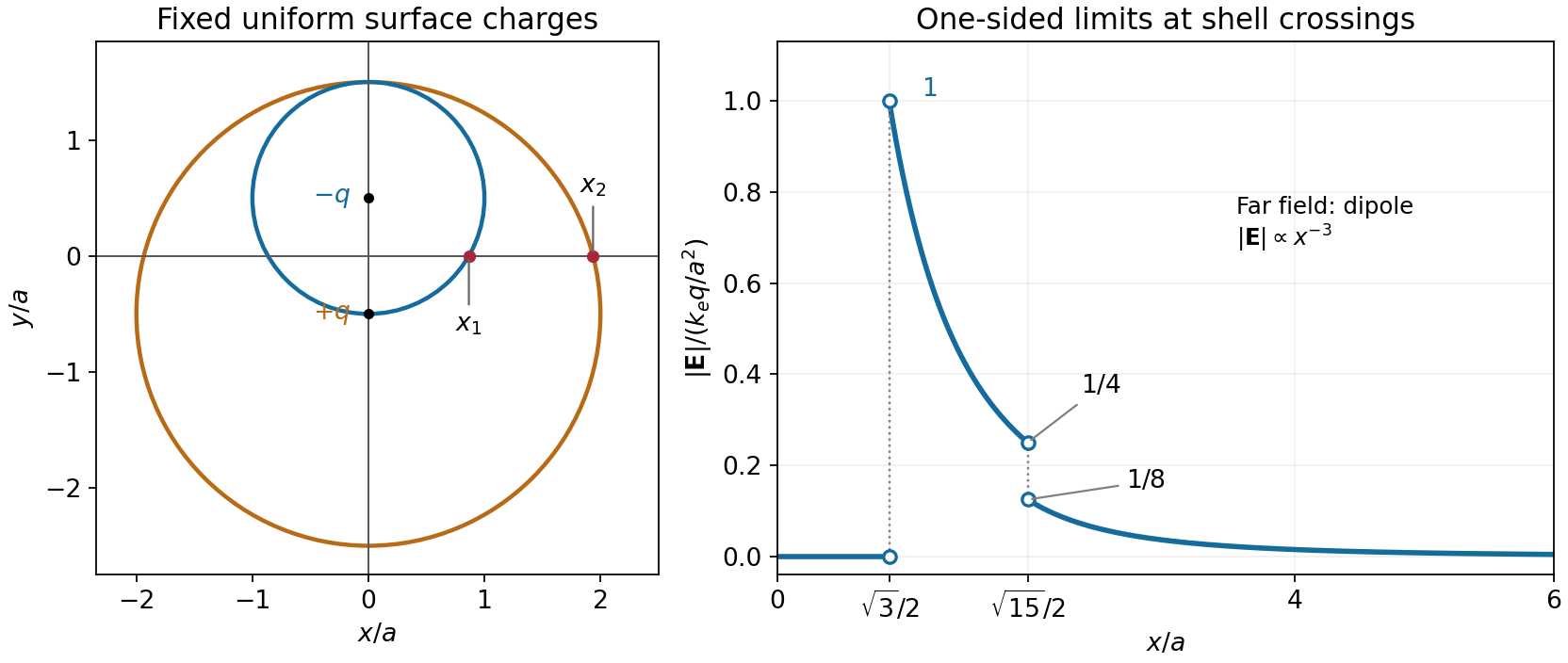
Geometry and electric-field magnitude for the two offset charged shells
. The open endpoints give the one-sided limits at the two surface crossings. The field is zero inside both shells and has a dipolar far-field tail. Details. Past exam of the physics 2 paper of the University of Oxford 2014 resit 8 2 Solution by Codex 0 2026-10-25
Codex 0 2026-10-25Put charges and on the concentric conductors. Gauss's law gives between them, . The potential difference isThe capacitance of this vacuum spherical capacitor is thereforeThe conductors are equipotentials; a uniform dielectric filling would replace by its permittivity.
Past exam of the physics 2 paper of the University of Oxford 2014 resit 8 1 Solution by Codex 0 2026-10-25
Codex 0 2026-10-25In matter, Gauss's law for free electric charge isThe area normal points out of . In vacuum , so these become and .
Past exam of the physics 2 paper of the University of Oxford 2014 resit 7 b Solution by Codex 0 2026-10-25
Codex 0 2026-10-25At the largest admitted orbit, and . ConsequentlyUsing and with the specified and yieldsThis is about ; the displayed results use the nonrelativistic approximation explicitly requested by the paper. The drive amplitude controls the energy gain per gap crossing and hence the number of turns, but the ideal orbit-radius limit is set by and .
Past exam of the physics 2 paper of the University of Oxford 2014 resit 7 a Solution by Codex 0 2026-10-25
Codex 0 2026-10-25For a proton, the fundamental cyclotron resonance condition isA half-orbit takes , during which the applied voltage reverses sign once. The proton then crosses the gap in the opposite direction and receives another accelerating impulse. The electric force in the gap, rather than the magnetic bending inside a dee, provides the kinetic energy. The injection phase must be chosen so the first crossing accelerates the proton.
Past exam of the physics 2 paper of the University of Oxford 2014 resit 7 2 Solution by Codex 0 2026-10-25
Codex 0 2026-10-25Take the initial velocity perpendicular to a uniform magnetic field. The magnetic Lorentz force is perpendicular to the motion, has constant magnitude , and supplies the centripetal force:The rotation sense is fixed by . A component of velocity parallel to the field remains constant and produces a helical motion in a uniform magnetic field; a circle requires that component to vanish. The speed-independent cyclotron frequency here assumes nonrelativistic motion.
Past exam of the physics 2 paper of the University of Oxford 2014 resit 7 1 Solution by Codex 0 2026-10-25
Codex 0 2026-10-25The Lorentz force law isIts rate of work is , because . Thus, with , the kinetic energy cannot increase: a static magnetic field changes the direction of motion but does no work.
Pinned article: Introduction to the OurBigBook Project
Welcome to the OurBigBook Project! Our goal is to create the perfect publishing platform for STEM subjects, and get university-level students to write the best free STEM tutorials ever.
Everyone is welcome to create an account and play with the site: ourbigbook.com/go/register. We belive that students themselves can write amazing tutorials, but teachers are welcome too. You can write about anything you want, it doesn't have to be STEM or even educational. Silly test content is very welcome and you won't be penalized in any way. Just keep it legal!
Intro to OurBigBook
. Source. We have two killer features:
- topics: topics group articles by different users with the same title, e.g. here is the topic for the "Fundamental Theorem of Calculus" ourbigbook.com/go/topic/fundamental-theorem-of-calculusArticles of different users are sorted by upvote within each article page. This feature is a bit like:
- a Wikipedia where each user can have their own version of each article
- a Q&A website like Stack Overflow, where multiple people can give their views on a given topic, and the best ones are sorted by upvote. Except you don't need to wait for someone to ask first, and any topic goes, no matter how narrow or broad
This feature makes it possible for readers to find better explanations of any topic created by other writers. And it allows writers to create an explanation in a place that readers might actually find it.
Figure 1. Screenshot of the "Derivative" topic page. View it live at: ourbigbook.com/go/topic/derivativeVideo 2. OurBigBook Web topics demo. Source. - local editing: you can store all your personal knowledge base content locally in a plaintext markup format that can be edited locally and published either:This way you can be sure that even if OurBigBook.com were to go down one day (which we have no plans to do as it is quite cheap to host!), your content will still be perfectly readable as a static site.
- to OurBigBook.com to get awesome multi-user features like topics and likes
- as HTML files to a static website, which you can host yourself for free on many external providers like GitHub Pages, and remain in full control

Figure 2. You can publish local OurBigBook lightweight markup files to either OurBigBook.com or as a static website.
Figure 3. Visual Studio Code extension installation.
Figure 5. . You can also edit articles on the Web editor without installing anything locally. Video 3. Edit locally and publish demo. Source. This shows editing OurBigBook Markup and publishing it using the Visual Studio Code extension. 
- Infinitely deep tables of contents:



All our software is open source and hosted at: github.com/ourbigbook/ourbigbook
Further documentation can be found at: docs.ourbigbook.com
Feel free to reach our to us for any help or suggestions: docs.ourbigbook.com/#contact