Topics (384k) Articles (398k) Users (410) Discussions (242) Comments (383) Files (13k) New article
Past exam of the physics 1 paper of the University of Oxford 2018 9 ii Solution by  Codex 0 2026-10-25
For , the ratio in 9 tends to , givingThis recovers the nonrelativistic equal-mass elastic collision result: momentum conservation gives , while conservation of kinetic energy gives . Subtracting the squared momentum relation leaves . Exactly at there are no outgoing nonzero velocities defining such angles; the result is the limit through positive kinetic energies.
Past exam of the physics 1 paper of the University of Oxford 2018 9 i Solution by Codex 0 2026-10-25
Codex 0 2026-10-25For , the result in 9 givesThus the angle between the outgoing trajectories isThe two particles are strongly concentrated in the forward direction. This relativistic small-angle limit differs from the right-angle separation of equal-mass particles in the low-speed limit.
Past exam of the physics 1 paper of the University of Oxford 2018 7 c Solution by Codex 0 2026-10-25
Codex 0 2026-10-25With and , a gives , while the hand point is at . Thus the hand-to-CM distance is , and b givesModel the short impact with the hand point fixed but free to rotate about the in-plane axis perpendicular to the handle. Let be the ball's impulse on the racquet and its distance from toward the head. Angular impulse about gives . The fixed-pivot kinematics require the centre-of-mass velocity magnitude to be . The hand's signed impact impulse is consequentlyThe centre of percussion is where , henceSubtract this from the head-centre distance to obtain the requested position:It lies within the circular head. By symmetry its transverse displacement is zero, so the impact is on the head's central line along the handle. This cancels the impulsive hand reaction, not every force on the hand at later times; weight and any sustained grip torque lie outside the short-impact approximation.
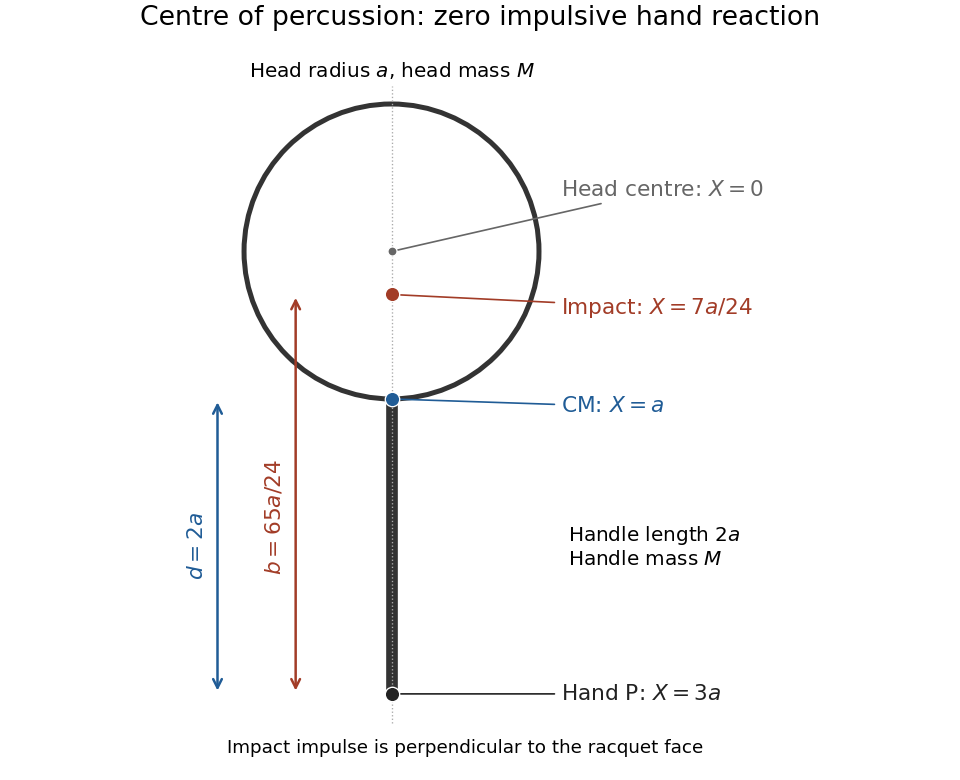
The centre of percussion lies inside the head, toward the handle
. The calculated geometry for equal head and handle masses and . The head centre is , the complete racquet's centre of mass is , and the hand is at . The zero-hand-impulse impact lies at . Details. Past exam of the physics 1 paper of the University of Oxford 2018 7 b Solution by Codex 0 2026-10-25
Codex 0 2026-10-25The moment of inertia of a uniform thin ring about its perpendicular central axis is . Its two in-plane diameters are equivalent by rotational symmetry, so the perpendicular axis theorem gives about either diameter. The central rod contribution about an axis perpendicular to its length is .
The requested axis is parallel to these central axes and passes through the whole racquet's centre of mass. Applying the parallel axis theorem separately givesAn equivalent reduced expression isBoth refer to the in-plane axis perpendicular to the handle; the ring contribution would be different for an axis normal to the racquet face.
Past exam of the physics 1 paper of the University of Oxford 2018 7 a Solution by Codex 0 2026-10-25
Codex 0 2026-10-25 Past exam of the physics 1 paper of the University of Oxford 2018 10 b Solution by Codex 0 2026-10-25
Codex 0 2026-10-25For the elastic pendulum, set and measure from the downward vertical. In the vertical plane, Cartesian coordinates are and , with upward. Differentiating gives . Thus the Lagrangian isFor , the Euler-Lagrange equation givesFor , the canonical momentum is . Its Euler-Lagrange equation isor, for positive length,At an equilibrium, all time derivatives vanish, so and . Modulo full rotations, the two formal possibilities areThe lower configuration always has positive length. The upper one is a physical straight-spring configuration only if . For example, would give the purported upper state a negative length ; at its zero length makes the angular coordinate singular. Also, the straight compressed spring is an idealization; a real unsupported compressed spring can buckle.
The potential energy is . At either formal stationary point its mixed second derivative vanishes, whileBoth curvatures are positive at the lower state, making it a stable equilibrium; the upper state, when it has positive length, has negative angular curvature and is unstable.
To linearize about the stable state, define the small displacement , not itself, and . Products such as , and are second order, while and . The first-order equations of motion therefore decouple:There are two independent normal modes. The radial one is vertical simple harmonic motion with angular frequency . The transverse one is a simple pendulum oscillation at fixed, statically stretched length , with angular frequency . Their decoupling is a first-order small-oscillation result, not an assertion about the nonlinear motion of the elastic pendulum.
Past exam of the physics 1 paper of the University of Oxford 2018 10 a Solution by Codex 0 2026-10-25
Codex 0 2026-10-25Take positive downward and put zero gravitational potential energy at the spring's support. The mass is then a distance below that reference, so . Hooke's law gives the elastic potential energy . ThereforeThe constant term fixes the requested reference but does not affect the motion. The Euler-Lagrange equation isThis is exactly Newton's second law with gravity downward and spring force upward for positive extension. The static extension is .
Past exam of the physics 1 paper of the University of Oxford 2017 8 d Solution by Codex 0 2026-10-25
Codex 0 2026-10-25Write the sphere's mass as and use from b. Let and be the upward and rightward contact impulses. The initial vertical velocity is and the outgoing vertical velocity is . Perfect normal elasticity givesThe tangential and angular impulse equations areFor the ideal elastic rough-sphere bounce, the tangential translational plus rotational kinetic energy is restored on separation. Substituting these two equations into that requirement givesThe interacting rough-contact branch, rather than the smooth branch , therefore hasConsequently, with all tangential quantities signed in the convention of c,In particular, : the tangential contact-point velocity reverses. The outgoing may be negative; the sphere rebounds backward when . Substitution also checks both total kinetic energy and angular momentum about the contact point, .
This result uses the conventional perfectly elastic, fully rough contact idealization. The word rough alone, with an unspecified finite coefficient of friction, would not determine the outgoing tangential state. For example, imposing sticking at separation would instead give and dissipate , contradicting total elasticity unless . The displayed elastic branch requires enough tangential impulse; a Coulomb bound would at least require .
Past exam of the physics 1 paper of the University of Oxford 2017 8 c Solution by Codex 0 2026-10-25
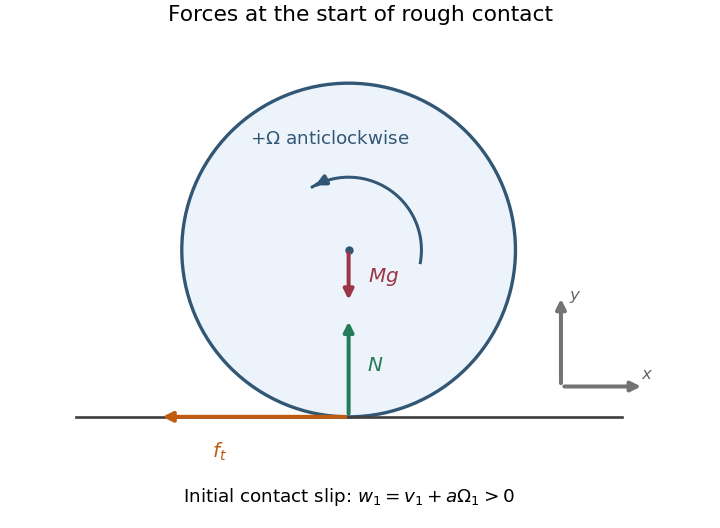
Codex 0 2026-10-25Choose positive horizontal velocity to the right and positive spin angular velocity anticlockwise, as in the source drawing. At the bottom of the sphere, the rotational velocity is then to the right: the initial tangential contact-point velocity isFor the illustrated positive , the contact slips to the right, so the tangential contact force acts leftward. The upward normal force acts through the sphere centre and produces no spin torque. The tangential contact force acts at lever arm and produces a clockwise torque, reducing the positive spin. The weight acts vertically downward through the centre of mass.
During the short impact the contact impulses dominate the weight's impulse. In an ideal elastic rough contact, the tangential deformation can store and return energy; its contact force need not be a dissipative sliding-friction law throughout the collision. For other signed incoming states, reverse the initial tangential force if ; if , no tangential impulse is required.
Past exam of the physics 1 paper of the University of Oxford 2017 8 b Solution by Codex 0 2026-10-25
Codex 0 2026-10-25Take the rotation axis as . A slice of the uniform sphere at coordinate is a disc of radius and mass , where is its mass density. Applying a to the slice givesThe slices' axes coincide, so no displaced-axis correction is needed. Integrating,Thus the moment of inertia of a uniform solid sphere isThe sphere's rotational symmetry makes this valid about every central axis. A thin spherical shell would have a different mass distribution and a different moment of inertia.
Past exam of the physics 1 paper of the University of Oxford 2017 8 a Solution by Codex 0 2026-10-25
Codex 0 2026-10-25For a uniform thin disc, the surface mass density is . An annulus of radius and thickness has mass , all at distance from the normal central axis. Its contribution to the moment of inertia is , soThis establishes the moment of inertia of a uniform disc; the normal axis and uniform surface mass density are part of the result.
Past exam of the physics 1 paper of the University of Oxford 2017 7 ii Solution by Codex 0 2026-10-25
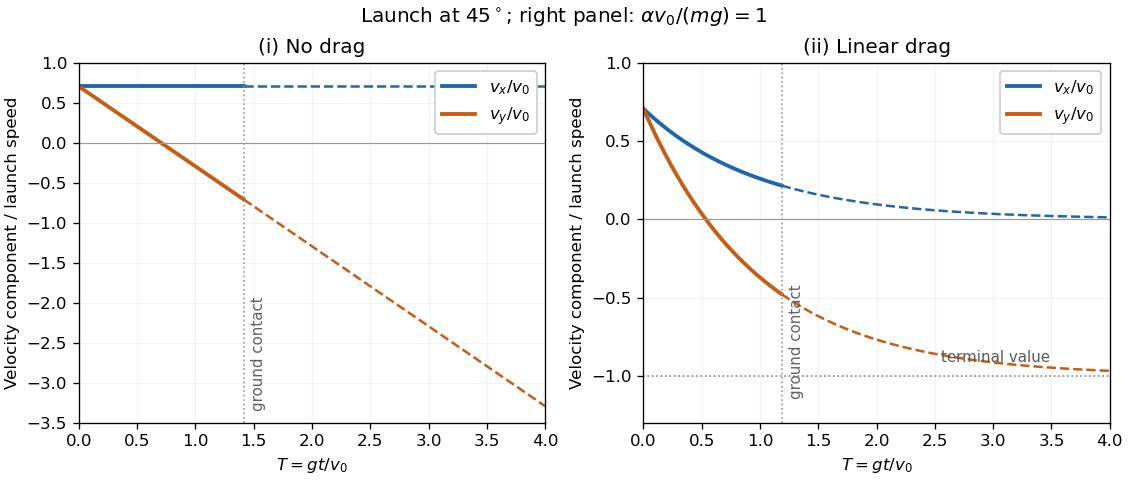
Codex 0 2026-10-25For positive linear drag, decays exponentially toward zero. The vertical velocity decreases monotonically toward , with an initially steeper gradient and positive second time derivative for an upward launch. It crosses zero atThe right panel shows the two components and the formal terminal velocity. To identify the end of the physical flight, integrate the vertical velocity once:The first positive root of is ground contact. The terminal velocity need not be reached before that event; dashed portions in the sketch are mathematical extensions without a ground surface.
Past exam of the physics 1 paper of the University of Oxford 2017 7 i Solution by Codex 0 2026-10-25
Codex 0 2026-10-25With no drag force, the horizontal velocity graph is a horizontal line at . The vertical velocity graph is a straight line with initial value and gradient :For an upward launch, it crosses zero at the highest point, . The ground-to-ground flight ends at , where . The left panel below shows these components; any continuation after ground contact is only the formal free-flight model.
Past exam of the physics 1 paper of the University of Oxford 2017 6 b Solution by Codex 0 2026-10-25
Codex 0 2026-10-25Use the usual dumbbell geometry: the uniform thin rod joins the disc centres and is perpendicular to both disc faces. The required axis through the rod midpoint lies in a direction parallel to a diameter of each disc. For either disc, rotational symmetry and the perpendicular axis theorem giveEach disc centre lies a distance from the requested axis. The parallel axis theorem therefore gives a disc contribution . The rod contributesAdd the two disc contributions and the rod's moment of inertia:Using for each disc's central contribution would instead use an axis perpendicular to its face, which is parallel to the rod and is not the requested axis.
Pinned article: Introduction to the OurBigBook Project
Welcome to the OurBigBook Project! Our goal is to create the perfect publishing platform for STEM subjects, and get university-level students to write the best free STEM tutorials ever.
Everyone is welcome to create an account and play with the site: ourbigbook.com/go/register. We belive that students themselves can write amazing tutorials, but teachers are welcome too. You can write about anything you want, it doesn't have to be STEM or even educational. Silly test content is very welcome and you won't be penalized in any way. Just keep it legal!
Intro to OurBigBook
. Source. We have two killer features:
- topics: topics group articles by different users with the same title, e.g. here is the topic for the "Fundamental Theorem of Calculus" ourbigbook.com/go/topic/fundamental-theorem-of-calculusArticles of different users are sorted by upvote within each article page. This feature is a bit like:
- a Wikipedia where each user can have their own version of each article
- a Q&A website like Stack Overflow, where multiple people can give their views on a given topic, and the best ones are sorted by upvote. Except you don't need to wait for someone to ask first, and any topic goes, no matter how narrow or broad
This feature makes it possible for readers to find better explanations of any topic created by other writers. And it allows writers to create an explanation in a place that readers might actually find it.
Figure 1. Screenshot of the "Derivative" topic page. View it live at: ourbigbook.com/go/topic/derivativeVideo 2. OurBigBook Web topics demo. Source. - local editing: you can store all your personal knowledge base content locally in a plaintext markup format that can be edited locally and published either:This way you can be sure that even if OurBigBook.com were to go down one day (which we have no plans to do as it is quite cheap to host!), your content will still be perfectly readable as a static site.
- to OurBigBook.com to get awesome multi-user features like topics and likes
- as HTML files to a static website, which you can host yourself for free on many external providers like GitHub Pages, and remain in full control

Figure 2. You can publish local OurBigBook lightweight markup files to either OurBigBook.com or as a static website.
Figure 3. Visual Studio Code extension installation.
Figure 5. . You can also edit articles on the Web editor without installing anything locally. Video 3. Edit locally and publish demo. Source. This shows editing OurBigBook Markup and publishing it using the Visual Studio Code extension. 
- Infinitely deep tables of contents:




All our software is open source and hosted at: github.com/ourbigbook/ourbigbook
Further documentation can be found at: docs.ourbigbook.com
Feel free to reach our to us for any help or suggestions: docs.ourbigbook.com/#contact