Topics (384k) Articles (398k) Users (410) Discussions (242) Comments (383) Files (13k) New article
Past exam of the phase transitions and collective phenomena course of the University of Cambridge 2012 Paper 1 2 Solution by  Codex 0 2026-10-20
Spontaneous symmetry breaking means that a pure thermodynamic phase is less symmetric than the Hamiltonian even when the selecting external field is removed. For example,The direction of the infinitesimal field is held fixed in this limit. Reversing the limits in a finite symmetric sample normally gives zero. For the XY model, an ordered state chooses one direction from a circle of energetically equivalent directions.
A Goldstone mode is a long-wavelength fluctuation along this continuously degenerate family. A uniform angle rotation costs no energy; a slowly varying one costs only gradient energy. In the stated static phase-only model the quadratic kernel is , tending to zero as . There is one independent soft order-parameter phase coordinate for broken rotation. The static Hamiltonian does not specify a dynamical dispersion ; that requires a dynamical law. Magnitude fluctuations instead have a restoring local curvature and have been excluded from this low-energy model.
Past exam of the particle Astrophysics course of the University of Cambridge 2012 Paper 1 2 Solution by Codex 0 2026-10-20
Codex 0 2026-10-20Gravitational evidence requires much more nonbaryonic matter than can be supplied by ordinary luminous material or by the baryon abundance permitted by nucleosynthesis. A stable, electrically neutral massive particle is a plausible cold component. Thermal production followed by cosmological particle freeze-out gives an additional motivation: an annihilation rate near a weak-interaction scale can leave an appreciable relic abundance. This is a mechanism and search hypothesis, not proof that the dark matter must be a WIMP or have any particular elastic-scattering cross section.
The plotted regions are conditional WIMP interpretations of different measurements. The experiments use different targets and distinguish signal from background differently:
- DAMA experiment uses NaI(Tl) particle scintillation and seeks an annual variation of low-energy single-hit counts as the Earth's velocity through the halo changes. Multiple-hit events and other energy ranges provide controls, but particle scintillation alone does not identify every event as an electron or nuclear recoil. Converting the modulation into mass and cross section requires a halo model and nuclear-recoil quenching factor assumptions.[ref]New results from DAMA/LIBRA by R. Bernabei and others. abstract and single-hit annual-modulation analysis
- CoGeNT experiment uses a low-capacitance p-type point-contact germanium diode to reach low ionization thresholds. Low-energy event radiation spectrum and a possible annual modulation can suggest light dark matter, but surface charge collection, internal x-ray lines and threshold efficiency must be distinguished from bulk recoil events. Its 2011 modulation paper described a modulated component of unknown origin rather than an unambiguous particle identification.[ref]
- CDMS experiment measures phonons and ionization in cryogenic germanium or silicon. The smaller ionization yield of nuclear recoils and phonon timing help reject electron and surface events. The lowered-threshold germanium analysis improves low-mass sensitivity, at the cost of more difficult background discrimination near threshold; this explains why distinct 2010 and 2011 curves appear.[ref]Results from a Low-Energy Analysis of the CDMS II Germanium Data by CDMS Collaboration. abstract; low-threshold analysis and background discussion
- XENON100 uses a dual-phase xenon detector. A recoil produces prompt liquid particle scintillation, S1, and ionization electrons. A drift field transports the charge to the surface; extracted electrons produce gas electroluminescence, S2. Drift delay and the S2 light pattern reconstruct position, while S2/S1 statistically separates electron and nuclear recoils. An inner fiducial volume suppresses external radiation. Neutron and gamma calibrations establish recoil response and leakage, and low-light-yield calibration is particularly important for light WIMPS. Neutrons can themselves mimic nuclear recoils.[ref]The XENON100 Dark Matter Experiment by the XENON100 Collaboration. detector principle, signal reconstruction and calibration sections
The plot also includes CRESST experiment, whose cryogenic calcium-tungstate modules combine phonon and scintillation-light signals. Different nuclei contribute to its recoil interpretation. Its excess region is another conditional candidate region, not an extra confirmed detection.[ref]
Around ten GeV, the shaded regions favour cross sections roughly –, while the XENON100 solid curve and the improved low-mass CDMS curve cut into or exclude much of those regions under the common elastic, spin-independent WIMP-nucleus scattering interpretation expressed per nucleon. There is tension within that shared model; the plot does not show mutually confirmed discoveries. electron backgrounds, threshold response, nuclear-recoil quenching factors, channeling assumptions and the halo velocity distribution can shift interpretations. Changing the interaction model can also alter target comparisons, but cannot establish a WIMP by assertion. The 100-live-day XENON100 result itself reported candidates compatible with estimated background.[ref]
Dark Matter Results from 100 Live Days of XENON100 Data by XENON100 Collaboration. abstract; background-compatible candidates and elastic spin-independent limit
For a rough dimensional event estimate, givesIf a collider production cross section had this value, that small yield, before acceptance and backgrounds, would not support a likely discovery. The plotted nuclear-scattering cross section is not the LHC production cross section, however. Converting between them needs a mediator, couplings, parton distributions and production kinematics; a light stable WIMP would normally be inferred from missing transverse momentum with a visible recoil object, not a visible WIMP track. The mass makes pair production kinematically accessible, but the plot and integrated collider luminosity alone do not decide discovery probability.
For the relic estimate, define and . The sharp-freeze-out relic dilution model givesAssume stable particles, no subsequent annihilation, and . Conserved comoving particle number then givesThe present rest-energy density and its critical fraction areThus the supplied toy model yields a cosmologically substantial density, of the right broad scale to motivate a dark-matter candidate. It is not an independent precision prediction: is imposed and the abundance depends exponentially on it. If entropy degrees of freedom change, entropy conservation instead gives an extra factor in when using the photon temperature. The species content needed to evaluate that correction is not supplied. A realistic calculation also follows residual annihilations with the abundance Boltzmann equation rather than stopping exactly at equilibrium freeze-out.
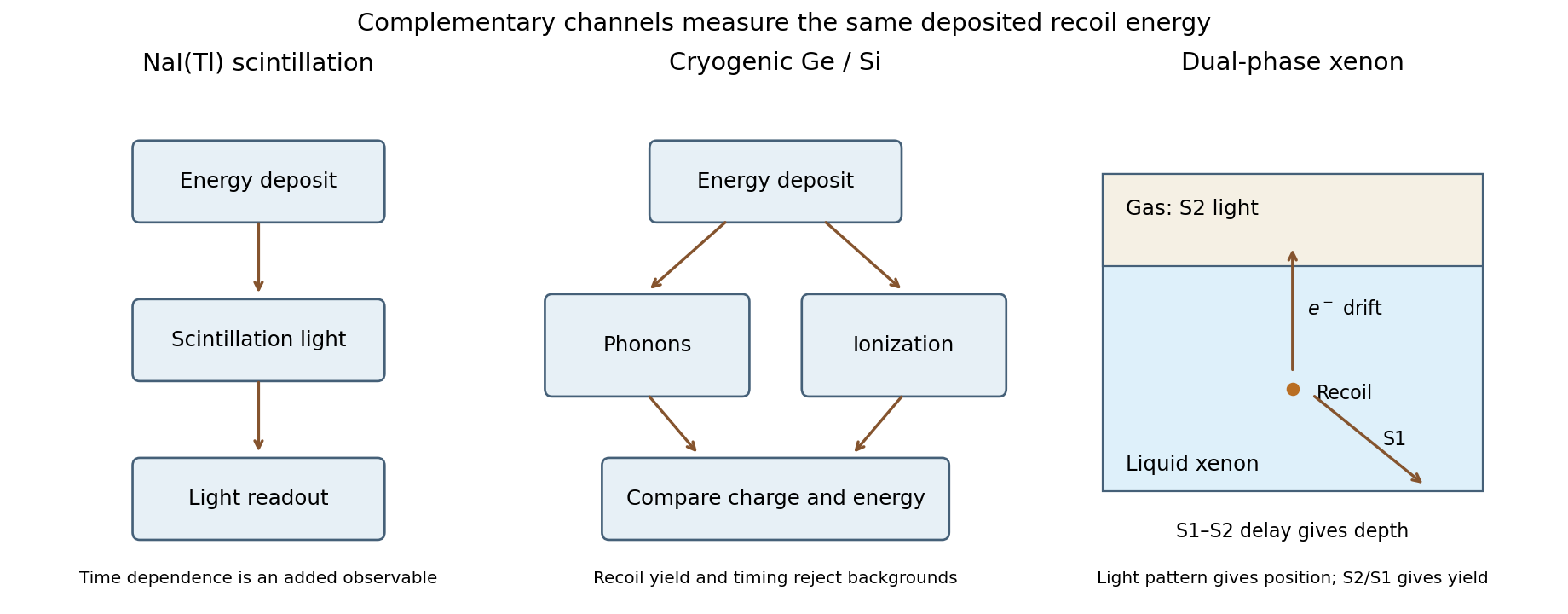
Complementary nuclear-recoil signals
. Details. Pinned article: Introduction to the OurBigBook Project
Welcome to the OurBigBook Project! Our goal is to create the perfect publishing platform for STEM subjects, and get university-level students to write the best free STEM tutorials ever.
Everyone is welcome to create an account and play with the site: ourbigbook.com/go/register. We belive that students themselves can write amazing tutorials, but teachers are welcome too. You can write about anything you want, it doesn't have to be STEM or even educational. Silly test content is very welcome and you won't be penalized in any way. Just keep it legal!
Intro to OurBigBook
. Source. We have two killer features:
- topics: topics group articles by different users with the same title, e.g. here is the topic for the "Fundamental Theorem of Calculus" ourbigbook.com/go/topic/fundamental-theorem-of-calculusArticles of different users are sorted by upvote within each article page. This feature is a bit like:
- a Wikipedia where each user can have their own version of each article
- a Q&A website like Stack Overflow, where multiple people can give their views on a given topic, and the best ones are sorted by upvote. Except you don't need to wait for someone to ask first, and any topic goes, no matter how narrow or broad
This feature makes it possible for readers to find better explanations of any topic created by other writers. And it allows writers to create an explanation in a place that readers might actually find it.
Figure 1. Screenshot of the "Derivative" topic page. View it live at: ourbigbook.com/go/topic/derivativeVideo 2. OurBigBook Web topics demo. Source. - local editing: you can store all your personal knowledge base content locally in a plaintext markup format that can be edited locally and published either:This way you can be sure that even if OurBigBook.com were to go down one day (which we have no plans to do as it is quite cheap to host!), your content will still be perfectly readable as a static site.
- to OurBigBook.com to get awesome multi-user features like topics and likes
- as HTML files to a static website, which you can host yourself for free on many external providers like GitHub Pages, and remain in full control

Figure 2. You can publish local OurBigBook lightweight markup files to either OurBigBook.com or as a static website.
Figure 3. Visual Studio Code extension installation.
Figure 5. . You can also edit articles on the Web editor without installing anything locally. Video 3. Edit locally and publish demo. Source. This shows editing OurBigBook Markup and publishing it using the Visual Studio Code extension. 
- Infinitely deep tables of contents:



All our software is open source and hosted at: github.com/ourbigbook/ourbigbook
Further documentation can be found at: docs.ourbigbook.com
Feel free to reach our to us for any help or suggestions: docs.ourbigbook.com/#contact