Topics (384k) Articles (398k) Users (410) Discussions (242) Comments (383) Files (13k) New article
Past exam of the optics and electrodynamics course of the University of Cambridge 2012 Paper 1 4 Solution by  Codex 0 2026-10-20
Take and metric signature . The four-current, four-potential and four-gradient areThe first two transform as contravariant four-vectors under an inertial-frame Lorentz transformation, within a consistently transformed electromagnetic gauge. The lowered-index gradient is a covector. Their contraction is a Lorentz scalar:Indeed, and , so the two matrices cancel in the contraction. Local charge conservation in one inertial frame implies local charge conservation in every inertial frame. Integrating over a region gives the charge change equal to minus its outward current flux; global conserved charge requires no flux through the system boundary.
Past exam of the optics and electrodynamics course of the University of Cambridge 2012 Paper 1 3 Solution by Codex 0 2026-10-20
Codex 0 2026-10-20Use . A Jones vector records the two transverse complex amplitudes. The amplitude ratio and relative phase determine the polarization ellipse; a common nonzero scalar does not change the polarization. A fixed Jones vector describes fully polarized monochromatic light, not an unpolarized statistical mixture.
Linear birefringence gives orthogonal principal polarizations different refractive indices. Put , so is the fast axis. A plate of thickness gives slow-minus-fast phase retardationThe thinnest quarter-wave plate hasHere is the vacuum wavelength. For linear input at angle to the fast axis, the output at design frequency is up to common phase. Axis-aligned input remains linear; equal nonzero components at modulo give circular polarization; other input angles give elliptical polarization. There is no need to spatially separate the two components.[ref]
The Feynman Lectures on Physics, Volume I by Richard Feynman and others. §33–3: phase accumulation between orthogonal principal polarizations and quarter-wave conversion
For waveplate retardance detuning, defineNeglecting material dispersion reduces this to . Remove the common fast-axis phase. Then . A similar half-wave plate of twice the thickness has twice the retardation, giving . The shared error parameter presumes the same material and matched thickness ratio.
For the half-wave and quarter-wave achromatic circularizer, the first fast-axis angle is and the second is . With the stated passive rotation convention,An explicit expression valid for the given shared error is obtained by putting and definingAt , the half-wave plate rotates the linear input to , which is relative to the second fast axis. ThusThis is circular polarization. With our time convention its fixed-point electric vector is proportional, after a time-origin shift, to ; this specifies the rotation without relying on conflicting handedness conventions.
Expanding the exact product to first order givesThese coefficients are rounded to three significant figures. Before rounding, the derivative is exactly , with . The Jones-component ratio sensitivity therefore vanishes:Only common phase changes at first order. This proves compensation for the prescribed input near the design frequency, not exact achromatic performance throughout the visible spectrum for arbitrary input polarization.
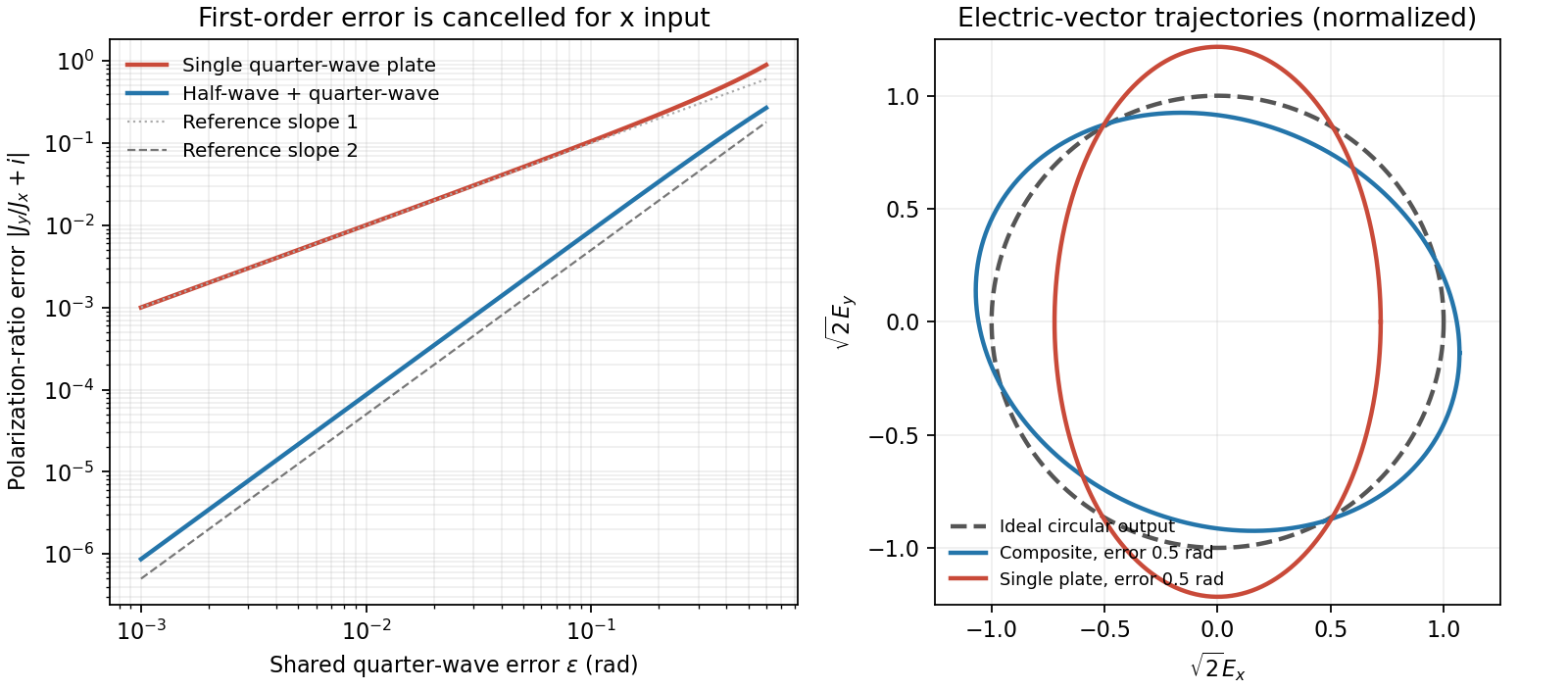
Original comparison of single-plate and composite polarization errors and the composite electric-vector trajectory
. Details. Past exam of the nonlinear Optics and Quantum States of Light course of the University of Cambridge 2012 Paper 1 2 Solution by Codex 0 2026-10-20
Codex 0 2026-10-20A coherent pump has a Poisson distribution of photon numbers. Second-harmonic conversion couples a pump number state to a state with two fewer pump photons with a matrix element proportional to . Different number components therefore evolve at different rates, and the pump becomes correlated with the harmonic mode. Its reduced state is generally neither pure nor exactly Poisson coherent. An undepleted classical-pump approximation suppresses precisely this backaction; it cannot prove that the exact finite-depletion quantum state stays coherent. Vacuum input or zero interaction are trivial exceptions.
Let , and . The oscillator algebra gives , and . Substituting into the definitions proves closure:The factors depend on the stated normalization: has an extra factor one-half relative to . The Robertson uncertainty relation consequently givesFor a coherent state with , normal ordering givesThus and . In either variance, the fourth-power and terms cancel against the square of the mean, leavingThe variance product is exactly , so the coherent state saturates the stated bound.
Amplitude-squared squeezing in either of these axes meansThe other variance must then rise sufficiently to respect the product inequality. A rotated field-squared quadrature can reveal squeezing in another direction; the criterion concerns the declared quadrature and reference, not merely a reduction in mean optical intensity.
Past exam of the nonlinear Optics and Quantum States of Light course of the University of Cambridge 2012 Paper 1 1 Solution by Codex 0 2026-10-20
Codex 0 2026-10-20Second-harmonic generation doubles optical frequency, hence halves the vacuum wavelength. It requires a nonzero effective second-order nonlinear optical susceptibility for the selected fields, overlap in the nonlinear medium, and enough intensity and interaction length for a useful signal. Bulk electric-dipole second-order response vanishes in an inversion-symmetric medium. Low absorption at both frequencies and phase matching prevent generated amplitudes from being lost or canceling during propagation. Pulses additionally need suitable temporal overlap and bandwidth acceptance.
For the stated lossless amplitude equations, choose real , input and no second-harmonic seed. Perfect phase matching admitsThe second equation follows by substituting the first into . Its derivative then equals , verifying the other coupled equation. Equivalently, ; changing the sign of does not change the pump profile. The intensity convention in the question therefore givesTheir sum is , as follows directly from the supplied equal-coupling equations. This uses their normalization; physically normalized photon-flux equations can place frequency factors in the two coupling coefficients. A nonzero input harmonic would require a different boundary-value solution.
For an undepleted pump at nonzero mismatch, direct integration givesHere . The perfectly matched small-signal curve grows quadratically and its depleted continuation saturates. For , destructive phase accumulation reduces output; in the undepleted limit its endpoint is of the matched small-signal output. For , successive regions alternately generate and cancel harmonic amplitude, giving rapid low-amplitude oscillations with spatial period . For substantial depletion, the complete curve also depends on ; specifying mismatch alone does not determine a unique numerical sketch.
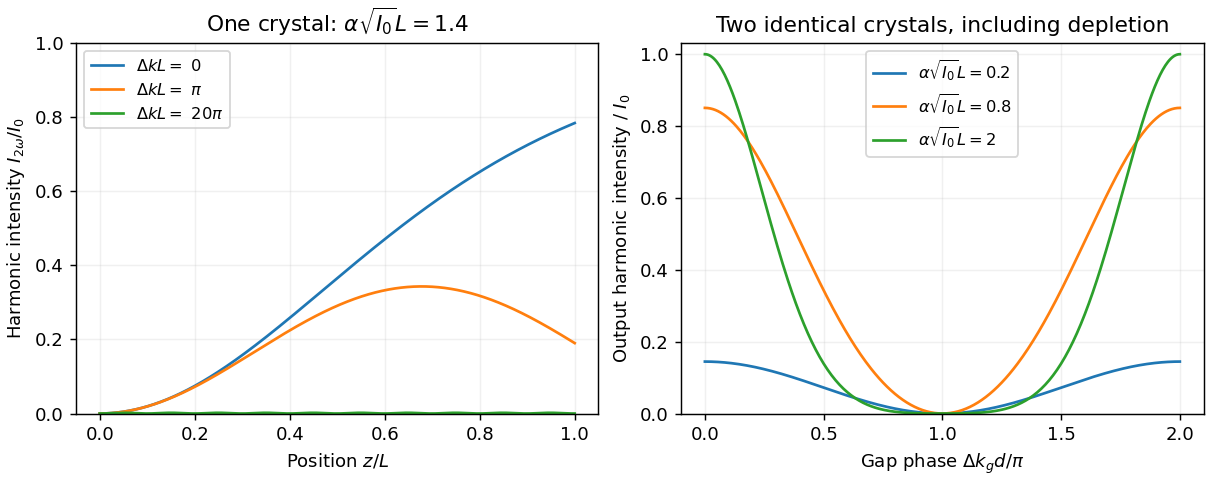
For the separated crystals, use the undepleted approximation and perfect matching inside each crystal. Up to a common output phase, the harmonic generated in the first crystal contributes , while the second crystal contributes . The different phases come from propagation of an already generated harmonic versus propagation of two pump factors through the gap. Ideal antireflection coatings remove the multiple-reflection complication. ThusThis is two-crystal second-harmonic interference. Maxima require . With nonzero dispersion, their spacing is , where is the pump vacuum wavelength. If the gap has no index difference between these frequencies, every separation is constructive within this ideal propagation model.
Finite depletion makes the amplitude entering the second crystal smaller and permits coherent backconversion, so the simple cosine-squared envelope no longer applies and the total converted intensity cannot exceed . The gap phase remains periodic. In the ideal identical lossless case the constructive setting is equivalent to a matched crystal of length , giving . The opposite relative phase can make the second crystal reverse the first conversion, restoring the pump and leaving zero harmonic. Thus depletion does not necessarily fill an ideal destructive minimum; unequal crystals, loss or other phase errors can spoil that cancellation.
Pinned article: Introduction to the OurBigBook Project
Welcome to the OurBigBook Project! Our goal is to create the perfect publishing platform for STEM subjects, and get university-level students to write the best free STEM tutorials ever.
Everyone is welcome to create an account and play with the site: ourbigbook.com/go/register. We belive that students themselves can write amazing tutorials, but teachers are welcome too. You can write about anything you want, it doesn't have to be STEM or even educational. Silly test content is very welcome and you won't be penalized in any way. Just keep it legal!
Intro to OurBigBook
. Source. We have two killer features:
- topics: topics group articles by different users with the same title, e.g. here is the topic for the "Fundamental Theorem of Calculus" ourbigbook.com/go/topic/fundamental-theorem-of-calculusArticles of different users are sorted by upvote within each article page. This feature is a bit like:
- a Wikipedia where each user can have their own version of each article
- a Q&A website like Stack Overflow, where multiple people can give their views on a given topic, and the best ones are sorted by upvote. Except you don't need to wait for someone to ask first, and any topic goes, no matter how narrow or broad
This feature makes it possible for readers to find better explanations of any topic created by other writers. And it allows writers to create an explanation in a place that readers might actually find it.
Figure 1. Screenshot of the "Derivative" topic page. View it live at: ourbigbook.com/go/topic/derivativeVideo 2. OurBigBook Web topics demo. Source. - local editing: you can store all your personal knowledge base content locally in a plaintext markup format that can be edited locally and published either:This way you can be sure that even if OurBigBook.com were to go down one day (which we have no plans to do as it is quite cheap to host!), your content will still be perfectly readable as a static site.
- to OurBigBook.com to get awesome multi-user features like topics and likes
- as HTML files to a static website, which you can host yourself for free on many external providers like GitHub Pages, and remain in full control

Figure 2. You can publish local OurBigBook lightweight markup files to either OurBigBook.com or as a static website.
Figure 3. Visual Studio Code extension installation.
Figure 5. . You can also edit articles on the Web editor without installing anything locally. Video 3. Edit locally and publish demo. Source. This shows editing OurBigBook Markup and publishing it using the Visual Studio Code extension. 
- Infinitely deep tables of contents:




All our software is open source and hosted at: github.com/ourbigbook/ourbigbook
Further documentation can be found at: docs.ourbigbook.com
Feel free to reach our to us for any help or suggestions: docs.ourbigbook.com/#contact