Topics (384k) Articles (398k) Users (410) Discussions (242) Comments (383) Files (13k) New article

An experimental physicist who coauthored a 1997 measurement of sound propagation in a Bose-Einstein condensate. A focused laser beam suddenly changed the trapping potential, launching localized density disturbances. Rapid nondestructive images followed their motion and measured the speed of sound as a function of density, testing the collective excitations predicted by Bogoliubov theory.[ref]
Propagation of Sound in a Bose-Einstein Condensate by M. R. Andrews and others. Abstract, Physical Review Letters 79, 553–556: optical excitation and phase-contrast image sequences
An experimental physicist who led a precision measurement of the hyperfine structure of positronium. The collaboration explicitly measured the bias caused by incomplete thermalization, rather than assuming that newly formed positronium had already reached the gas temperature. Correcting this effect changed the comparison with quantum electrodynamics, illustrating how collision dynamics can limit a precision test of a bound state.[ref]
New Precision Measurement of Hyperfine Splitting of Positronium by A. Ishida and others. Abstract: nonthermalization correction and revised comparison with QED, 2014 version
Anatoly Spitkovsky developed time-dependent calculations of plasma-filled pulsar magnetospheres using the force-free limit, including cases with a tilted magnetic axis. The simulations determine field structure and rotational energy loss while allowing magnetospheric currents and current sheets.[ref]
Time-dependent force-free pulsar magnetospheres: axisymmetric and oblique rotators by Anatoly Spitkovsky. Abstract: numerical method and aligned/oblique rotators
An experimental optical physicist who coauthored a 1986 demonstration of optical squeezed vacuum. Degenerate spontaneous parametric down-conversion inside a cavity produced reduced fluctuations of an optical quadrature, measured with balanced homodyne detection. The result made a noise level below the vacuum reference a directly measured optical property.[ref]
Generation of Squeezed States by Parametric Down Conversion by Ling-An Wu and others. Abstract: cavity down-conversion and below-vacuum homodyne noise
An experimental physicist who coauthored an early optical squeezed vacuum experiment. Its balanced homodyne detection compared the field's optical quadrature fluctuations with vacuum noise. The paper distinguishes observed noise reduction from the larger inferred reduction before optical attenuation, showing why propagation losses matter when quantifying squeezing.[ref]
Generation of Squeezed States by Parametric Down Conversion by Ling-An Wu and others. Author list and abstract: measured squeezing versus inferred pre-attenuation squeezing
An optical physicist who developed frequency-resolved optical gating with Rick Trebino. Their 1993 demonstration used nonlinear self-diffraction in glass to obtain a trace resolved in both delay and frequency. The pulse serves as its own gate, so the experiment does not require a separate, shorter reference pulse whose shape is already known.[ref]
Characterization of arbitrary femtosecond pulses using frequency-resolved optical gating by Daniel J. Kane and Rick Trebino. Abstract: reference-free pulse characterization and self-diffraction demonstration
An optical physicist who coauthored the introduction of frequency-resolved optical gating with Daniel J. Kane. The method records a nonlinear optical signal's spectrum while varying the delay between two input pulses. Reconstruction from this two-dimensional trace yields both intensity and phase, allowing an ultrashort laser pulse to be characterized beyond its duration alone.[ref]
An experimental atomic physicist who measured the Casimir force between conducting surfaces in 1997. His electromechanical apparatus used a torsion pendulum to detect the weak attraction over separations of roughly 0.6–6 micrometres. The experiment tested a consequence of changing the allowed electromagnetic field fluctuations by changing boundaries, connecting quantum electrodynamics to a directly measured mechanical force.[ref]
Demonstration of the Casimir Force in the 0.6 to 6 micrometre Range by S. K. Lamoreaux. Abstract: torsion-pendulum apparatus and comparison with vacuum-stress prediction; 1998 erratum also listed in source record
Lucien Hardy gave an argument against local hidden-variable theories using logical exclusions among two-particle measurement outcomes, rather than a statistical Bell inequality. The structure combines outcomes forbidden by quantum mechanics with another outcome that remains possible: assigning all the relevant local results in advance cannot satisfy these requirements together. His 1992 paper also examined an additional assumption about Lorentz-invariant elements of reality, keeping the role of that assumption explicit in its comparison with quantum mechanics.[ref]
Quantum mechanics, local realistic theories, and Lorentz-invariant realistic theories by Lucien Hardy. Abstract, two-particle inequality-free argument and Lorentz-invariant reality assumption
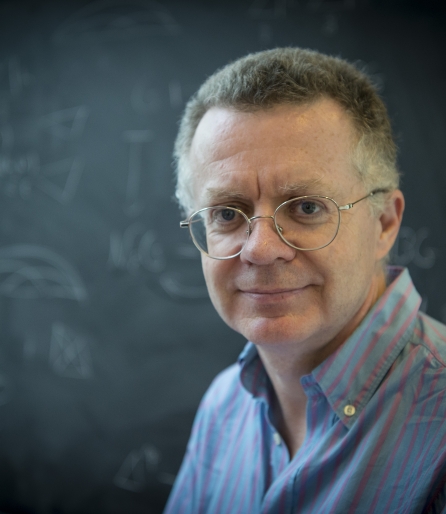
Lucien Hardy; portrait hosted by Perimeter Institute
. Charles H. Bennett and Gilles Brassard proposed quantum key distribution using qubits prepared in two incompatible measurement bases. The sender and receiver disclose their basis choices and retain events with matching bases; they test a sample for disturbance before deriving a key. A simple intercept-and-resend attack illustrates the principle: an eavesdropper choosing a random one of the two bases chooses incorrectly half the time and then causes a wrong retained bit half the time, giving a error rate. This example is an attack analysis, rather than a complete security proof.[ref]
Quantum cryptography: Public key distribution and coin tossing by Charles H. Bennett and Gilles Brassard. 1984 proceedings paper, quantum public-key distribution protocol

Portrait of Charles H. Bennett
. IBM Research. CC BY-SA 2.0, via Wikimedia Commons. Source.Don Eigler and Erhard Schweizer demonstrated controlled positioning of individual atoms with a scanning tunnelling microscope in 1990. Their apparatus moved adsorbed xenon atoms across a nickel crystal surface at 4 kelvin and assembled designed atomic structures. The low temperature limited unwanted atomic motion, while the scanning tunnelling microscope supplied both manipulation and subsequent imaging. This connected the ability to observe single atoms with the ability to build a chosen arrangement of them.[ref]

Portrait of Don Eigler
. AlmadenJenny; own photograph (upload history also names Jenny Hunter). Worldwide public-domain dedication by the copyright holder (PD-self); not a CC license grant., via Wikimedia Commons. Source.An experimental condensed matter physicist who, with Don Eigler, demonstrated controlled positioning of individual xenon chemical atoms on a nickel surface in 1990. Their scanning tunneling microscope operated at 4 K: its tip became a tool for constructing arrangements one chemical atom at a time, extending the instrument's role beyond imaging. This established a practical route to studying deliberately assembled structures on surfaces.[ref]
Positioning single atoms with a scanning tunnelling microscope by Don Eigler and Erhard Schweizer. Abstract: individual xenon atoms, single-crystal nickel, 4 K and atom-by-atom structures
An experimental nuclear physicist who coauthored a 1964 comparison of allowed and unique first-forbidden beta-decay spectrum shapes. A double-lens spectrometer measured the shapes of several isotope spectra, testing whether their energy dependence followed the simplest transition models. The report concerns specific indium, potassium, rubidium, strontium and yttrium isotopes; its conclusions should not be transferred to an arbitrary isotope without checking the transition.[ref]
Shapes of Allowed and Unique First-Forbidden β-Ray Spectra: 114In, 42K, 86Rb, 90Sr, and 90Y by H. Daniel and others. Abstract: double-lens spectrometer and comparison of allowed and unique first-forbidden spectra
Philip Alan Pincus studies the statistical mechanics of polymers. His 1976 scaling argument explains why a long flexible polymer in a good solvent becomes a nonlinear spring when stretched far beyond its equilibrium size. Stretching suppresses the conformations favored by entropy, while excluded volume prevents the chain behaving like an ideal random walk. In the three-dimensional scaling approximation used in that paper, the restoring force grows as the extension to the power , within the strong-extension regime before the chain approaches its full contour length. Thus a weak-extension Hooke's law cannot simply be extrapolated to large extensions.[ref]
Excluded Volume Effects and Stretched Polymer Chains by Philip Alan Pincus. pp. 386–388, abstract and scaling argument for strongly elongated chains
Institutional publication list: mrlweb.mrl.ucsb.edu/~pincus/

Portrait of Philip Alan Pincus
. External portrait hosted by University of California, Santa Barbara. Source.A theoretical physicist who studied quantum correlations in ideal gases with Takafumi Kita. Their fixed-particle-number treatment reproduces fermion antibunching from the Pauli exclusion principle and boson bunching associated with the Hanbury Brown and Twiss effect. It also follows how correlations change through Bose-Einstein condensation, connecting particle statistics to measurable pair-detection behavior.[ref]
Quantum Correlations of Ideal Bose and Fermi Gases in the Canonical Ensemble by Kazumasa Tsutsui and Takafumi Kita. Abstract: one- and two-body correlations, bunching, antibunching and condensation
A theoretical physicist who, with Kazumasa Tsutsui, derived reduced density matrices for ideal Bose gas and Fermi gas systems with fixed particle number. Their 2016 analysis distinguishes the canonical ensemble from familiar grand canonical ensemble applications of Wick's theorem, making explicit which particle-number assumptions enter calculations of quantum correlations.[ref]
Quantum Correlations of Ideal Bose and Fermi Gases in the Canonical Ensemble by Kazumasa Tsutsui and Takafumi Kita. Abstract: canonical reduced density matrices and comparison with grand-canonical Wick factorization
A particle physicist who authored a worked treatment of the Klein paradox for a spin-zero particle. Solving the Klein-Gordon equation at an electrostatic step requires tracking the sign of the charge current, rather than interpreting every transmitted amplitude as an ordinary positive-energy particle. The example connects boundary matching to the appearance of antiparticle and pair-creation interpretations in relativistic quantum theory.[ref]
Klein Paradox for Spin-0 Particles by Douglas M. Gingrich. Equations (4.137)–(4.155) and discussion of signed transmitted current
An experimental condensed matter physicist who coauthored an electrical readout method for electron spin states in a quantum dot. Different tunneling rates map the spin information onto distinguishable charge histories, followed by a fast charge measurement. Unlike simple energy-selective readout, this mechanism can work when the electron temperature exceeds the splitting between the states.[ref]
Single-shot readout of electron spin states in a quantum dot using spin-dependent tunnel rates by R. Hanson and others. Abstract and pp. 1–2: tunnel-rate-selective spin-to-charge conversion
A theoretical condensed matter physicist who coauthored a microscopic study of interacting electrons in an antidot-based interferometer using the Aharonov-Bohm effect. The calculation treats the electrostatic potential self-consistently, linking charge rearrangement and Coulomb blockade to conductance oscillations. It shows why an observed magnetic-field period need not be explained by counting magnetic flux through one rigid geometric area.[ref]
Electron-electron interactions in antidot-based Aharonov-Bohm interferometers by S. Ihnatsenka and others. Abstract and sections I and III: charging, bound states and unexpected oscillation periodicity

Portrait of Thomas Nagel
. Nagelt; cropped by Lykos and converted to greyscale by WikiPedant. CC BY-SA 4.0, via Wikimedia Commons. Source. Pinned article: Introduction to the OurBigBook Project
Welcome to the OurBigBook Project! Our goal is to create the perfect publishing platform for STEM subjects, and get university-level students to write the best free STEM tutorials ever.
Everyone is welcome to create an account and play with the site: ourbigbook.com/go/register. We belive that students themselves can write amazing tutorials, but teachers are welcome too. You can write about anything you want, it doesn't have to be STEM or even educational. Silly test content is very welcome and you won't be penalized in any way. Just keep it legal!
Intro to OurBigBook
. Source. We have two killer features:
- topics: topics group articles by different users with the same title, e.g. here is the topic for the "Fundamental Theorem of Calculus" ourbigbook.com/go/topic/fundamental-theorem-of-calculusArticles of different users are sorted by upvote within each article page. This feature is a bit like:
- a Wikipedia where each user can have their own version of each article
- a Q&A website like Stack Overflow, where multiple people can give their views on a given topic, and the best ones are sorted by upvote. Except you don't need to wait for someone to ask first, and any topic goes, no matter how narrow or broad
This feature makes it possible for readers to find better explanations of any topic created by other writers. And it allows writers to create an explanation in a place that readers might actually find it.
Figure 1. Screenshot of the "Derivative" topic page. View it live at: ourbigbook.com/go/topic/derivativeVideo 2. OurBigBook Web topics demo. Source. - local editing: you can store all your personal knowledge base content locally in a plaintext markup format that can be edited locally and published either:This way you can be sure that even if OurBigBook.com were to go down one day (which we have no plans to do as it is quite cheap to host!), your content will still be perfectly readable as a static site.
- to OurBigBook.com to get awesome multi-user features like topics and likes
- as HTML files to a static website, which you can host yourself for free on many external providers like GitHub Pages, and remain in full control

Figure 2. You can publish local OurBigBook lightweight markup files to either OurBigBook.com or as a static website.
Figure 3. Visual Studio Code extension installation.
Figure 5. . You can also edit articles on the Web editor without installing anything locally. Video 3. Edit locally and publish demo. Source. This shows editing OurBigBook Markup and publishing it using the Visual Studio Code extension. 
- Infinitely deep tables of contents:




All our software is open source and hosted at: github.com/ourbigbook/ourbigbook
Further documentation can be found at: docs.ourbigbook.com
Feel free to reach our to us for any help or suggestions: docs.ourbigbook.com/#contact