Topics (384k) Articles (398k) Users (410) Discussions (242) Comments (383) Files (13k) New article

Rudolf Pietschnig coauthored experimental and computational work on the hydrogen-chloride adduct of trimethylphosphine oxide. The study analyses the polar phosphorus-oxygen sigma bond and interactions involving oxygen lone pairs.
The example shows why a conventional multiple-bond drawing need not identify a unique localized-orbital description. Experimental structure and electronic calculations constrain different aspects of chemical bonds.[ref]
Computational and experimental approaches to the molecular structure of the HCl adduct of Me3PO by Andreas Orthaber and others. Research topic and author attribution in the primary publication
Triphenylphosphine is , a neutral phosphine ligand whose phenyl substituents affect both steric demand and electronic donation.
Jared S. Silvia coauthored synthesis and structural characterization of a molybdenum tricarbonyl coordination complex with a cyclic trimetaphosphate ligand. The isolated material contains an organic counterion.
Crystallographic determination of ligand geometry establishes molecular connectivity, while isolation with a specified counterion establishes which salt was actually obtained. These are complementary experimental claims.[ref]
Synthesis and characterization of the trimetaphosphate molybdenum tricarbonyl anion [(P3O9)Mo(CO)3]3- as its tris(bis(triphenylphosphine)iminium) salt by Christopher R. Clough and others. Research topic and author attribution in the primary publication
Peter Müller coauthored crystallographic characterization of a trimetaphosphate-bound molybdenum tricarbonyl anion. The structure establishes facial oxygen coordination of the phosphate ligand.
The result shows how a cyclic oxyanion can act as a multidentate ligand. Counterion identity and coordination geometry remain distinct parts of the characterization.[ref]
Synthesis and characterization of the trimetaphosphate molybdenum tricarbonyl anion [(P3O9)Mo(CO)3]3- as its tris(bis(triphenylphosphine)iminium) salt by Christopher R. Clough and others. Research topic and author attribution in the primary publication
Christopher C. Cummins investigated cleavage of the strong nitrogen triple bond with a molybdenum complex. In work reported in 1995, two three-coordinate molybdenum complexes reacted with molecular nitrogen to give two molybdenum–nitrogen units. The result provided a molecular example of nitrogen-bond cleavage under mild conditions.[ref]
https://news.mit.edu/1995/nitrogen-0517. MIT News, 17 May 1995: three-coordinate molybdenum complex and nitrogen cleavage
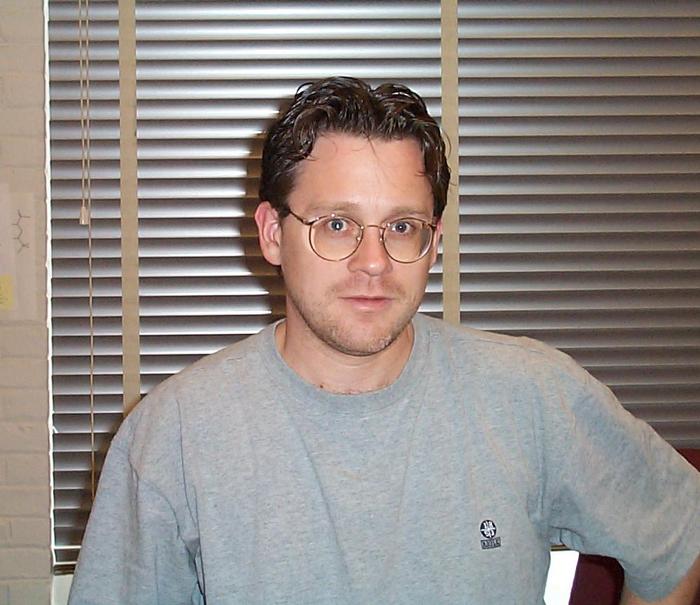
Portrait of Christopher C. Cummins
. External portrait hosted by Massachusetts Institute of Technology, Department of Chemistry. Source.A carbon nanotube comprising one rolled graphene wall. The wrapping indices determine its allowed circumferential electronic wave vectors and therefore its metallic or semiconducting band structure.
, with a linear C–N–N skeleton and a planar carbon environment. Important resonance contributors are and .
, with a linear C–N–N skeleton and a planar carbon environment. Important resonance contributors are and .
, with a linear C–N–N skeleton and a planar carbon environment. Important resonance contributors are and .
E. A. Jeffery investigated how organoaluminium compounds associate through bridging organic groups. The study compared aryl and phenylethynyl bridges, providing an example of a molecular aggregate whose bonding cannot be understood by drawing only isolated monomeric units.[ref]
Organoaluminium compounds. XIII. Association through aryl and phenylethynyl bridges by E. A. Jeffery and others. 1968, printed p.137: summary and introduction
A molecular orbital is a one-electron spatial wavefunction for the combined atomic nuclei of a molecule. For a normalized molecular orbital, the Born rule gives the position probability density , with . The molecular orbital is the amplitude, rather than its squared modulus or a classical trajectory.
Inga Fischer-Hjalmars developed theoretical approaches to chemical bonding, including work with Charles Alfred Coulson on bond dissociation. Stretching a bond tests whether an approximate electronic description can represent the separated fragments correctly.
This links a calculation near equilibrium with its behaviour far from equilibrium. A model that works well near a minimum can fail when a bond breaks and several electronic configurations become important.[ref]
https://www.iaqms.org/obituary/IngaFish-Hjalmar.pdf. IAQMS obituary by Björn Roos, 1947 dissociation collaboration

Portrait of Inga Fischer-Hjalmars
. Via Wikimedia Commons; credits and usage information are on the linked source file page. Source.A restriction on transitions between quantum states for a specified interaction. An electric-dipole selection rule is one example.
Kyoyeon Park investigated singlet state and triplet state potential-energy surfaces for the reaction of molecular oxygen with Ethylene. The calculations distinguish stepwise pathways on a multidimensional energy landscape from a single imposed correlation path.[ref]
Singlet and triplet potential surfaces for the O2+C2H4 reaction by Kyoyeon Park and others. 2010, Journal of Chemical Physics133,184306: singlet/triplet addition surfaces
Lisa F. Frey investigated a carbene-based rearrangement for rapidly assembling substituted fused-ring structures. The synthetic study illustrates how rearranging existing connectivity can create a complex carbon framework in a short sequence.[ref]
Rapid assembly of substituted dihydrocycloheptapyrroloindoles by Lisa F. Frey and colleagues. 2000, Journal of the American Chemical Society122,1215–1216: carbene-based rearrangement
Pinned article: Introduction to the OurBigBook Project
Welcome to the OurBigBook Project! Our goal is to create the perfect publishing platform for STEM subjects, and get university-level students to write the best free STEM tutorials ever.
Everyone is welcome to create an account and play with the site: ourbigbook.com/go/register. We belive that students themselves can write amazing tutorials, but teachers are welcome too. You can write about anything you want, it doesn't have to be STEM or even educational. Silly test content is very welcome and you won't be penalized in any way. Just keep it legal!
Intro to OurBigBook
. Source. We have two killer features:
- topics: topics group articles by different users with the same title, e.g. here is the topic for the "Fundamental Theorem of Calculus" ourbigbook.com/go/topic/fundamental-theorem-of-calculusArticles of different users are sorted by upvote within each article page. This feature is a bit like:
- a Wikipedia where each user can have their own version of each article
- a Q&A website like Stack Overflow, where multiple people can give their views on a given topic, and the best ones are sorted by upvote. Except you don't need to wait for someone to ask first, and any topic goes, no matter how narrow or broad
This feature makes it possible for readers to find better explanations of any topic created by other writers. And it allows writers to create an explanation in a place that readers might actually find it.
Figure 1. Screenshot of the "Derivative" topic page. View it live at: ourbigbook.com/go/topic/derivativeVideo 2. OurBigBook Web topics demo. Source. - local editing: you can store all your personal knowledge base content locally in a plaintext markup format that can be edited locally and published either:This way you can be sure that even if OurBigBook.com were to go down one day (which we have no plans to do as it is quite cheap to host!), your content will still be perfectly readable as a static site.
- to OurBigBook.com to get awesome multi-user features like topics and likes
- as HTML files to a static website, which you can host yourself for free on many external providers like GitHub Pages, and remain in full control

Figure 2. You can publish local OurBigBook lightweight markup files to either OurBigBook.com or as a static website.
Figure 3. Visual Studio Code extension installation.
Figure 5. . You can also edit articles on the Web editor without installing anything locally. Video 3. Edit locally and publish demo. Source. This shows editing OurBigBook Markup and publishing it using the Visual Studio Code extension. 
- Infinitely deep tables of contents:



All our software is open source and hosted at: github.com/ourbigbook/ourbigbook
Further documentation can be found at: docs.ourbigbook.com
Feel free to reach our to us for any help or suggestions: docs.ourbigbook.com/#contact