An particle physicist studies particle physics through mathematical theory, observation or experiment. The field determines the relevant physical systems and measurements, while the individual biographies below connect particular contributions with their scientific ideas.
Dan Pirjol is a researcher whose work spans theoretical particle physics and mathematical finance. Stevens Institute of Technology's profile describes research in derivatives pricing, hedging and risk management using asymptotic analysis and applied probability. Its linked publication record directly associates him with the2001 physics paper by Christian W. Bauer, Sean Fleming, Pirjol and Iain W. Stewart.[ref]
Dan Pirjol profile at Stevens Institute of Technology. Research and identity-linked institutional bibliography
That paper develops an effective field theory for energetic quarks and soft/collinear gluons and uses scale-separated calculations of heavy-to-light processes. It forms part of the development of soft-collinear effective theory.[ref]
An effective field theory for collinear and soft gluons: heavy to light decays by Christian W. Bauer and others. byline and Abstract
The institutional link is important here: the physics author and the financial-mathematics researcher are not being identified by name similarity alone.An original payoff calculation illustrates one mathematical feature of the option models named in his research profile. An arithmetic-average Asian option with observation values and strike can have payoffFor stipulated observations90,90,90and130 with , the arithmetic mean is100 and this payoff is zero. A European option using only the terminal value130 instead has call payoff30. Four observations130,130,130and130 instead give Asian payoff30 with the same terminal price. Thus identical terminal prices need not determine an average-dependent payoff. This is an explanatory calculation, not a pricing result attributed to Pirjol or a recommendation about a financial product.
His profile's focus on asymptotic analysis concerns mathematical approximations to such stochastic-model quantities, while the earlier physics work organizes approximations through scale hierarchies. The applications differ, but both require an explicit model and a justified regime for the approximation.
Sean Fleming is a theoretical physicist whose work develops and applies effective field theory to quantum chromodynamics. The University of Arizona's physics profile identifies him with research on separating the disparate energy scales that occur in strong-interaction measurements.[ref]
With Christian W. Bauer, Dan Pirjol and Iain W. Stewart, he coauthored a2001 construction of a theory for energetic quarks coupled to collinear and soft gluons.[ref]
An effective field theory for collinear and soft gluons: heavy to light decays by Christian W. Bauer and others. byline and Abstract
His2006 overview discusses soft-collinear effective theory and applications to particular meson decays and a radiative-decay spectrum.[ref] These works connect a scale-organized field theory with quantities inferred from particle observations.An original calculation illustrates why power counting is useful. Suppose a dimensionless observable is modeled byFor chosen values , , and , the first three displayed terms give1.19; retaining only the leading term gives1. The small parameter organizes corrections, but the coefficients still matter. At instead, the first correction is2, so a small alone would not make that correction negligible. These invented coefficients are not a fit or a prediction from Fleming's papers.
A controlled expansion therefore needs both a scale hierarchy and a specification of which contributions have been retained. Fleming's institutional research statement describes effective theories as an organizing tool for disentangling scales rather than treating a complicated measurement as a one-scale calculation.[ref]

Sean Fleming, identified on his University of Arizona physics profile
. Source. Christian W. Bauer is a theoretical particle physicist associated with Lawrence Berkeley National Laboratory. His laboratory theory-group entry and personal research page identify his work in high-energy physics.[ref]
Christian W. Bauer profile at Berkeley Lab. official theory-group entry and About page
With Sean Fleming, Dan Pirjol and Iain W. Stewart, Bauer coauthored a2001 paper constructing an effective field theory for energetic quarks interacting with soft and collinear gluons. The paper matches currents between theories and evolves their Wilson coefficients using the renormalization group.[ref]
An effective field theory for collinear and soft gluons: heavy to light decays by Christian W. Bauer and others. Abstract
This is a foundational contribution to soft-collinear effective theory, which organizes strongly interacting processes involving separated momentum scales.An original toy expansion illustrates the general logic of retaining controlled low-energy information. Consider an exchange contribution proportional toThe geometric series separates a leading coefficient from corrections with additional powers of momentum. If , replacing the exact expression by gives a relative error of1percent; retaining the next term reduces that relative error to0.01percent. This simple exchange model is not the Lagrangian or a numerical result of the2001 paper. It shows why specifying an expansion parameter and truncation order gives an approximation more content than merely calling it a low-energy model.
In the actual collinear problem, an energetic particle can still have a small invariant mass. The relevant low-energy description therefore retains selected energetic modes instead of removing every field carrying a large energy. The explicit hierarchy and degrees of freedom in soft-collinear effective theory encode this distinction.
Iain W. Stewart is a theoretical nuclear and particle physicist at the Massachusetts Institute of Technology, where his research develops and applies effective field theory to interactions of elementary particles, especially quantum chromodynamics. MIT's biographical sketch records his joining its physics faculty in January2003. His research description emphasizes choosing the relevant degrees of freedom and symmetries, then organizing calculations through power counting.[ref]
A2001 paper with Christian W. Bauer, Sean Fleming and Dan Pirjol constructs an effective theory for energetic quarks interacting with collinear and soft gluons. This is part of the development of soft-collinear effective theory. The primary paper identifies an energetic scale , a transverse-momentum scale and a lower scale . It also matches currents and uses renormalization group equations to organize the calculation.[ref]
An original scale-accounting example makes the hierarchy concrete. In units where the speed of light is1, choose illustrative values and . ThenThese numbers are not experimental inputs from the paper. They show why an interaction can involve several parametrically different momentum scales even when it belongs to one collision process. Power counting tracks powers of a small ratio such as , making the size of retained and omitted terms explicit within the chosen framework. It does not replace comparison with data or justify an approximation outside its scale assumptions.
Stewart also authored Advanced Classical Mechanics by Iain W. Stewart, whose treatment of moving holonomic constraints distinguishes an actual displacement during elapsed time from a virtual displacement at fixed time.[ref] This connects his teaching to the careful definition of mathematical variations used in mechanics.

Tilman Plehn develops quantitative particle-physics treatments of dark matter. His notes with Martin Bauer connect candidate models with relic abundance, direct detection, indirect detection and collider searches.[ref]
These are different tests of a proposed interaction. A parameter choice that supplies the cosmological abundance need not automatically evade a scattering experiment or produce a collider signal. Placing the calculations in one framework makes those competing constraints explicit rather than treating “dark matter” as one uniquely specified particle.
Palash Baran Pal coauthored a study asking whether a grand unified theory can explain the number of fermion generations. The paper tests antisymmetric representations of special unitary groups, using branching rules and gauge anomaly cancellation to restrict the matter content. Its proposed construction illustrates how mathematical consistency can eliminate particle models before their detailed phenomenology is considered; the generation count depends on the model's assumptions.[ref]
Number of fermion generations from a novel grand unified model by Pritibhajan Byakti and others. Abstract and section 3: failed embeddings, representation branching and proposed generation-count construction

Portrait of Palash Baran Pal
. Suratnadas; 24 June 2017; source listed as own work; uploader Frangipani white. CC BY-SA 4.0, via Wikimedia Commons. Source.
A theoretical particle physicist who coauthored a proposed grand unified theory addressing the number of fermion generations. The study tests which special unitary groups and antisymmetric representations can accommodate the required matter content. It illustrates how gauge anomaly cancellation and representation branching constrain a model before comparison with measured particle properties.[ref]
Number of fermion generations from a novel grand unified model by Pritibhajan Byakti and others. Abstract and section 3: model-building constraints and representation branching
A theoretical particle physicist who coauthored a study of the number of fermion generations in grand unified theories. The paper investigates models built from special unitary groups and antisymmetric tensor representations, arriving at a proposed construction. The result is a model-building proposal: its assumptions connect the family structure to symmetry and consistency conditions.[ref]
Number of fermion generations from a novel grand unified model by Pritibhajan Byakti and others. Abstract: unsuccessful embeddings and proposed SU(9) model
Andrei Sakharov connected the cosmic excess of matter over antimatter with microscopic particle reactions. His 1967 paper proposed baryon number violation and CP violation in the expanding early universe as ingredients for generating a baryon asymmetry. The resulting Sakharov conditions also require departure from thermal equilibrium in the usual reaction-based setting: otherwise inverse reactions and symmetry constraints erase the attempted asymmetry. This turns an astronomical abundance question into a test of particle interactions and cosmological history.[ref]
Violation of CP invariance, C asymmetry, and baryon asymmetry of the universe by Andrei Sakharov. 1967 original note: baryon-number nonconservation, CP violation and expanding-universe mechanism

Portrait of Andrei Sakharov
. RIA Novosti archive, image 25981 / Vladimir Fedorenko / CC-BY-SA 3.0; photographed 1 March 1989. Existing Commons close-up crop by JB Hoang Tam 2 (2025). CC BY-SA 3.0, via Wikimedia Commons. Source.
A theoretical particle physicist who proposed an early grand unified theory mechanism for baryogenesis. His 1978 paper asks whether reactions violating baryon number in the early universe could account for the excess of matter over antimatter. It connects a measurable cosmic asymmetry to particle reactions at much higher energies than laboratory experiments can directly reach.[ref]
Unified Gauge Theories and the Baryon Number of the Universe by Motohiko Yoshimura. Abstract: baryon-number-violating early-universe reactions; source record includes 1979 erratum
Tom Kibble related spontaneous symmetry breaking in the early universe to the formation of topological defects. Different regions can choose different states on a vacuum manifold. Its homotopy groups determine whether boundaries, loops or surrounding surfaces can be continuously unwound, giving possible domain walls, cosmic strings or monopoles. His 1976 paper also examines their subsequent cosmological effects. The connection makes the global shape of a space of field states relevant to large-scale physical structures.[ref]
Topology of cosmic domains and strings by Thomas Walter Bannerman Kibble. 1976 abstract and opening: homotopy classification and cosmological evolution of defects

Portrait of Tom Kibble
. Jason Socrates Bardi, 15 February 2010; existing portrait crop by Artem.G. Public-domain dedication by copyright holder, worldwide, via Wikimedia Commons. Source.
Raman Sundrum and Lisa Randall proposed the Randall–Sundrum model to address the hierarchy problem. A warped spacetime metric produces an exponential relation between physical scales on two branes, even with only one compact additional spatial direction. In their 1999 construction, the Standard Model fields occupy one brane. The proposal makes the geometry of spacetime part of the explanation for a large separation of energy scales, with characteristic massive spin-two excitations as possible tests.[ref]
A Large Mass Hierarchy from a Small Extra Dimension by Lisa Randall and Raman Sundrum. 1999 abstract: exponential warp factor, two branes and predicted spin-two excitations

Portrait of Raman Sundrum
. Lubos Motl (Lumidek), Harvard, 2003; existing crop by Wabbuh. Public-domain dedication by copyright holder, worldwide, via Wikimedia Commons. Source.
Lisa Randall co-developed a geometric approach to the hierarchy problem with Raman Sundrum. Their Randall–Sundrum model uses a slice of five-dimensional Anti-de Sitter spacetime; its varying spacetime metric converts a fundamental large scale into a much smaller scale on the brane containing Standard Model fields. The mechanism relies on warping rather than an enormous compactification volume. It illustrates how assumptions about inaccessible spatial geometry can imply measurable particle excitations.[ref]
A Large Mass Hierarchy from a Small Extra Dimension by Lisa Randall and Raman Sundrum. 1999 abstract: warped background geometry and phenomenological distinction from large extra dimensions

Portrait of Lisa Randall
. Christopher Michel, 27 March 2015. CC BY-SA 4.0, via Wikimedia Commons. Source.
Giorgi Dvali, Nima Arkani-Hamed and Savas Dimopoulos proposed using large extra dimensions to address the hierarchy problem. In the proposal, gravity propagates through the larger spatial volume while low-energy Standard Model fields are confined to an effectively four-dimensional region. The resulting Planck mass from compactification volume relates apparently weak long-distance gravity to the geometry. Changes in short-distance gravitational forces and missing-energy signals provide possible experimental tests of this proposed framework.[ref]
The Hierarchy Problem and New Dimensions at a Millimeter by Nima Arkani-Hamed and others. 1998 abstract: localized Standard Model fields, gravitational propagation and experimental signatures

Portrait of Giorgi Dvali
. Gela Patashuri, lecture in Georgia, 29 September 2017. CC BY-SA 4.0, via Wikimedia Commons. Source.
A theoretical particle physicist who coauthored a proposal relating the hierarchy problem to large compact extra dimensions. In the model, gravity spreads through dimensions unavailable to ordinary Standard Model fields, making it appear weak at long distances. The proposal connects an otherwise abstract disparity of energy scales to possible short-distance gravity and accelerator measurements.[ref]
The Hierarchy Problem and New Dimensions at a Millimeter by Nima Arkani-Hamed and others. Abstract: compact dimensions, localized Standard Model fields and experimental signatures
Nima Arkani-Hamed coauthored a proposal in which large extra dimensions account for the separation between the observed Planck mass and the electroweak scale. The model assigns different propagation spaces to gravity and the low-energy Standard Model fields. Its importance as a physical proposal lies in the resulting tests: altered short-distance gravity and processes in which energy escapes into the additional directions. Those predictions depend on the assumed geometry and localization mechanism.[ref]
The Hierarchy Problem and New Dimensions at a Millimeter by Nima Arkani-Hamed and others. 1998 abstract: scale hierarchy, compact dimensions and laboratory/accelerator consequences

Portrait of Nima Arkani-Hamed
. Lumidek at English Wikipedia; existing crop by Wabbuh. CC BY 3.0, via Wikimedia Commons. Source.
A theoretical particle physicist who, with Abdus Salam, proposed treating leptons as a fourth color alongside the three quark colors. The Pati-Salam model places quarks and leptons in related symmetry multiplets, seeking a common organization of the strong interaction, weak interaction and electromagnetic interaction. The enlarged symmetry also motivates possible processes beyond the Standard Model.[ref]
An experimental particle physicist who coauthored CRESST experiment reports searching for dark matter. The 730 kg-day study used cryogenic crystals with two readout channels: phonons measured deposited energy, while particle scintillation helped classify the interacting particle. Candidate events were compared with explicit background models before being interpreted in a possible WIMP scenario.[ref]
Results from 730 kg days of the CRESST-II Dark Matter Search by G. Angloher and others. Abstract: dual-channel detectors, recoil candidates and background analysis
An experimental physicist who coauthored a CoGeNT experiment search for annual modulation in dark-matter direct detection. A point-contact germanium detector recorded low-energy events over time. The 2011 paper reported evidence for a modulated component whose origin remained unknown, distinguishing a measured time dependence from an established identification of dark matter.[ref]
An experimental particle physicist who coauthored DAMA/LIBRA studies of annual modulation in dark-matter direct detection. The apparatus measures low-energy events in thallium-doped sodium iodide crystals over successive annual cycles. The collaboration compared the amplitude, period and phase of single-detector events with a dark matter modulation hypothesis; the measured modulation and its physical interpretation are separate questions.[ref]
New results from DAMA/LIBRA by R. Bernabei and others. Abstract: annual cycles and single-hit modulation in the sodium-iodide target
A theoretical particle physicist who coauthors the Particle Data Group review of the electroweak interaction with J. Erler. It connects measured observables to renormalization, radiative corrections and fits of Standard Model parameters. Comparing many precision observables with one consistent theory makes small departures from its predictions a quantitative constraint on proposed new interactions.[ref]
Electroweak Model and Constraints on New Physics by J. Erler and A. Freitas (2024). Sections 10.2, 10.6 and 10.7: radiative corrections, global fits and constraints
A theoretical particle physicist who coauthors a Particle Data Group review of precision electroweak interactions with A. Freitas. Its combined treatment of neutrino scattering, parity-sensitive measurements and massive-boson observables helps test whether the same Standard Model parameters describe very different experiments. Global fits can then constrain extensions without relying on a single anomalous measurement.[ref]
Electroweak Model and Constraints on New Physics by J. Erler and A. Freitas (2024). Contents and sections 10.3–10.7: observables, fits and new-physics constraints
A particle physicist who authored a worked treatment of the Klein paradox for a spin-zero particle. Solving the Klein-Gordon equation at an electrostatic step requires tracking the sign of the charge current, rather than interpreting every transmitted amplitude as an ordinary positive-energy particle. The example connects boundary matching to the appearance of antiparticle and pair-creation interpretations in relativistic quantum theory.[ref]
Klein Paradox for Spin-0 Particles by Douglas M. Gingrich. Equations (4.137)–(4.155) and discussion of signed transmitted current
An experimental particle physicist who, with Bruno Rossi, compared the decay of cosmic-ray muons selected by their penetrating power. The less energetic group decayed more rapidly than the more penetrating group, consistent with time dilation. Using absorbers to separate momentum ranges turned naturally occurring particles into a test of the rate of moving clocks.[ref]
Variation of the Rate of Decay of Mesotrons with Momentum by Bruno Rossi and David B. Hall. Abstract: lead-range groups and momentum-dependent decay rate
A theoretical physicist who studied the relation between entanglement entropy and boundary area. In his 1993 calculation, a partial trace over the interior of an imaginary sphere in a free-field ground state leaves a mixed exterior state whose entropy scales with area. The example shows how quantum correlations across a boundary can produce an area law without introducing a material surface there.[ref]
Entropy and Area by Mark Srednicki. Abstract: tracing a massless free field over a sphere; coupled-oscillator construction in equations (1)–(5)
John McGreevy develops quantum field theory through connections with many-particle physics. His authored lectures construct coherent-state path integrals for both bosons and fermions, relating the choice of integration variables to their different quantum statistics. The same treatment derives low-energy phase dynamics for a superfluid. This gives a concrete route from microscopic quantum degrees of freedom to a collective field description, explaining why similar field-theory methods recur in particle and condensed-matter physics.[ref]
Physics 215C: Quantum Field Theory, Part 3 by John McGreevy. Sections 2.3 and 3.1–3.2, superfluid phase dynamics and bosonic/fermionic coherent-state path integrals
Author of Physics 215C: Quantum Field Theory, Part 3 by John McGreevy. Course record: mcgreevy.physics.ucsd.edu/s22/lecture-notes.html
Francis Halzen initiated IceCube, using a large volume of Antarctic ice as a medium for neutrino detection. Optical modules record Cherenkov radiation from secondary charged particles. Their arrival times and detected light allow reconstruction of a particle's direction and deposited energy. Because atmospheric particles also produce signals, identifying cosmic neutrinos requires event selection and explicit background estimates. The instrument connects high-energy particle with observations of distant astrophysical sources.[ref]
The IceCube Neutrino Observatory: Instrumentation and Online Systems by IceCube Collaboration. Sections 1–2: instrument layout, optical modules and functional detection description
A physicist who initiated IceCube and researched particle, astrophysics and cosmology.[ref]
Professional profile of Francis Halzen (physics.wisc.edu). Biography: physics faculty since 1972; IceCube principal investigator

Portrait of Francis Halzen
. infn.it. CC0 1.0 Universal, via Wikimedia Commons. Source.
Yoichiro Suzuki worked on water-based Cherenkov radiation detection of neutrinos, including solar and atmospheric measurements. The Super-Kamiokande method classifies the visible rings made by secondary electrons and muons and compares their rates with the direction through the Earth. A directional deficit carries information about propagation distance as well as production. This makes the apparatus a test of neutrino oscillations, rather than simply a counter of weakly interacting particles.[ref]
Evidence for oscillation of atmospheric neutrinos by Y. Fukuda and others. 1998, event classification and zenith-angle-dependent muon-neutrino deficit
A physicist researching solar neutrinos and neutrino detection.[ref]
ICRR’s Takaaki Kajita to share Breakthrough Prize in Fundamental Physics by Institute for Cosmic Ray Research, University of Tokyo. Independent professional identity
Arthur B. McDonald led work at the Sudbury Neutrino Observatory, which distinguished a change of neutrino flavor from a low total solar neutrino flux. Reactions on deuterium provided different flavor sensitivities: the charged-current channel selected electron neutrinos, while the neutral-current channel measured all active neutrino flavors. Their comparison revealed a non-electron component while the total flux agreed with solar expectations. The detector thereby tested the solar neutrino problem without requiring all missing electron-flavor events to mean missing solar production.[ref]
A physicist working in experimental particle astrophysics.[ref]
Arthur McDonald by Queen’s University. Independent professional identity

Portrait of Arthur B. McDonald
. Holger Motzkau, 2015, Wikipedia/Wikimedia Commons; photograph at the Royal Swedish Academy of Sciences press conference, 7 December 2015. Creative Commons Attribution-Share Alike 3.0 Unported., via Wikimedia Commons. Source.
Takaaki Kajita contributed to the Super-Kamiokande observation of atmospheric neutrino oscillations. Muon neutrinos arriving from below had crossed a much longer path through the Earth than those produced overhead. The direction-dependent deficit therefore tested propagation, while comparisons with electron-like events helped constrain possible production or detector explanations. The 1998 report found the pattern consistent with conversion between muon neutrinos and tau neutrinos.[ref]
Evidence for oscillation of atmospheric neutrinos by Y. Fukuda and others. 1998 abstract and zenith-angle analysis; oscillation interpretation and checks on flux/detector uncertainties
A physicist researching atmospheric neutrinos and neutrino oscillations.[ref]
ICRR’s Takaaki Kajita to share Breakthrough Prize in Fundamental Physics by Institute for Cosmic Ray Research, University of Tokyo. Independent professional identity

Portrait of Takaaki Kajita
. Holger Motzkau. CC BY-SA 3.0, via Wikimedia Commons. Source.
Robert Brout and François Englert showed how gauge bosons can acquire mass in a theory with spontaneous symmetry breaking. Their 1964 analysis couples a degenerate-vacuum matter system to a gauge field. The resulting excitation spectrum can contain massive vector particles rather than the massless scalar modes expected for an ungauged broken symmetry. This supplied a mechanism for relating interaction symmetry to particle mass, an essential ingredient of the later electroweak theory.[ref]
Broken Symmetry and the Mass of Gauge Vector Mesons by François Englert and Robert Brout. 1964 original paper, gauge coupling and massive-vector spectrum
A physicist who developed theoretical physics research at Université libre de Bruxelles.[ref]
Professional profile of Robert Brout (actus.ulb.be). Independent professional identity

Portrait of Robert Brout
. Pnicolet at the English Wikipedia; image provided by Robert Brout on 20 August 2007. CC BY-SA 3.0, via Wikimedia Commons. Source.
François Englert co-developed a mechanism for generating gauge boson masses with Robert Brout. The starting theory retains its local gauge structure, while the physical vacuum gives a different excitation spectrum. Their 1964 paper explains how this avoids carrying the massless-mode conclusion of a global broken symmetry unchanged into a gauge theory. The connection between spontaneous symmetry breaking and massive vector particles became central to the Higgs mechanism.[ref]
Broken Symmetry and the Mass of Gauge Vector Mesons by François Englert and Robert Brout. 1964 original paper, broken-symmetry matter coupled to gauge fields
A physicist who co-directed the theoretical physics unit at Université libre de Bruxelles.[ref]
Professional profile of François Englert (physth.ulb.be). Independent professional identity

Portrait of François Englert
. Bengt Nyman, photograph; Wabbuh, existing portrait crop. CC BY 2.0, via Wikimedia Commons. Source.
Peter Higgs explained how coupling a broken-symmetry scalar theory to gauge fields changes the physical particle spectrum. In his 1964 model, a massless scalar degree of freedom supplies the longitudinal mode of a massive gauge boson; another scalar excitation remains. Thus the massless-particle conclusion of the Goldstone theorem does not apply unchanged to the gauged system. This Higgs mechanism connects the vacuum's field configuration with measurable particle masses and an additional scalar particle.[ref]
Broken Symmetries and the Masses of Gauge Bosons by Peter Higgs. 1964, opening and scalar/vector model: longitudinal gauge mode and surviving scalar excitation
A physicist who investigated the Higgs mechanism.[ref]
Professional profile of Peter Higgs (ph.ed.ac.uk). Independent professional identity

Portrait of Peter Higgs
. Bengt Nyman, photograph; JB Hoang Tam, existing portrait crop. CC BY 2.0, via Wikimedia Commons. Source.
Nicola Cabibbo organized decay probability amplitudes of the weak interaction through a single mixing angle. His 1963 paper related strangeness-conserving and strangeness-changing processes within a symmetry-based weak current. In modern quark notation, the combination expresses this quark mixing: the relative strengths depend on one Cabibbo angle. Comparing different decay rates therefore tests one common structure instead of fitting every weak channel independently. The quark notation is a later interpretation of the original current construction.[ref]
Unitary Symmetry and Leptonic Decays by Nicola Cabibbo. 1963, weak-current assumptions and one-angle relation among decay amplitudes; modern quark illustration
A physicist working on quark mixing.[ref]
Nicola Cabibbo (1935-2010) by CERN. Independent professional identity

Portrait of Nicola Cabibbo
. Marcella Bona. CC BY-SA 2.0, via Wikimedia Commons. Source.
Toshihide Maskawa and Makoto Kobayashi investigated how CP violation could fit within a renormalizable theory of the weak interaction. A complex quark mixing matrix is not enough by itself: phases removable by redefining quark fields have no physical effect. With three fermion generations, a physical complex phase can remain in the Cabibbo-Kobayashi-Maskawa matrix. Their 1973 analysis connected an observed symmetry failure with the possible number and organization of quarks.[ref]
CP-Violation in the Renormalizable Theory of Weak Interaction by Makoto Kobayashi and Toshihide Maskawa. 1973, six-quark scheme and phases of the three-by-three unitary mixing matrix
A physicist working on quark mixing.[ref]
Professional profile of Toshihide Maskawa. Independent professional identity

Portrait of Toshihide Maskawa
. 日本学士院ホームページ (Japan Academy website). CC BY 4.0, via Wikimedia Commons. Source.
Makoto Kobayashi co-developed a mechanism linking CP violation to quark mixing. With Toshihide Maskawa, he examined which phases of the weak-interaction mixing matrix can survive field redefinitions. Three fermion generations permit one independent CP-violating phase in the usual three-by-three Cabibbo-Kobayashi-Maskawa matrix. The proposal connected apparently separate questions about particle families and symmetry, and made comparison with flavor-changing decays a test of one common mixing structure.[ref]
CP-Violation in the Renormalizable Theory of Weak Interaction by Makoto Kobayashi and Toshihide Maskawa. 1973, discussion of the six-quark scheme and nonremovable matrix phase
A physicist working on quark mixing.[ref]
Professional profile of Makoto Kobayashi. Independent professional identity

Portrait of Makoto Kobayashi
. Marcella Bona from Geneva, Switzerland. CC BY-SA 2.0, via Wikimedia Commons. Source.
Jeffrey Goldstone established a central consequence of spontaneous symmetry breaking: under the usual relativistic assumptions, breaking a continuous global symmetry produces massless Goldstone bosons. Moving along equivalent vacuum states costs no restoring potential energy, giving a low-energy collective mode. His work also developed diagrammatic methods for interacting many-fermion systems. These contributions connect the symmetries of an underlying theory with the physical excitations that an experiment can detect.[ref]
Jeffrey Goldstone by MIT Department of Physics. Biographical sketch and award citations: many-body diagrammatic methods and theorem on spontaneously broken global symmetry
A physicist working on spontaneous symmetry breaking.[ref]
Jeffrey Goldstone by MIT Department of Physics. Independent professional identity
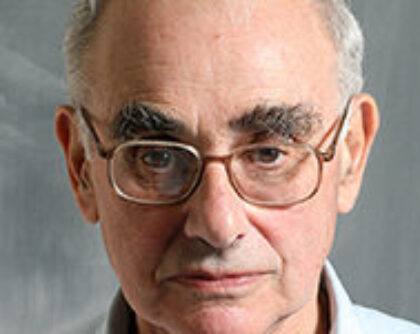
Portrait of Jeffrey Goldstone
. Giovanni Jona-Lasinio and Yoichiro Nambu proposed a dynamical model of particle mass inspired by superconductivity. A nonlinear four-fermion interaction produces a self-consistent massive fermionic state, analogous to the gap in a superconductor. The model also produces a massless pseudoscalar bound state in its symmetry limit, interpreted as an idealized pion. It demonstrates how both a massive constituent-like excitation and a light collective mode can arise from one interacting theory.[ref]
Dynamical Model of Elementary Particles Based on an Analogy with Superconductivity. I by Yoichiro Nambu and Giovanni Jona-Lasinio. 1961 abstract: self-energy, generalized Hartree-Fock treatment and idealized massless pion
A physicist working in mathematical physics.[ref]
Professional profile of Giovanni Jona-Lasinio. Independent professional identity

Portrait of Giovanni Jona-Lasinio
. Prolineserver. GNU Free Documentation License 1.2 only, via Wikimedia Commons. Source.
Yoichiro Nambu transferred the idea of dynamical symmetry breaking from superconductivity into particle. His model with Giovanni Jona-Lasinio treats particle mass as a self-consistent interaction effect, while collective excitations reflect the underlying chiral symmetry breaking. This makes the physical vacuum and its excitations part of the explanation of particle properties. Their simplified four-fermion theory is a model of the mechanism, rather than the modern fundamental theory of the strong interaction.[ref]
Dynamical Model of Elementary Particles Based on an Analogy with Superconductivity. I by Yoichiro Nambu and Giovanni Jona-Lasinio. 1961 abstract and model: superconducting analogy, generated fermion mass and collective bound states
A physicist working on spontaneous symmetry breaking.[ref]
Guide to the Yoichiro Nambu Papers 1917-2009 by University of Chicago Library. Independent professional identity

Portrait of Yoichiro Nambu
. Betsy Devine; Franklin Institute ceremony in Philadelphia, 2005; existing Commons image adjusted by WikiPedant. CC BY-SA 3.0, via Wikimedia Commons. Source.
- Dynamical Model of Elementary Particles Based on an Analogy with Superconductivity. I by Yoichiro Nambu and Giovanni Jona-Lasinio
- Nobel Lecture: Spontaneous symmetry breaking in particle physics: A case of cross fertilization by Yoichiro Nambu
- Quasi-Particles and Gauge Invariance in the Theory of Superconductivity by Yoichiro Nambu
Frank Wilczek and David Gross established asymptotic freedom in a class of Non-Abelian gauge theories. The effective interaction weakens at shorter distances, up to calculable logarithmic corrections. This permits perturbation theory to describe sufficiently high-energy processes in quantum chromodynamics, despite its strong long-distance interactions. Their 1973 result connected the approximate scaling seen in deep inelastic scattering with the dynamics of a gauge theory.[ref]
Ultraviolet Behavior of Non-Abelian Gauge Theories by David J. Gross and Frank Wilczek. 1973 abstract: free-field asymptotic behavior, logarithmic corrections and Bjorken scaling
A physicist working in theoretical physics.[ref]
Professional profile of Frank Wilczek. Independent professional identity

Portrait of Frank Wilczek
. Bengt Oberger, own photograph, 9 December 2017. Creative Commons Attribution-Share Alike 4.0 International., via Wikimedia Commons. Source.
A theoretical particle physicist who established asymptotic freedom for a class of Yang-Mills theories in 1973. The effective interaction becomes weak at sufficiently high energy, allowing perturbation theory to be useful in a theory that has strong interactions at longer distances. This supplies a key theoretical route from quantum chromodynamics to quantitative short-distance predictions.[ref]
Reliable Perturbative Results for Strong Interactions? by Hugh David Politzer. Abstract and short-distance perturbative calculation
David Gross co-discovered asymptotic freedom with Frank Wilczek. Their calculation showed that a broad class of Non-Abelian gauge theories approaches free-field behavior at very short distances, with calculable logarithmic deviations. This gave a theoretical route from quantum chromodynamics to quantitative high-energy predictions and helped explain why deep inelastic scattering could reveal nearly free pointlike constituents inside strongly bound hadrons.[ref]
A physicist working on quantum chromodynamics.[ref]
Professional profile of David J. Gross. Independent professional identity

Portrait of David Gross
. NextEinstein; existing crop by Finemann. Creative Commons Attribution 2.0 Generic., via Wikimedia Commons. Source.
Masatoshi Koshiba helped turn underground neutrino detectors into astronomical instruments. The Kamiokande II report of the 1987 supernova burst described eleven electron-like events over about thirteen seconds. These rare interactions supplied information about the collapsing star through weakly interacting particles rather than only its escaping light. The observation joined the timing and energy measurements of particle detection with a transient event far outside the solar system.[ref]

Portrait of Masatoshi Koshiba
. Source. 
A theoretical particle physicist who, with Gerardus 't Hooft, developed a consistent procedure for regularization and renormalization of gauge theories. Their 1972 paper handles divergent loop calculations while preserving the identities needed for gauge consistency in nonanomalous cases. This made higher-order predictions in theories such as the electroweak interaction calculable rather than formally infinite.[ref]
Regularization and renormalization of gauge fields by Gerardus 't Hooft and Martinus Justinus Godefridus Veltman. Abstract and introduction: overlapping divergences, Ward identities and arbitrary perturbative order
Gerard 't Hooft showed how theories with massive gauge fields described by Yang-Mills theory generated through spontaneous symmetry breaking could support consistent renormalization. His 1971 paper constructs models, derives Feynman rules and checks the associated Ward identities. Controlling these identities while removing divergent intermediate expressions is what permits finite higher-order predictions without losing the theory's gauge consistency. The work made spontaneously broken gauge theories usable for precision particle calculations.[ref]
Renormalizable Lagrangians for massive Yang-Mills fields by Gerardus 't Hooft. 1971 abstract: renormalizable models, path-integral rules, Ward identities and unitary spectrum
A physicist working on theoretical physics at Utrecht.[ref]
Gerard 't Hooft homepage by Gerardus 't Hooft. Independent professional identity

Portrait of Gerard 't Hooft
. Wammes Waggel, own photograph. Creative Commons Attribution-ShareAlike 3.0 Unported chosen from dual CC/GFDL licenses., via Wikimedia Commons. Source.
Clyde Cowan and Frederick Reines detected reactor electron antineutrinos through inverse beta decay, . The Positron supplied a prompt annihilation signal; capture of the neutron supplied a delayed signal. Requiring this pair and comparing operation at different reactor powers separated the weak interaction signature from background. Their 1956 report tested both the timing and physical origin of the signals, including changes to the neutron-capture material.[ref]
Detection of the Free Neutrino: a Confirmation by Clyde Cowan and others. 1956, reaction, prompt/delayed coincidence, reactor dependence and cadmium checks
A physicist who taught at the Catholic University of America from 1958 to 1974.[ref]
History by Catholic University of America Department of Physics. Independent professional identity

Portrait of Clyde Cowan
. US Army. Public domain in the United States (U.S. Army work). Source usage terms, via Wikimedia Commons. Source.
Frederick Reines co-developed a coincidence method for detecting reactor electron antineutrinos. A prompt Positron signal followed by delayed neutron capture made an otherwise rare interaction recognizable. Calibration sources tested the response, while reactor-off data and changes to the capture conditions tested backgrounds. The result demonstrates why identifying a particle requires a reproducible pattern of observables and controls, rather than an unexplained excess of detector counts.[ref]
Detection of the Free Neutrino: a Confirmation by Clyde Cowan and others. 1956, prompt/delayed signals, calibrations, reactor comparisons and neutron-capture controls
A physicist and founding dean at the University of California, Irvine.[ref]
A Message from the Chair by Manoj Kaplinghat. Independent professional identity

Portrait of Frederick Reines
. US Department of Energy; source Fermilab (fnal.gov); existing Commons contrast adjustment by Hohum. Public domain in the United States (US Department of Energy employee work). Source usage terms, via Wikimedia Commons. Source.

Martin Lewis Perl coauthored the evidence that led to identification of the tau lepton. The experiment found electron-muon pairs of opposite electric charges in electron–positron annihilation, with missing energy and momentum and no other detected charged particles or photons. The distributions required additional unseen particles. Studying these unusual final states provided a route to recognizing a new unstable lepton, even though it decayed before leaving a directly visible track.[ref]
An experimental physicist who led particle searches at SLAC.[ref]
Professional profile of Martin Lewis Perl. Independent professional identity

Portrait of Martin Lewis Perl
. Unknown photographer; source Fermilab (fnal.gov); existing Commons crop by Cookai1205. Public domain in the United States (US Department of Energy employee work). Source usage terms, via Wikimedia Commons. Source.

Georges Charpak developed the multiwire proportional chamber, replacing repeated photographic recording with electronic measurements of charged-particle passages. Ionization electrons drift through a gas toward thin wires; the strong local electric field produces avalanches and readable pulses. Knowing which wires respond supplies spatial information, while the electrical output permits rapid processing of many events. This connects microscopic ionization with the practical rate and position resolution of a particle detector.[ref]
The Use of Multiwire Proportional Counters to Select and Localize Charged Particles by Georges Charpak and others. 1968, multiwire counter construction, localization and proportional response
A physicist who developed electronic particle detectors at CERN.[ref]
Professional profile of Georges Charpak. Independent professional identity

Portrait of Georges Charpak
. Photographe de la Ville de Saint-Dié-des-Vosges, dans le cadre de sa mission ; scan par Ji-Elle. CC BY-SA 4.0, via Wikimedia Commons. Source.
Jack Steinberger coauthored the experiment establishing a distinction between the muon neutrino and electron neutrino. A beam produced through meson decays generated predominantly muons in the detector rather than the expected electron showers for a single common neutrino type. Comparing the two interaction signatures made lepton identity experimentally testable.[ref]
Observation of High-Energy Neutrino Reactions and the Existence of Two Kinds of Neutrinos by G. Danby and others. 1962, beam preparation and observed muon reactions compared with electron-like events
An experimental physicist who conducted neutrino-scattering research at CERN and was the first ALEPH spokesperson.[ref]
Professional profile of Jack Steinberger. Independent professional identity

Portrait of Jack Steinberger
. Sigismund von Dobschütz, 23 July 2008. CC BY-SA 3.0, via Wikimedia Commons. Source.
Articles were limited to the first 100 out of 203 total.
Articles by others on the same topic
There are currently no matching articles.