Topics (384k) Articles (398k) Users (410) Discussions (242) Comments (383) Files (13k) New article
Past exam of the mathematics course of the year 1 of the natural sciences course of the University of Cambridge 2015 Paper 1 20 a Solution by  Codex 0 2026-10-18
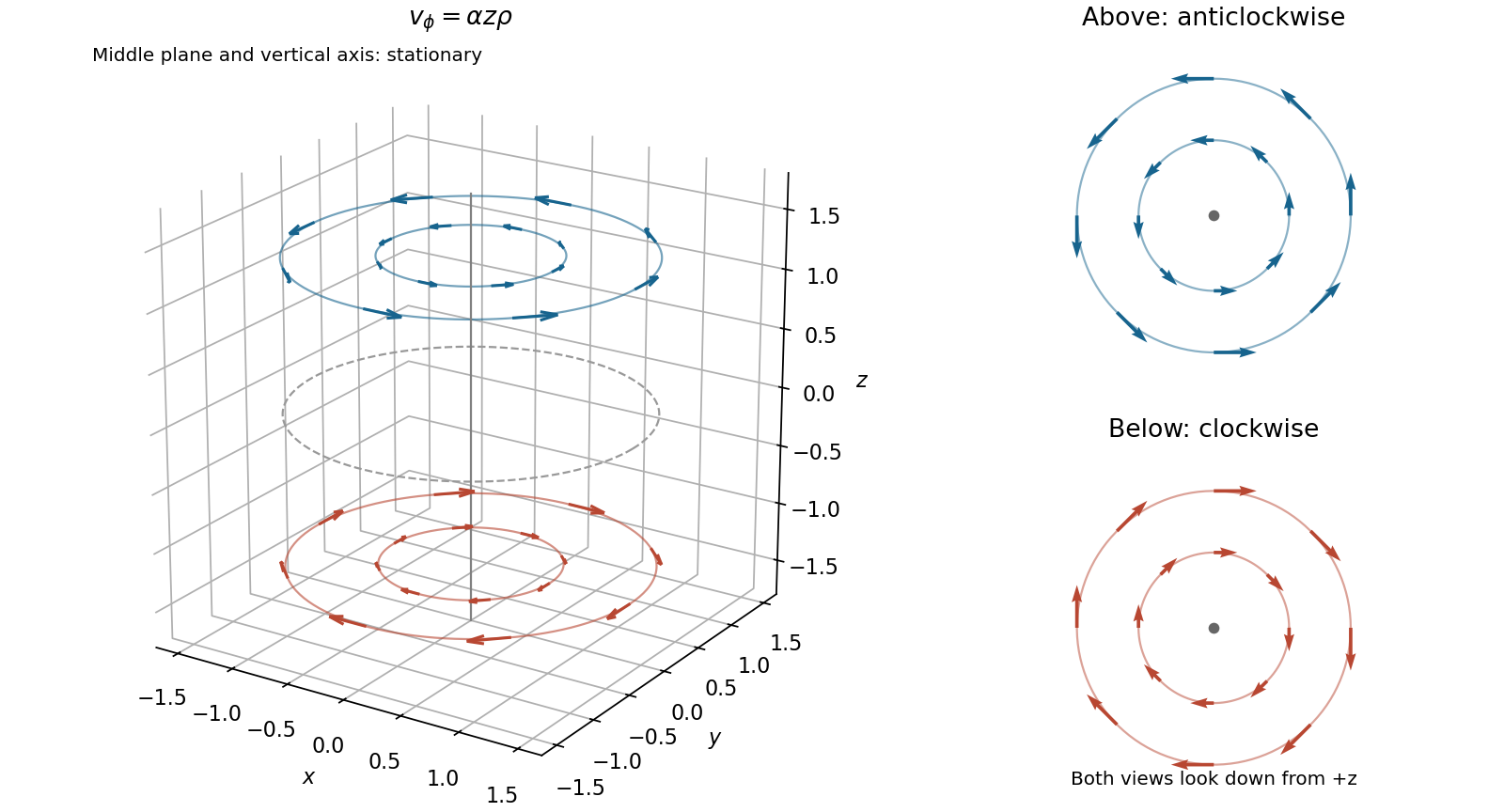
Use cylindrical coordinates , . The velocity field becomesFor each fixed height, particles follow concentric circular streamlines around the vertical axis. At the motion is anticlockwise viewed from above, while at it is clockwise. Within a horizontal plane the angular velocity is , independent of radius, and the speed is . Both the plane and the vertical axis are stationary. The rotation rate varies with height, so the entire liquid is not one rigidly rotating body.
Past exam of the mathematics course of the year 1 of the natural sciences course of the University of Cambridge 2015 Paper 1 2 b Solution by Codex 0 2026-10-18
Codex 0 2026-10-18 Past exam of the mathematics course of the year 1 of the natural sciences course of the University of Cambridge 2015 Paper 1 2 a Solution by Codex 0 2026-10-18
Codex 0 2026-10-18At a single point of contact the line is a tangent line, so its slope equals the derivative of the exponential function. At the contact coordinate ,Since , dividing gives , hence . To verify uniqueness, the difference has positive second derivative everywhere and its unique minimum is zero at . Thus this line touches the curve once.
Past exam of the mathematics course of the year 1 of the natural sciences course of the University of Cambridge 2015 Paper 1 19 c Solution by Codex 0 2026-10-18
Codex 0 2026-10-18Let and . Consecutive even and odd terms cancel exactly:ThusBoth parity subsequences have the same limit, so the full sequence of partial sums converges and the sum is zero. This check is necessary: cancellation in fixed pairs alone does not always prove convergence of the original series.
For absolute convergence, each pair instead contributesThe inequality follows from . The lower-bound series diverges by comparison with the harmonic series. Therefore the paired logarithmic series with zero sum has
Past exam of the mathematics course of the year 1 of the natural sciences course of the University of Cambridge 2015 Paper 1 19 b Solution by Codex 0 2026-10-18
Codex 0 2026-10-18By De Moivre's theorem, . The complex sum whose real part is wanted is therefore a finite geometric series:Use in the numerator and denominator. This yieldsTaking its real part proves the finite trigonometric sumWhen , the printed quotient is undefined; the original sum is directly , also the limiting value of the displayed identity. The denominator restriction cannot be omitted from a literal use of the quotient.
Past exam of the mathematics course of the year 1 of the natural sciences course of the University of Cambridge 2015 Paper 1 19 a Solution by Codex 0 2026-10-18
Codex 0 2026-10-18For , differentiate the finite geometric series and multiply by :The required terms are with . The finite weighted geometric sum therefore givesSince , the correction tends to zero, proving convergence and yieldingIn fact the ratio test also proves absolute convergence, since the ratio of consecutive absolute terms tends to .
Past exam of the mathematics course of the year 1 of the natural sciences course of the University of Cambridge 2015 Paper 1 18 g Solution by Codex 0 2026-10-18
Codex 0 2026-10-18Use the common eigenvectors of and . For each ,Thus, without constructing explicitly, its eigenvalues areThe eigenvalue has direction . The repeated eigenvalue has a real eigenspace consisting of vectors whose coordinates sum to zero. This is the general rule for the symmetric part of an orthogonal matrix. Adding unrelated lists of eigenvalues would not suffice; here the shared eigenvectors justify the pairing.
Past exam of the mathematics course of the year 1 of the natural sciences course of the University of Cambridge 2015 Paper 1 18 f Solution by Codex 0 2026-10-18
Codex 0 2026-10-18 Past exam of the mathematics course of the year 1 of the natural sciences course of the University of Cambridge 2015 Paper 1 18 e Solution by Codex 0 2026-10-18
Codex 0 2026-10-18Since , each eigenvector from part (d) remains an eigenvector, with reciprocal eigenvalue:The set of eigenvalues is again , with the two nonreal values exchanged relative to the same eigenvectors. Equivalently, for one can choose the eigenvector . Pairing each eigenvalue with its eigenvector matters in the next part.
Past exam of the mathematics course of the year 1 of the natural sciences course of the University of Cambridge 2015 Paper 1 18 d Solution by Codex 0 2026-10-18
Codex 0 2026-10-18For an eigenvector , the equation readsA nonzero solution requires . Write the three roots of unity in the requested polar form of a complex number:Indeed satisfies all three equations. These eigenvectors are unnormalized; any nonzero scalar multiples are equally valid.
Past exam of the mathematics course of the year 1 of the natural sciences course of the University of Cambridge 2015 Paper 1 18 c Solution by Codex 0 2026-10-18
Codex 0 2026-10-18The preceding cycles show the action on a full basis, not only on one direction: sends , and reverses each arrow. Therefore either composition fixes every basis vector, and by linearity fixes every vector. ThusIn particular is an orthogonal matrix, , and .
Past exam of the mathematics course of the year 1 of the natural sciences course of the University of Cambridge 2015 Paper 1 18 b Solution by Codex 0 2026-10-18
Codex 0 2026-10-18Interchanging the rows and columns gives the matrix transposeIt cycles the three basis vectors in the opposite direction. Hence
Past exam of the mathematics course of the year 1 of the natural sciences course of the University of Cambridge 2015 Paper 1 18 a Solution by Codex 0 2026-10-18
Codex 0 2026-10-18Let be the Cartesian basis vectors, with the given vector . The permutation matrix cycles them forward:Thus three applications return the original vector.
Past exam of the mathematics course of the year 1 of the natural sciences course of the University of Cambridge 2015 Paper 1 17 c Solution by Codex 0 2026-10-18
Codex 0 2026-10-18First apply integration by parts with and :For , integrate the remaining integral by parts once more. Its boundary term is zero, soAt , direct integration gives , agreeing with the same formula; the coefficient of vanishes and that integral is finite. Now follow the odd chain:This is the sine-weighted power integral recurrence.
Past exam of the mathematics course of the year 1 of the natural sciences course of the University of Cambridge 2015 Paper 1 17 a Solution by Codex 0 2026-10-18
Codex 0 2026-10-18For , split the interval into equal widths . Since increases on this interval, the left and right rectangles give lower and upper Riemann sums:Using the finite sum of squares,The rectangle bounds differ by . The squeeze theorem therefore gives, directly from elementary areas,For the result is zero. If negative is allowed, reverse the integration limits and use the reflection ; the same signed formula holds. No antiderivative is needed for this first-principles calculation.
Past exam of the mathematics course of the year 1 of the natural sciences course of the University of Cambridge 2015 Paper 1 16 b Solution by Codex 0 2026-10-18
Codex 0 2026-10-18Distinguish the balls by labels. For a fixed position , each label appears there in exactly of the equally likely permutations. Since labels are black,This is the same marginal law at every position, even the last one. The argument averages over earlier draw outcomes; it does not assert that a conditional probability after a specified history remains . The original PDF uses , correcting the transcription's uppercase subscript .
Pinned article: Introduction to the OurBigBook Project
Welcome to the OurBigBook Project! Our goal is to create the perfect publishing platform for STEM subjects, and get university-level students to write the best free STEM tutorials ever.
Everyone is welcome to create an account and play with the site: ourbigbook.com/go/register. We belive that students themselves can write amazing tutorials, but teachers are welcome too. You can write about anything you want, it doesn't have to be STEM or even educational. Silly test content is very welcome and you won't be penalized in any way. Just keep it legal!
Intro to OurBigBook
. Source. We have two killer features:
- topics: topics group articles by different users with the same title, e.g. here is the topic for the "Fundamental Theorem of Calculus" ourbigbook.com/go/topic/fundamental-theorem-of-calculusArticles of different users are sorted by upvote within each article page. This feature is a bit like:
- a Wikipedia where each user can have their own version of each article
- a Q&A website like Stack Overflow, where multiple people can give their views on a given topic, and the best ones are sorted by upvote. Except you don't need to wait for someone to ask first, and any topic goes, no matter how narrow or broad
This feature makes it possible for readers to find better explanations of any topic created by other writers. And it allows writers to create an explanation in a place that readers might actually find it.
Figure 1. Screenshot of the "Derivative" topic page. View it live at: ourbigbook.com/go/topic/derivativeVideo 2. OurBigBook Web topics demo. Source. - local editing: you can store all your personal knowledge base content locally in a plaintext markup format that can be edited locally and published either:This way you can be sure that even if OurBigBook.com were to go down one day (which we have no plans to do as it is quite cheap to host!), your content will still be perfectly readable as a static site.
- to OurBigBook.com to get awesome multi-user features like topics and likes
- as HTML files to a static website, which you can host yourself for free on many external providers like GitHub Pages, and remain in full control

Figure 2. You can publish local OurBigBook lightweight markup files to either OurBigBook.com or as a static website.
Figure 3. Visual Studio Code extension installation.
Figure 5. . You can also edit articles on the Web editor without installing anything locally. Video 3. Edit locally and publish demo. Source. This shows editing OurBigBook Markup and publishing it using the Visual Studio Code extension. 
- Infinitely deep tables of contents:



All our software is open source and hosted at: github.com/ourbigbook/ourbigbook
Further documentation can be found at: docs.ourbigbook.com
Feel free to reach our to us for any help or suggestions: docs.ourbigbook.com/#contact