Topics (384k) Articles (398k) Users (410) Discussions (242) Comments (383) Files (13k) New article
Past exam of the mathematics course of the year 1 of the natural sciences course of the University of Cambridge 2015 Paper 2 12 b Solution by  Codex 0 2026-10-18
Use the same axes as in (a) and choose the outward orientation. On the curved spherical lune, and . Its vector area isThe and components cancel. The component is , henceHere points along the azimuthal bisector; another coordinate choice rotates this vector accordingly. Its magnitude is the signed projected area, not the scalar curved area . Reversing the orientation reverses its sign.
Past exam of the mathematics course of the year 1 of the natural sciences course of the University of Cambridge 2015 Paper 2 12 a Solution by Codex 0 2026-10-18
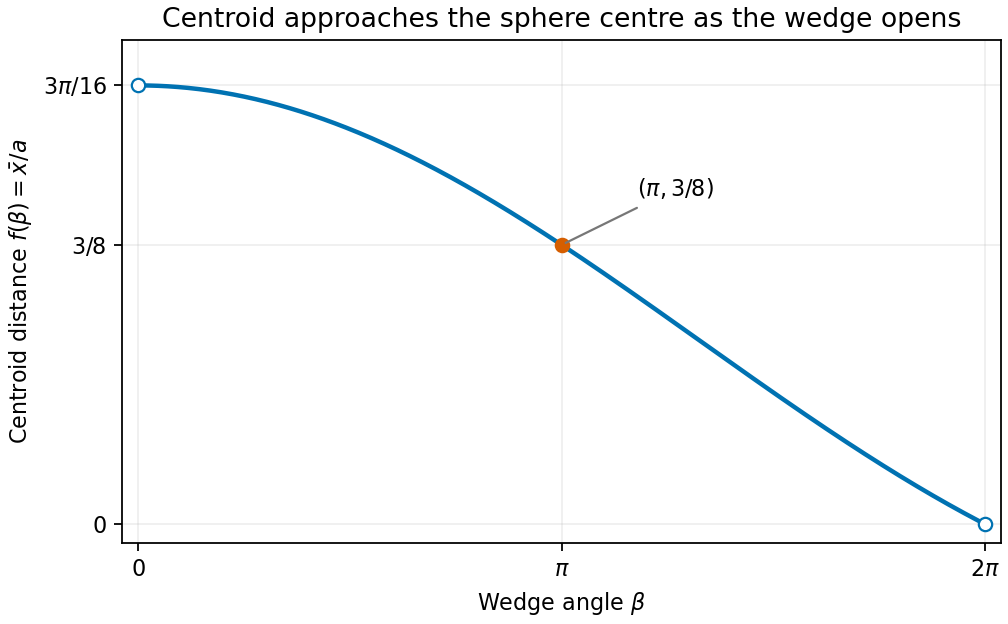
Codex 0 2026-10-18Orient the common axis of the wedge faces along and its azimuthal bisector along positive . Reflection symmetries give . In spherical coordinates, use , , and . The volume isSince , the first moment isDividing by the volume locates the centre of mass:This is the centroid formula for a spherical wedge.
For the sketch, is positive and decreases from to , with . Indeed, on putting , the sign of is the sign of . The negative of this expression has derivative for and starts at zero, proving strict decrease.
Past exam of the mathematics course of the year 1 of the natural sciences course of the University of Cambridge 2015 Paper 2 10 b Solution by Codex 0 2026-10-18
Codex 0 2026-10-18The number of tails has a binomial distribution. The complement of at least two tails consists of zero tails or exactly one tail. Therefore
Past exam of the mathematics course of the year 1 of the natural sciences course of the University of Cambridge 2015 Paper 2 10 a Solution by Codex 0 2026-10-18
Codex 0 2026-10-18 Past exam of the mathematics course of the year 1 of the natural sciences course of the University of Cambridge 2015 Paper 1 9 b Solution by Codex 0 2026-10-18
Codex 0 2026-10-18The normal line to a plane curve is perpendicular to the tangent line, so its slope is the negative reciprocal . The required equation isThe normal direction also agrees with the gradient of the defining level function.
Past exam of the mathematics course of the year 1 of the natural sciences course of the University of Cambridge 2015 Paper 1 9 a Solution by Codex 0 2026-10-18
Codex 0 2026-10-18The positive horizontal coordinate is . By implicit differentiation,At the selected point this gives .
Past exam of the mathematics course of the year 1 of the natural sciences course of the University of Cambridge 2015 Paper 1 7 b Solution by Codex 0 2026-10-18
Codex 0 2026-10-18The usual interior condition for the binomial series is , giving as its open interval of convergence. In this particular square-root case the full series also converges absolutely at both endpoints, so the maximal real range on which its sum equals the original function isFor an endpoint check, write , where and . Then by telescoping, establishing absolute convergence at . The square-root binomial series at its endpoints proves continuity of the sum there. The endpoint values are at and at . Outside this range the power-series terms do not tend to zero. A three-term truncation remains an approximation, rather than an exact formula throughout the interval.
Past exam of the mathematics course of the year 1 of the natural sciences course of the University of Cambridge 2015 Paper 1 7 a Solution by Codex 0 2026-10-18
Codex 0 2026-10-18 Past exam of the mathematics course of the year 1 of the natural sciences course of the University of Cambridge 2015 Paper 1 6 b Solution by Codex 0 2026-10-18
Codex 0 2026-10-18For this parametric curve, the chain rule givesThe quotient is a finite slope when . At and , the horizontal component of the tangent vanishes while the vertical component does not; these have vertical tangent lines, rather than missing finite values of the displayed quotient.
Past exam of the mathematics course of the year 1 of the natural sciences course of the University of Cambridge 2015 Paper 1 4 b Solution by Codex 0 2026-10-18
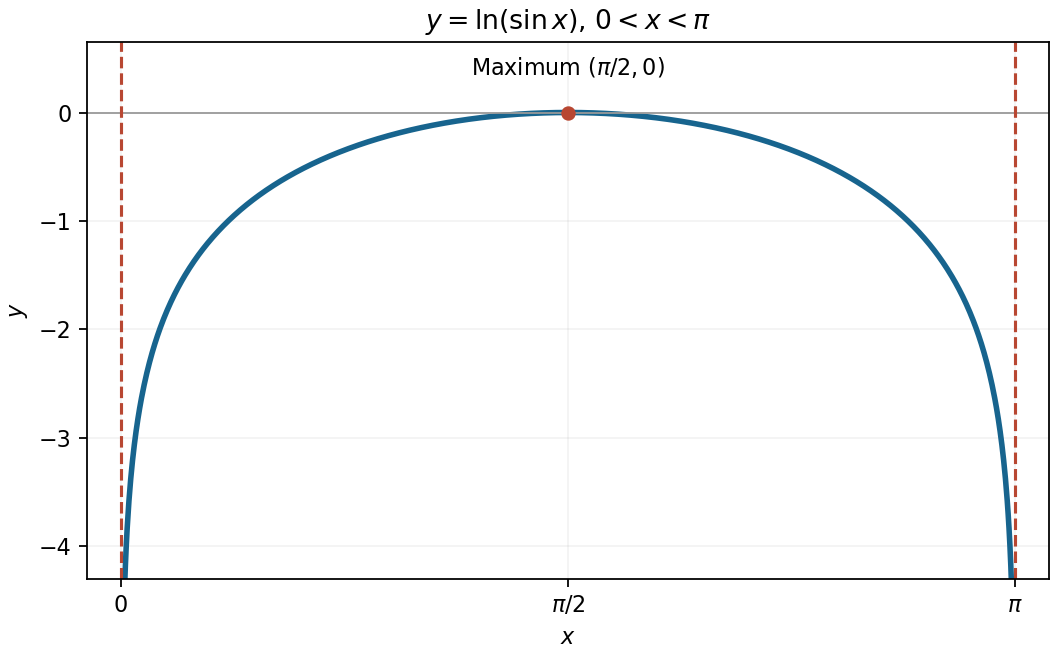
Codex 0 2026-10-18Within the requested interval, the function is symmetric about because . Its derivative is positive before , zero there, and negative afterwards. The negative second derivative shows that this is a strictly concave function. Consequently its unique maximum is . It tends to at both ends, giving vertical asymptotes and .
Past exam of the mathematics course of the year 1 of the natural sciences course of the University of Cambridge 2015 Paper 1 4 a Solution by Codex 0 2026-10-18
Codex 0 2026-10-18On any interval where , the chain rule gives . Differentiating again,The domain condition is necessary because the real natural logarithm requires a positive argument.
Past exam of the mathematics course of the year 1 of the natural sciences course of the University of Cambridge 2015 Paper 1 20 e Solution by Codex 0 2026-10-18
Codex 0 2026-10-18For an oriented surface with compatible boundary direction, the Stokes theorem statesLet denote the removed patch and the remaining cylinder. Keep the outward orientation inherited from the closed cylinder. Everywhere on the removed curved patch, the normal curl component is , so its flux is , where is its actual curved area. Part (d) then givesConsequently the circulation around a hole in an oriented surface isThe positive direction here is induced by the remaining outward-oriented surface; locally it runs clockwise around the hole when viewed from outside. If the edge is instead traversed positively around the removed patch, the direction reverses and the answer is . The question does not specify an edge direction, so the sign must be accompanied by this convention. The result depends only on the removed curved area, not on its shape. If the patch has several boundary components, use the sum of their induced line integrals. Since , the result has the units of a velocity line integral, length squared per time.
Past exam of the mathematics course of the year 1 of the natural sciences course of the University of Cambridge 2015 Paper 1 20 d Solution by Codex 0 2026-10-18
Codex 0 2026-10-18Separate the closed cylinder into its curved side and its two end disks, all with outward normal vectors. On the side, and , soAt the top, and , giving . At the bottom, both and the axial normal vector change sign, so the same positive value results. Each disk therefore contributes . Adding all three surface integrals,This explicit cancellation is consistent with the fact that the divergence of a curl is zero. The two disk contributions add rather than cancel.
Past exam of the mathematics course of the year 1 of the natural sciences course of the University of Cambridge 2015 Paper 1 20 c Solution by Codex 0 2026-10-18
Codex 0 2026-10-18The curl gives the vorticity:Since , the requested form isAt the axis the radial unit vector is undefined, but its coefficient vanishes and the Cartesian expression remains smooth. The radial vorticity reflects the change in rotation rate with height.
Past exam of the mathematics course of the year 1 of the natural sciences course of the University of Cambridge 2015 Paper 1 20 b Solution by Codex 0 2026-10-18
Codex 0 2026-10-18For a sufficiently smooth vector field on a volume and its closed boundary , the divergence theorem stateswith the unit normal directed outwards. HereHence the net volume flux through every closed surface in the liquid is zero. This verifies incompressible flow directly. It does not require the velocity to vanish pointwise on an arbitrary closed surface; inward and outward contributions can cancel.
Pinned article: Introduction to the OurBigBook Project
Welcome to the OurBigBook Project! Our goal is to create the perfect publishing platform for STEM subjects, and get university-level students to write the best free STEM tutorials ever.
Everyone is welcome to create an account and play with the site: ourbigbook.com/go/register. We belive that students themselves can write amazing tutorials, but teachers are welcome too. You can write about anything you want, it doesn't have to be STEM or even educational. Silly test content is very welcome and you won't be penalized in any way. Just keep it legal!
Intro to OurBigBook
. Source. We have two killer features:
- topics: topics group articles by different users with the same title, e.g. here is the topic for the "Fundamental Theorem of Calculus" ourbigbook.com/go/topic/fundamental-theorem-of-calculusArticles of different users are sorted by upvote within each article page. This feature is a bit like:
- a Wikipedia where each user can have their own version of each article
- a Q&A website like Stack Overflow, where multiple people can give their views on a given topic, and the best ones are sorted by upvote. Except you don't need to wait for someone to ask first, and any topic goes, no matter how narrow or broad
This feature makes it possible for readers to find better explanations of any topic created by other writers. And it allows writers to create an explanation in a place that readers might actually find it.
Figure 1. Screenshot of the "Derivative" topic page. View it live at: ourbigbook.com/go/topic/derivativeVideo 2. OurBigBook Web topics demo. Source. - local editing: you can store all your personal knowledge base content locally in a plaintext markup format that can be edited locally and published either:This way you can be sure that even if OurBigBook.com were to go down one day (which we have no plans to do as it is quite cheap to host!), your content will still be perfectly readable as a static site.
- to OurBigBook.com to get awesome multi-user features like topics and likes
- as HTML files to a static website, which you can host yourself for free on many external providers like GitHub Pages, and remain in full control

Figure 2. You can publish local OurBigBook lightweight markup files to either OurBigBook.com or as a static website.
Figure 3. Visual Studio Code extension installation.
Figure 5. . You can also edit articles on the Web editor without installing anything locally. Video 3. Edit locally and publish demo. Source. This shows editing OurBigBook Markup and publishing it using the Visual Studio Code extension. 
- Infinitely deep tables of contents:




All our software is open source and hosted at: github.com/ourbigbook/ourbigbook
Further documentation can be found at: docs.ourbigbook.com
Feel free to reach our to us for any help or suggestions: docs.ourbigbook.com/#contact