Topics (384k) Articles (398k) Users (410) Discussions (242) Comments (383) Files (13k) New article
Past exam of the mathematics course of the year 1 of the natural sciences course of the University of Cambridge 2015 Paper 2 17 d Solution by  Codex 0 2026-10-18
Expanding the determinant along the first row givesThe eigenvalues and normalized spatial eigenvectors, in increasing frequency order, areFor each mode both signs of give the same cosine displacement. An arbitrary overall mode amplitude remains free. These vectors are the instances of the sine eigenvectors of the fixed-end spring chain.
Past exam of the mathematics course of the year 1 of the natural sciences course of the University of Cambridge 2015 Paper 2 17 c Solution by Codex 0 2026-10-18
Codex 0 2026-10-18With , the eigenvalue equation isThe dimensionless matrix is the stiffness matrix divided by ; its eigenvalues determine squared angular frequencies.
Past exam of the mathematics course of the year 1 of the natural sciences course of the University of Cambridge 2015 Paper 2 17 b Solution by Codex 0 2026-10-18
Codex 0 2026-10-18Each proposed displacement has second derivative . Matching the coefficients of the common time factor in the three equations givesThese algebraic relations hold for the entire oscillation, including the isolated times when the common cosine vanishes.
Past exam of the mathematics course of the year 1 of the natural sciences course of the University of Cambridge 2015 Paper 2 17 a Solution by Codex 0 2026-10-18
Codex 0 2026-10-18An eigenvalue equation has the form , where is an eigenvector and its eigenvalue. It means that the linear map preserves the vector's line and acts there by multiplication by . Nonzero solutions occur precisely when ; the zero vector is excluded because it would satisfy the equation for every .
Past exam of the mathematics course of the year 1 of the natural sciences course of the University of Cambridge 2015 Paper 2 16 b Solution by Codex 0 2026-10-18
Codex 0 2026-10-18Put , so . On an interval with , substitution and cancellation giveSince , no constant- solution is lost when separating. Integrateto obtainAfter restoring , a local implicit general solution isThe inverse tangent is chosen continuously on a solution branch. Using the continuous polar angle of extends the expression to charts through when the original equation permits it. A differentiable graph cannot pass through , because there the original equation would require .
Past exam of the mathematics course of the year 1 of the natural sciences course of the University of Cambridge 2015 Paper 2 16 a Solution by Codex 0 2026-10-18
Codex 0 2026-10-18For a continuously differentiable differential one-form, exactness requires . It is locally sufficient, and globally sufficient on a simply connected domain; on a domain with holes, closedness alone need not imply exactness.
An integrating factor for a differential one-form depending only on must satisfyThus, where ,If the ratio depends only on , this defines a nonzero factor and makes it a closed differential form, hence locally exact. For a factor depending only on , the analogous calculation givesprovided the ratio is a function only of on the region where . A nonzero constant multiple of either factor works equally well.
Past exam of the mathematics course of the year 1 of the natural sciences course of the University of Cambridge 2015 Paper 2 15 b Solution by Codex 0 2026-10-18
Codex 0 2026-10-18The repeated factor in the differential operator suggests . Direct differentiation gives , so andThe first value gives . The second gives , hence and . Therefore
Past exam of the mathematics course of the year 1 of the natural sciences course of the University of Cambridge 2015 Paper 2 14 f Solution by Codex 0 2026-10-18
Codex 0 2026-10-18Under the same independence assumption, inclusion-exclusion givesOn ,There is one interior inflection point, where the curvature changes from positive to negative:At the graph reaches one with zero slope and then stays constant. There is no further change from one sign of curvature to the opposite sign there.
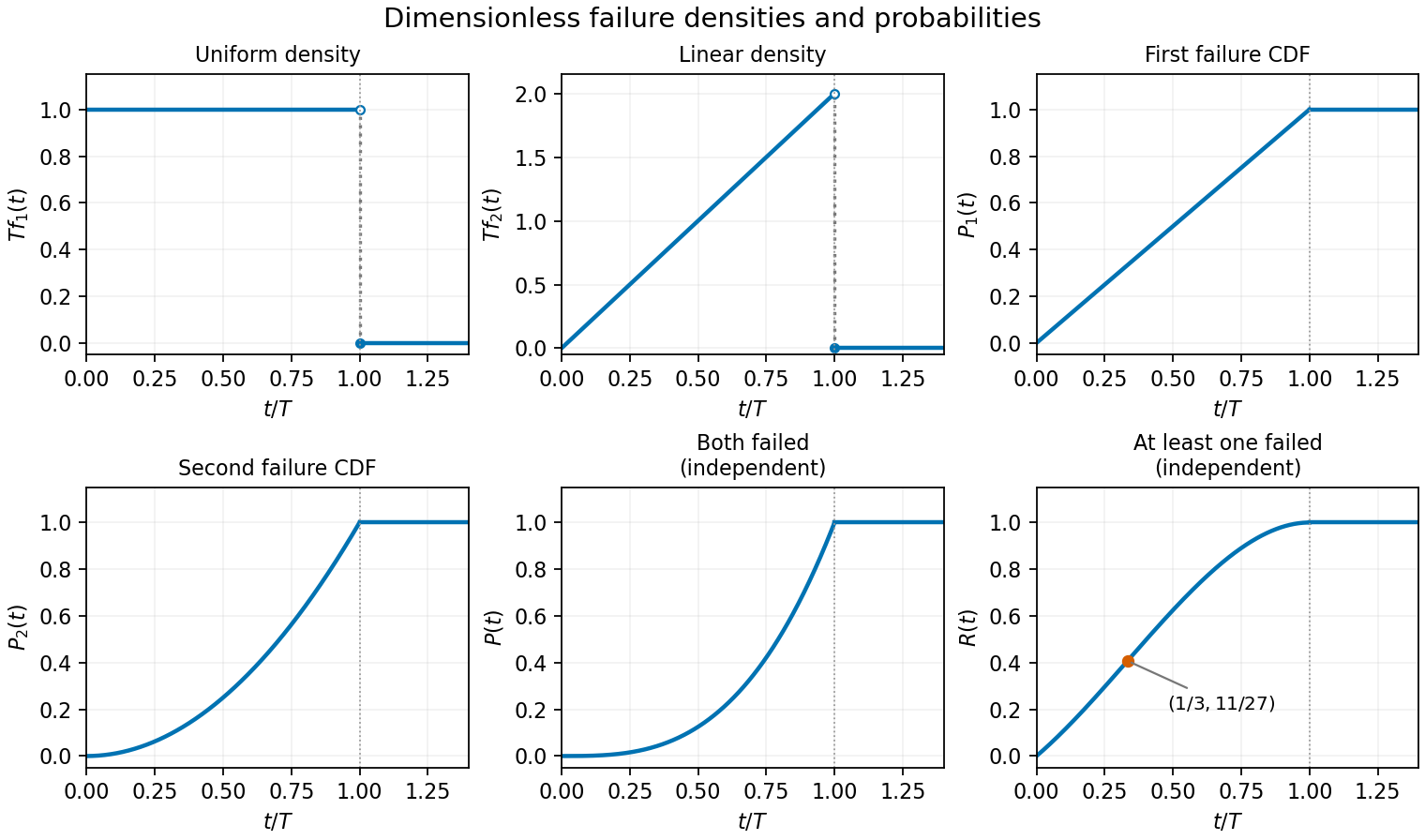
Without independence, still holds, but only is forced by the marginals. Its inflection behaviour is then not determined. The shared- construction in (e), for example, gives before the plateau.
Past exam of the mathematics course of the year 1 of the natural sciences course of the University of Cambridge 2015 Paper 2 14 e Solution by Codex 0 2026-10-18
Codex 0 2026-10-18The product formula requires independent failure times. This assumption is not stated in the original PDF. Under that intended assumption, put and use the failure probabilities for two independent lifetimes:Its graph is a cubic increasing from to , convex before reaching its plateau.
Without independence, the marginal distributions do not determine . The Fréchet inequalities give the sharp pointwise boundsFor example, taking and with the same uniform random variable preserves both prescribed marginals but gives , rather than .
Past exam of the mathematics course of the year 1 of the natural sciences course of the University of Cambridge 2015 Paper 2 14 d Solution by Codex 0 2026-10-18
Codex 0 2026-10-18 Past exam of the mathematics course of the year 1 of the natural sciences course of the University of Cambridge 2015 Paper 2 14 c Solution by Codex 0 2026-10-18
Codex 0 2026-10-18Integrating the first probability density function gives the cumulative distribution functionIts graph is a straight ramp from to , followed by a horizontal plateau.
Past exam of the mathematics course of the year 1 of the natural sciences course of the University of Cambridge 2015 Paper 2 14 b Solution by Codex 0 2026-10-18
Codex 0 2026-10-18 Past exam of the mathematics course of the year 1 of the natural sciences course of the University of Cambridge 2015 Paper 2 14 a Solution by Codex 0 2026-10-18
Codex 0 2026-10-18A uniform distribution has constant density on its support, fixed by normalization. ThusThe density's assigned values at the endpoints do not affect probabilities.
Past exam of the mathematics course of the year 1 of the natural sciences course of the University of Cambridge 2015 Paper 2 13 c Solution by Codex 0 2026-10-18
Codex 0 2026-10-18 Past exam of the mathematics course of the year 1 of the natural sciences course of the University of Cambridge 2015 Paper 2 13 b Solution by Codex 0 2026-10-18
Codex 0 2026-10-18On the first straight segment, and only is nonzero, so both integrals vanish. On the second segment, and only is nonzero; each integrand is one, contributing . On the last segment, and only is nonzero; each integrand is , contributing . ThusThe second result also follows from the fundamental theorem for line integrals, using the potential found in (a). Agreement on this one path does not make conservative.
Past exam of the mathematics course of the year 1 of the natural sciences course of the University of Cambridge 2015 Paper 2 13 a Solution by Codex 0 2026-10-18
Codex 0 2026-10-18The curl of the first vector field iswhich is not identically zero. Thus is not conservative on and cannot equal a negative gradient there.
For the second field, direct differentiation showsTherefore is conservative, and the requested negative-gradient potential isIts curl vanishes, consistently with the curl of a gradient identity.
Pinned article: Introduction to the OurBigBook Project
Welcome to the OurBigBook Project! Our goal is to create the perfect publishing platform for STEM subjects, and get university-level students to write the best free STEM tutorials ever.
Everyone is welcome to create an account and play with the site: ourbigbook.com/go/register. We belive that students themselves can write amazing tutorials, but teachers are welcome too. You can write about anything you want, it doesn't have to be STEM or even educational. Silly test content is very welcome and you won't be penalized in any way. Just keep it legal!
Intro to OurBigBook
. Source. We have two killer features:
- topics: topics group articles by different users with the same title, e.g. here is the topic for the "Fundamental Theorem of Calculus" ourbigbook.com/go/topic/fundamental-theorem-of-calculusArticles of different users are sorted by upvote within each article page. This feature is a bit like:
- a Wikipedia where each user can have their own version of each article
- a Q&A website like Stack Overflow, where multiple people can give their views on a given topic, and the best ones are sorted by upvote. Except you don't need to wait for someone to ask first, and any topic goes, no matter how narrow or broad
This feature makes it possible for readers to find better explanations of any topic created by other writers. And it allows writers to create an explanation in a place that readers might actually find it.
Figure 1. Screenshot of the "Derivative" topic page. View it live at: ourbigbook.com/go/topic/derivativeVideo 2. OurBigBook Web topics demo. Source. - local editing: you can store all your personal knowledge base content locally in a plaintext markup format that can be edited locally and published either:This way you can be sure that even if OurBigBook.com were to go down one day (which we have no plans to do as it is quite cheap to host!), your content will still be perfectly readable as a static site.
- to OurBigBook.com to get awesome multi-user features like topics and likes
- as HTML files to a static website, which you can host yourself for free on many external providers like GitHub Pages, and remain in full control

Figure 2. You can publish local OurBigBook lightweight markup files to either OurBigBook.com or as a static website.
Figure 3. Visual Studio Code extension installation.
Figure 5. . You can also edit articles on the Web editor without installing anything locally. Video 3. Edit locally and publish demo. Source. This shows editing OurBigBook Markup and publishing it using the Visual Studio Code extension. 
- Infinitely deep tables of contents:



All our software is open source and hosted at: github.com/ourbigbook/ourbigbook
Further documentation can be found at: docs.ourbigbook.com
Feel free to reach our to us for any help or suggestions: docs.ourbigbook.com/#contact