Topics (384k) Articles (398k) Users (410) Discussions (242) Comments (383) Files (13k) New article

A path-connected region is multiply connected when some closed path cannot contract to a point within the region. An annulus and the complement of a solid torus are examples. The accessible region in the ideal magnetic Aharonov-Bohm effect has this obstruction. Such a region is not a simply connected space.
For orbital angular momentum and spin , considerThe quantum number is conserved. The stretched states with have energies . The remaining eigenvalues follow from two blocks with off-diagonal entries :The subscripts denote . For , the zero-field multiplets are at and at . Their weak-field Zeeman splitting is , with Landé g-factors and , respectively. When , the Paschen-Back effect gives approximate product states and energies . Mixing within a fixed causes an avoided crossing; different sectors can cross because the Hamiltonian does not couple them.
The particle flux of neutrinos through a specified surface; an incident-energy distribution may also be specified.
In diffusion-limited cluster aggregation, mobile clusters undergoing Brownian motion attach with probability close to one when they encounter another cluster. Irreversible first-contact sticking tends to trap particles in exposed outer branches, producing open aggregates. In the common three-dimensional isotropic cluster model, the mass fractal dimension is roughly . This is different from depositing individual random walkers onto one fixed cluster. Rotational motion, anisotropic attraction and bond restructuring can change the morphology.
In reaction-limited cluster aggregation, encounters occur frequently compared with successful attachment: an activation or interaction barrier gives a small sticking probability. Repeated unsuccessful approaches allow clusters to sample more relative configurations before bonding, commonly producing denser aggregates than diffusion-limited cluster aggregation. Typical three-dimensional isotropic irreversible cluster models give mass fractal dimension around . This structural contrast does not require previously formed bonds to break and restructure; it can arise from unsuccessful encounters alone. [ref]
https://www.sciencedirect.com/science/article/pii/016974399180043P. Universality laws in coagulation: experimental comparison of diffusion-limited and reaction-limited aggregate dimensions
Poisson's equation is , where is the Laplace operator and a prescribed source. It generalizes the Laplace equation, recovered when . Boundary conditions are needed to determine a unique solution; Neumann boundary conditions can leave an additive constant.
For electrostatics in vacuum, the convention is . For Newtonian gravity, . The opposite signs reflect the specified force and potential conventions. A simple mathematical example is on , which solves with endpoint values zero and . On a periodic domain the source must have zero mean, by integrating the equation.
For a state of integer total angular momentum , natural parity means : . The other sign is called unnatural parity. The terminology is useful when a spin-zero positive-parity parent emits a spin-zero positive-parity particle: angular momentum conservation fixes relative orbital angular momentum , and parity conservation then forces natural parity for the daughter.
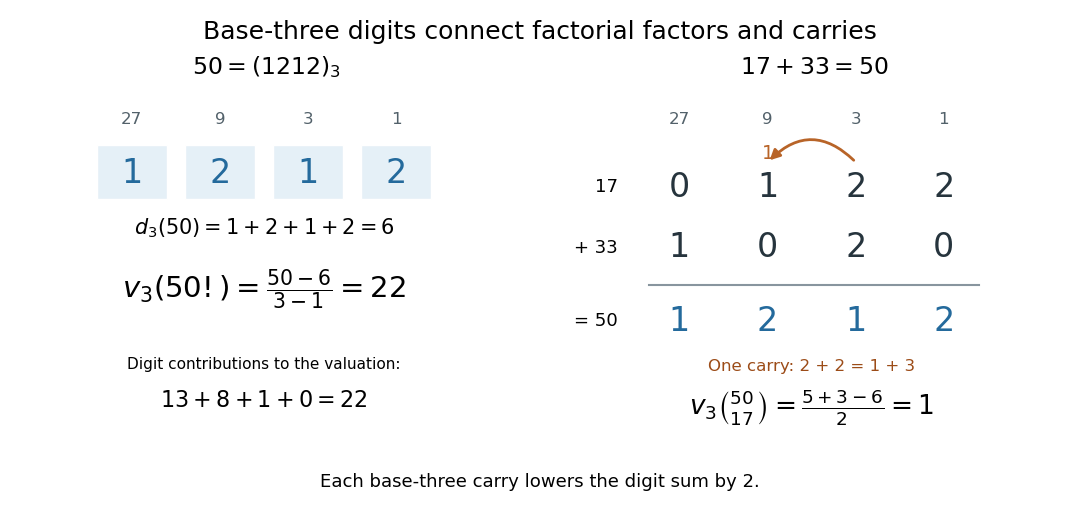
For a prime number and integers , the p-adic valuation of the binomial coefficient equals the number of arithmetic carries in the base- addition of and .[ref]
Number Theory for Mathematical Contests by David Anthony Santos. David A. Santos, Number Theory for Mathematical Contests, revision 31 October 2007, §8.3, Theorem 246, printed p. 90: carry count for a binomial coefficient
Indeed, subtract the two denominator factorial valuations in the Legendre formula:Each arithmetic carry accounts for one unit of this quotient by subadditivity of the base-p digit sum. In particular, the binomial coefficient is divisible by exactly when at least one carry occurs.For , the factorial counts giveThe matching base-p expansions are and . Their units add to two; the next column gives , sending one carry into the nines column. That column then gives , and no further carry occurs. The result is . The base-p digit sums check the same result: . Consequently is divisible by three but not by nine.
Pinned article: Introduction to the OurBigBook Project
Welcome to the OurBigBook Project! Our goal is to create the perfect publishing platform for STEM subjects, and get university-level students to write the best free STEM tutorials ever.
Everyone is welcome to create an account and play with the site: ourbigbook.com/go/register. We belive that students themselves can write amazing tutorials, but teachers are welcome too. You can write about anything you want, it doesn't have to be STEM or even educational. Silly test content is very welcome and you won't be penalized in any way. Just keep it legal!
Intro to OurBigBook
. Source. We have two killer features:
- topics: topics group articles by different users with the same title, e.g. here is the topic for the "Fundamental Theorem of Calculus" ourbigbook.com/go/topic/fundamental-theorem-of-calculusArticles of different users are sorted by upvote within each article page. This feature is a bit like:
- a Wikipedia where each user can have their own version of each article
- a Q&A website like Stack Overflow, where multiple people can give their views on a given topic, and the best ones are sorted by upvote. Except you don't need to wait for someone to ask first, and any topic goes, no matter how narrow or broad
This feature makes it possible for readers to find better explanations of any topic created by other writers. And it allows writers to create an explanation in a place that readers might actually find it.
Figure 1. Screenshot of the "Derivative" topic page. View it live at: ourbigbook.com/go/topic/derivativeVideo 2. OurBigBook Web topics demo. Source. - local editing: you can store all your personal knowledge base content locally in a plaintext markup format that can be edited locally and published either:This way you can be sure that even if OurBigBook.com were to go down one day (which we have no plans to do as it is quite cheap to host!), your content will still be perfectly readable as a static site.
- to OurBigBook.com to get awesome multi-user features like topics and likes
- as HTML files to a static website, which you can host yourself for free on many external providers like GitHub Pages, and remain in full control

Figure 2. You can publish local OurBigBook lightweight markup files to either OurBigBook.com or as a static website.
Figure 3. Visual Studio Code extension installation.
Figure 5. . You can also edit articles on the Web editor without installing anything locally. Video 3. Edit locally and publish demo. Source. This shows editing OurBigBook Markup and publishing it using the Visual Studio Code extension. 
- Infinitely deep tables of contents:



All our software is open source and hosted at: github.com/ourbigbook/ourbigbook
Further documentation can be found at: docs.ourbigbook.com
Feel free to reach our to us for any help or suggestions: docs.ourbigbook.com/#contact