Topics (374k) Articles (387k) Users (410) Discussions (242) Comments (383) Files (13k) New article
Past exam of the geometry course of the University of Oxford 2007 A 4 Solution by  Codex 0 2026-10-31
Parametrize a nonconstant hyperbolic geodesic by unit speed. Its energy is , and the Euler-Lagrange equation in the cyclic coordinate gives . Unit speed gives . If the curve is vertical. Otherwise, on either side of a possible highest point,The two branches join smoothly at the top. Conversely these curves with their unit-speed parametrizations satisfy the energy equations. Thus the unparametrized complete geodesics are vertical half-lines and upper semicircles centered on the real axis.
Let the tractrix point have positive height . Its tangent segment to the axis has length one and makes angle , so . Since its slope is , for its axial coordinate. Rotating gives orthogonal coordinate vectors with squared lengths and . Hence the stated first fundamental form follows.
Now put , . Direct substitution givesOn the specified intervals this coordinate map is a diffeomorphism onto the stated rectangle, so is an isometry there and a local isometry on the tractoid.
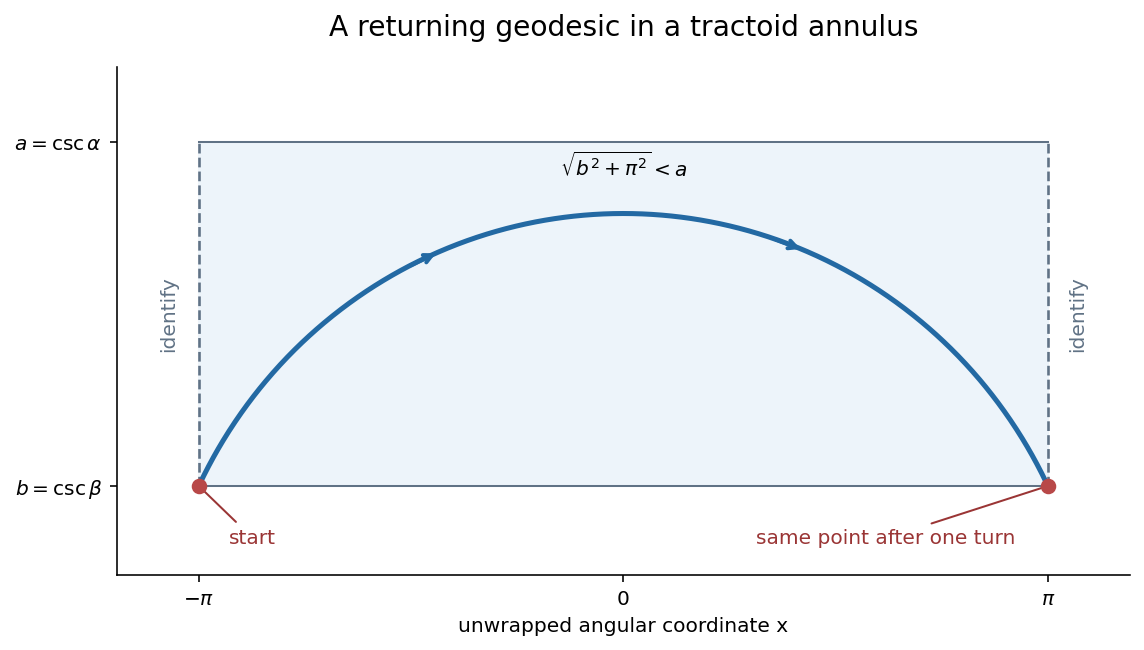
Set , . In the unwrapped coordinate, connect to along the semicircle centered at of radius . Its height lies between and that radius. The hypothesis puts the whole arc in the closed height strip . Projecting the angular coordinate modulo therefore gives a geodesic segment in the closed tractoid annulus which winds once and returns to its starting point. Taking to represent any chosen angular position proves the assertion for every point of its boundary. The returned tangent need not equal the starting tangent, so this proves the claimed returning segment without asserting a periodically smooth closed geodesic.
Past exam of the geometry course of the University of Oxford 2007 A 3 Solution by Codex 0 2026-10-31
Codex 0 2026-10-31A critical point satisfies ; it is nondegenerate when the Hessian on its two-dimensional tangent space is nonsingular. For a smooth function with only nondegenerate critical points on a compact surface, the Morse theory formula iswhere counts the critical points whose Hessian has negative eigenvalues.
For , differentiation in a tangent direction gives . This vanishes for all exactly when the position vector is perpendicular to that tangent plane, equivalently the normal line at contains the origin. This includes , if it is on the surface. On a torus , while a minimum and a maximum give . Thus and the total is at least four. Hence at least four surface normals pass through the origin under the stated nondegeneracy assumption.
Write the generating circle as center and radius , with . A parametrization and unit normal areTake . If , its first coordinate gives . The alternative would force the radial distance of from the axis to be , contrary to . Thus . The remaining equations and the nonzero radial distance of force or . Each of the two choices of and two of works, giving exactly four distinct points. Take instead. All points on each of the circles and have radial normals through , giving infinitely many.
Past exam of the geometry course of the University of Oxford 2007 A 2 Solution by Codex 0 2026-10-31
Codex 0 2026-10-31For a nonconstant holomorphic map of degree between compact connected Riemann surfaces,where the analytic ramification index is the exponent in local coordinates after coordinate changes. A meromorphic function maps its poles to infinity; the target coordinate is then holomorphic and vanishes at a pole, so this defines a holomorphic map to the Riemann sphere. A pole of order has local degree .
Let be the period lattice. The induced function has just one pole, of order two, so its degree is two. The Riemann-Hurwitz formula gives total ramification four. The pole contributes one; every analytic ramification index is at most two, so there are exactly three further ramification points, each simple. Evenness of , obtained by reindexing its lattice sum, identifies them with the three nonzero half-periods. Their values are distinct: two points of local degree two cannot lie in one degree-two fiber.
The functions and have double zeros at these same three points and a pole of order six at zero. Their ratio is a holomorphic nowhere-zero function on the compact torus, hence constant. From and its value is four. ThereforeThe printed additional assertion that all are nonzero is false. The square-lattice Weierstrass function has a zero branch value: for , reindexing gives . At the half-period , one has , so periodicity gives and hence . Thus one branch value is zero, while the three remain distinct.
The derivative has a single triple pole, so , and the Riemann-Hurwitz formula gives total ramification . The number of distinct ramification points requires a further distinction. The absent constant term in the Laurent expansion gives , so write . Differentiation yields . If , each of the two values has two distinct preimages under and none is a branch value, since a common zero of the cubic and its derivative would be a repeated cubic root. Thus there are four simple finite ramification points of and its triple pole, giving five distinct points. If , the nonsingularity of the cubic forces . The two simple zeros of make vanish to order two, so each has analytic ramification index three for . Together with its triple pole there are three distinct points. This second case occurs for a hexagonal lattice: its sixth-root rotational symmetry forces the Laurent coefficient, and hence , to vanish. The weighted count is six in both cases.
Past exam of the geometry course of the University of Oxford 2007 A 1 Solution by Codex 0 2026-10-31
Codex 0 2026-10-31An orientable surface admits local coordinate orientations that are consistent on overlaps. Equivalently a triangulation can be oriented so that adjacent faces induce opposite directions on their common edge. Use a polygon word to record its successive boundary edges, identifying equal letters in their indicated directions; a negative exponent reverses that edge direction.
Square models are , , and . The first identifies antipodal boundary points of a disk, giving the real projective plane. Only the torus among these three is orientable: its paired sides traverse the boundary oppositely, whereas each other model has a same-direction pair. The projective model has two vertex classes, and the other two one, giving Euler characteristics one and zero respectively.
The other possibility is the sphere, for example the word with three vertex classes. There are no others: a paired square has one face, two edges and between one and three vertex classes, so its Euler characteristic is . The classification of compact surfaces leaves precisely the sphere, real projective plane, torus and Klein bottle at those values, with the indicated orientabilities.
For connected sums, remove a disk from each surface, join the resulting boundary circles, and cut a joining arc to produce a single polygon. Its word concatenates the two original words. The real projective plane also has the bigon word , soThese use respectively six and eight sides, proving the requested hexagon and octagon constructions. Their Euler characteristics are and , also obtained from .
Past exam of the functional analysis course of the University of Oxford 2011 3 iv Solution by Codex 0 2026-10-31
Codex 0 2026-10-31Assume first that for all . Given and , choose a finite linear combination of the with . For all sufficiently large , . ThereforeThus , and the formula in part (iii) yields the norm-convergent expansionThis proves the stated existence of coefficients.
Conversely, suppose every has some norm-convergent expansion . Applying the continuous functional to its partial sums and passing to the limit gives . Hence those partial sums are precisely , so for every . In particular for each fixed . The Uniform boundedness principle, using completeness of , now givesThis proves the reverse implication. The coefficients are automatically unique, so the equivalence is the uniform partial-sum criterion for a Schauder basis for the given minimal total sequence. Its projection bound is the basis constant.
Past exam of the functional analysis course of the University of Oxford 2011 3 iii Solution by Codex 0 2026-10-31
Codex 0 2026-10-31Define the finite-rank operatorIt is linear and bounded, with . Biorthogonality gives exactly the two required values on . It also givesThus is a bounded projection onto , with kernel . Its action on the dense span determines it uniquely among bounded linear operators. These are the partial-sum projections; no uniform bound in has yet been assumed.
Past exam of the functional analysis course of the University of Oxford 2011 3 ii Solution by Codex 0 2026-10-31
Codex 0 2026-10-31Fix and let . The hypothesis gives . Moreover , since otherwise the closed span of all the vectors would be contained in . Hence .
On , define . It is well-defined because . For ,so ; the inequality also holds for . The Hahn-Banach theorem extends without increasing its norm to . This gives .
If two continuous functionals have these values, their difference vanishes on the linear span of every , which is dense in . Continuity then makes the difference zero everywhere. Thus each functional is unique, proving the required unique biorthogonal system. In fact its norm is , by taking vectors in approaching the distance infimum. This is the coordinate-functional construction for a minimal total family in a normed space.
Past exam of the functional analysis course of the University of Oxford 2011 3 i Solution by Codex 0 2026-10-31
Codex 0 2026-10-31A biorthogonal system is a family with , , satisfyingThus each continuous coordinate functional takes value one on its own vector and zero on all others. The vectors need not be orthogonal in any inner product, and totality of their linear span is an additional condition.
Past exam of the functional analysis course of the University of Oxford 2011 2 v Solution by Codex 0 2026-10-31
Codex 0 2026-10-31Take . Part (iv) supplies with . Goldstine's theorem gives a net with weak-star. By continuity of , in . Reflexivity of makes this the weak topology on by part (iii). Thus is contained in the weak closure of .
The reverse containment holds because , and the latter ball is weakly closed: it is the intersection of the closed evaluation constraints for . The set is convex, so part (ii), now on the Banach space , givesDensity of the ball gives exact surjectivity by a convergent correction argument. For nonzero , choose with and . Inductively approximate the current residual by with and . If a residual is zero, stop.
The residual norms are bounded by , while . Completeness of gives , and continuity of gives . For use . ThereforeThis is evaluation onto the dual of a reflexive dual subspace. The correction argument is needed: a dense image alone would not imply surjectivity.
Pinned article: Introduction to the OurBigBook Project
Welcome to the OurBigBook Project! Our goal is to create the perfect publishing platform for STEM subjects, and get university-level students to write the best free STEM tutorials ever.
Everyone is welcome to create an account and play with the site: ourbigbook.com/go/register. We belive that students themselves can write amazing tutorials, but teachers are welcome too. You can write about anything you want, it doesn't have to be STEM or even educational. Silly test content is very welcome and you won't be penalized in any way. Just keep it legal!
Intro to OurBigBook
. Source. We have two killer features:
- topics: topics group articles by different users with the same title, e.g. here is the topic for the "Fundamental Theorem of Calculus" ourbigbook.com/go/topic/fundamental-theorem-of-calculusArticles of different users are sorted by upvote within each article page. This feature is a bit like:
- a Wikipedia where each user can have their own version of each article
- a Q&A website like Stack Overflow, where multiple people can give their views on a given topic, and the best ones are sorted by upvote. Except you don't need to wait for someone to ask first, and any topic goes, no matter how narrow or broad
This feature makes it possible for readers to find better explanations of any topic created by other writers. And it allows writers to create an explanation in a place that readers might actually find it.
Figure 1. Screenshot of the "Derivative" topic page. View it live at: ourbigbook.com/go/topic/derivativeVideo 2. OurBigBook Web topics demo. Source. - local editing: you can store all your personal knowledge base content locally in a plaintext markup format that can be edited locally and published either:This way you can be sure that even if OurBigBook.com were to go down one day (which we have no plans to do as it is quite cheap to host!), your content will still be perfectly readable as a static site.
- to OurBigBook.com to get awesome multi-user features like topics and likes
- as HTML files to a static website, which you can host yourself for free on many external providers like GitHub Pages, and remain in full control

Figure 2. You can publish local OurBigBook lightweight markup files to either OurBigBook.com or as a static website.
Figure 3. Visual Studio Code extension installation.
Figure 5. . You can also edit articles on the Web editor without installing anything locally. Video 3. Edit locally and publish demo. Source. This shows editing OurBigBook Markup and publishing it using the Visual Studio Code extension. 
- Infinitely deep tables of contents:



All our software is open source and hosted at: github.com/ourbigbook/ourbigbook
Further documentation can be found at: docs.ourbigbook.com
Feel free to reach our to us for any help or suggestions: docs.ourbigbook.com/#contact