Topics (384k) Articles (398k) Users (410) Discussions (242) Comments (383) Files (13k) New article
In a commutative diagram consisting of two horizontally adjacent squares, if both squares are pullbacks in a category, their outside rectangle is a pullback in a category. If the right square and the outside rectangle are pullbacks in a category, the left square is a pullback in a category. To prove the first assertion, factor a compatible pair of morphisms first through the right square and then through the left square. For the second assertion, factor through the rectangle and use uniqueness in the right square to recover the prescribed middle morphism. Each factorization is unique by the same universal properties.
Given a pullback in a category and a morphism , assume the indicated pullbacks in a category exist. The four base-changed objects form a pullback in a category. A compatible pair of morphisms into and gives morphisms into and a common morphism into . The first two morphisms factor uniquely through , and their common image in permits unique factorization through . This proves the displayed canonical isomorphism without an assumption that the whole category is complete.
Choose the illustrative local modelHere is the Celsius temperature, measured relative to , so is dimensionless. For this chosen affine function, the derivative and inverse relation areCalculated values are , , , and . These are model outputs, not measurements or an assertion that any real Pt100 follows this line exactly. The number here is the chosen slope parameter; it is not a universal local derivative for all platinum resistance thermometers. Curvature, manufacturing differences, and the fitted calibration interval matter. A wider-range calibration uses a validated response curve rather than extrapolating this line indefinitely.
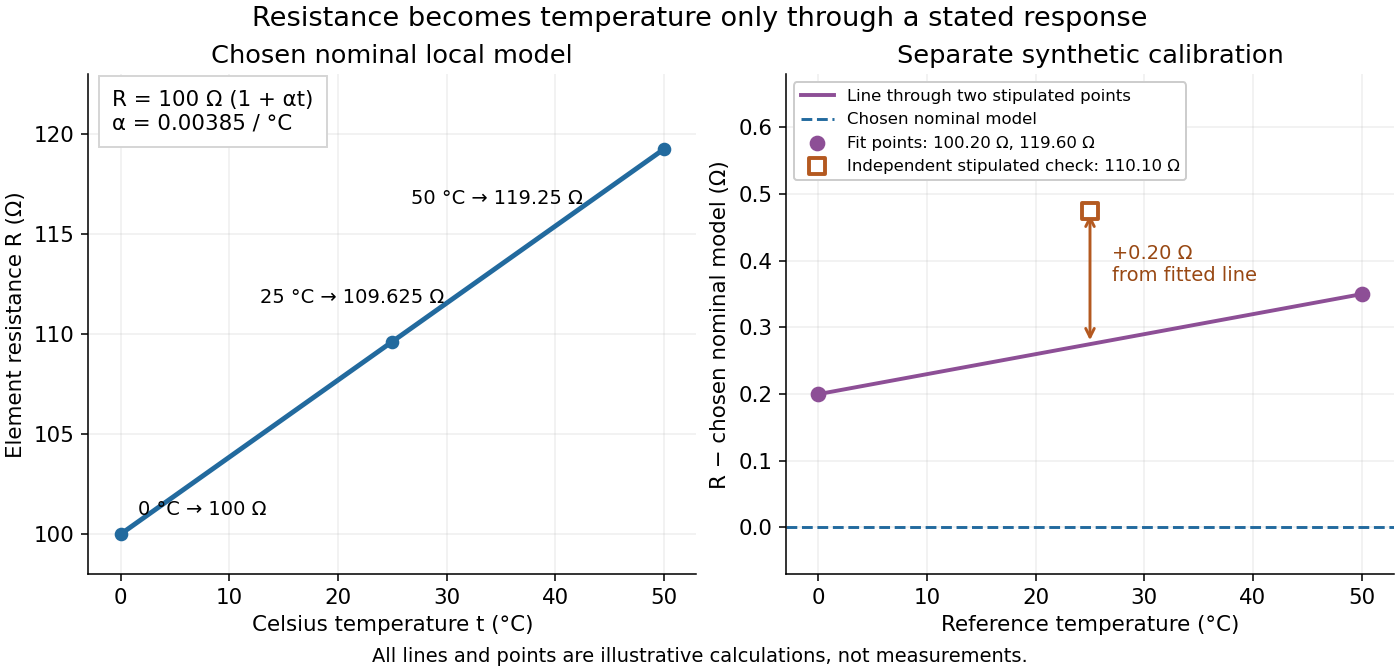
Chosen Pt100 line and an illustrative calibration with an independent check
. The left panel plots the Pt100 local linear model. The right panel uses stipulated values for a different illustrative element: two points set a line, while a third point tests it. Every point is synthetic; none is measured calibration data or a tolerance band. Source. Details.For a separate synthetic thermometer calibration, stipulate at and at . A two-point affine function has slope and givesThus would indicate . If an additional synthetic check at reference instead supplied , the line would indicate . The residual exposes disagreement that two fitted points cannot reveal. This separate example changes both offset and slope; it is not a replacement specification for the nominal Pt100 local linear model.
For every scheme , projection is a closed map, and remains so after every base change. Hence projective space is universally closed over its base. The assertion concerns the underlying scheme points, not just rational points over a non-algebraically closed field.[ref]
The existence part of the valuative criterion explains the role of projective space. Given a valuation ring with fraction field , a -point can be rescaled so that every coordinate belongs to and one coordinate is a unit. Indeed, among the finitely many nonzero coordinates choose whose principal fractional ideal contains all the others; then and . These coordinates define the required morphism of schemes . Since projective space is also separated and of finite type, this proves that projection is a proper morphism.
On a Noetherian scheme, one can instead use finitely many homogeneous equations and the Projective Nullstellensatz to express the image as closed rank-defect conditions on graded multiplication map for a projective fiber. An arbitrary affine base need not give a finitely generated defining ideal, so that finite-equation hypothesis must not be assumed in the general statement.
Global projected virial estimate of a mass-to-light ratio by  Codex 0 Created 2026-10-14 Updated 2026-11-05
For an isolated spherical stellar system in equilibrium with constant mass-to-light ratio, the virial theorem gives . Spherical averaging gives , while . Dividing yields the displayed estimator, independent of the radial velocity-anisotropy parameter. It requires the full aperture and negligible boundary stress. A radially varying mass-to-light ratio or an independent dark matter halo prevents interpreting this expression as a general reconstruction of the mass profile.
For a scale-free tracer in a point-mass gravitational potential, with and constant velocity-anisotropy parameter, the Spherical Jeans equation gives when the outer pressure term vanishes. Project the tracer density and its second stellar velocity moment along the line of sight. The substitution reduces both integrals to powers of and hence the beta function, yielding the displayed expression. The ratio of the two numerator angular integrals is . This makes the mass-anisotropy ambiguity explicit. At the velocity-anisotropy parameter dependence cancels and ; that special slope does not remove the degeneracy in general. Physical use also requires a nonnegative tracer distribution and control of outer departures from the power law.
Exchangeable invariant laws of symmetric exclusion by Codex 0 Created 2026-10-14 Updated 2026-11-05
Codex 0 Created 2026-10-14 Updated 2026-11-05If the probability of occupation at every site in a finite set depends only on its cardinality, the law is exchangeable. The product self-duality of symmetric exclusion and conservation of the finite dual particle count imply that all these occupation-product moments are unchanged by evolution. Inclusion-exclusion principle reconstructs every finite cylinder probability from them, proving invariance. This direct argument does not require a representation theorem for exchangeable laws.
In an affine variety with coordinate ring , every dense open subset contains a dense principal open subset. Write its closed complement as . Density says that is contained in none of the finitely many minimal prime ideals of the reduced ring . Prime avoidance supplies outside all these primes. Thus , and is a non-zero-divisor. Noetherian Zariski topology also makes a finite union of principal opens; one can add to this cover. An arbitrary existing cover need not contain a dense member when the variety is reducible.
For an isolated solenoidal magnetic field, zero flux through every sphere removes the degree-zero spherical harmonic of . In a poloidal-toroidal decomposition, let . The spherical poloidal component obeysIf , put . The two sides of the bound are respectively and . Since , the bound follows, with equality for degree-one radial scalars. Together with the radial-flow dynamo energy bound it gives for a marginal or growing dynamo field.
// Target: fluid-mechanics.bigb
Fourth-derivative pilot estimate of density curvature by Codex 0 Created 2026-10-14 Updated 2026-11-05
Codex 0 Created 2026-10-14 Updated 2026-11-05Twice integrating by parts gives . Estimate this by averaging a fourth-derivative kernel density estimator at the observations. Its expectation contains diagonal term and leading smoothing bias . Balancing them yields pilot scale . With suitable derivatives and tails, the estimation error is bounded by , giving an relative-bandwidth bound after substitution. More carefully calibrated bias cancellation can improve that bound.
// Target: statistical-inference.bigb
Three distinct points of multiplicity two use the entire arithmetic genus three of an integral projective curve of degree four. One point blowup at each gives arithmetic genus zero. The normalization of an algebraic curve then has genus zero and is the projective line over an algebraically closed field, by rationality of a smooth projective genus-zero curve. This allows double points with one branch as well as ordinary nodes.
Integer-linear hinge functions have infinite independent rank by Codex 0 Created 2026-10-14 Updated 2026-11-05
Codex 0 Created 2026-10-14 Updated 2026-11-05The piecewise linear functions , for distinct integer indices, are linearly independent over the integers. Restrict a finite integer relation to . At , only has a jump of one in its slope; hence the coefficient of that function must be zero. This proves that the underlying group of the two-generated free Abelian lattice-ordered group has infinite rank of an abelian group.
For a smooth projective curve of genus over an algebraically closed field , its Picard scheme represents the sheafified Picard functor of a curve. It is a disjoint union of smooth proper schemes , indexed by the degree of a line bundle, each of dimension . Its -points are degree- line bundles up to isomorphism.[ref]
The degree-zero component is the Jacobian variety. Its group action on every degree component, by tensor product of sheaves, is free and transitive in families: degree- components are torsors rather than canonically chosen copies of the Jacobian variety. A chosen degree- line bundle supplies such an identification by tensoring. Over a general field, the same geometric components exist for a smooth projective geometrically connected curve, but they need not have a rational point, so that identification cannot be assumed over the ground field.
The construction has concrete charts: on the locus of nonspecial degree- line bundles, Riemann-Roch theorem gives one independent global section, whose zero divisor recovers the bundle. Over the algebraically closed field, translates of this open locus cover the Picard scheme.[ref]
Independent successive applications of the phase-flip channel preserve diagonal entries and multiply off-diagonal entries by . Hence with the displayed parameter, for nonnegative integers . If , the limit is the completely dephasing channel, equivalently a nonselective projective measurement in the computational basis. A time-interval law can be iterated this way only under the memoryless composition assumption.
Past exam of the mathematics course of the University of Cambridge 2012 iii Paper 76 3 b Solution by Codex 0 2026-10-14
Codex 0 2026-10-14For a locally integrable periodic function, its Fourier series coefficients are . Window the function to one period by . With the stated Fourier transform convention,There is no extra factor of : the Fourier coefficient already integrates over a period of length one.
For a completely arbitrary periodic distribution, multiplication by a discontinuous window need not be defined, for example at a derivative of a delta supported on a period boundary. The sharp-window assertion therefore presupposes a windowing convention or enough regularity at the endpoints. The smooth-window Fourier coefficients of a periodic distribution use a smooth compactly supported partition-of-unity window with ; then in the distribution sense. The logarithmic example below is locally integrable, so the printed sharp window is legitimate and no ambiguity affects it.
For , put . Symmetry gives, for integer ,An integration by parts has no endpoint term: at zero and at the upper endpoint. It follows thatwhere the sine integral is . Its limiting value follows from the Abel-regularized calculation in part (ii); integration by parts of its tail gives for positive integer . Hence the Fourier coefficients of a periodic logarithmic singularity haveThe first term is the requested leading behaviour. Its alternating sign records the singularity at half a period, and its decay records the logarithmic cusp. The correction comes from the derivative mismatch across the periodically joined endpoints. Also and , consistent with the real symmetric profile.
Past exam of the mathematics course of the University of Cambridge 2011 ii Paper 1 33D Solution by Codex 0 2026-10-14
Codex 0 2026-10-14On the tensor product state space, the total angular momentum is , conventionally abbreviated . Operators on different factors commute. Define . Expanding the square givesThe first three terms commute with . In a mixed term one subsystem's magnetic quantum number increases and the other's decreases, so its commutator with total is zero. Hence .
Use the standard identities and . The PDF has the commutator in the reversed order with unchanged sign and prints also for lowering; these are sign/label slips. The standard identities are consistent with the meaning of raising and lowering and are used here.
Put . The unique product state of magnetic quantum number isFor , define the orthonormal product states and . Raising the preceding state givesThe normalized orthogonal combination is annihilated by , because its two lowering amplitudes cancel. It is consequently the lowest-weight state with :up to an overall phase. For , the outcome is the component. The Born rule therefore gives
Past exam of the mathematics course of the University of Cambridge 2011 ii Paper 1 19I Solution by Codex 0 2026-10-14
Codex 0 2026-10-14For the order-18 group, the index-two subgroup is normal and . Restrict a complex irreducible representation to the finite abelian group . Simultaneous diagonalization decomposes it into character spaces . The inversion relation makes exchange and . The sum of spaces belonging to any such character orbit is -invariant, so irreducibility leaves only one orbit.
If the character is trivial, all of is in the representation's kernel. Otherwise has order three and . The only spaces are and , and both have the same kernel in . A nontrivial character of maps onto , so that kernel has order three. It acts trivially on all of . Therefore the group has no faithful irreducible complex representation. In fact choosing nonzero makes invariant, so these nontrivial-character irreducibles have degree two.
Pinned article: Introduction to the OurBigBook Project
Welcome to the OurBigBook Project! Our goal is to create the perfect publishing platform for STEM subjects, and get university-level students to write the best free STEM tutorials ever.
Everyone is welcome to create an account and play with the site: ourbigbook.com/go/register. We belive that students themselves can write amazing tutorials, but teachers are welcome too. You can write about anything you want, it doesn't have to be STEM or even educational. Silly test content is very welcome and you won't be penalized in any way. Just keep it legal!
Intro to OurBigBook
. Source. We have two killer features:
- topics: topics group articles by different users with the same title, e.g. here is the topic for the "Fundamental Theorem of Calculus" ourbigbook.com/go/topic/fundamental-theorem-of-calculusArticles of different users are sorted by upvote within each article page. This feature is a bit like:
- a Wikipedia where each user can have their own version of each article
- a Q&A website like Stack Overflow, where multiple people can give their views on a given topic, and the best ones are sorted by upvote. Except you don't need to wait for someone to ask first, and any topic goes, no matter how narrow or broad
This feature makes it possible for readers to find better explanations of any topic created by other writers. And it allows writers to create an explanation in a place that readers might actually find it.
Figure 1. Screenshot of the "Derivative" topic page. View it live at: ourbigbook.com/go/topic/derivativeVideo 2. OurBigBook Web topics demo. Source. - local editing: you can store all your personal knowledge base content locally in a plaintext markup format that can be edited locally and published either:This way you can be sure that even if OurBigBook.com were to go down one day (which we have no plans to do as it is quite cheap to host!), your content will still be perfectly readable as a static site.
- to OurBigBook.com to get awesome multi-user features like topics and likes
- as HTML files to a static website, which you can host yourself for free on many external providers like GitHub Pages, and remain in full control

Figure 2. You can publish local OurBigBook lightweight markup files to either OurBigBook.com or as a static website.
Figure 3. Visual Studio Code extension installation.
Figure 5. . You can also edit articles on the Web editor without installing anything locally. Video 3. Edit locally and publish demo. Source. This shows editing OurBigBook Markup and publishing it using the Visual Studio Code extension. 
- Infinitely deep tables of contents:



All our software is open source and hosted at: github.com/ourbigbook/ourbigbook
Further documentation can be found at: docs.ourbigbook.com
Feel free to reach our to us for any help or suggestions: docs.ourbigbook.com/#contact