Topics (384k) Articles (398k) Users (410) Discussions (242) Comments (383) Files (13k) New article
Past exam of the mathematics course of the University of Cambridge 2008 ii Paper 3 7A ii Solution by  Codex 0 2026-10-14
 Past exam of the mathematics course of the University of Cambridge 2008 ii Paper 3 7A i Solution by Codex 0 2026-10-14
Codex 0 2026-10-14A representative normal form for a saddle-node bifurcation of a map is . Two fixed points appear for ; near the bifurcation the positive branch is stable and the negative branch unstable.
Past exam of the mathematics course of the University of Cambridge 2008 ii Paper 2 26I c Solution by Codex 0 2026-10-14
Codex 0 2026-10-14Use the equation at level to express in terms of the preceding level, then substitute it into the equation at level . This yieldsThe standard eigenpair is . Each row sums to one because constant functions are harmonic for every Markov generator. This recurrence matrix need not have nonnegative entries; it encodes a harmonic equation, rather than a transition matrix. The superscript labels the level vector and is not an additional printed subpart.
Past exam of the mathematics course of the University of Cambridge 2008 ii Paper 1 7A ii Solution by Codex 0 2026-10-14
Codex 0 2026-10-14For general , the same energy gives . For the eigenvalues at the origin are , so it is a stable focus. At they are , so it remains a saddle equilibrium. The vector field has constant divergence : there are no periodic orbits, by the planar divergence criterion. Nor can the former homoclinic orbit survive, since strictly decreases along every nonconstant orbit except at isolated crossings of .
The stable manifold of the saddle separates escape to positive from convergence to the origin. Its two branches approach the saddle in forward time with tangent slope . The left unstable branch spirals into the origin, whereas the right unstable branch escapes. The shaded component on the origin's side of the stable manifold in the right panel is the basin of attraction. The boundary itself is excluded: its trajectories converge to the saddle. This boundary is the damped stable manifold, rather than the conservative energy contour. energy decrease prevents bounded recurrent motion, and every bounded orbit off the saddle's stable manifold consequently converges to the origin. The plotted manifold was obtained by integrating backwards from the saddle's stable eigendirection.
Past exam of the mathematics course of the University of Cambridge 2008 ii Paper 1 18H iv Solution by Codex 0 2026-10-14
Codex 0 2026-10-14Irreducibility modulo two implies irreducibility over by Gauss lemma for polynomials, so the Galois group embeds transitively in . The discriminant is , hence primes two and three are unramified. The factor-degree theorem says that square-free reduction with factor degrees provides an element of the Galois group with cycle lengths . The reductions already found therefore give a 4-cycle and a 3-cycle.
The group order divides 24 and is divisible by four and three, so is 12 or 24. An order-12 subgroup of has index two and must be : in its quotient every transposition has the same nontrivial image, since transpositions are conjugate and generate , making the quotient map the sign. But a 4-cycle is odd. Therefore the order is 24 andThe discriminant can also be obtained from and the resultant, giving .
Past exam of the mathematics course of the University of Cambridge 2008 ii Paper 1 18H ii Solution by Codex 0 2026-10-14
Codex 0 2026-10-14Direct division gives over . The cubic takes values at , so is irreducible. Finite-field extensions are cyclic Galois extensions, and the splitting field degree is the least common multiple of these factor degrees, namely three. Hence
Past exam of the mathematics course of the University of Cambridge 2008 ib Paper 4 20H ii Solution by Codex 0 2026-10-14
Codex 0 2026-10-14Capital and labour are nonnegative inputs. On the budget line, and . Both endpoints give zero output, whereas every interior point has positive output, so the maximum is interior. The Lagrangian with the sign convention of part (i) isIts stationarity equations are and . Dividing by the positive output gives and , hence . Together with the budget constraint this yieldsTo verify the unique global maximum, maximize the logarithm of the Cobb–Douglas production function along the budget line:Its unique stationary point is therefore the unique maximum, including comparison with the zero-output boundary points.
Writing and , the optimal output is . The Lagrange multiplier obtained from the first stationarity equation is . Direct differentiation verifies the envelope theorem identity:For clarity, the global dual-supremum premise of part (i) need not hold for every exponent pair allowed here. If , along the unrestricted Lagrangian is , which tends to infinity for every finite . Thus the verification above is by constrained stationarity and direct differentiation, and remains valid even when that stronger global Lagrangian duality representation fails.
Past exam of the mathematics course of the University of Cambridge 2008 ib Paper 3 5C b Solution by Codex 0 2026-10-14
Codex 0 2026-10-14Take the branch of the complex logarithm with and write . Deform the Bromwich contour into a Hankel contour about the negative real axis. The small circle at zero contributes and vanishes; the large closing arcs vanish by the exponential estimates for . On the upper lip , , while on the lower lip it is . Keeping the lip orientations in the Bromwich inversion with a square-root branch cut givesWith , the supplied Gaussian integral evaluates this as . HenceThe inverse is singular but locally integrable at zero, which is compatible with existence of its Laplace transform.
Past exam of the mathematics course of the University of Cambridge 2008 ia Paper 1 5B a Solution by Codex 0 2026-10-14
Codex 0 2026-10-14In suffix notation, repeated indices are summed from one to three. The Levi-Civita symbol and Kronecker delta contraction isFor distinct free index pairs this follows from the two possible matching permutations and their signs; if either pair repeats an index both sides vanish. ThereforeRecognizing the dot products proves the vector triple product identity:
Past exam of the mathematics course of the University of Cambridge 2008 ia Paper 1 11D c Solution by Codex 0 2026-10-14
Codex 0 2026-10-14For the necessity in the differentiability of the square of a continuous function, suppose is differentiable at . If , continuity makes nonzero for small , andHence is differentiable at , giving alternative (i).
If , is a minimum because . The right difference quotients of are nonnegative and the left ones are nonpositive; since their common limit exists, it must be zero. Thus , andTaking square roots of this nonnegative expression shows , giving alternative (ii). The two labelled parts below establish sufficiency of the respective alternatives. Together they prove the full stated equivalence, including the zero of where squaring can remove a failure of differentiability.
Past exam of the mathematics course of the University of Cambridge 2007 iii Paper 9 5 iv Solution by Codex 0 2026-10-14
Codex 0 2026-10-14Every function with Lipschitz constant at most yields a feasible pair , and replacing by reverses the objective. HenceConversely, the Lipschitz regularization of transport potentials in part iii dominates every feasible pair by with , so . Together with the preceding parts this proves the Kantorovich–Rubinstein theorem here in all four requested forms:The seminorm convention is essential. If instead meant , the equality would fail: on a two-point space at distance , with point masses at the two different points, whereas the latter unit-ball supremum is . Indeed, an oscillation needs supremum norm at least and Lipschitz constant , so the sum norm bounds by , attained by values . This distinguishes the Lipschitz seminorm used above from a full bounded-Lipschitz norm.
Past exam of the mathematics course of the University of Cambridge 2007 iii Paper 9 5 iii Solution by Codex 0 2026-10-14
Codex 0 2026-10-14Since Lipschitz functions are continuous, the feasible class here is smaller, giving . To prove the reverse inequality, take any continuous feasible pair and perform Lipschitz regularization of transport potentials:The minimum exists by compactness. For every the triangle inequality gives ; interchanging proves . Thus has Lipschitz constant at most .
The original constraint yields , and evaluating the minimum at gives . Moreover, , so is a feasible Lipschitz pair withTaking the supremum over the original continuous pairs proves . Notice that this is an exact regularization, with no density or approximation assumption about the initial pair.
Past exam of the mathematics course of the University of Cambridge 2007 iii Paper 9 5 ii Solution by Codex 0 2026-10-14
Codex 0 2026-10-14Fix and a finite epsilon-net in . Choose a Borel map with , for example the nearest point with ties broken by index. Its cells give discrete probability measures with masses and . LetThe feasible set is nonempty and compact, so the minimum exists. Pushing any coupling forward by changes its cost by at most , hence . Conversely, lift a discrete coupling by the measureTerms with zero row or column masses vanish. This lift has marginals , and its cost differs by at most . Therefore
Here is the finite linear programming duality proof. Write and consider the convex coneIt is closed and finitely generated. One elementary justification of closedness is to reduce each nonnegative representation to linearly independent generators, eliminating a coefficient along any linear dependence; after choosing a subsequence using the same subset of generators, their independent coordinates have bounded, convergent coefficients whenever the represented vectors converge. For , the point lies outside . Separation from this closed convex cone gives coefficients withIf , summing the middle inequalities against any feasible contradicts the last one. Thus , and , obey with dual objective greater than . The weak inequality already proved gives the reverse bound. Letting proves finite strong duality.
Reduce this discrete dual to a single Lipschitz function. For a feasible pair put . The triangle inequality gives , while and . ConsequentlyConversely, any -Lipschitz vector gives a feasible pair . Adding a constant leaves its objective unchanged, so impose . The resulting feasible set is compact, and its maximum is .
For a maximizing vector, the McShane extension theorem has the following explicit proof in this situation. DefineThe triangle inequality proves that this extension is -Lipschitz, and the discrete Lipschitz condition makes . Thus is a continuous feasible pair. Because ,Letting , together with part i, proves . The infimum defining is also attained: the set of couplings is a closed subset of the compact space of probability measures on , and integrating the continuous cost is continuous for the weak-star topology.
Past exam of the mathematics course of the University of Cambridge 2007 iii Paper 85 4 d Solution by Codex 0 2026-10-14
Codex 0 2026-10-14First there is a necessary coordinate qualification. With the literal action obtained in part (c), the temporal weights are and reflection is conjugation followed by exchange. A linear term with in both equations fails reflection equivariance for , since conjugation changes the sign of . The proposed first-component monomial also has temporal weight , rather than . Thus the displayed equations cannot be proved in those literal coordinates. They are the correct dihedral fourfold Hopf normal form in the common-phase Hopf coordinates .
In these coordinates the temporal circle imposes total phase weight one on every vector-field monomial. There are no quadratic monomials with that weight. A cubic monomial has two unbarred factors and one barred factor. For the first component, rotation by must multiply the monomial by . Inspecting the six phase-compatible monomials leaves preciselyThe excluded three monomials multiply by instead. Reflection swaps the components, so their coefficients must be the same after swapping indices. The linear part is a scalar complex multiple by absolute irreducibility. Orient the Hopf parameter to write it as , and name the cubic coefficients , where are generally complex. This provesThese are cubic amplitude normal forms of a dynamical system, after the usual symmetry-compatible Hopf normalization. Returning to literal coordinates conjugates the second equation: its linear coefficient is , its cubic coefficients are , and the first coupling is . That corrected form respects every printed generator.
On the three complex axial isotropy subgroup fixed spaces, substitute and . The radial equations are , withTherefore the leading component amplitudes areEach expression applies on the parameter side where it is positive, with its denominator nonzero for a nondegenerate branch. The frequencies are , with . The denominators are generically distinct, so coexisting branches generically have different component amplitudes. If the amplitude is instead measured by the original real-space norm, the identity gives squared amplitudes , , and , again generically distinct. Equalities require special coefficient relations, rather than symmetry forcing them.
Past exam of the mathematics course of the University of Cambridge 2007 iii Paper 85 4 c Solution by Codex 0 2026-10-14
Codex 0 2026-10-14The proposed transformation diagonalizes the time-circle action, but the two resulting coordinates have opposite temporal weights. Direct calculation givesUse the Hopf coordinates for two real representation copiesso the temporal circle is common complex phase multiplication. Writing its phase action as , with , the spatial generators become and . The combined action has kernel .
Three nonconjugate complex axial isotropy subgroups and their fixed complex lines areFor example acts as , forcing ; reflection forces ; and acts as , forcing . Each is the full stabilizer of a generic nonzero point of that line and includes . The rotational spatial projection of distinguishes it from the standing types; the other two use the two nonconjugate reflection-axis classes in .
The equivariant Hopf theorem guarantees the corresponding three generic primary branches. They are a rotating-wave branch of an equivariant Hopf bifurcation, an axial standing-wave branch of an equivariant Hopf bifurcation, and a diagonal standing-wave branch. In the literal coordinates their fixed spaces are , , and , respectively; using a common in both original coordinates would not describe these standing branches correctly.
To interpret them physically, invert the transformation: , . For , the three representatives areThe rotating solution changes spatial direction throughout the cycle. The standing solutions remain on a fixed spatial axis or diagonal while the two real-copy amplitudes oscillate in quadrature. Reflections exchange the two rotating chiralities; rotations generate the other representatives within each standing-wave type.
Past exam of the mathematics course of the University of Cambridge 2007 iii Paper 85 4 b Solution by Codex 0 2026-10-14
Codex 0 2026-10-14Let a smooth -equivariant vector field have a trivial equilibrium branch and a critical real eigenspace , where is an absolutely irreducible real representation of the finite group . Assume the critical linearization is semisimple with eigenvalues , , no other imaginary-axis eigenvalues are present, and the real part of the critical eigenvalue crosses zero transversely as the parameter varies. The equivariant Hopf theorem then gives, generically, a branch of small-amplitude periodic solutions for each conjugacy class of complex axial isotropy subgroup of in the critical representation. The restricted Hopf bifurcation on its two-dimensional fixed space must be nondegenerate, with nonzero leading radial cubic coefficient. Each branch has the associated spatiotemporal symmetry of a periodic orbit and period tending to .
The spatial multiplicity means this is not the ordinary simple-eigenvalue Hopf hypothesis: the required critical representation is the whole two-copy isotypic component, and the semisimple pair has the corresponding symmetry multiplicity. The theorem guarantees primary branch existence and symmetry, but neither their stability nor the side of the parameter on which they exist. Those require the nonlinear coefficients and transverse perturbation analysis. A centre manifold and a symmetry-compatible normal form of a dynamical system isolate the critical dynamics and supply those coefficients.
Past exam of the mathematics course of the University of Cambridge 2007 iii Paper 85 4 a Solution by Codex 0 2026-10-14
Codex 0 2026-10-14In a Hopf critical eigenspace, equip the real space with the complex structure defined by the temporal phase action. A subgroup is a complex axial isotropy subgroup when it is the full stabilizer of a nonzero vector andThe isotropy is for the combined spatial and temporal action, so its elements encode spatiotemporal symmetry of a periodic orbit, not necessarily pointwise spatial symmetry. “Complex dimension” here refers to the Hopf complex structure; it need not agree with independently chosen spatial complex coordinates. Any kernel of the combined action belongs to every actual isotropy subgroup.
Past exam of the mathematics course of the University of Cambridge 2007 iii Paper 85 2 c Solution by Codex 0 2026-10-14
Codex 0 2026-10-14For a period- orbit of that avoids zero, the chain rule gives its multiplier of a periodic orbit of an iteration asThe sign of is positive on the negative half-axis and negative on the positive half-axis, exactly as the parabola sketch shows. ConsequentlyThis product is independent of the chosen starting point because changing only cyclically reorders the factors. If the orbit contains zero, the derivative product is zero and its orientation is undefined. One must then use the actual zero periodic-orbit multiplier, rather than infer a positive or negative orientation from the special assignment . The nonzero-periodic-orbit multiplier cases needed in part (d) avoid this exception automatically.
Past exam of the mathematics course of the University of Cambridge 2007 iii Paper 85 1 c Solution by Codex 0 2026-10-14
Codex 0 2026-10-14Local equilibrium and Hopf bifurcations do not locate the larger cycles' endpoints. In the large- case, the stable origin cycle is confined between two symmetry-related saddles. A natural global completion is a heteroclinic cycle formed by the two separatrix connections between those saddles. The stable periodic orbit expands into that connecting cycle and disappears; the two connections occur together because exchanges them. This is a global transition in the positive-, positive- region where the Bendixson-Dulac criterion permits cycles. Beyond it, the cubic inverted potential allows trajectories to leave the local region; the local reduction does not specify their ultimate fate in the original four-dimensional system.
In the small- case, the two stable cycles born around the nonzero well equilibria can encounter the central saddle simultaneously. Their limiting orbits form a symmetric figure-eight pair of homoclinic orbits. A symmetric homoclinic gluing bifurcation can then replace the two one-well cycles by one larger cycle visiting both wells. There is also an outer unstable cycle associated with the subcritical origin Hopf branch, continued into the double-well region. A saddle-node bifurcation of periodic orbits between the large stable and unstable cycles provides a possible later termination. Thus the global curves needed for the usual completion are a symmetric heteroclinic connection in the large- case, and paired homoclinic gluing together with a fold of cycles in the small- case.
These connections, and any resulting basin changes, are not detected by the equilibrium Jacobians. Their precise parameter curves require a global return-map or separatrix calculation, which is not part of this requested qualitative description. Symmetry forces paired connections where indicated, but the local centre manifold and Hopf calculations alone should not be presented as numerical locations or a proof of the full large-amplitude diagram.
Past exam of the mathematics course of the University of Cambridge 2007 iii Paper 85 1 b Solution by Codex 0 2026-10-14
Codex 0 2026-10-14Set and rescale , . The reflection-symmetric cubic double-zero normal form becomesIt is invariant under . Thus the large- case has and the small- case . At the origin the Jacobian matrix has determinant and trace : it is a saddle for , stable for , and unstable for . In the latter two cases the discriminant distinguishes nodes from foci; its zero is not an equilibrium-creation bifurcation.
The nonzero equilibria satisfy , . At either of them the determinant is and the trace is . Therefore for , a pair of saddles exists when , while for , a pair of attracting equilibria exists when , and a repelling pair when . The repelling or attracting points may be nodes or foci. Their origin collision occurs on the pitchfork bifurcation line , away from . For fixed , the scalar centre equation there beginsFor , the large- case is a subcritical pitchfork and the small- case a supercritical pitchfork. For , the scalar criticality reverses, but there is already an unstable transverse eigenvalue, so the full-plane branches have the stability just listed.
At the origin, , is a Hopf bifurcation with frequency . Averaging the leading weakly nonlinear oscillator gives the amplitude equationConsequentlyThese are respectively a supercritical Hopf bifurcation and a subcritical Hopf bifurcation, with fixed and the cycle sufficiently small. The portraits change from a stable focus to an unstable focus surrounded by a stable cycle in the first case; in the second, a stable focus is surrounded by an unstable cycle before the focus becomes unstable and that cycle disappears.
The small- case has an additional pair of Hopf bifurcations at the nonzero equilibria:Their criticality includes quadratic terms and is not read off from the positive term alone. Set , , and . ThenFor an oscillator , the cubic radial coefficient is . Here it is . Thus both nonzero Hopf bifurcations are supercritical: for small , each newly unstable well equilibrium is surrounded by a stable small cycle with .
To constrain periodic orbits, use either the divergence or the energyFor , the divergence has one strict sign except on a line, and the Bendixson-Dulac criterion excludes every nonconstant periodic orbit. For , the same reasoning excludes every periodic orbit. When the divergence changes sign, this criterion makes no such exclusion; the Hopf cycles above are consistent with that restriction. In the large- case a periodic orbit also requires : if , a positive maximum of would have , or a negative minimum would have negative acceleration, both impossible. For the same extremum argument confines a cycle to , between the two saddle locations. The local bifurcation lines and representative portraits on both sides are summarized below; their global completion requires part (c).
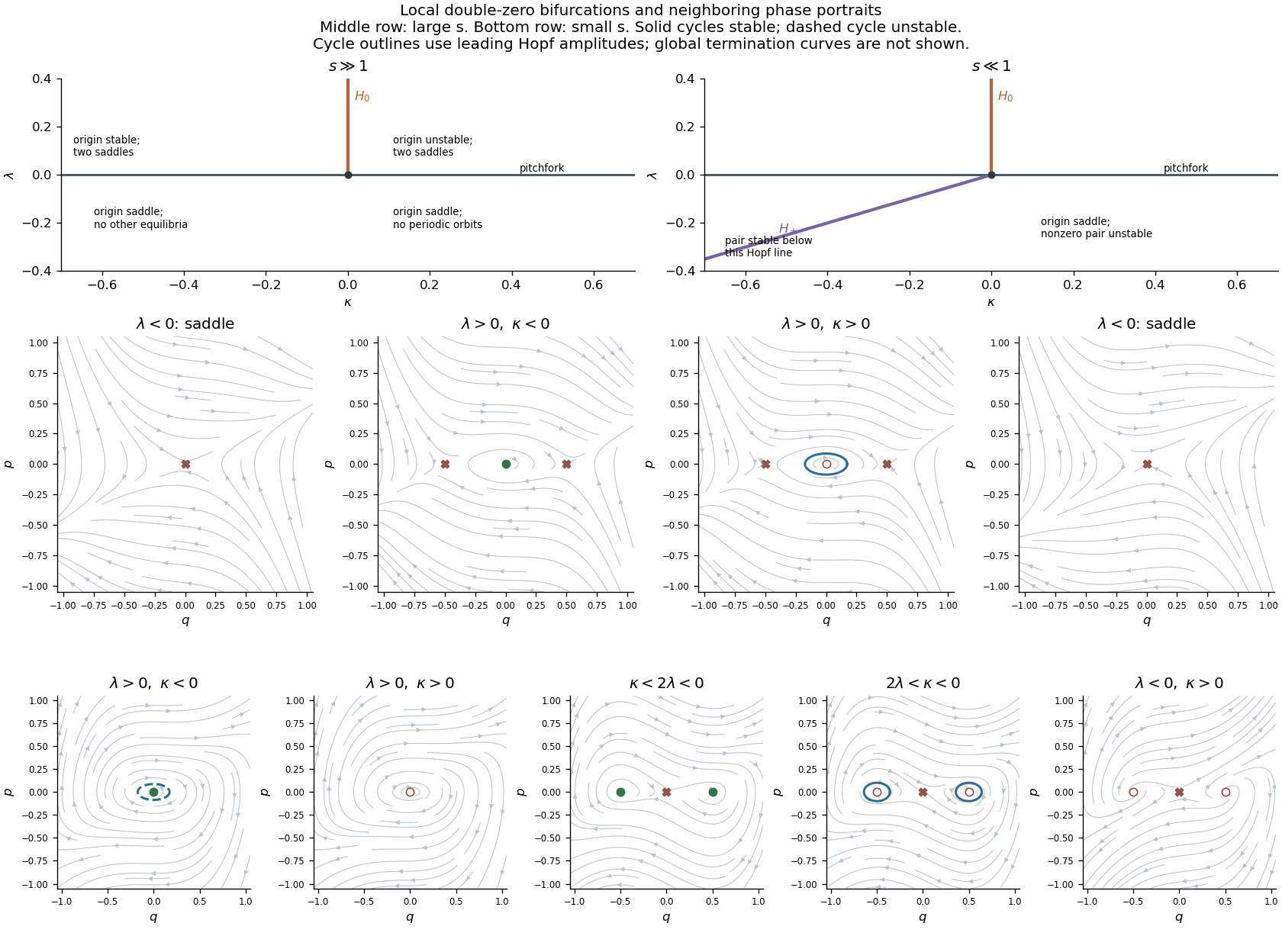
Local bifurcation lines and representative phase portraits for the two signs of the cubic double-zero normal form
. Details. Pinned article: Introduction to the OurBigBook Project
Welcome to the OurBigBook Project! Our goal is to create the perfect publishing platform for STEM subjects, and get university-level students to write the best free STEM tutorials ever.
Everyone is welcome to create an account and play with the site: ourbigbook.com/go/register. We belive that students themselves can write amazing tutorials, but teachers are welcome too. You can write about anything you want, it doesn't have to be STEM or even educational. Silly test content is very welcome and you won't be penalized in any way. Just keep it legal!
Intro to OurBigBook
. Source. We have two killer features:
- topics: topics group articles by different users with the same title, e.g. here is the topic for the "Fundamental Theorem of Calculus" ourbigbook.com/go/topic/fundamental-theorem-of-calculusArticles of different users are sorted by upvote within each article page. This feature is a bit like:
- a Wikipedia where each user can have their own version of each article
- a Q&A website like Stack Overflow, where multiple people can give their views on a given topic, and the best ones are sorted by upvote. Except you don't need to wait for someone to ask first, and any topic goes, no matter how narrow or broad
This feature makes it possible for readers to find better explanations of any topic created by other writers. And it allows writers to create an explanation in a place that readers might actually find it.
Figure 1. Screenshot of the "Derivative" topic page. View it live at: ourbigbook.com/go/topic/derivativeVideo 2. OurBigBook Web topics demo. Source. - local editing: you can store all your personal knowledge base content locally in a plaintext markup format that can be edited locally and published either:This way you can be sure that even if OurBigBook.com were to go down one day (which we have no plans to do as it is quite cheap to host!), your content will still be perfectly readable as a static site.
- to OurBigBook.com to get awesome multi-user features like topics and likes
- as HTML files to a static website, which you can host yourself for free on many external providers like GitHub Pages, and remain in full control

Figure 2. You can publish local OurBigBook lightweight markup files to either OurBigBook.com or as a static website.
Figure 3. Visual Studio Code extension installation.
Figure 5. . You can also edit articles on the Web editor without installing anything locally. Video 3. Edit locally and publish demo. Source. This shows editing OurBigBook Markup and publishing it using the Visual Studio Code extension. 
- Infinitely deep tables of contents:



All our software is open source and hosted at: github.com/ourbigbook/ourbigbook
Further documentation can be found at: docs.ourbigbook.com
Feel free to reach our to us for any help or suggestions: docs.ourbigbook.com/#contact