Topics (384k) Articles (398k) Users (410) Discussions (242) Comments (383) Files (13k) New article
Suppose a small category has equalizers. If a categorical presheaf is a retract , with , then equalizes and . The Yoneda lemma writes for an endomorphism . An equalizer of and gives the same presheaf equalizer, since the Yoneda embedding preserves categorical limits. Uniqueness of equalizers gives .
Instantaneous solvent term in a relaxation modulus by  Codex 0 Created 2026-10-14 Updated 2026-11-05
For a linear viscoelastic fluid, write the solvent stress explicitly as , or use the displayed kernel with a causal endpoint delta satisfying . If a symmetric delta is integrated with half its weight at the endpoint, its coefficient must instead be . Mixing those conventions loses a factor of two. The Oldroyd-B model has the displayed exponentially decaying polymer part after linearization.
Take independent and identically distributed draws from the uniform three-outcome reference above. An observed sample mean at least is unusual because the source expected value is zero. For two draws, the only successful ordered pairs are , giving probability .
For long samples, the relevant empirical distributions have mean at least . The method of types assigns a profile a leading probability cost . The least costly admissible profile is the information projection on three outcomes: in this example the minimizing mean is on the boundary , and the leading exponent is approximately nats per draw. The exponential scale is not an exact finite-sample probability formula.[ref]
The attraction of this connection is that a constrained optimization problem predicts the most probable way an unusual aggregate observation can occur. It links relative entropy, expected value constraints and rare empirical distributions without identifying a rare event with just one exact attainable type class.
For a subgroup of a group generated by a set , choose representatives of right cosets . If represents , then lies in . These Schreier generators generate : inserting successive coset representatives along a word telescopes the word into such factors. Lifted relators can be rewritten in the same factors.
For a real or complex matrix, the three displayed conditions are equivalent to being a regular matrix summability method. For necessity, first apply the Uniform boundedness principle to each row's finite partial sums on the convergent sequence space, obtaining absolute summability of that row. Apply the principle again to the full row functionals, obtaining a uniform bound. Coordinate vectors and the constant-one sequence give the remaining conditions. For sufficiency, write and split the error into a finite head, controlled by columnwise convergence, and a uniformly small tail, controlled by the absolute row bound.
For every regular summability matrix , there is a bounded sequence whose transformed row sums do not converge. A gliding hump argument selects successive rows whose mass on already assigned coordinates is small and whose remaining tails are small. On each new finite block, choose signs agreeing or disagreeing with that row alternately. Since row sums tend to one, the transformed values have subsequences uniformly above and below zero. This does not contradict preservation of ordinary convergence, since the constructed sequence is divergent.
The summability domain is the inverse image of the convergent sequence space under the bounded matrix operator on the l-infinity sequence space. It is therefore a closed linear subspace. The bounded divergence for every regular summability matrix makes it proper, so it has empty interior and is a nowhere dense set. The Baire category theorem then ensures that countably many regular methods miss some common bounded sequence.
Selecting a subsequence is a regular matrix summability method: every row has one entry equal to one, every fixed column eventually vanishes, and all row sums equal one. Every bounded sequence of real or complex numbers has a convergent subsequence by the Bolzano-Weierstrass theorem, so each bounded sequence is summable by some sequence-dependent regular method. The order of the quantifiers matters: no single regular matrix sums all bounded sequences.
For a Gaussian linear model with an intercept and one explanatory variable, and , the regression intercept estimator is normal with variance . The residual variance estimate is independent of the coefficient estimators and has a chi-squared distribution with degrees of freedom. Consequently the displayed statistic has a Student t-distribution under , and a two-sided level- test rejects for .
// Target: mathematical-optimization.bigb
The stationary law is the law of . Let . The Exponential martingale for Brownian motion , stopped on first hitting , is bounded by . On no hitting, the driving path tends to minus infinity. Dominated convergence and optional stopping therefore give . The reflected process started at zero converges to this supremum law: its value at time has the law of the driving path's maximum up to , by reversing the increments. The resulting density is for .
Suppose has analytic near zero, , and a solution , with a positive integer. The indicial roots are . The Abel identity gives . Dividing by gives . Integrating this reduction of order expression from zero, multiplying by , and choosing proves the displayed normalized expansion. The integral's zero constant eliminates the added multiple of . Its nonzero Wronskian proves independence. In this setting the assumed exponent-zero solution prevents a logarithm in the constructed exponent- solution.
The category of rectangular bands is Cartesian closed. For nonempty products , , the exponential is . Also and for nonempty . It has no subobject classifier: the classifier would have two elements, hence would be left-zero or right-zero, while its characteristic maps on a two-by-two product could not single out a one-point subalgebra.
The three cyclic versions of this inequality are necessary and sufficient for routing unit calls on a triangle with complete instantaneous rearrangement. Necessity counts endpoint calls through a node cut. For sufficiency, at most one call count can exceed its direct-link capacity, since any two such excesses would violate their common endpoint cut. Route that one excess along the two other links; the two relevant cut inequalities guarantee room there. This gives an exact reduction to a loss network with a virtual resource at each node.
Let measure position along the line joining two mutually incoherent optical point sources in the focal plane, with equal detected radiant fluxes and separation . Extend the even Airy disk profile to signed , and put as in Airy disk normalization and encircled energy. Relative to the peak of one source carrying the pair's total radiant flux, their summed light intensity isThe two-dimensional point spread functions underlying these line profiles all have the same total radiant flux. The line-profile integrals themselves need not equal one.
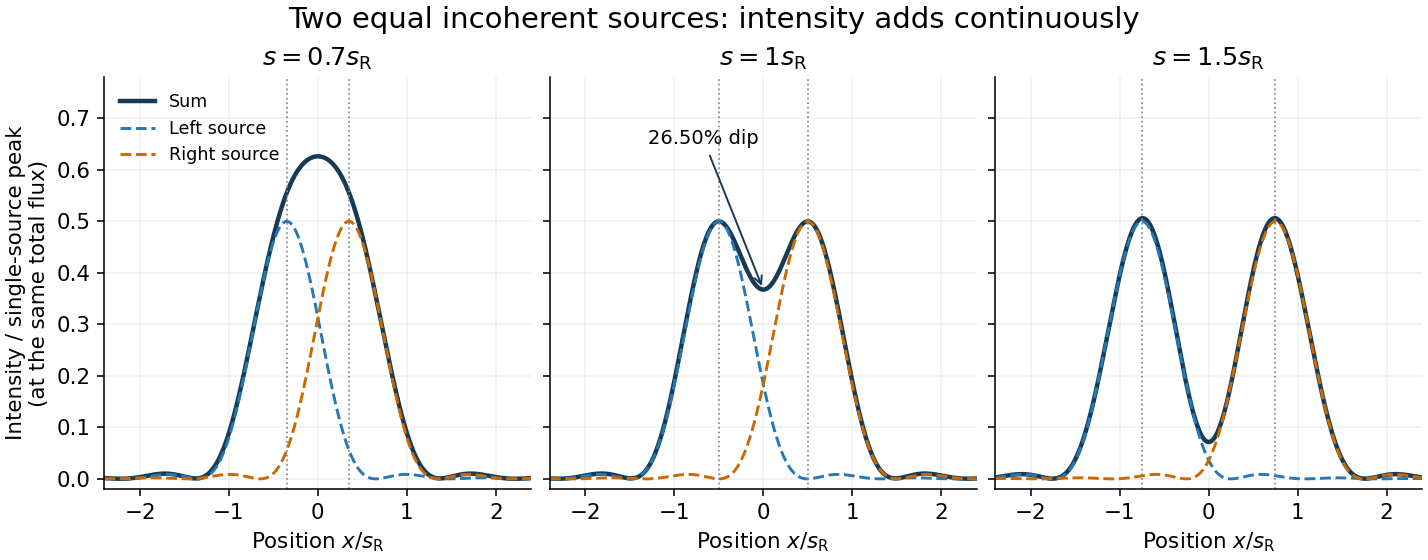
The dashed curves show individual contributions; the solid curve is their sum. All panels use the same brightness scale, and the vertical markers indicate the true source centres. At , the other source contributes zero at each centre, so . At the midpoint,The midpoint is therefore about below the source-centre peak. This is a calculation for this particular Airy disk and equal-incoherent-source convention, not a universal experimental threshold. At the two central peaks merge; at the valley is deeper. Changing separation continuously changes the profile, without a discontinuity at the Rayleigh criterion.
To see how information survives when the central peaks merge, set and . A symmetric Taylor expansion givesThe linear terms cancel because the source positions are symmetric. At the midpoint, the Airy disk derivation gives . Thus a close pair's shape differs from that of one source, but only quadratically at leading order. Detecting this small change becomes sensitive to noise and response calibration. For unequal flux fractions and , the intensity instead becomes ; its valley and peak positions need not match the equal-source example.
A map between simply connected spaces is a rational homotopy equivalence when it induces isomorphisms in every degree. Equivalently it induces an equivalence of their rationalizations, or a rational homology isomorphism by the rational Whitehead theorem. Spaces have the same rational homotopy type when they are connected by a zigzag of such maps. This is distinct from rational homotopy equivalence of algebraic cycles.
On an irreducible algebraic curve, let be the constant rational-section sheaf and put . Every open subset is quasi-compact, so compatible finite-support families glue with finite support. Its stalk at is the displayed rational-principal-part quotient. A rational section is regular outside finitely many points, making its principal-part map well defined. The resulting sequence is stalkwise exact. Both right-hand sheaves are flasque, and consequently is the cokernel of the global principal-part map and for . The curve and Zariski-topology hypotheses distinguish finite support here from locally finite pole sets in complex analysis.
A rational maximal torus is elliptic when it is contained in no proper rational parabolic subgroup. This definition allows the split central torus of the ambient group; an absolute absence of every split subtorus is not the right condition when the centre is nontrivial.
For a nonzero discrete Liouville period group, this is its positive generator. In Euclidean symplectic space, the same group is obtained from signed symplectic areas of disks with boundary on , by the Stokes theorem and contractibility of the ambient space. A product of circles of common radius is a rational Lagrangian submanifold with . Translation changes a primitive only by an exact form and hence leaves the period group unchanged.
At a smooth point with local parameter , expand a rational differential as in the completed local field; its residue is . Formal substitution shows this coefficient is independent of the parameter, in arbitrary characteristic. For a finite separable extension of these local fields, residues commute with the differential trace, with a sum over branches. The monogenic trace formula in the trace-dual module of a finite curve map proves this compatibility by coefficient extraction.
For tangential data with , the harmonic function has zero prescribed data on both axes but a growing nonzero derivative. For normal data with , also has zero prescribed data, and decays at infinity but is singular at the corner. Thus decay of the data, and even decay of the solution gradient, does not alone determine the quadrant representation. Requiring the reflected gradient to decay at infinity and satisfy at the corner removes both examples. Without such conditions, add homogeneous holomorphic terms obeying the reflection parity.
Pinned article: Introduction to the OurBigBook Project
Welcome to the OurBigBook Project! Our goal is to create the perfect publishing platform for STEM subjects, and get university-level students to write the best free STEM tutorials ever.
Everyone is welcome to create an account and play with the site: ourbigbook.com/go/register. We belive that students themselves can write amazing tutorials, but teachers are welcome too. You can write about anything you want, it doesn't have to be STEM or even educational. Silly test content is very welcome and you won't be penalized in any way. Just keep it legal!
Intro to OurBigBook
. Source. We have two killer features:
- topics: topics group articles by different users with the same title, e.g. here is the topic for the "Fundamental Theorem of Calculus" ourbigbook.com/go/topic/fundamental-theorem-of-calculusArticles of different users are sorted by upvote within each article page. This feature is a bit like:
- a Wikipedia where each user can have their own version of each article
- a Q&A website like Stack Overflow, where multiple people can give their views on a given topic, and the best ones are sorted by upvote. Except you don't need to wait for someone to ask first, and any topic goes, no matter how narrow or broad
This feature makes it possible for readers to find better explanations of any topic created by other writers. And it allows writers to create an explanation in a place that readers might actually find it.
Figure 1. Screenshot of the "Derivative" topic page. View it live at: ourbigbook.com/go/topic/derivativeVideo 2. OurBigBook Web topics demo. Source. - local editing: you can store all your personal knowledge base content locally in a plaintext markup format that can be edited locally and published either:This way you can be sure that even if OurBigBook.com were to go down one day (which we have no plans to do as it is quite cheap to host!), your content will still be perfectly readable as a static site.
- to OurBigBook.com to get awesome multi-user features like topics and likes
- as HTML files to a static website, which you can host yourself for free on many external providers like GitHub Pages, and remain in full control

Figure 2. You can publish local OurBigBook lightweight markup files to either OurBigBook.com or as a static website.
Figure 3. Visual Studio Code extension installation.
Figure 5. . You can also edit articles on the Web editor without installing anything locally. Video 3. Edit locally and publish demo. Source. This shows editing OurBigBook Markup and publishing it using the Visual Studio Code extension. 
- Infinitely deep tables of contents:



All our software is open source and hosted at: github.com/ourbigbook/ourbigbook
Further documentation can be found at: docs.ourbigbook.com
Feel free to reach our to us for any help or suggestions: docs.ourbigbook.com/#contact