Topics (384k) Articles (398k) Users (410) Discussions (242) Comments (383) Files (13k) New article

A sunspot is a relatively cool, dark photospheric region associated with concentrated magnetic flux. The strong magnetic field inhibits convective heat transport, reducing the emergent local intensity. Spots commonly emerge in bipolar active regions, whose polarity and systematic tilt follow Hale's polarity law and Joy's law. Their number and latitude distribution are visible tracers of the solar cycle.
The solar dynamo is the induction and regeneration of the solar magnetic field by conducting flows powered ultimately by solar convection and rotation. In a mean-field dynamo, differential rotation supplies the Omega effect and helical correlations or the Babcock-Leighton mechanism regenerate a poloidal magnetic field. The mean induction equation iswhere is the mean-field electromotive force. A model must close this correlation and include feedback to predict a saturated magnetic cycle; prescribing a shear alone does not close the regeneration loop.
A spatially extended pattern of magnetic concentrations near boundaries of supergranulation. Surface transport and convergence redistribute magnetic elements into this network; flux emergence, cancellation and diffusion also continually modify it. It is distinct from the much smaller-scale field pattern in individual intergranular lanes and from the organized strong fields of sunspots.
The evolving cellular intensity pattern on the Sun's photosphere, produced by solar granules. Its radiative appearance and flow pattern are related but are not identical observables. Near-surface horizontal flow can redistribute weak magnetic field into the surrounding intergranular lanes.
With , the upper and lower limiting Cauchy integrals are . They obey . The actual complementary idempotent projections are and ; confusing this signed convention with two positive projectors changes reconstruction signs. These boundary operators naturally enter the spectral reconstruction of an attenuated Radon transform.
Two equal circular rings of radius in parallel planes at provide a boundary for an open film. In the ideal axisymmetric model, a stationary connected film has the catenoid profileThe catenoid existence threshold for equal rings explains why this equation can have two solutions, one solution, or none. The cancellation of principal curvatures holds for both solutions whenever they exist; the mean curvature equation alone does not select a stable minimal surface.
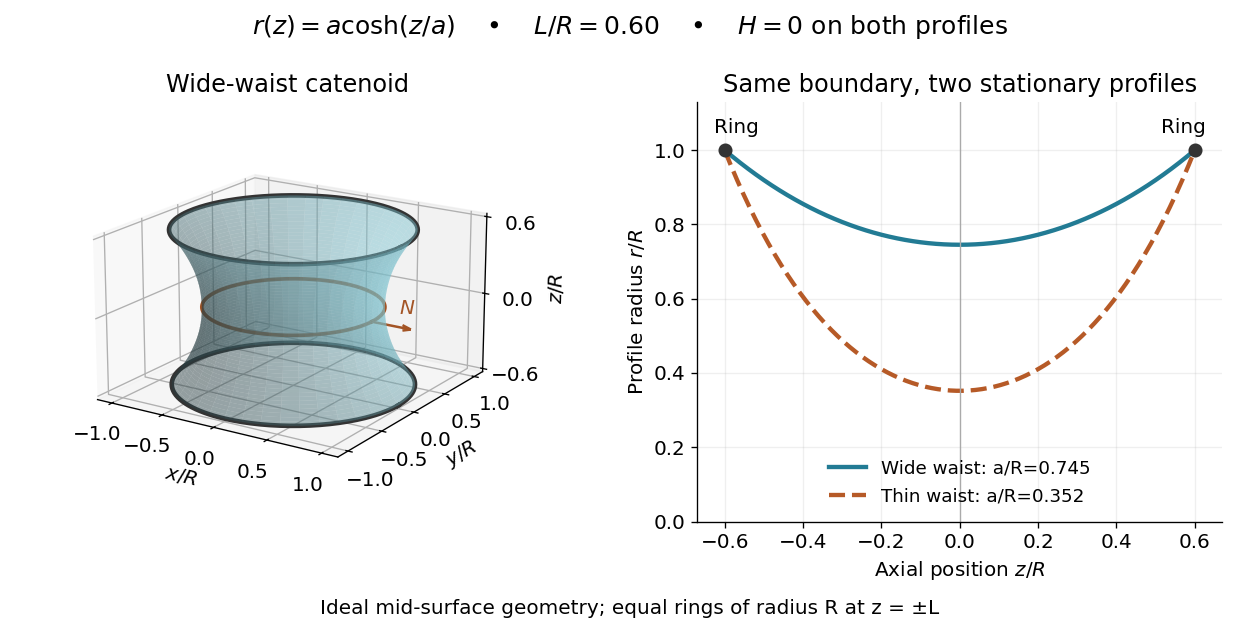
This ideal geometry uses and . The two profiles have different waist radii , although both have . For either profile the surface area follows by integration:At this illustrated separation both profiles have greater surface area than the two disconnected disks, whose total is . This comparison disproves a claim of global area minimization in a class allowing disconnected competitors; it does not determine the sign of the second variation for small variations of a connected film.
A reported experiment used coaxial wire rings of radius , drawn from a surfactant solution and slowly separated until collapse. The solution contained tetradecyltrimethylammonium bromide in deionized water, with glycerol added to vary viscosity. Fluorescein enabled fluorescence imaging under cyan LED arrays; a Phantom V641 camera recorded 4,000 or 5,600 frames per second. Extracted contours gave neck radius, attachment angle, and inferred surface area. They showed neck narrowing and eventual breakup, rather than indefinite persistence of a stationary catenoid. Comparing solutions across viscosities helped distinguish liquid dissipation from the surrounding air's inertia, but the ring displacement beyond the last stable state was not precisely controlled. These are collapse observations, not direct measurements of equilibrium . [ref]
Geometry of catenoidal soap film collapse induced by boundary deformation by Raymond E. Goldstein and others. Geometry of Catenoidal Soap Film Collapse Induced by Boundary Deformation, §II, manuscript pp. 3–4, Figs. 1–3: apparatus, contour readouts, viscosity comparison, and displacement limitation
A proposed classroom measurement would instead hold two equal rings coaxial on a translation stage, leave both sides open to the same gas, and photograph the settled silhouette beside a scale. Fit and inspect fit residuals before inferring cancellation of the principal curvatures. Repeat at several separations and with the camera rotated about the axis to test rotational symmetry. Keep solution composition, ring wetting, and elapsed drainage time comparable, and shield the film from drafts. Film weight, drainage, evaporation, surfactant gradients, and rupture can invalidate the ideal soap film pressure balance. A silhouette fit alone neither measures the pressure jump nor tests all possible perturbations of a stable minimal surface.
Let be the average of on successive knot intervals. Minimizing the displayed loss over gives a quadratic spline with constant tails outside the first and last knots. To prove the reduction, choose the unique constant-tail quadratic spline with the same interval averages as a candidate , and put . Since is constant on every knot interval, is continuous and vanishes on both tails, integration by parts gives . Consequently the data loss is unchanged and . The penalty decreases strictly unless is constant; its zero interval averages then force . The finite-dimensional quadratic optimization on this spline space also gives a unique minimizer because the interval-average map is injective.
A negative curve is an irreducible algebraic curve on a smooth projective surface whose self-intersection number is negative. The negativity prevents it from moving in a nontrivial effective linear system and constrains how many curves can represent a fixed numerical class.
A very general smooth degree- surface with has Picard group generated by its hyperplane class. The exceptional surfaces lie in a countable union of proper closed loci. A proof is given by Griffiths and Harris, "On the Noether-Lefschetz Theorem".
For a closed oriented smooth four-manifold with , the Seiberg–Witten invariant of a four-manifold associates an integer-valued invariant, with a choice of homology orientation, to a Spin-c structure. It is obtained from the moduli space of solutions of the Seiberg–Witten equations modulo gauge transformations. When the expected dimension is zero, it is a signed count of solutions after a generic perturbation. Positive-dimensional cases require suitable insertions; when , chamber data matters. These analytic counts can distinguish smooth structures and, through Taubes nonvanishing theorem, obstruct decompositions of symplectic manifolds of dimension four.[ref]
Remove tubular neighborhoods of diffeomorphic embedded oriented surfaces with opposite normal Euler numbers, and glue their boundary circle bundles by a fiber-reversing identification. The resulting smooth manifold is a fiber sum. The square-zero case uses trivial normal bundles. Additional symplectic hypotheses give a symplectic fiber sum along a square-zero surface.
If one-dimensional smooth linear characters of a local multiplicative group have conductors tending to infinity, their direct sum can be admissible. Its algebraic dual is the product of inverse linear characters, but a smooth vector in this product has only finitely many nonzero coordinates. A common open stabilizer contains one fixed principal-unit subgroup, on which every sufficiently ramified linear character is nontrivial. Thus the smooth dual is again a direct sum.
Every projective line through on a smooth cubic surface lies in its projective tangent plane. Each is a distinct linear factor of the cubic plane section. There can therefore be at most three. Equality occurs when the tangent section consists of three concurrent lines.
Write a line as and the surface equation as . Smoothness says , have no common zero. Projection extends over by . Its fibres are the residual plane conics in the planes through , since substituting , gives . Different residual conics are disjoint everywhere, including their points on , because they are fibres of one morphism of algebraic varieties. The family is flat: over the smooth base curve its local rings are torsion-free over the corresponding discrete valuation ring; smoothness of the total surface supplies the reduced-fibre conclusions.
For two skew lines on a smooth cubic surface, their joining line meets the surface at a third point generically. In coordinates with and , write . The third point is whenever . Neither nor is identically zero, because that would make one of the two lines singular on the surface. The inverse records and of a general surface point. Thus the surface is birational to , hence to .
A right-going, boundary-forced internal gravity wave has horizontal momentum per unit inertial density . Its envelope-induced Eulerian mean acceleration is to leading slow order. In the frame moving at horizontal phase velocity , the change of mean kinetic energy relative to the initial current is at quadratic wave order. Its time derivative is minus the boundary work . The lab-frame mean kinetic energy alone is fourth order in wave amplitude; retaining the moving-frame cross term is essential.
A natural transformation assigns a set of points over every element . These fibers form a functor on the category of elements of . Conversely, a functor on the category of elements gives as the disjoint union of its values over all . The two constructions are inverse up to natural isomorphism. Smallness of makes the category of elements small and allows this description to transfer Cartesian closure to every slice.
For the Integer Heisenberg group, choose , and central . Every element has a unique form , and . The group algebra is therefore the displayed skew Laurent polynomial ring, with . The base is a commutative Laurent polynomial ring and an integral domain; the skew Hilbert basis theorem gives both-sided Noetherianity and the leading coefficient of a product proves that there are no zero divisors.
Let have no zero divisors and be an automorphism. For nonzero Laurent polynomials and with greatest exponents , the coefficient of in is . No other exponent pair contributes to that highest degree. Both factors are nonzero, so their product is nonzero, proving the noncommutative domain property in every characteristic.
On a finite-dimensional positive inner-product space, a skew-adjoint nilpotent operator is zero. In an orthonormal basis, , since a nilpotent matrix has zero trace and so does its square. The Frobenius norm therefore vanishes. In particular, a nonzero nilpotent adjoint map rules out a compact Lie algebra.
Pinned article: Introduction to the OurBigBook Project
Welcome to the OurBigBook Project! Our goal is to create the perfect publishing platform for STEM subjects, and get university-level students to write the best free STEM tutorials ever.
Everyone is welcome to create an account and play with the site: ourbigbook.com/go/register. We belive that students themselves can write amazing tutorials, but teachers are welcome too. You can write about anything you want, it doesn't have to be STEM or even educational. Silly test content is very welcome and you won't be penalized in any way. Just keep it legal!
Intro to OurBigBook
. Source. We have two killer features:
- topics: topics group articles by different users with the same title, e.g. here is the topic for the "Fundamental Theorem of Calculus" ourbigbook.com/go/topic/fundamental-theorem-of-calculusArticles of different users are sorted by upvote within each article page. This feature is a bit like:
- a Wikipedia where each user can have their own version of each article
- a Q&A website like Stack Overflow, where multiple people can give their views on a given topic, and the best ones are sorted by upvote. Except you don't need to wait for someone to ask first, and any topic goes, no matter how narrow or broad
This feature makes it possible for readers to find better explanations of any topic created by other writers. And it allows writers to create an explanation in a place that readers might actually find it.
Figure 1. Screenshot of the "Derivative" topic page. View it live at: ourbigbook.com/go/topic/derivativeVideo 2. OurBigBook Web topics demo. Source. - local editing: you can store all your personal knowledge base content locally in a plaintext markup format that can be edited locally and published either:This way you can be sure that even if OurBigBook.com were to go down one day (which we have no plans to do as it is quite cheap to host!), your content will still be perfectly readable as a static site.
- to OurBigBook.com to get awesome multi-user features like topics and likes
- as HTML files to a static website, which you can host yourself for free on many external providers like GitHub Pages, and remain in full control

Figure 2. You can publish local OurBigBook lightweight markup files to either OurBigBook.com or as a static website.
Figure 3. Visual Studio Code extension installation.
Figure 5. . You can also edit articles on the Web editor without installing anything locally. Video 3. Edit locally and publish demo. Source. This shows editing OurBigBook Markup and publishing it using the Visual Studio Code extension. 
- Infinitely deep tables of contents:



All our software is open source and hosted at: github.com/ourbigbook/ourbigbook
Further documentation can be found at: docs.ourbigbook.com
Feel free to reach our to us for any help or suggestions: docs.ourbigbook.com/#contact