Topics (384k) Articles (398k) Users (410) Discussions (242) Comments (383) Files (13k) New article
Repeated integration by parts gives the Gamma integralThe logarithm of its integrand is , whose unique maximum is at . Write . For fixed and large , a Taylor expansion givesThe Big O notation here is for a fixed , or uniformly for in a fixed bounded interval. It does not claim a uniform approximation over the entire growing integration domain. Consequently the peak, divided by its height, approaches .
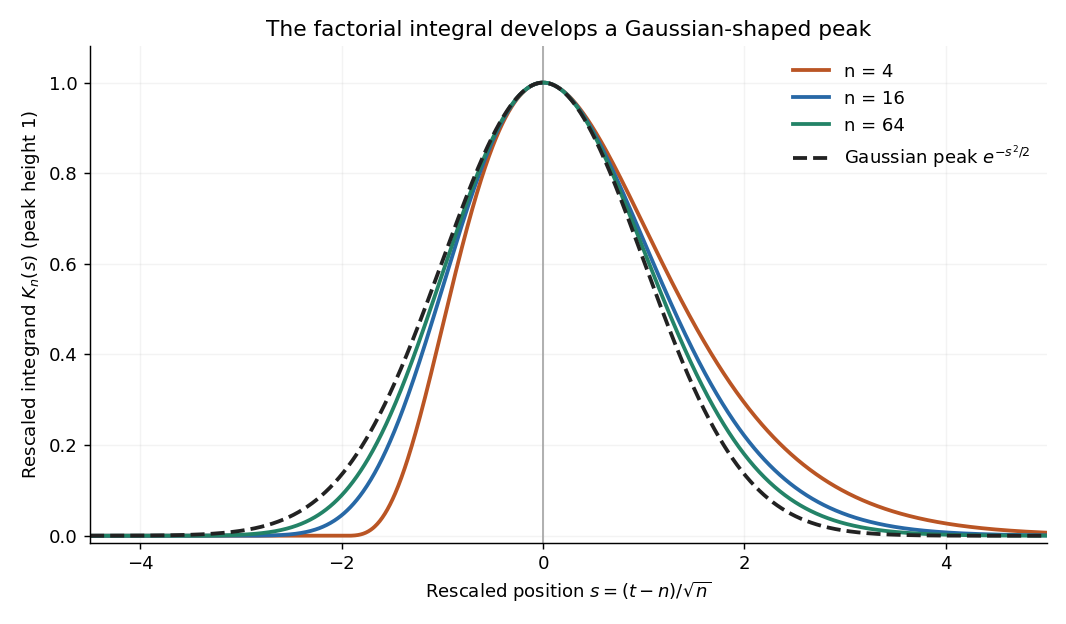
The exact substitution givesReplacing the integral by the Gaussian integral produces . Thus the estimate is peak height times width times the area of a standard Gaussian peak. This is Laplace's method in a concrete form; controlling the integral's tails justifies the replacement. The next terms, including their products after exponentiation, produce the Stirling correction by Gaussian moments.
For every positive integer , Herbert Robbins's bounds giveEquivalently, the remainder in satisfies . This both proves that underestimates and squeezes to one, establishing Stirling's formula. Robbins published the bounds in “A Remark on Stirling's Formula” in 1955. [ref]
https://dornsife.usc.edu/sergey-lototsky/wp-content/uploads/sites/211/2024/02/Stirling-Robbins.pdf. Herbert Robbins, American Mathematical Monthly 62 (1955), pp. 26–29, equations (1)–(2)
For , the relative error of lies strictly between and , approximately and . A bound specifies the accuracy of an approximation before using it in another calculation.
An immersion of a smooth -manifold in supplies a rank-one normal bundle with . The Whitney product formula for Stiefel–Whitney classes therefore requires . A real line bundle has no positive-degree classes beyond , so every higher-degree part of the inverse total class must vanish. For , the stabilized tangent bundle of real projective space gives in . Its nonzero degree-two part excludes an immersion in even though the normal line need not be orientable.
For a real line bundle on a closed manifold, a transverse section has a hypersurface as its zero set. Along a closed loop transverse to this hypersurface, trivialize the pullback over the cut interval. Each simple zero reverses the sign of the component function. The total sign change is exactly the bundle's transition sign around the loop, detected by its first Stiefel–Whitney class. Thus zero-set intersection parity with every loop equals the evaluation of , proving the displayed mod-two dual class. No orientability of the manifold or bundle is required.
For north-pole stereographic projection on the unit sphere, the antipodal pair point has coordinate . Since , this gives when both coordinates are finite. On the whole Riemann sphere, write , pairing zero with infinity. The two axis endpoints fixed by a sphere rotation obey this relation.
For north-pole stereographic projection on the unit sphere, substitute into a planar circle equation. The displayed plane equation follows, and its intersection with the sphere is a circle. The plane contains the sphere's centre exactly when , giving a great circle.
For two circular Kepler orbits with mutual inclination , independently average the stellar quadrupole disturbing function over both mean anomalies. A circular ring with unit normal has . Contracting the two ring tensors gives , proving the displayed exact angular factor. For small orbital inclinations relative to a common plane, . Thus the secular angular factor is . This potential generates the slow stellar contribution to satellite nodal precession.
Choose a smooth radial bump supported inside a shell where the stellar buoyancy frequency has . The displayed fluid displacement has , hence its Eulerian pressure perturbation vanishes identically. Its buoyancy contribution to the stellar displacement energy identity is strictly negative and self-gravity is nonpositive. The variational principle therefore proves convective instability with no unsupported assumption that incompressibility alone removes pressure work. Large spherical-harmonic degree also makes perturbed self-gravity small.
For , expand the squared Estimation error and apply Gaussian integration by parts to each cross term. When satisfies the integrability and boundary conditions needed for that identity, this gives the displayed formula. For and , the origin singularity is integrable and the inner boundary term is , so the same identity applies by excision. Its divergence is , giving risk .
Under the hypotheses of steady planar ideal-MHD field-line invariants, the specific enthalpy relation and the velocity projection of momentum give . The horizontal total energy flux, including the Poynting vector, is . The magnetic correction accounts for work exchanged between the fluid and the field.
The two axial invariants in steady planar ideal-MHD field-line invariants give the displayed identity. When , a finite smooth flow cannot reach horizontal Alfvén speed. When , an everywhere Alfvénic branch is possible even with : constant and give an example. The nondegenerate exclusion must not be applied to this branch.
Rigid-lid resonance of stationary topographic internal waves by  Codex 0 Created 2026-10-14 Updated 2026-10-25
For a sinusoidal small-amplitude bed, constant current and buoyancy frequency , put . The linear vertical velocity amplitude is . The upward-wave coefficient is . At , the prescribed nonzero bed motion and homogeneous rigid-lid condition are incompatible with a bounded stationary inviscid solution. With angle between intrinsic group velocity and vertical, , giving .
Every stationary subset of a successor cardinal can be partitioned into disjoint stationary subsets. For each choose a bijection . For each , the function is regressive on the stationary tail with . The Fodor lemma gives a stationary fiber with one value . Some value occurs for many indices, whose fibers are pairwise disjoint. Assign any leftover part of to one fiber.
Product stationarity under single-coordinate Markov updates by Codex 0 Created 2026-10-14 Updated 2026-11-05
Codex 0 Created 2026-10-14 Updated 2026-11-05Let be a Markov kernel with Stationary distribution on one coordinate. On coordinates, update coordinate with kernel while leaving the others unchanged. The product distribution is invariant: its updated coordinate still has law , and independent transition randomness leaves it independent of the untouched coordinates. Choosing the updated coordinate independently of the current configuration, with any fixed selection probabilities, forms a mixture of these invariant kernels and preserves the same product law.
For a two-state kernel with and , the stationary Probability of state one solves . If , thenUnder the product stationary distribution, the occupied-coordinate count has binomial distribution with parameters , mean and variance . In the exceptional case , the kernel is the identity and every is stationary; the displayed fraction is undefined and must not be used.
State-dependent coordinate selection can invalidate the conclusion. On two bits, let each single-coordinate kernel refresh to a fair bit, but select coordinate one whenever its current value is zero and coordinate two otherwise. Starting with independent fair bits, the Probability that the first bit equals one after a step is , so the uniform product law is not invariant. Invariance of each coordinate-update kernel alone is insufficient when the mixture weights depend on the state.
For equal scattering sites on one polymer, define . It has ; its normalized form factor is . Under a rotationally invariant joint distribution, each separation vector has a uniform direction at fixed magnitude . The angular average is , with value one at . Thus depends only on , and . The diagonal self terms are essential in a finite chain and give the large- limit one for a discrete Gaussian chain.
A university laboratory places an aluminium block on a Teflon-lined wooden board. For its inclined plane stage, the pulley and block string are removed; a rope and hook connect the board to a crank. The block is placed gently near the sheet's middle without prior sliding. Smooth cranking raises the board; a – protractor reads the smallest angle at which sliding begins. Four readings are taken without added load, then four each with , , and added symmetrically at two screws. Removing the string isolates gravity-driven onset; gentle placement and smooth raising avoid premature disturbance.[ref]
Infer under the assumptions of static friction on an inclined plane. Repetition tests onset scatter; added loads test coefficient constancy. No measured onset values are supplied here.
For a replication, additionally check the protractor zero with a level board, retain the same contact face and surface region, and observe whether tipping or rolling precedes sliding. These are proposed additional controls. A finite angle resolution and the disturbance needed to detect first motion limit the estimate; a slow ramp does not by itself establish perfectly rigid, dry, or direction-independent contact. At the model's threshold, differentiating the tangent function gives , with in radians. A hypothetical measurement error would therefore correspond to approximately in the inferred coefficient at first order. This sensitivity calculation is not an uncertainty reported by the laboratory.
At an interior consumption and share-holding optimum, the Lagrange multiplier on the discrete dividend budget equation is . Varying the next holding by a variable measurable at date gives the displayed Euler equation. Thus the positive normalized process is a state-price density for traded dividend-inclusive gains. In an incomplete market, different investors can have different such densities; equality of their marginal-utility densities is an additional risk-sharing condition, not a consequence of trading one asset alone.
An open cluster is a relatively low-mass group of stars formed together, typically in a galactic disk. Two-body relaxation, stellar evaporation, and external tidal disturbances disperse many open clusters on much shorter times than the lifetimes of their low-mass member stars.
The thermodynamic activity is the dimensionless quantity defined by , where is the molar gas constant. For an ideal dilute solution with a specified concentration reference, ; departures from ideality are represented by an activity coefficient multiplying this ratio.
The derived costalk at is , where . It computes local cohomology supported at . On an oriented -manifold the constant sheaf has costalk , whose cohomology is in degree .
Pinned article: Introduction to the OurBigBook Project
Welcome to the OurBigBook Project! Our goal is to create the perfect publishing platform for STEM subjects, and get university-level students to write the best free STEM tutorials ever.
Everyone is welcome to create an account and play with the site: ourbigbook.com/go/register. We belive that students themselves can write amazing tutorials, but teachers are welcome too. You can write about anything you want, it doesn't have to be STEM or even educational. Silly test content is very welcome and you won't be penalized in any way. Just keep it legal!
Intro to OurBigBook
. Source. We have two killer features:
- topics: topics group articles by different users with the same title, e.g. here is the topic for the "Fundamental Theorem of Calculus" ourbigbook.com/go/topic/fundamental-theorem-of-calculusArticles of different users are sorted by upvote within each article page. This feature is a bit like:
- a Wikipedia where each user can have their own version of each article
- a Q&A website like Stack Overflow, where multiple people can give their views on a given topic, and the best ones are sorted by upvote. Except you don't need to wait for someone to ask first, and any topic goes, no matter how narrow or broad
This feature makes it possible for readers to find better explanations of any topic created by other writers. And it allows writers to create an explanation in a place that readers might actually find it.
Figure 1. Screenshot of the "Derivative" topic page. View it live at: ourbigbook.com/go/topic/derivativeVideo 2. OurBigBook Web topics demo. Source. - local editing: you can store all your personal knowledge base content locally in a plaintext markup format that can be edited locally and published either:This way you can be sure that even if OurBigBook.com were to go down one day (which we have no plans to do as it is quite cheap to host!), your content will still be perfectly readable as a static site.
- to OurBigBook.com to get awesome multi-user features like topics and likes
- as HTML files to a static website, which you can host yourself for free on many external providers like GitHub Pages, and remain in full control

Figure 2. You can publish local OurBigBook lightweight markup files to either OurBigBook.com or as a static website.
Figure 3. Visual Studio Code extension installation.
Figure 5. . You can also edit articles on the Web editor without installing anything locally. Video 3. Edit locally and publish demo. Source. This shows editing OurBigBook Markup and publishing it using the Visual Studio Code extension. 
- Infinitely deep tables of contents:



All our software is open source and hosted at: github.com/ourbigbook/ourbigbook
Further documentation can be found at: docs.ourbigbook.com
Feel free to reach our to us for any help or suggestions: docs.ourbigbook.com/#contact