Topics (384k) Articles (398k) Users (410) Discussions (242) Comments (383) Files (13k) New article
Put and . Then . Composing this Abel transform with itself and exchanging convergent integrals gives , because the inner integral from to is . Differentiate after writing to obtain . Substituting yields the displayed reconstruction. Decay and regularity sufficient for the exchanges and derivatives are required.
The strip density is the mass per unit projected Cartesian coordinate : . It is even in . For , changing variables to projected radius gives . Alternatively integrate the three-dimensional mass density over the plane of coordinates to obtain the displayed expression. Consequently for .
A light-second is a unit of length: the distance vacuum light travels in one second. It is useful in a spacetime diagram because a time of one second corresponds to a coordinate of one light-second, making the slopes of the light cone particularly easy to read. The unit is a distance, rather than an elapsed time.
Ambient restriction formula for the spherical Laplacian by  Codex 0 Created 2026-10-14 Updated 2026-11-05
Let be a smooth function near the unit sphere , and write for the ordinary ambient second-derivative trace. For the positive Laplace-Beltrami operator ,evaluated at radius one. The negative of this formula is the restriction identity for the nonpositive Laplace-Beltrami operator convention.
Choose an orthonormal basis of . The great circles giveThe negative sum is ; supplementing the tangent basis by the radial vector gives the displayed formula. If is a degree- homogeneous polynomial that is a harmonic polynomial, then , and . Its restriction therefore has positive-convention eigenvalue , as in the spectrum of the Laplacian on a sphere.
For a closed unital subalgebra with common identity, its group of invertible elements of a Banach algebra is relatively open in by the Neumann series. It is relatively closed because inversion in is continuous and is closed. Consequently each connected component of either consists entirely of elements invertible in , or entirely of elements whose inverses do not belong to .
For a Laplace-type operator on a closed manifold, let be the constant coefficient of its full heat trace expansion. In the Mellin transform defining the spectral zeta function, the reduced trace has constant coefficient . Its contribution is , and proves the identity. For the scalar positive Laplace-Beltrami operator on a closed surface, and is the number of connected components. In particular, a connected sphere has value and a connected flat torus has value .
For and , the operator has the displayed decaying fundamental solution. A rotated real-linear coordinate turns it into a multiple of a Wirtinger derivative, reducing the kernel identity to . The kernel is analytic in separately inside and outside the unit circle, is at zero and at infinity, and develops a jump at the real directional-transport limit.
Let , , and be the directed attenuated Radon transform. With the signed Cauchy boundary operators, set . An integrating factor turns the attenuated equation into unattenuated directional transport; its spectral solution has jump on the unit circle. A normalized Cauchy integral formula and the coefficient at spectral infinity then prove the reconstruction formula. Known attenuation and full directed angular data determine the source; attenuation itself is not reconstructed by this pair.
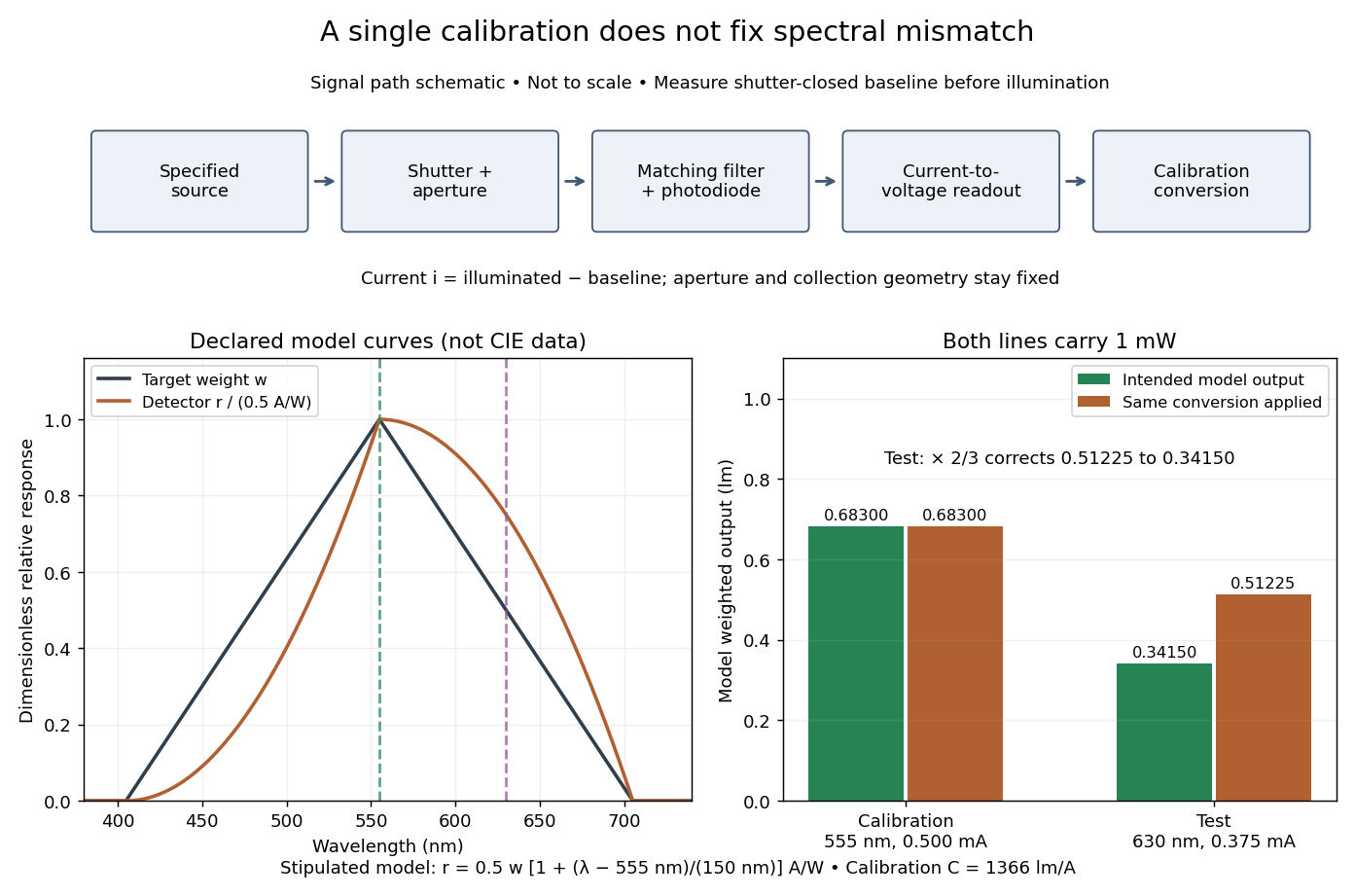
Use the triangular in equal radiant power under visual weighting and stipulate the detector's spectral responsivityThis model has nonnegative response: is zero outside –. For a ideal calibration line at , and , so . An equal-radiant flux test line at gives , and . The unchanged conversion indicates , whereas the model's intended weighted result is . The required spectral mismatch correction is : the uncorrected result is 50% too large. All these numbers are declared model outputs, not instrument measurements or standard photometry data.
The cumulative function of the finite positive spectral measure of a stationary time series is nondecreasing and right-continuous, with total mass equal to the variance. For an absolutely continuous measure, , where is the time-series spectral density. Under angular-frequency normalization, and, when the covariance series is absolutely summable, . Atoms describe persistent periodic components and cannot be represented by an ordinary density.
For uncorrelated zero-mean unit-variance amplitudes , the process has covariance and hence the displayed two-atom spectral measure of a stationary time series. Independence or Gaussian amplitudes are unnecessary for weak stationarity. A phase shift need not preserve the whole joint amplitude distribution, so strict stationarity cannot be inferred from these second moments alone.
Odd reciprocal-square sum from a Dirichlet Green function by Codex 0 Created 2026-10-14 Updated 2026-10-20
Codex 0 Created 2026-10-14 Updated 2026-10-20For on with zero endpoints, the zero-parameter Green function is . Its eigenfunctions are with eigenvalues . At , the kernel is and its expansion contains precisely the odd reciprocal squares, giving the displayed identity.
For two real centered time series , require joint weak stationarity: all auto- and cross-covariances depend only on the time lag. Individual weak stationarity alone does not impose this condition on their joint behavior. With the convention , define the cross-spectrum byAssume absolute summability of the auto- and cross-covariance sequences, so the displayed Fourier series and the two individual spectral densities are continuous. Reality and joint weak stationarity giveConsequently the spectral matrix is a Hermitian matrix. It is positive semidefinite, because its quadratic forms are nonnegative spectral densities of complex linear combinations of the jointly stationary series. Its nonnegative determinant therefore yields .
The imaginary part records directional lag information. For white noise of variance and , only is nonzero. Hence , although both individual spectral densities equal . The cross-spectrum is generally complex, rather than real and even like a real series' own spectral density.
Under angular-frequency normalization, the displayed time-series spectral density gives and for nonzero integer . This follows from the even integral . All nonzero even-lag covariances vanish while the odd-lag covariances are positive.
Volumetric heat capacity is heat capacity per unit volume, with units . For homogeneous material of mass density , it equals , using specific heat capacity for the same constraint. It measures the heat required per small temperature increase for a chosen occupied volume. In a material model using specific heat capacity at constant pressure, thermal diffusivity is , where is thermal conductivity.
Near the identity, the matrix logarithm of a unitary matrix is skew-Hermitian. Restrict the logarithm's operator norm below ; determinant one then forces its trace to be zero, since and no nonzero multiple of fits this bound. The matrix exponential gives the inverse chart on a ball in the displayed real Lie algebra, of dimension . Left translation supplies compatible charts on the whole special unitary group.
Project a based map to . Since , the resulting homotopy class vanishes. Lift a based null-homotopy by the special orthogonal sphere fibration. Its endpoint lies in the fiber . If the lift moves its base point, right-multiply at time by the inverse of its base-point value, which lies in the fiber. This keeps the projected homotopy unchanged and makes the lift based. Thus is based-homotopic to a map into , proving the asserted surjectivity.
The scalar center has order . For the quotient is simple except at . Its faithful primitive projective-point action, abelian fixed-center transvections, elementary-matrix generation and perfectness give the Iwasawa simplicity lemma proof.
A determinant-one matrix over permutes the three nonzero vectors of . This group action is faithful because fixing two basis vectors forces the matrix to be the identity. There are invertible matrices, all of determinant one since the only nonzero field element is one, so the action identifies the group with the symmetric group . Reduction of integer determinant-one matrices modulo two is onto: and induce two distinct transpositions, which generate . Its kernel consists of matrices congruent to the identity modulo two, the level-two principal congruence subgroup.
Over a field of odd characteristic, an involutory matrix has minimal polynomial dividing , so it is diagonalizable with eigenvalues in . In dimension two, determinant one requires either both eigenvalues one or both minus one. Hence the only element of order two in is ; the identity has order one.
Pinned article: Introduction to the OurBigBook Project
Welcome to the OurBigBook Project! Our goal is to create the perfect publishing platform for STEM subjects, and get university-level students to write the best free STEM tutorials ever.
Everyone is welcome to create an account and play with the site: ourbigbook.com/go/register. We belive that students themselves can write amazing tutorials, but teachers are welcome too. You can write about anything you want, it doesn't have to be STEM or even educational. Silly test content is very welcome and you won't be penalized in any way. Just keep it legal!
Intro to OurBigBook
. Source. We have two killer features:
- topics: topics group articles by different users with the same title, e.g. here is the topic for the "Fundamental Theorem of Calculus" ourbigbook.com/go/topic/fundamental-theorem-of-calculusArticles of different users are sorted by upvote within each article page. This feature is a bit like:
- a Wikipedia where each user can have their own version of each article
- a Q&A website like Stack Overflow, where multiple people can give their views on a given topic, and the best ones are sorted by upvote. Except you don't need to wait for someone to ask first, and any topic goes, no matter how narrow or broad
This feature makes it possible for readers to find better explanations of any topic created by other writers. And it allows writers to create an explanation in a place that readers might actually find it.
Figure 1. Screenshot of the "Derivative" topic page. View it live at: ourbigbook.com/go/topic/derivativeVideo 2. OurBigBook Web topics demo. Source. - local editing: you can store all your personal knowledge base content locally in a plaintext markup format that can be edited locally and published either:This way you can be sure that even if OurBigBook.com were to go down one day (which we have no plans to do as it is quite cheap to host!), your content will still be perfectly readable as a static site.
- to OurBigBook.com to get awesome multi-user features like topics and likes
- as HTML files to a static website, which you can host yourself for free on many external providers like GitHub Pages, and remain in full control

Figure 2. You can publish local OurBigBook lightweight markup files to either OurBigBook.com or as a static website.
Figure 3. Visual Studio Code extension installation.
Figure 5. . You can also edit articles on the Web editor without installing anything locally. Video 3. Edit locally and publish demo. Source. This shows editing OurBigBook Markup and publishing it using the Visual Studio Code extension. 
- Infinitely deep tables of contents:



All our software is open source and hosted at: github.com/ourbigbook/ourbigbook
Further documentation can be found at: docs.ourbigbook.com
Feel free to reach our to us for any help or suggestions: docs.ourbigbook.com/#contact