Topics (384k) Articles (398k) Users (410) Discussions (242) Comments (383) Files (13k) New article
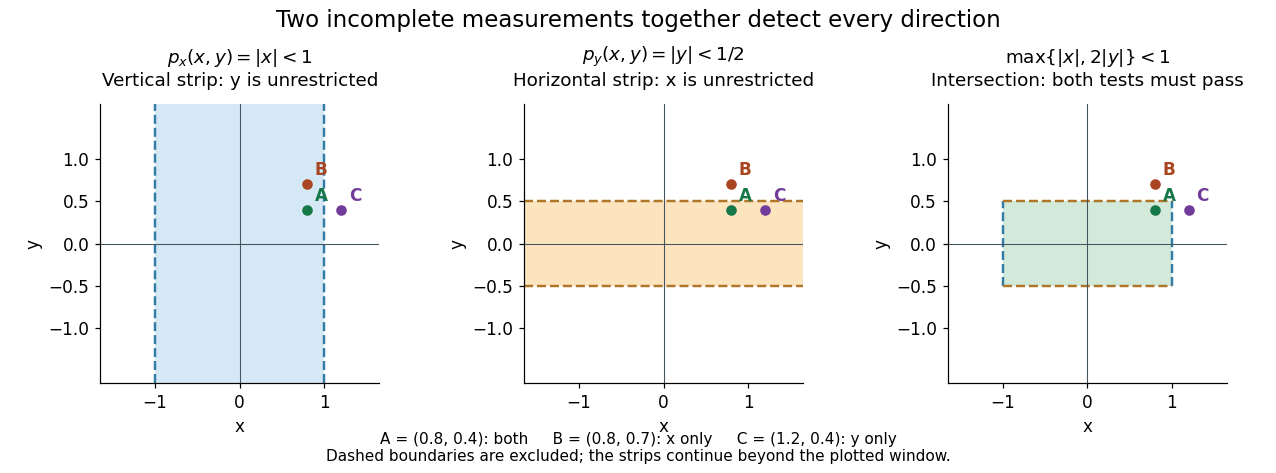
On , the coordinate seminorms and measure horizontal and vertical components separately. Their kernels of seminorms are the vertical and horizontal axes. Neither is a norm, but together they form a separating family of seminorms. A basic zero neighbourhood isEach condition alone is an unbounded strip; their intersection is an open rectangle. For , this is the unit open ball of the maximum norm . For unequal tolerances it is the unit open ball of the weighted norm . Thus the two coordinate measurements generate the usual topology of the plane.
The kernel of a seminorm is its zero set, a linear subspace by absolute homogeneity and the triangle inequality. The estimate shows that adding an element of does not change . Hence defines a norm on the quotient vector space .
On itself, is a pseudometric; it is a metric exactly when is a norm. In particular, zero distance in one pseudometric need not mean equality of vectors. A separating family of seminorms removes the common zero-distance ambiguity.
A rectangular band is a semigroup satisfying the displayed identities; these also imply associativity. Every nonempty such algebra is a product with . Fixing , the factor sets are and , and has inverse . Homomorphisms between nonempty products are exactly pairs of maps on the two factors.
An atmospheric thermal inversion is a region where temperature increases outward. In a strongly irradiated atmosphere it can arise when shortwave opacity exceeds thermal infrared opacity and stellar energy is absorbed high in the atmosphere.
If a self-orthogonal binary subspace has odd length and dimension , its dual code is obtained by adjoining the all-ones word. Self-orthogonality makes every codeword even-weight, so but . Comparing dimensions proves the formula. The dimension hypothesis alone is insufficient: at length three is a counterexample.
For a smooth projective algebraic curve , the normal bundle of its diagonal in is : on the diagonal the quotient of by the diagonal subbundle is identified with by taking the difference. The self-intersection formula therefore gives .
In oriented Euclidean four-space, gauge curvature is self-dual when . The Hodge star squares to one on two-forms, so this picks its positive eigenspace; the negative eigenspace is anti-self-duality of gauge curvature. The Bianchi identity then implies the Yang-Mills equations, and the action saturates the positive-charge Yang-Mills instanton Bogomolny bound.
For studies conditionally independent given the truth of one relationship, the event that at least one is positive has probability under the alternative and under the null. Its Bayes factor therefore gives the displayed posterior odds. For interior error probabilities these tend back to the prior odds . If power exceeds size, the Bayes factor decreases to one: the quotient of geometric sums is a weighted average of decreasing powers .
This result concerns the coarsened selection event. Full observed results instead multiply their individual Bayes factors, and concordant evidence can accumulate without this bound. It is a useful example of information discarded by publication bias.
A small planar crack of area opening normally by has volume change and the displayed seismic moment tensor. Its principal dipoles are : two act in the crack plane and the largest acts normally for positive opening and ordinary positive Lamé parameters. The definition follows by contracting the isotropic elastic stiffness tensor with two copies of the crack normal.
Tangential fault slip in an isotropic elastic material has the displayed moment density. It is symmetric and trace-free, with eigenvalues . The two off-diagonal force dipoles form equal couples with opposite torques, producing zero resultant force and torque. For a uniform patch of area , the scalar seismic moment is . Traction continuity removes the single-force layer in the elastodynamic surface-jump representation.
Explosion radiation in an isotropic elastic solid by  Codex 0 Created 2026-10-14 Updated 2026-10-20
These characteristic wave amplitudes split a one-dimensional elastic wave into forward and backward components. Their instantaneous net elastic-wave energy flux is . For real-part harmonic phasors the mean flux is . In a static graded medium with real positive seismic impedance, put ; then . Seismic impedance gradients couple the two directions while preserving net flux.
At normal incidence, a uniform lossless elastic wave layer of thickness , speed and seismic impedance has wave phase thickness . With phasors proportional to , particle velocity and compressive traction , the displayed matrix maps from the top to the bottom. It has determinant one. Multiplying these matrices in physical order accounts for all coherent multiple reflections. Continuity of connects adjacent layers without another propagation factor.
How can an invisible change in concentration produce a readable signal? The saponification of ethyl acetate by hydroxide in water gives ethanol and an acetate ion:The rate law used for this assay is . Each reactant has coefficient one, so equals either disappearance rate. If the two initial concentrations are equal, they remain equal under this stoichiometry, giving and , without a factor of two.
Manual for Advanced Physical Chemistry Laboratory-II by Nasima Arshad (Unit 7, Experiment 2, printed pp. 66–67) specifies a conductivity cell holding about in constant-temperature baths, with ethyl acetate and sodium hydroxide stocks equilibrated separately. Mixing of each initiates the run. The readout is electrical resistance: every minute for ten minutes, every two minutes for ten more, then every five minutes for twenty-five. The cell is rinsed with distilled water. A matched sodium hydroxide–water dilution estimates the initial resistance; a potassium chloride standard determines the cell constant. The manual asks for comparison with the extrapolated initial signal.[ref]
Manual for Advanced Physical Chemistry Laboratory-II by Nasima Arshad. Unit 7, Experiment 2, printed pp. 66–67: Procedure and Calculations; title page credits Nasima Arshad as manual author
The post-mixing initial concentration is for each reactant, assuming additive volumes. This matches our illustrative starting concentration, but the prescribed is not a measured value from the manual. As hydroxide is replaced by the less mobile acetate ion, electrical conductance decreases. The preceding experiment describes two platinum electrodes and an alternating-voltage Wheatstone bridge to limit polarization at the electrodes. For measured electrical resistance , electrical conductance is ; electrical conductivity is . Keep the probe geometry fixed and use one signal convention throughout.[ref]
Manual for Advanced Physical Chemistry Laboratory-II by Nasima Arshad. Unit 7, Experiment 1, printed pp. 62–63: reaction, ionic conductances, inverse resistance, platinum electrodes and alternating-voltage bridge; Experiment 2, p. 66: hydroxide replaced by acetate
For the equal-starting-concentration model, assume an affine calibration between electrical conductance and remaining hydroxide concentration, with endpoints and at the same temperature. This givesThe last plot has slope , with units , whereas plotting against time has slope , with units . These are different slopes. This endpoint transformation also shows why raw resistance must not be substituted for conductance.
Useful additional controls are repeat runs, fixed immersion depth, an independently checked final signal, and comparisons of several starting concentrations. Mixing delay obscures early conversion; temperature drift changes both the rate constant and the signal; contamination adds mobile ions. The affine calibration can fail when ionic mobilities change with composition. Near completion, becomes small, so endpoint error is strongly amplified. Those are methodological limits and proposed checks, not new experimental observations. A conductivity trace supports a calibrated rate law over its tested range; it does not independently reveal the full reaction mechanism.
For unequal starting concentrations and in a one-to-one chemical reaction, let be the consumed concentration. Then , , andThe natural logarithm acts on a dimensionless quantity; differentiating the left side with respect to gives , verifying the relation. Mixing of the stated ethyl acetate stock with of the sodium hydroxide stock would give and . The difference stays constant, rather than their ratio. Neither the equal-concentration reciprocal formula nor a pseudo-first-order reaction approximation is justified solely by that twofold excess.
A Cauchy-Euler equation is a linear ordinary differential equation whose coefficient powers match their derivative orders, for exampleWith and , the chain rule gives and . Thus the equation becomes the constant-coefficient differential equation . In the homogeneous case, the power-law ansatz gives the indicial equation .
For two real self-adjoint equations with continuous coefficients, and , between consecutive zeros of a nontrivial first solution a nontrivial second solution either has a zero or is proportional to the first there. This comparison controls oscillation through the coefficients.
Quadratic-variable reduction of a singular oscillator by Codex 0 Created 2026-10-14 Updated 2026-10-18
Codex 0 Created 2026-10-14 Updated 2026-10-18The chain rule with gives and transforms the equation, away from zero, into . Thus its solution space is spanned by and . Both extend smoothly through the regular singular point at zero. Their even power series allow the independent data and to select the two solutions; every smooth solution has .
Write the non-Newtonian extra stress as , with the Jaumann derivative. For a steady Stokes flow, . If , the extra force is a gradient and only alters pressure. In a planar incompressible flow, , so its divergence is also a gradient; no coefficient restriction is needed. A Newtonian velocity with prescribed boundary velocities consequently solves the second-order model with an altered pressure. On the regular weak-flow branch, Uniqueness of Stokes flow makes each velocity correction vanish. This does not establish uniqueness of arbitrary large nonlinear branches or the absence of higher-order effects in a real material.
For a sphere of radius rotating with angular velocity , the primary Stokes flow has , . In the weak, inertialess second-order fluid correction, put . The stream function in the title hasBoth meridional components vanish at and decay at infinity. Indeed, gives , and the curl of the momentum equation reduces to . For the secondary flow enters towards the equator and leaves near the poles; reverses it and removes this correction. The meridional circulation is even in the sign of sphere rotation. Inertial secondary flow is excluded from this calculation.
Pinned article: Introduction to the OurBigBook Project
Welcome to the OurBigBook Project! Our goal is to create the perfect publishing platform for STEM subjects, and get university-level students to write the best free STEM tutorials ever.
Everyone is welcome to create an account and play with the site: ourbigbook.com/go/register. We belive that students themselves can write amazing tutorials, but teachers are welcome too. You can write about anything you want, it doesn't have to be STEM or even educational. Silly test content is very welcome and you won't be penalized in any way. Just keep it legal!
Intro to OurBigBook
. Source. We have two killer features:
- topics: topics group articles by different users with the same title, e.g. here is the topic for the "Fundamental Theorem of Calculus" ourbigbook.com/go/topic/fundamental-theorem-of-calculusArticles of different users are sorted by upvote within each article page. This feature is a bit like:
- a Wikipedia where each user can have their own version of each article
- a Q&A website like Stack Overflow, where multiple people can give their views on a given topic, and the best ones are sorted by upvote. Except you don't need to wait for someone to ask first, and any topic goes, no matter how narrow or broad
This feature makes it possible for readers to find better explanations of any topic created by other writers. And it allows writers to create an explanation in a place that readers might actually find it.
Figure 1. Screenshot of the "Derivative" topic page. View it live at: ourbigbook.com/go/topic/derivativeVideo 2. OurBigBook Web topics demo. Source. - local editing: you can store all your personal knowledge base content locally in a plaintext markup format that can be edited locally and published either:This way you can be sure that even if OurBigBook.com were to go down one day (which we have no plans to do as it is quite cheap to host!), your content will still be perfectly readable as a static site.
- to OurBigBook.com to get awesome multi-user features like topics and likes
- as HTML files to a static website, which you can host yourself for free on many external providers like GitHub Pages, and remain in full control

Figure 2. You can publish local OurBigBook lightweight markup files to either OurBigBook.com or as a static website.
Figure 3. Visual Studio Code extension installation.
Figure 5. . You can also edit articles on the Web editor without installing anything locally. Video 3. Edit locally and publish demo. Source. This shows editing OurBigBook Markup and publishing it using the Visual Studio Code extension. 
- Infinitely deep tables of contents:



All our software is open source and hosted at: github.com/ourbigbook/ourbigbook
Further documentation can be found at: docs.ourbigbook.com
Feel free to reach our to us for any help or suggestions: docs.ourbigbook.com/#contact