Topics (384k) Articles (398k) Users (410) Discussions (242) Comments (383) Files (13k) New article
A dissimilarity matrix records pairwise separation of observations or profiles. Usually it is symmetric, nonnegative and zero on the diagonal. A metric space additionally requires the triangle inequality and separation of distinct profiles. Agglomerative hierarchical clustering can be applied to many dissimilarity matrices that are not Euclidean distance matrices; the claimed geometry must be checked separately.
The index measures similarity of finite sets by shared presence relative to total presence. For binary profiles it ignores joint absences, unlike the simple matching coefficient. When both sets are empty, define the similarity to be one. The complementary Jaccard distance measures dissimilarity.
For a prescribed number of groups, minimize within-cluster squared Euclidean distances. At fixed assignments, differentiating the objective gives the mean as the optimal centroid. At fixed centroids, assigning each point to a nearest centroid minimizes its contribution. Alternating these steps cannot increase the objective but can converge to a local optimum, so multiple starts are useful. Empty clusters and ties need an explicit handling rule. The method favors roughly spherical groups and depends on variable scaling.
A cluster in cluster analysis is a nonempty group of observations treated as similar under the chosen representation and dissimilarity. A partition assigns each observation to exactly one cluster; agglomerative hierarchical clustering supplies a nested sequence of such partitions. An algorithmic cluster need not correspond to a distinct probabilistic population.
For a stable -point closed-string scattering amplitude on a genus- surface, let count complex unmarked worldsheet moduli and count complex dimensions of the worldsheet conformal Killing group. Integrating the vertex positions and moduli, then fixing positions, leaves complex integrations. The punctured Riemann surface moduli dimension identifies this as . Faddeev-Popov ghost fields and antighost insertions implement the removed zero modes and the surviving modulus measure; they do not add independently integrated worldsheet coordinates.
A compact interval in the real numbers is either the empty set or a closed bounded interval with . Its compactness follows from the Heine-Borel theorem.
For an irreducible closed migration process with finite population , positive departure rates and routing matrix , choose positive traffic weights satisfying . On , its stationary distribution has the displayed form. For a predecessor , its weighted transition into is . Summing over gives by the traffic equation, and summing over proves global balance for a continuous-time Markov chain. The distribution need not satisfy detailed balance.
// Target: probability-and-statistics.bigb
Represent telephone lines by a closed migration process with free-line, operator and automated-service colonies. Accepted arrivals have rate when a free line exists, operators complete at rate , and automated calls complete at rate . Define andThe product-form stationary distribution of a closed migration process and Poisson arrivals see time averages give the displayed blocking probability. This extends a single-operator model without treating the independent operators as a server with rate when fewer than calls are present.
// Target: probability-and-statistics.bigb
A primitive closed geodesic is a closed geodesic with its smallest positive period, rather than a repeated traversal of a shorter periodic geodesic. A degree- lift of a primitive base geodesic is still primitive upstairs when its monodromy permutation has a cycle of exact length : no smaller number of traversals returns to the starting sheet.
On the punctured plane, this one-form is closed and locally the differential of the polar angle. Its line integral around a closed curve is times the winding number. A once-winding circle therefore has nonzero integral, proving that no global single-valued angle potential exists and the form is not an exact differential form.
For a counterclockwise circle of radius , substitute , . The pullback of a differential form isThe radius cancels. In coordinates, and satisfy away from the origin, so there. The nonzero integral is a global obstruction to being an exact differential form, not a nonzero local exterior derivative.
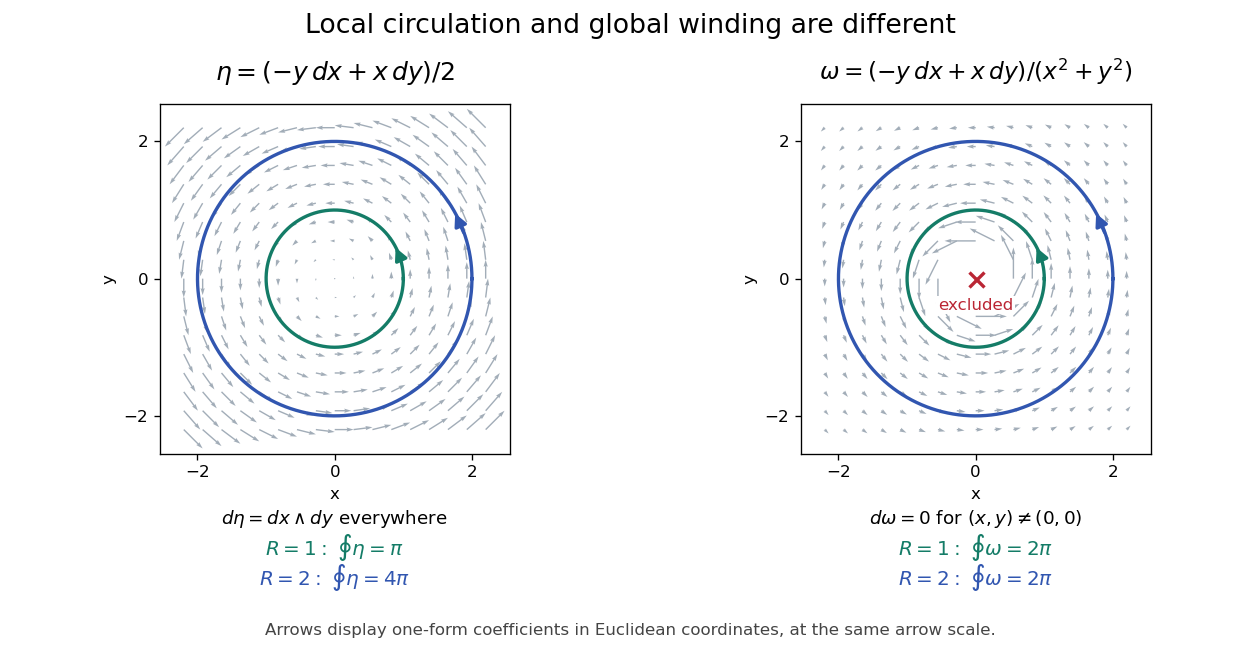
Smooth local circulation scales with enclosed area, whereas a closed angular form detects winding around an excluded point
. Details. Compare this with the smooth one-form on the whole plane. Here , and its integral around a radius- circle is , the enclosed area. The Generalized Stokes theorem applies to the full disc for . For , that disc crosses the excluded origin, where the one-form is undefined. On an annulus the theorem applies, but its induced inner boundary is clockwise: the two integrals and cancel. This explains exactly why closedness and nonzero circulation can coexist.
Uniform utility convergence need not preserve closed preference convergence by  Codex 0 Created 2026-10-14 Updated 2026-11-05
On the utility functions converge uniformly on the whole domain to . Their preference relations remain the usual order, while the limiting utility function makes all pairs indifferent. The weak comparison in the limit cannot be approximated by comparisons from the varying graphs. Uniform convergence does guarantee the upper graph-limit condition, because convergent pairs remain in a fixed bounded set.
With gross star formation rate , constant returned mass fraction , and the instantaneous recycling approximation, the net locked mass rate is . Mass conservation gives . For constant stellar yield per unit locked mass and initially pristine gas, metal conservation gives , so gas-phase metallicity grows as . Gross star formation and permanent locking have different normalizations.
For a pristine closed-box model of galactic chemical evolution, and imply independently of the star formation rate. The resulting metallicity distribution function is exponential on . Its normalized density is . A fixed initial mass function and survival selection are needed to turn locked stellar mass into a stellar number distribution. Logarithmic abundance intervals have the additional factor .
A finite-metal-fraction variant of the closed-box model of galactic chemical evolution uses effective stellar yield , rather than constant yield. With pristine initial gas and , metal accounting gives and hence . The mass-weighted mean stellar metallicity is . At final gas fraction , the metallicity distribution function is on . For trace abundances, and the usual closed-box metallicity distribution is recovered to leading order.
Tensor contractions in the SU2 Clebsch-Gordan decomposition by Codex 0 Created 2026-10-14 Updated 2026-11-05
Codex 0 Created 2026-10-14 Updated 2026-11-05Realize . Contract pairs of indices, one from each symmetric tensor, with the alternating invariant tensor , and symmetrize the remaining indices. This is a nonzero intertwining operator into . In the bihomogeneous polynomial realization, is a highest-weight vector of weight . Its lowering string has length . These inequivalent irreducible summands exhaust the tensor product, since their dimensions sum to .
Let contain finite partially ordered sets and all order-preserving functions, including the empty object. The covariant functor category classifies weak partial orders. Finite positive presentations reduce to finite preorders with mutually comparable cycles identified. An internal model gives a flat functor on ; conversely the corresponding filtered presentation by finite models recovers its carrier and order relation.
Let contain finite strict partial orders and strict order-preserving functions. Its covariant set-valued functor category classifies the strict theory. A finite presentation with a strict cycle is contradictory; every other finite diagram gives a finite strict partial order. Equalizing finitely many element identifications either gives such an order or forces a forbidden cycle, so the internal model-to-flat-functor construction remains valid. The reflexification of a strict partial order induces a surjective geometric morphism to the weak-order classifier, but not a geometric embedding because strict maps exclude collapse of comparable elements.
With empty objects allowed, finite totally ordered sets and all weak order-preserving functions give a presheaf classifier for weak total orders. Finite tuples in a model can locally be merged into a sorted tuple using finitely many totality disjunctions. Equalizing two maps between finite chains amounts to collapsing the convex intervals forced equal. These two constructions give the flatness conditions without assuming decidable equality.
Finite strict total orders and increasing injections, including the empty order, give a presheaf classifier for strict total orders. Trichotomy locally merges two finite sorted tuples, identifying equal entries. A strict map from a chain is injective, so parallel maps admitting the same realization are already equal. Reflexification gives a geometric morphism to the classifying topos of linear orders; pulling back weak totality gives exactly strict trichotomy.
In the sheaf topos for the Zariski coverage on finitely presented rings, the universal local ring is represented by the polynomial ring . At the stage of a finitely presented ring , its section set is , and restriction along is that ring map. It is internally local because the localizations at and cover each stage. Its square-zero infinitesimals are represented by . Stage rings need not themselves be local or reduced; their variation supplies the internal local and infinitesimal semantics.
Pinned article: Introduction to the OurBigBook Project
Welcome to the OurBigBook Project! Our goal is to create the perfect publishing platform for STEM subjects, and get university-level students to write the best free STEM tutorials ever.
Everyone is welcome to create an account and play with the site: ourbigbook.com/go/register. We belive that students themselves can write amazing tutorials, but teachers are welcome too. You can write about anything you want, it doesn't have to be STEM or even educational. Silly test content is very welcome and you won't be penalized in any way. Just keep it legal!
Intro to OurBigBook
. Source. We have two killer features:
- topics: topics group articles by different users with the same title, e.g. here is the topic for the "Fundamental Theorem of Calculus" ourbigbook.com/go/topic/fundamental-theorem-of-calculusArticles of different users are sorted by upvote within each article page. This feature is a bit like:
- a Wikipedia where each user can have their own version of each article
- a Q&A website like Stack Overflow, where multiple people can give their views on a given topic, and the best ones are sorted by upvote. Except you don't need to wait for someone to ask first, and any topic goes, no matter how narrow or broad
This feature makes it possible for readers to find better explanations of any topic created by other writers. And it allows writers to create an explanation in a place that readers might actually find it.
Figure 1. Screenshot of the "Derivative" topic page. View it live at: ourbigbook.com/go/topic/derivativeVideo 2. OurBigBook Web topics demo. Source. - local editing: you can store all your personal knowledge base content locally in a plaintext markup format that can be edited locally and published either:This way you can be sure that even if OurBigBook.com were to go down one day (which we have no plans to do as it is quite cheap to host!), your content will still be perfectly readable as a static site.
- to OurBigBook.com to get awesome multi-user features like topics and likes
- as HTML files to a static website, which you can host yourself for free on many external providers like GitHub Pages, and remain in full control

Figure 2. You can publish local OurBigBook lightweight markup files to either OurBigBook.com or as a static website.
Figure 3. Visual Studio Code extension installation.
Figure 5. . You can also edit articles on the Web editor without installing anything locally. Video 3. Edit locally and publish demo. Source. This shows editing OurBigBook Markup and publishing it using the Visual Studio Code extension. 
- Infinitely deep tables of contents:



All our software is open source and hosted at: github.com/ourbigbook/ourbigbook
Further documentation can be found at: docs.ourbigbook.com
Feel free to reach our to us for any help or suggestions: docs.ourbigbook.com/#contact