Topics (384k) Articles (398k) Users (410) Discussions (242) Comments (383) Files (13k) New article
For radiation in cosmology, the comoving-gauge density contrast satisfies . The displayed basis solves it. The first mode is regular and grows as outside the sound horizon; the second diverges as toward the initial singularity. At large , the regular mode approaches and has constant-amplitude acoustic oscillations.
For fixed real , the number of isolated vertices in a binomial random graph with converges to a Poisson distribution of mean . Its fixed factorial moments tend to . A union bound for small connected components, together with exclusion of intermediate components, shows that isolated vertices are asymptotically the only obstruction to connectivity. Thus the displayed limit is the zero-mass of that Poisson distribution.
A disconnected binomial random graph has a connected component of a graph with at most half its vertices. The union bound over its possible vertex sets givesThe final geometric series bound tends to zero for fixed .
If is connective spectrum in the sense of a connective spectrum, , and is -connected with , then . In the homological Atiyah-Hirzebruch spectral sequence, the only nonzero term in total degree is . Incoming differentials have negative coefficient degree, and outgoing differentials have spatial degree below . The Hurewicz theorem identifies this term with .
A smooth self-adjoint projection of locally constant rank defines the Hermitian vector bundle inside the trivial bundle. Projecting the flat derivative gives the unitary connection for . Differentiating gives and . For a section , , proving the curvature formula. Relative to , is off-diagonal and is diagonal. Therefore . These are explicit closed representatives of the Chern character.
A vector field is parallel for a specified connection on a vector bundle on the tangent bundle when its covariant derivative in every direction vanishes. Its values along every smooth curve are related by parallel transport. For a Levi-Civita connection, its length is constant on each connected component, since the connection preserves the Riemannian metric.
A U(1) connection is a principal connection on a principal bundle with circle group . In a local trivialization it has a real one-form potential , with convention under a gauge transformation . Its curvature form is globally defined, although need not be a global one-form.
For a closed curve , choose a local trivialization of the pulled-back circle bundle along . In unit-charge normalization the holonomy is . Changing that local trivialization changes the integral by times an integer, leaving the exponential unchanged. When computing with several local potentials, transition phases must be included at chart changes.
On the trivial circle bundle over a circle, has but holonomy . Thus zero curvature form need not imply trivial holonomy. On any closed oriented surface, the integral is the integral First Chern class, relating the curvature form to the topology of the circle bundle.
For a smooth strictly convex rigid body with a smooth unique contact point, a configuration consists of its orientation and horizontal position ; its height is fixed by contact. Translation makes this a principal bundle over with group . If points from its reference point to contact and is its spatial angular velocity, rolling without slipping requires . The displayed translation-valued principal connection vanishes on precisely these velocities. It is translation-invariant and equals the identity on vertical translation vectors. A prescribed orientation curve consequently has a unique horizontal lift from a given initial position. No-slip alone leaves spin free and does not specify a connection over the plane with orientation as its fiber; an additional no-twist constraint is needed for that familiar spherical model.
Tube the projective lines in the two summands of through the connecting neck. Their connected sum is an embedded two-sphere in the class , with self-intersection two. Its oriented normal disk bundle has Euler number two, so its boundary is the unit tangent bundle of , namely . The boundary separates the interior of the tubular neighborhood from its nonempty exterior.
// Destination: geometry-and-topology.bigb
For a connected sum of identical oriented manifolds of dimension at least three, one can permute the attachment balls in a punctured sphere and match the attached copies by their chosen parametrizations. This gives orientation-preserving diffeomorphisms realizing the permutations on the middle cohomology summands. For sums of complex projective planes, these permutations preserve the diagonal positive intersection form.
// Destination: geometry-and-topology.bigb
Remove small disks around a nondegenerate maximum of a smooth function on one closed surface and a nondegenerate minimum on another. Rescale their values so the boundary values agree with the two ends of a neck. Their regular level collars allow a strictly monotone function on the neck, with nonzero derivative, matching smoothly to both sides. The resulting connected sum has all the old critical points except the deleted maximum and minimum. This permits one degenerate torus saddle to be retained while adding ordinary handles for higher genus.
For a finite group and a Sylow subgroup , conjugation by on all Sylow subgroups has stabilizer at : the normal Sylow subgroup of contains every -subgroup of that normalizer. Thus the orbit length is . If every has this index at least , each such orbit length is divisible by , whereas is a singleton orbit. Summing orbit lengths proves the displayed stronger integer congruence.
A normal-gamma conjugate prior for the mean and precision parameter of a Gaussian distribution specifies a Gamma distribution in the shape-rate convention and a conditional Gaussian distribution . Its joint probability density function is proportional to , with . For independent observations with Gaussian distribution , multiplication by the likelihood and completing the square givesand . The identity behind conjugacy is .
A discrete group is ICC when every nonidentity element has an infinite conjugacy class. The trivial group satisfies this condition vacuously. It characterizes when the group von Neumann algebra is a Von Neumann factor.
Conjugacy classes of the symmetric group on three letters by  Codex 0 Created 2026-10-14 Updated 2026-10-25
The symmetric group has exactly six permutations, written using permutation cycles:Here is the identity element; , and are transpositions; and and are permutation cycles of length three. With and , rightmost-first function composition gives and . The conjugacy classes and representative centralizers are
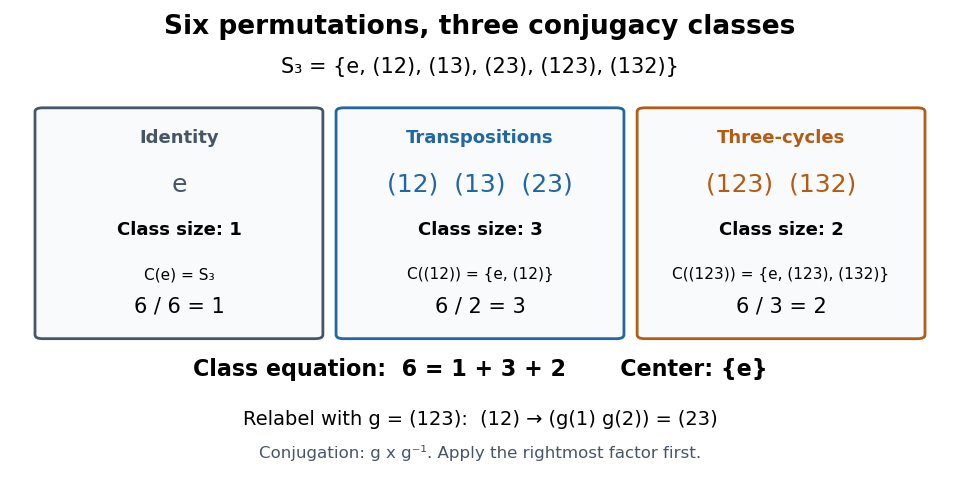
All six permutations of the symmetric group , their conjugacy classes, and representative centralizers
. Details. An explicit check of the conjugation with sends , , and , where each chain applies , then , then . Thus is fixed and are exchanged: . Relabelling also produces , so the three transpositions share one conjugacy class. A transposition reverses the length-three permutation cycle, since , putting both length-three permutation cycles in one conjugacy class.
Checking each of the six possible permutations against gives the displayed centralizers. Only has a one-element conjugacy class, so the center of a group here is . The class equation is . The second diagram in centralizer and normalizer uses the same and to show how preserving a cyclic subgroup differs from fixing its group generator.
In characteristic different from two, a local equation for a conic bundle is with symmetric. A fibre is singular exactly when the determinant vanishes. Changing the fibre coordinates multiplies that determinant by a nonzero square, so its zero locus is intrinsically defined even when the quadratic coefficients belong to twisting line bundles.
User-network decomposition of concave utility maximization by Codex 0 Created 2026-10-14 Updated 2026-10-31
Codex 0 Created 2026-10-14 Updated 2026-10-31Maximize a sum of increasing strictly concave utilities subject to , . Suppose capacities are positive, every route is nonempty, and . At its unique positive optimizer , the Karush-Kuhn-Tucker conditions give nonnegative resource congestion prices and route congestion prices . Choosing makes each user maximize at . It also makes maximize the entropy maximization for loss-network occupancy objective, since its gradient is . Thus user and network optima implement the same system optimum.
A useful motivating experiment moves a bead emitting fluorescence through the selected optical focus and records the detector signal against position. Measurement of point-spread function (PSF) for confocal fluorescence microscopy by InCheon Song and others (2005, §2 and Fig. 1) describes a laser delivered through a single-mode optical fiber, collimation, beam-size adjustment and a dichroic beam splitter. A , numerical aperture oil-immersion objective optical lens excites slide-mounted fluorescent beads and collects their emission. Emission passes a filter and collecting optical lens, then a pinhole, before an avalanche photodiode. A three-dimensional positioning stage moves the specimen. The apparatus also contains a phase plate for deliberately modified responses.[ref]
Measurement of point-spread function (PSF) for confocal fluorescence microscopy by InCheon Song and others. §2 and Fig. 1, pp. 2–3: apparatus and readout
The published comparison uses nominal bead diameters : larger beads give broader measured spots. This is a control on the finite emitter, because the image is the convolution of bead emission with the confocal point spread function. The smallest bead has weaker signal relative to noise; incorrect bead size, defocus, bleaching and optical aberrations limit inference from a restored response. The reported bead-size comparison concerns lateral responses; it is not a measured pinhole-size series or a measured sheet-sectioning curve.[ref]
To test axial pinhole selection with this kind of apparatus, the following is a proposed extension, not an additional result from that paper. Choose an isolated bead small relative to the response, centre it laterally, then step through optical focus while recording background-subtracted signal at several pinhole settings. Hold excitation power, dwell interval, detector gain, emission band and sampling fixed. Preserve raw peaks before also plotting peak-normalized traces. A lower peak and faster relative decay with axial displacement would support the paired-selection mechanism; fitting only normalized widths would miss the throughput cost.
Measure blocked-excitation background, include a bead-free region, avoid detector saturation, and repeat scans in reversed order to reveal drift or bleaching. Check pinhole centring separately, since misalignment can mimic signal loss. Record bead diameter, immersion medium, refractive index, numerical aperture, wavelengths and axial step. A finite bead is an approximation to an optical point source; a point trace does not certify confocal optical sectioning of a whole fluorescent sheet. Depth-dependent spherical aberration, scattering and sample motion can broaden or distort the response. Increasing magnification or making a display brighter does not correct those effects.
Pinned article: Introduction to the OurBigBook Project
Welcome to the OurBigBook Project! Our goal is to create the perfect publishing platform for STEM subjects, and get university-level students to write the best free STEM tutorials ever.
Everyone is welcome to create an account and play with the site: ourbigbook.com/go/register. We belive that students themselves can write amazing tutorials, but teachers are welcome too. You can write about anything you want, it doesn't have to be STEM or even educational. Silly test content is very welcome and you won't be penalized in any way. Just keep it legal!
Intro to OurBigBook
. Source. We have two killer features:
- topics: topics group articles by different users with the same title, e.g. here is the topic for the "Fundamental Theorem of Calculus" ourbigbook.com/go/topic/fundamental-theorem-of-calculusArticles of different users are sorted by upvote within each article page. This feature is a bit like:
- a Wikipedia where each user can have their own version of each article
- a Q&A website like Stack Overflow, where multiple people can give their views on a given topic, and the best ones are sorted by upvote. Except you don't need to wait for someone to ask first, and any topic goes, no matter how narrow or broad
This feature makes it possible for readers to find better explanations of any topic created by other writers. And it allows writers to create an explanation in a place that readers might actually find it.
Figure 1. Screenshot of the "Derivative" topic page. View it live at: ourbigbook.com/go/topic/derivativeVideo 2. OurBigBook Web topics demo. Source. - local editing: you can store all your personal knowledge base content locally in a plaintext markup format that can be edited locally and published either:This way you can be sure that even if OurBigBook.com were to go down one day (which we have no plans to do as it is quite cheap to host!), your content will still be perfectly readable as a static site.
- to OurBigBook.com to get awesome multi-user features like topics and likes
- as HTML files to a static website, which you can host yourself for free on many external providers like GitHub Pages, and remain in full control

Figure 2. You can publish local OurBigBook lightweight markup files to either OurBigBook.com or as a static website.
Figure 3. Visual Studio Code extension installation.
Figure 5. . You can also edit articles on the Web editor without installing anything locally. Video 3. Edit locally and publish demo. Source. This shows editing OurBigBook Markup and publishing it using the Visual Studio Code extension. 
- Infinitely deep tables of contents:



All our software is open source and hosted at: github.com/ourbigbook/ourbigbook
Further documentation can be found at: docs.ourbigbook.com
Feel free to reach our to us for any help or suggestions: docs.ourbigbook.com/#contact