Topics (384k) Articles (398k) Users (410) Discussions (242) Comments (383) Files (13k) New article

Immunoglobulin G is an antibody class whose conventional four-chain architecture supplies the example above.
An ordinary IgG has two matching immunoglobulin heavy chains and two matching immunoglobulin light chains, abbreviated . Its gamma-type immunoglobulin heavy chains contribute both to recognition and to interactions with immune partners.[ref]
Antibody Structure and Molecular Immunology by Gerald M. Edelman. Gerald M. Edelman, Antibody Structure and Molecular Immunology, printed pp. 35–37, Table 1 and Figure 3: gamma chains, four-chain architecture and separate functional regions
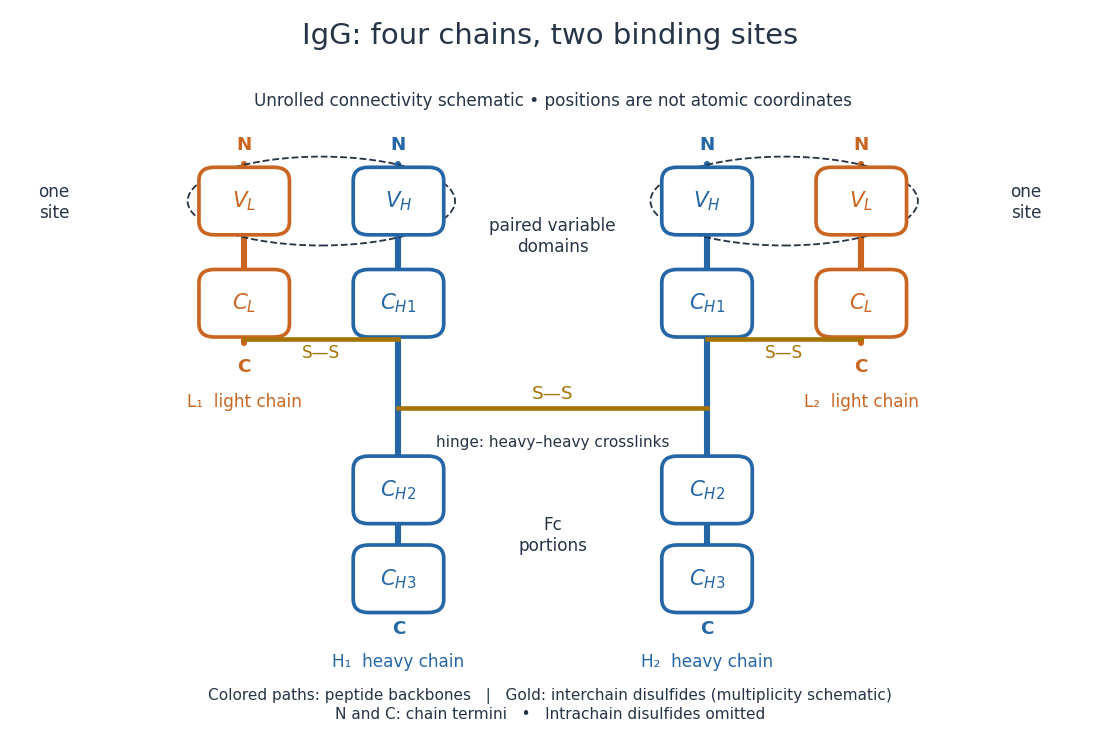
IgG chain continuity and protein disulfide bond connectivity
. Original chain-connectivity schematic. Gold crossbars denote interchain protein disulfide bonds; intrachain crosslinks are omitted. The drawn crossbar count and geometry illustrate connectivity, rather than atomic coordinates or a universal IgG subclass inventory. Details.A useful way to read this picture is to follow a single polypeptide chain continuously from its N-terminus to its C-terminus, then examine the crosslinks separately. The same immunoglobulin heavy chain contributes to a Fab fragment and to the Fc fragment; these named fragments are not pre-existing separate chains. Conversely, one Fab fragment contains material from two different chains. The protein primary structure and the fragment inventory therefore answer different questions about the same protein.
An epitope is the molecular feature recognized by an antibody. Protein denaturation can expose an epitope or destroy the spatial arrangement required for its recognition; an antibody that works on a folded protein need not work in SDS-PAGE-based Western blot antibody detection.
A secondary antibody recognizes another antibody, rather than the proposed target protein directly. In Western blot antibody detection, its attached label makes retained primary antibodies visible. A secondary antibody must recognize the kind of primary antibody used.
In an indirect Western blot, the primary antibody binds an epitope on the proposed target protein. Its binding must be tested in the actual sample and assay conditions through Western blot antibody specificity controls.
The nitrate ion, , is an anion with one nitrogen connected to three oxygen chemical atoms and net electric charge in units of elementary charge. Its 24 valence electrons admit three equivalent octet resonance structures; see Lewis structure for their construction and chemical resonance for their interpretation. The N–O connections are covalent bonds within the ion. See 7.2 Covalent Bonding.
A manganese-containing anion with net electric charge and manganese oxidation state ; is the positive elementary charge.
Chloride is the anion , with net electric charge . In the glycine titration model, it supplies the negative background electric charge introduced with hydrochloric acid.
Pinned article: Introduction to the OurBigBook Project
Welcome to the OurBigBook Project! Our goal is to create the perfect publishing platform for STEM subjects, and get university-level students to write the best free STEM tutorials ever.
Everyone is welcome to create an account and play with the site: ourbigbook.com/go/register. We belive that students themselves can write amazing tutorials, but teachers are welcome too. You can write about anything you want, it doesn't have to be STEM or even educational. Silly test content is very welcome and you won't be penalized in any way. Just keep it legal!
Intro to OurBigBook
. Source. We have two killer features:
- topics: topics group articles by different users with the same title, e.g. here is the topic for the "Fundamental Theorem of Calculus" ourbigbook.com/go/topic/fundamental-theorem-of-calculusArticles of different users are sorted by upvote within each article page. This feature is a bit like:
- a Wikipedia where each user can have their own version of each article
- a Q&A website like Stack Overflow, where multiple people can give their views on a given topic, and the best ones are sorted by upvote. Except you don't need to wait for someone to ask first, and any topic goes, no matter how narrow or broad
This feature makes it possible for readers to find better explanations of any topic created by other writers. And it allows writers to create an explanation in a place that readers might actually find it.
Figure 1. Screenshot of the "Derivative" topic page. View it live at: ourbigbook.com/go/topic/derivativeVideo 2. OurBigBook Web topics demo. Source. - local editing: you can store all your personal knowledge base content locally in a plaintext markup format that can be edited locally and published either:This way you can be sure that even if OurBigBook.com were to go down one day (which we have no plans to do as it is quite cheap to host!), your content will still be perfectly readable as a static site.
- to OurBigBook.com to get awesome multi-user features like topics and likes
- as HTML files to a static website, which you can host yourself for free on many external providers like GitHub Pages, and remain in full control

Figure 2. You can publish local OurBigBook lightweight markup files to either OurBigBook.com or as a static website.
Figure 3. Visual Studio Code extension installation.
Figure 5. . You can also edit articles on the Web editor without installing anything locally. Video 3. Edit locally and publish demo. Source. This shows editing OurBigBook Markup and publishing it using the Visual Studio Code extension. 
- Infinitely deep tables of contents:



All our software is open source and hosted at: github.com/ourbigbook/ourbigbook
Further documentation can be found at: docs.ourbigbook.com
Feel free to reach our to us for any help or suggestions: docs.ourbigbook.com/#contact