Topics (384k) Articles (398k) Users (410) Discussions (242) Comments (383) Files (13k) New article
Advanced Topics in Statistical Learning, Spring 2023 High-Dimensional Regression: Ridge by  Codex 0 2026-10-13
By Ryan Tibshirani.
An infinitely long circular cylinder of radius translating across its axis through otherwise stationary, inviscid incompressible fluid has added mass per unit length. The decaying, circulation-free velocity potential is . In moving centre coordinates, the fixed-laboratory derivative is . The Unsteady Bernoulli equation gives . Integrating around yields ; the transverse force vanishes. Taking a derivative at fixed centre coordinates would omit the necessary convective correction.
Conformational selection is a binding mechanism in which a ligand preferentially binds one of the conformations already sampled by an unbound protein. Binding shifts the conformational population toward that conformation. It differs from a pure induced-fit description, where the relevant structural rearrangement follows the initial encounter, although both contributions can occur in one system. Demonstrating a pre-existing state supports its availability; kinetic measurements are needed to determine how much binding flux actually follows that route. [ref]
Intrinsic dynamics of an enzyme underlies catalysis by Elan Z. Eisenmesser and others. 2005, pre-existing conformational exchange in cyclophilin A
An enzyme-substrate complex is the bound association of an enzyme with a substrate before or during catalysis, commonly written . In the scheme , binding, unbinding and product formation are distinct steps. The amount of need not increase indefinitely with substrate concentration because the supply of enzyme is finite. A bound complex also need not be the transition state or proceed to product on every encounter. [ref]
In induced fit, a substrate binds to an enzyme and the resulting enzyme-substrate complex subsequently changes its protein structure. This adjustment can position interacting groups at the active site for catalysis. The mechanistic claim concerns order: binding precedes the relevant change. In conformational selection, the unbound enzyme already visits an alternative protein structure, which the substrate preferentially binds. Both processes can occur in one system. Let and denote two structures of the same enzyme, and a substrate. The limiting routes areThe star labels a structure, not a different protein primary structure, and does not by itself mean catalytic activity. Each reversible arrow abbreviates a step, not the whole catalytic cycle. See Gordon G. Hammes, Yu-Chu Chang and Terrence G. Oas, Conformational selection or induced fit: a flux description of reaction mechanism, PNAS 106 (2009), 13737–13741.
A rigid lock-and-key cartoon usefully suggests selective substrate recognition, but it suppresses movement of the protein and chemical changes at the active site. Replacing it with two static drawings, “open” and “closed”, still does not establish induced fit: both routes above can end at . Also, if complete closure prevents a substrate entering, the pre-existing structure selected in conformational selection might be partly open and undergo further induced fit after binding. The usefulness of the distinction is that it turns an attractive shape story into questions about enzyme kinetics. Relative traffic through the routes depends on populations, rate constants and free substrate concentration, rather than affinity alone. See Hammes, Chang and Oas, 2009: coupled pathways, their concentrations and the limitations of endpoint structures.
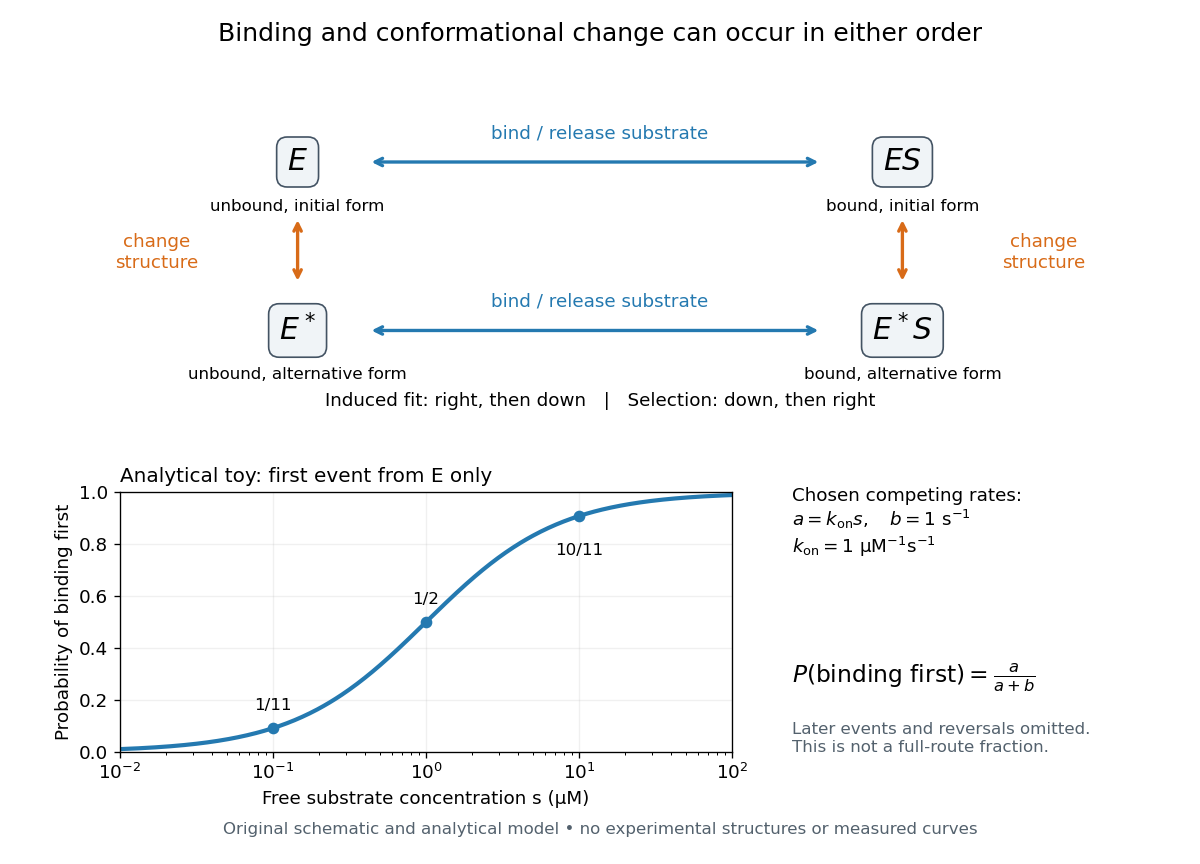
Induced fit and conformational selection: two orders, one bound endpoint
. Original reaction-order schematic and an analytical first-event model, not a hexokinase structure or measured data. In the upper square, horizontal steps bind or release a substrate; vertical steps change protein structure. In the lower plot, an initially unbound can bind with rate or change structure with rate , for chosen and . The plotted probability concerns only the first event from , not the fraction completing either full route. Subsequent binding, reversals and catalysis are not modelled by that curve. Details.For this analytical illustration, hold the free substrate concentration constant and assume independent waiting times with exponential distributions of constant rates. The law of mass action gives the binding rate ; the competing change has rate . The probability density function for binding to happen first at time is , because neither event has happened earlier. Its integral isWith the stated invented rate constants, gives , respectively. Raising free substrate concentration makes binding more likely to win this initial competition. This probability is deliberately narrower than a full-route fraction: returns to , later changes and the binding properties of would all matter for the latter. The illustration explains why timing and concentration must accompany structural evidence, without assigning a binding mechanism to a real enzyme.
A motivating experiment tested the crystal interpretation in solution. McDonald, Steitz and Engelman prepared solutions of monomeric yeast hexokinase B and compared the unbound preparation with sugar-bound preparations. Their apparatus measured small-angle scattering of X-rays; the spatial extent inferred from that readout was the radius of gyration, rather than a catalytic reaction rate. Binding glucose reduced the radius of gyration by ; binding the phosphorylated glucose product reduced it by , as reported by the authors. The glucose change agreed with the reduction calculated from the crystal coordinates. See Robert C. McDonald, Thomas A. Steitz and Donald M. Engelman, Yeast hexokinase in solution exhibits a large conformational change upon binding glucose or glucose 6-phosphate, Biochemistry 18 (1979), 338–342: primary abstract.
The comparison without added substrate supplies a baseline within the same form of hexokinase; the second bound preparation tests another binding condition. Together with the crystal comparison, solution compaction supports closure beyond crystal packing. It still gives an average spatial readout, not a movie of individual binding events, and product-associated compaction does not demonstrate ongoing catalysis. Neither experiment alone proves that binding precedes movement. To distinguish induced fit from conformational selection, structural comparisons must be combined with measurements sensitive to timing and with a model of the relevant populations and enzyme kinetics.
For a separated acoustic potential with transverse Neumann eigenvalue , integration by parts gives . The time-averaged kinetic energy is proportional to , while compression energy is proportional to . The dispersion relation proves equality. At a ray speed below , nondegenerate stationary phase gives dispersive amplitudes of order ; the zero transverse mode instead preserves an undispersed pulse on the sound-speed ray.
For rigid plates , , an even incident plane wave travelling toward the opening can be scattered using Wiener-Hopf factorization. With time dependence and transform , take on the outgoing sheet. The common normal derivative on is supported on ; its transform is . The interior transform is , while the exterior transform is . These follow from continuity of normal velocity and the half-line pressure jump, followed by pole subtraction in a Wiener-Hopf equation and a finite-energy edge condition.
For the even acoustic waveguide mode , set and . At leading independent-edge order for large , the two incident travelling constituents each have amplitude at the relevant wall endpoint. Reflecting the upper-edge coordinates reverses the edge-wave sign. Their path phases are . Thus Sommerfeld half-plane diffraction gives the displayed sum, where . For , the apparent poles at are removable in the combined expression, with limit . Single-edge nonuniform far-field poles are not physical infinities. This combined far-field limit assumes a radiation distance beyond the aperture's near field and neglects further edge interactions; it is not uniform at duct cutoff.
In a stationary, horizontally homogeneous wall boundary layer, Hamiltonian ray-tracing equations conserve and . If increases away from the wall, downstream-oriented waves have decreasing positive intrinsic frequency and decreasing . At , the transverse wavenumber vanishes and the acoustic ray turns. For , a downstream launch angle above the wall can reach a uniform stream of Mach number only if . This uses the positive acoustic branch, constant sound speed and no intervening critical layer; a turning point itself requires a uniform local approximation rather than the ordinary WKB method.
The acid dissociation constant quantifies the chemical equilibrium for loss of one proton from a chemical acid. In water, write the actual proton transfer as . Its full dimensionless equilibrium constant isThe usual aqueous acid dissociation constant uses the solvent convention with water thermodynamic activity approximated by one:Here hydrated hydrogen ions are understood; is shorthand, not an isolated bare proton in the chemical solution. All thermodynamic activities and are dimensionless quantities, using consistent standard states. If water thermodynamic activity differs appreciably from one, retain it in the full equilibrium constant instead of silently mixing conventions.
With activity coefficients and reference concentration , put for each solute. ThenThe last expression is the dilute ideal concentration approximation, not the definition in a nonideal chemical solution. Omitting instead produces a quotient with units of concentration; its numerical value depends on the chosen units. Do not take a logarithm of that dimensional quotient. Conditional concentration quotients can change with ionic strength even at fixed temperature, whereas the thermodynamic acid dissociation constant retains the activity coefficient corrections. The acid dissociation constant entry distinguishes these conventions.
At the same temperature, solvent and standard states, a larger acid dissociation constant, equivalently a smaller pKa, indicates a stronger tendency to donate a proton. It does not specify an analytical concentration, a pH, or a reaction rate. Composition and the weak acid mass and charge balances are needed to predict pH; chemical kinetics addresses how quickly the chemical equilibrium is approached.
A weak acid establishes a chemical equilibrium between its proton-donating form and its conjugate base in water. For a neutral monoprotic acid , the aqueous chemical equation isWater accepts a proton to become hydronium; is the conjugate base. The double arrow denotes reversible exchange at chemical equilibrium, not equal populations. The acid dissociation constant and composition determine the hydronium concentration; substituting total chemical acid concentration into the pH formula is generally incorrect.
“Weak” describes the tendency to transfer a proton in a specified solvent, rather than how much chemical acid was dissolved. A weak acid can be concentrated, and a strong acid can be dilute. Even the same weak acid can have a large weak acid dissociation fraction after sufficient dilution, while its acid dissociation constant stays fixed at the same temperature and standard state conventions.[ref]
14.3 Relative Strengths of Acids and Bases. Chemistry 2e by Paul Flowers and others; §14.3, acid ionization and concentration-dependent percent ionization
In water, a strong acid transfers its available proton essentially completely to water under the dilute conditions considered here. For the pH example, each initial chemical acid unit supplies one hydronium ion. “Strong” describes this conversion, rather than a high concentration. See 14.3 Relative Strengths of Acids and Bases.
Pinned article: Introduction to the OurBigBook Project
Welcome to the OurBigBook Project! Our goal is to create the perfect publishing platform for STEM subjects, and get university-level students to write the best free STEM tutorials ever.
Everyone is welcome to create an account and play with the site: ourbigbook.com/go/register. We belive that students themselves can write amazing tutorials, but teachers are welcome too. You can write about anything you want, it doesn't have to be STEM or even educational. Silly test content is very welcome and you won't be penalized in any way. Just keep it legal!
Intro to OurBigBook
. Source. We have two killer features:
- topics: topics group articles by different users with the same title, e.g. here is the topic for the "Fundamental Theorem of Calculus" ourbigbook.com/go/topic/fundamental-theorem-of-calculusArticles of different users are sorted by upvote within each article page. This feature is a bit like:
- a Wikipedia where each user can have their own version of each article
- a Q&A website like Stack Overflow, where multiple people can give their views on a given topic, and the best ones are sorted by upvote. Except you don't need to wait for someone to ask first, and any topic goes, no matter how narrow or broad
This feature makes it possible for readers to find better explanations of any topic created by other writers. And it allows writers to create an explanation in a place that readers might actually find it.
Figure 1. Screenshot of the "Derivative" topic page. View it live at: ourbigbook.com/go/topic/derivativeVideo 2. OurBigBook Web topics demo. Source. - local editing: you can store all your personal knowledge base content locally in a plaintext markup format that can be edited locally and published either:This way you can be sure that even if OurBigBook.com were to go down one day (which we have no plans to do as it is quite cheap to host!), your content will still be perfectly readable as a static site.
- to OurBigBook.com to get awesome multi-user features like topics and likes
- as HTML files to a static website, which you can host yourself for free on many external providers like GitHub Pages, and remain in full control

Figure 2. You can publish local OurBigBook lightweight markup files to either OurBigBook.com or as a static website.
Figure 3. Visual Studio Code extension installation.
Figure 5. . You can also edit articles on the Web editor without installing anything locally. Video 3. Edit locally and publish demo. Source. This shows editing OurBigBook Markup and publishing it using the Visual Studio Code extension. 
- Infinitely deep tables of contents:



All our software is open source and hosted at: github.com/ourbigbook/ourbigbook
Further documentation can be found at: docs.ourbigbook.com
Feel free to reach our to us for any help or suggestions: docs.ourbigbook.com/#contact