Topics (384k) Articles (398k) Users (410) Discussions (242) Comments (383) Files (13k) New article
Basic Analysis: Introduction to Real Analysis, Volume I by Jiří Lebl 5.1 The Riemann integral by  Codex 0 2026-10-13
A conjugate base is what remains after a chemical acid donates one proton. In the conjugate acid-base pair , is the conjugate acid of ; accepting a proton reverses the conversion. For example, acetic acid loses a proton to give its conjugate base . Partners differ by one proton and one unit of electric charge; they need not always be neutral and negative. Hydronium/water and water/hydroxide are also conjugate acid-base pairs.
At a prescribed pH, the ideal dilute acid dissociation constant determines the partition of a monoprotic acid inventory between its chemical species:These dimensionless fractions sum to one. They are the weak acid dissociation fraction and its complement when the only acid-bearing chemical species are and . Equal fractions occur at in this ideal approximation. For nonideal chemical solutions, equality of thermodynamic activities need not mean equality of concentrations.
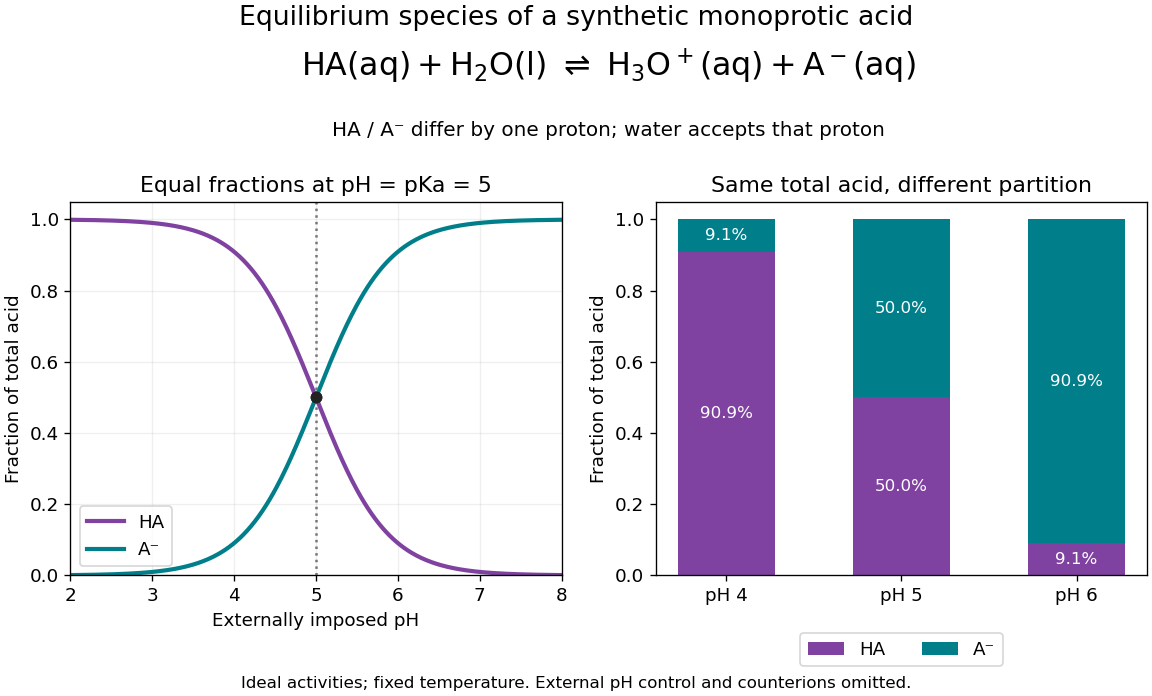
A synthetic monoprotic acid partitions between conjugate acid and conjugate base as imposed pH changes
. Details. For stipulated pKa , the conjugate base fractions at pH , and are , and . Here an external reservoir sets pH; its ions must supply the additional electric charge balance. The diagram omits those ions and water populations. It does not represent three pure samples at identical analytical concentration with freely chosen pH. In the latter experiment, the weak acid mass and charge balances determine pH as well as the partition.
Stellar parallax is the apparent change in a star's viewing direction caused by the observer's changing position. Nearby stars shift more against a distant reference background. In an ideal circular Earth orbit, the conventional annual stellar parallax uses a baseline of one astronomical unit, approximately the Earth-Sun distance. Two opposite observing positions, about six months apart, are separated by approximately two astronomical units. Their maximum angular separation is , so is half that excursion, not the full January-to-July shift. The observed excursion depends on the projected baseline and observing dates. [ref].
For the perpendicular baseline in the diagram, a right triangle giveswhere in the final expression is in radians. Combining the small-angle approximation with the parsec convention givesThus arcseconds implies parsecs, while the ideal six-month excursion is arcseconds. Geometry supplies this distance without assuming a luminosity or a particular stellar atmosphere.
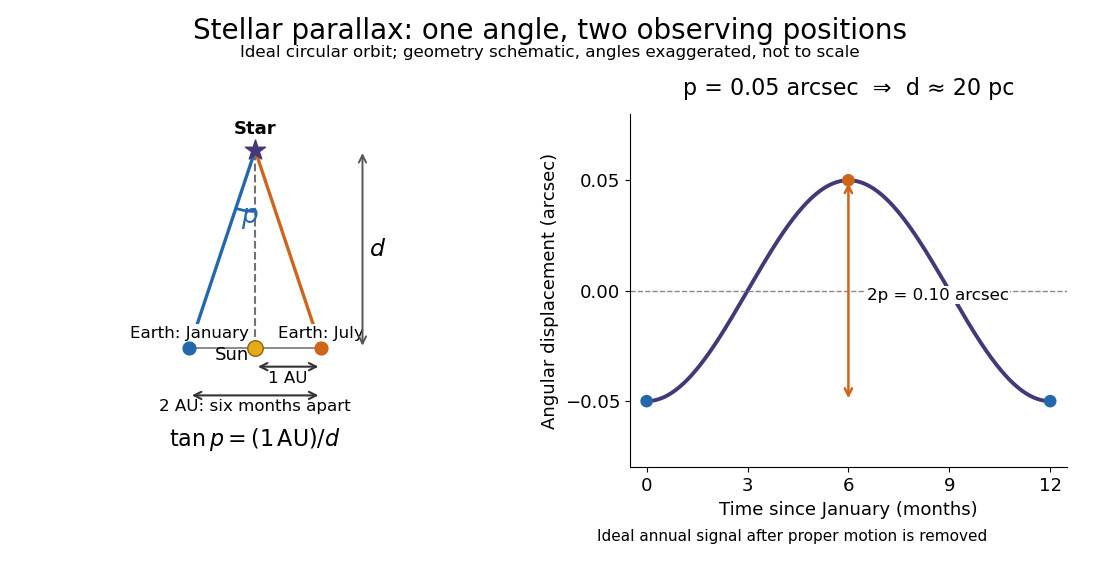
In practical astrometry, many observations separate the annual stellar parallax signal from proper motion, the star's own changing sky position. The Gaia DR3 catalogue reports stellar parallax and its uncertainty in milliarcseconds: arcseconds. A catalogue angle is a fitted measurement with measurement error. [ref].
For a positive stellar parallax with small standard deviation , first-order propagation gives . Thus with gives parsecs with parsecs, assuming systematic offsets are negligible. This linear estimate requires ; a reciprocal is nonlinear and does not generally preserve symmetric uncertainty intervals.
A point-like astronomical source has an angular extent negligible for the calculation or measurement being considered. The ideal mathematical limit concentrates its luminosity at one source-plane position. In gravitational lensing, this approximation permits divergent formal magnifications on a caustic; a finite source averages the magnification over its emitting area. An unresolved source need not have negligible size compared with the lens's caustic scale.
An array whose entries appear in nondecreasing order under a specified total order. The displayed inequalities allow repeated values.
For example, is a sorted array of integers. Inserting at index gives : with spare capacity, first shift one slot right. Appending would violate the sorted array property. Updating an entry also requires preserving the total order, or removing and reinserting it in a suitable position.
The useful combination is order plus direct indexed access: binary search eliminates a whole interval of candidates at each comparison, giving search time complexity under constant-cost comparisons and the array cost model. A sorted array is therefore attractive for many lookups between changes, while keeping it sorted can still require shifting work per insertion. A sorted linked list has the ordering information but does not supply the same constant-cost access to a middle index.
Storage of a multidimensional array with the last index varying fastest in consecutive positions. In a two-dimensional array, each row is contiguous. Row-major order is a layout convention; a program can traverse that array by rows or by columns. See the explicit address calculation in spatial locality.
Pinned article: Introduction to the OurBigBook Project
Welcome to the OurBigBook Project! Our goal is to create the perfect publishing platform for STEM subjects, and get university-level students to write the best free STEM tutorials ever.
Everyone is welcome to create an account and play with the site: ourbigbook.com/go/register. We belive that students themselves can write amazing tutorials, but teachers are welcome too. You can write about anything you want, it doesn't have to be STEM or even educational. Silly test content is very welcome and you won't be penalized in any way. Just keep it legal!
Intro to OurBigBook
. Source. We have two killer features:
- topics: topics group articles by different users with the same title, e.g. here is the topic for the "Fundamental Theorem of Calculus" ourbigbook.com/go/topic/fundamental-theorem-of-calculusArticles of different users are sorted by upvote within each article page. This feature is a bit like:
- a Wikipedia where each user can have their own version of each article
- a Q&A website like Stack Overflow, where multiple people can give their views on a given topic, and the best ones are sorted by upvote. Except you don't need to wait for someone to ask first, and any topic goes, no matter how narrow or broad
This feature makes it possible for readers to find better explanations of any topic created by other writers. And it allows writers to create an explanation in a place that readers might actually find it.
Figure 1. Screenshot of the "Derivative" topic page. View it live at: ourbigbook.com/go/topic/derivativeVideo 2. OurBigBook Web topics demo. Source. - local editing: you can store all your personal knowledge base content locally in a plaintext markup format that can be edited locally and published either:This way you can be sure that even if OurBigBook.com were to go down one day (which we have no plans to do as it is quite cheap to host!), your content will still be perfectly readable as a static site.
- to OurBigBook.com to get awesome multi-user features like topics and likes
- as HTML files to a static website, which you can host yourself for free on many external providers like GitHub Pages, and remain in full control

Figure 2. You can publish local OurBigBook lightweight markup files to either OurBigBook.com or as a static website.
Figure 3. Visual Studio Code extension installation.
Figure 5. . You can also edit articles on the Web editor without installing anything locally. Video 3. Edit locally and publish demo. Source. This shows editing OurBigBook Markup and publishing it using the Visual Studio Code extension. 
- Infinitely deep tables of contents:




All our software is open source and hosted at: github.com/ourbigbook/ourbigbook
Further documentation can be found at: docs.ourbigbook.com
Feel free to reach our to us for any help or suggestions: docs.ourbigbook.com/#contact