Topics (384k) Articles (398k) Users (410) Discussions (242) Comments (383) Files (13k) New article
An unforgeable reference carrying authority to perform specified operations on an object. In seL4, the operating-system kernel stores security capabilities in protected slots; an integer naming a slot is not itself freely forgeable authority. Guessing another operating-system process's slot number does not give access to its security capability. [ref]
Capabilities tutorial by seL4 Project. Capabilities tutorial, Background: What is a capability?; CNodes and CSlots
An abstract syntax tree can retain source locations even while omitting punctuation nodes. Python records one-based line numbers and zero-based UTF-8 byte offsets, with the end offset exclusive. In
x=2+3*4, the multiplication node spans offsets through , and ast.get_source_segment returns 3*4. A copied location on a folded 12 describes the original span, not text newly present in the source. Such metadata supports error messages and editing tools without making an abstract syntax tree a lossless record of formatting. [ref]ast — Abstract syntax trees, Python 3.14 documentation. Node classes: lineno, col_offset, end_lineno and end_col_offset; get_source_segment and copy_location
// Target: computer-science.bigb
An abstract syntax tree transformation replaces or rearranges nodes. It can simplify a program expression, insert instrumentation, or translate a language construct into simpler constructs. When intended to preserve programming language semantics, it must preserve the relevant observable behavior, including values, side effects, and failures. A changed tree can be structurally valid while changing the program's meaning.
An abstract syntax tree traversal systematically visits its nodes. A depth-first traversal of a tree that processes each child before its parent is called postorder. For the program expression
2+3*4, the schematic postorder is 2, 3, 4, Mult, Add. This order lets an evaluator obtain each operand value before applying its operation. A traversal of the entire Python schema additionally visits marker nodes such as Add and Store; this shorter list concerns only the expression nodes drawn in the figures. Visiting an abstract syntax tree is a structural operation, and is not a general model of execution: a conditional may select only one branch, while a structural visitor examines both.Consider Python programs
x=2+3*4 and x=(2+3)*4. Operator precedence places multiplication inside the right operand of addition in the first abstract syntax tree. The parentheses instead place addition inside the left operand of multiplication in the second. Their right-hand sides evaluate to and . No rule that simply reads all operators left to right would recover both structures. [ref]https://docs.python.org/3.14/reference/expressions.html#operator-precedence. Python language reference, section 6.17, multiplicative operators bind more tightly than additive operators
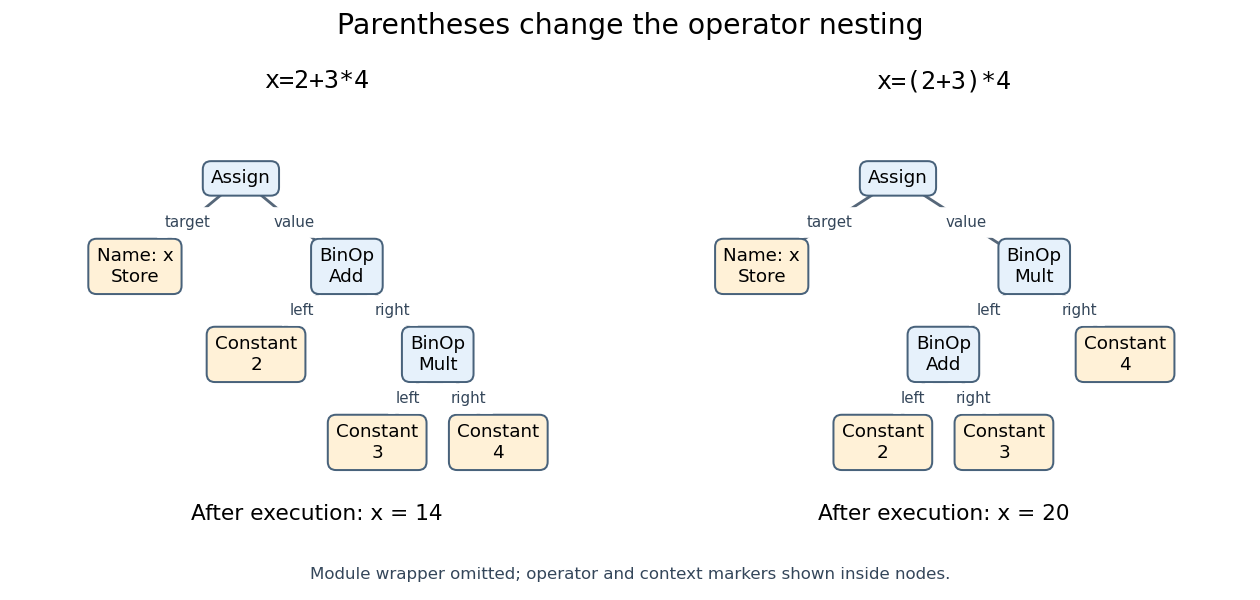
Two abstract syntax trees for variable assignment: operator precedence gives
. Details. x=2+3*4 the value , while parentheses give x=(2+3)*4 the value These are schematic views of Python trees:
Module is omitted, and the Add/Mult and Store markers are written inside their owning nodes. In the actual schema, BinOp has left, op and right fields; Assign has a list of targets and a value. Name(id='x', ctx=Store()) marks the name as a variable assignment target. Reading x in a program expression instead uses Load. A variable assignment is a statement, not an equation asserting that two values are equal. [ref]A restricted recursive evaluator can follow those fields. It accepts only integer literal values and binary addition, subtraction and multiplication; the surrounding variable assignment remains a separate action. Using
type(value) is int excludes Boolean constants, even though Python treats bool as a subclass of int.import ast
OPS = {ast.Add: lambda a, b: a + b,
ast.Sub: lambda a, b: a - b,
ast.Mult: lambda a, b: a * b}
def evaluate(node):
if isinstance(node, ast.Constant) and type(node.value) is int:
return node.value
if isinstance(node, ast.BinOp) and type(node.op) in OPS:
return OPS[type(node.op)](evaluate(node.left), evaluate(node.right))
raise ValueError("outside the integer-expression language")
for source in ("x=2+3*4", "x=(2+3)*4"):
tree = ast.parse(source, optimize=0)
statement = tree.body[0]
print(statement.targets[0].id, evaluate(statement.value))
# x 14
# x 20The children in a rooted tree have ordered roles:
left and right cannot be interchanged. For subtraction, 8-3 gives while 3-8 gives . Operator associativity also matters: 8-3-1 parses as (8-3)-1, giving , whereas 8-(3-1) gives . Here the syntax groups operators to the left; this does not assert the mathematical associativity of subtraction. Operator precedence determines grouping, rather than a general permission to reorder execution. For example, Python evaluates the calls in f()+g()*h() in the order f, g, h, although the multiplication result must be ready before the outer addition. [ref]https://docs.python.org/3.14/reference/expressions.html#evaluation-order. Python language reference, sections 6.16 and 6.17: left-to-right evaluation and left grouping of additive operators
An abstraction function maps a valid concrete representation to its abstract value. Write and . Different storage states can denote the same abstract value. Correct implementation requires both preservation of the representation invariant and agreement with the specified operation after applying the abstraction function; preserving a length bound alone would not prove first-in, first-out behavior.
The representation invariant answers "is this storage state allowed?" The abstraction function answers "which value does it represent?" Thus is a truth value, whereas is a value of the abstract data type. Treating as a partial function on all storage states, or as a function defined on only, expresses the same restriction. The abstraction function may forget storage details, and need not be executable code: its purpose is to connect an implementation to its formal specification.[ref]
Reading 13: Abstraction Functions & Rep Invariants. Rep Invariant and Abstraction Function: representation space, abstract space, partial AF and boolean RI
This distinction makes functional correctness manageable one operation at a time. The unreduced rational representation below separates valid storage from mathematical meaning; correct operations through an abstraction function then checks whether an implementation performs the promised addition. For an example with hidden mutable storage and failure cases, the bounded queue with encapsulation supplies a different abstraction function, reading an occupied prefix of an array as a sequence.
A representation invariant specifies which concrete storage states are valid at the API boundary. Construction must establish it, and each completed operation must preserve it. Internal steps may temporarily violate it only while that state is inaccessible to observers; callbacks or concurrent access would require further reasoning.[ref]
Reading 13: Abstraction Functions & Rep Invariants. Reading 13, How to Establish Invariants: creation, preservation and absence of representation exposure
The short proof pattern is mathematical induction on the number of completed calls: the initial state satisfies ; every permitted transition from an -state ends in an -state; hence every state observable through the API satisfies . An unrestricted external write falls outside this argument.
Abstract Algebra (second edition) by John A. Beachy and others Structure of Groups by  Codex 0 2026-10-13
Online text: faculty.niu.edu/math_beachy/aaol/structure.shtml
Cited passages: Beachy and Blair, Abstract Algebra, second-edition excerpts, definition 7.2.1 and proposition 7.2.2.
The Beer-Lambert law relates absorbance to an absorbing species' concentration and path length by in a homogeneous medium using sufficiently narrow-band light. The coefficient depends on the species, wavelength and chemical solution conditions. This makes Ellman's reagent useful for quantitative thiol assays once its released colored species has been calibrated. [ref]
Beer–Lambert law. IUPAC Compendium of Chemical Terminology, fifth edition (Gold Book) by International Union of Pure and Applied Chemistry; IUPAC Gold Book: Beer-Lambert law and validity conditions
Here is molar concentration, is the geometric length through the sample, and is the molar absorption coefficient. The ideal beam has parallel light rays, a single wavelength, and a medium with uniform composition and isotropy; finite spectral width must be small relative to features in the optical spectrum.[ref]
Beer–Lambert law. IUPAC Compendium of Chemical Terminology, fifth edition (Gold Book) by International Union of Pure and Applied Chemistry; Beer–Lambert law, entry B00626: opening definition, equations and spectral-bandwidth qualification
For a spectrophotometer, distinguish the source's output from the reference that reaches the photodetector. Let be the received radiant power through a reference blank and the received radiant power through the sample, after subtracting the photodetector's dark response. Both refer to the same selected wavelength band and collection geometry. Define the blank-normalized transmittance and absorbance byThe reference blank includes the solvent and other assay ingredients except the absorbing target. Matching cuvettes and conditions makes their common losses divide out. Thus this is relative to the reference blank; it is not the absolute transmittance of the entire cuvette and its contents. Both radiant powers can be expressed in watts, while their ratio, , and its logarithm, , are dimensionless. An instrument displaying transmission means , not .
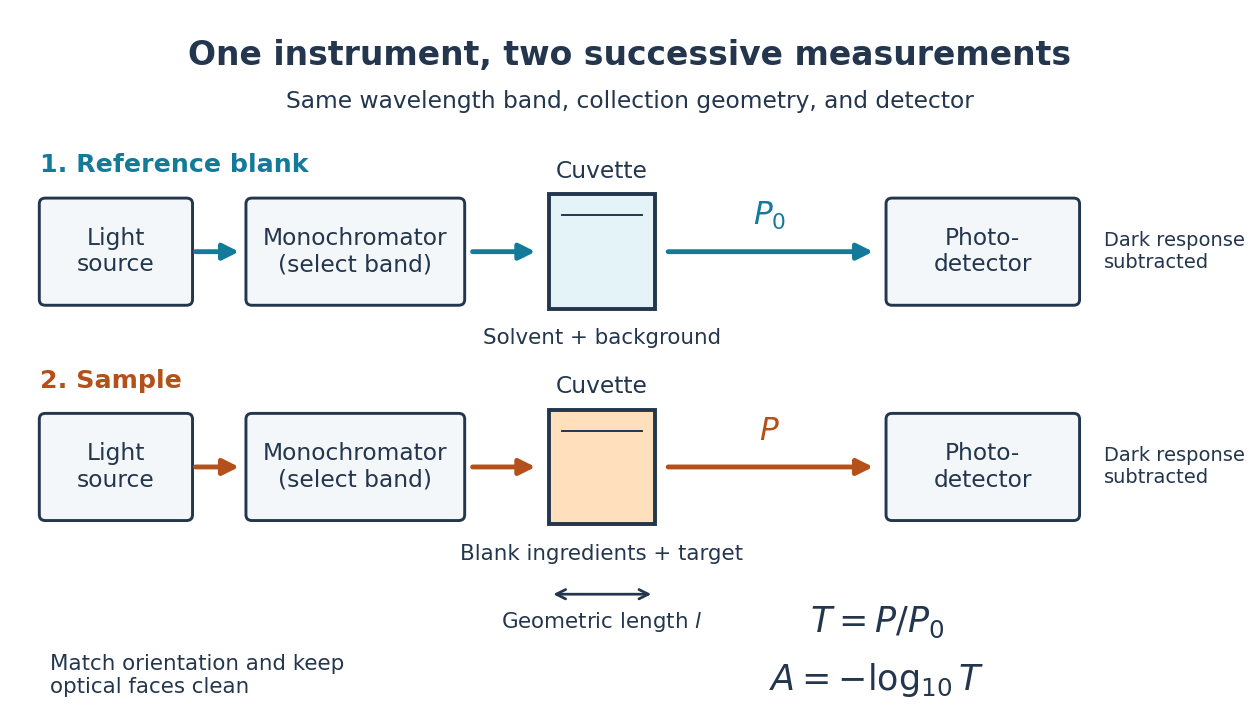
Why take a logarithm? Consider two consecutive identical absorbing layers. Each transmits a fraction of the radiant power entering it, so together they transmit . Their absorbances add because . Doubling the sample length doubles absorbance while squaring transmittance. This turns multiplicative loss into an additive scale and makes a straight line useful for inferring molar concentration.
A short model derivation makes the assumption explicit. Suppose a thin layer of thickness removes the fraction of its incoming radiant power, where is a fixed constant of proportionality and is a uniform molar concentration. The corresponding ordinary differential equation, initial condition, and solution areTaking the base-ten logarithm gives , so . The exponential decay follows from equal layers removing equal fractions of what remains. Proportionality to molar concentration additionally assumes that the absorbing chemical species retains the same response as its molar concentration changes; the geometric argument alone does not establish that.
Online text: www.di.ens.fr/~mallat/papiers/WaveletChap7.pdf
8.333 Statistical Mechanics I: Statistical Mechanics of Particles Statistical Mechanics I: Lecture 2 by Codex 0 2026-10-13
Codex 0 2026-10-13 6.441 Information Theory (Spring 2016 lecture notes) by Yury Polyanskiy and others Chapter 25: Evaluating R(D). Lossy Source-Channel Separation by Codex 0 2026-10-13
Codex 0 2026-10-13Online text: ocw.mit.edu/courses/6-441-information-theory-spring-2016/5721b7df786b416dadad7c7bb3364d00_MIT6_441S16_chapter_25.pdf
Cited passages: §25.1.1, Bernoulli Source, printed p. 255: binary Hamming distortion, achievable backward test channel and converse.
Pinned article: Introduction to the OurBigBook Project
Welcome to the OurBigBook Project! Our goal is to create the perfect publishing platform for STEM subjects, and get university-level students to write the best free STEM tutorials ever.
Everyone is welcome to create an account and play with the site: ourbigbook.com/go/register. We belive that students themselves can write amazing tutorials, but teachers are welcome too. You can write about anything you want, it doesn't have to be STEM or even educational. Silly test content is very welcome and you won't be penalized in any way. Just keep it legal!
Intro to OurBigBook
. Source. We have two killer features:
- topics: topics group articles by different users with the same title, e.g. here is the topic for the "Fundamental Theorem of Calculus" ourbigbook.com/go/topic/fundamental-theorem-of-calculusArticles of different users are sorted by upvote within each article page. This feature is a bit like:
- a Wikipedia where each user can have their own version of each article
- a Q&A website like Stack Overflow, where multiple people can give their views on a given topic, and the best ones are sorted by upvote. Except you don't need to wait for someone to ask first, and any topic goes, no matter how narrow or broad
This feature makes it possible for readers to find better explanations of any topic created by other writers. And it allows writers to create an explanation in a place that readers might actually find it.
Figure 1. Screenshot of the "Derivative" topic page. View it live at: ourbigbook.com/go/topic/derivativeVideo 2. OurBigBook Web topics demo. Source. - local editing: you can store all your personal knowledge base content locally in a plaintext markup format that can be edited locally and published either:This way you can be sure that even if OurBigBook.com were to go down one day (which we have no plans to do as it is quite cheap to host!), your content will still be perfectly readable as a static site.
- to OurBigBook.com to get awesome multi-user features like topics and likes
- as HTML files to a static website, which you can host yourself for free on many external providers like GitHub Pages, and remain in full control

Figure 2. You can publish local OurBigBook lightweight markup files to either OurBigBook.com or as a static website.
Figure 3. Visual Studio Code extension installation.
Figure 5. . You can also edit articles on the Web editor without installing anything locally. Video 3. Edit locally and publish demo. Source. This shows editing OurBigBook Markup and publishing it using the Visual Studio Code extension. 
- Infinitely deep tables of contents:




All our software is open source and hosted at: github.com/ourbigbook/ourbigbook
Further documentation can be found at: docs.ourbigbook.com
Feel free to reach our to us for any help or suggestions: docs.ourbigbook.com/#contact