Topics (384k) Articles (398k) Users (410) Discussions (242) Comments (383) Files (13k) New article
Equivalent chemical bonds in an intact molecule need not have equal successive bond-dissociation enthalpies. Once one chemical bond is removed, the next reactant has a different electronic quantum state and may relax to a different molecular geometry. The successive steps compare different species. This distinction also explains why a tabulated average chemical bond strength is not necessarily the cost of the first cleavage.[ref]
7.5 Strengths of Ionic and Covalent Bonds. “Bond Strength: Covalent Bonds”, methane paragraph: equivalent initial bonds and unequal sequential breaking costs
For an invented species , stipulate the following gas-phase steps, with all enthalpies at the same temperature and the same standard states:The symbols stand for hypothetical species with consistently chosen electronic states. They are not values for water or another measured molecule. By Hess's law, the total enthalpy of atomization for is ; the arithmetic mean per broken chemical bond is . Neither individual step equals that mean. Nor must the second step be cheaper: here it is deliberately more expensive. An exact sequence sums exactly; substituting averages taken from other molecules generally gives only an estimate.
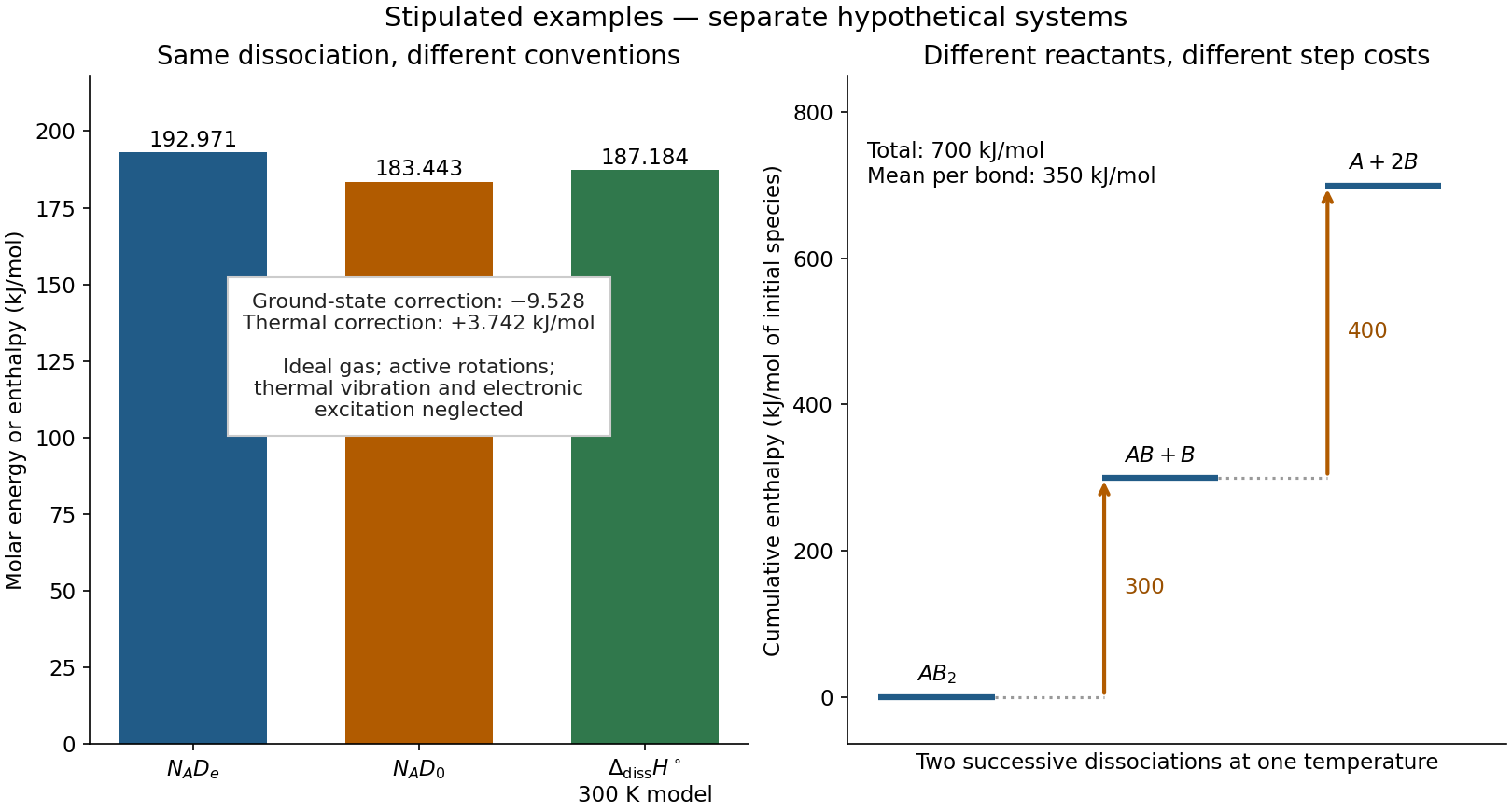
Two stipulated examples: changing the energy convention for one dissociation, and changing the reactant during sequential cleavage
. Left: , , and the model bond-dissociation enthalpy at . Right: cumulative enthalpy levels for two successive steps, with costs and and mean . The panels are separate hypothetical systems; neither contains molecular measurements. Details.Take an invented diatomic molecule with a Morse potential, setting the separated-atom energy to zero:Here is an inverse length, the equilibrium bond length, and , with reduced mass . These stipulated parameters describe a simple model, not a measured chemical substance. For the one-dimensional Morse oscillator, energy eigenvalues above the minimum areConsequently,The harmonic estimate is slightly larger than this model's exact zero-point energy. The physical bound-level restriction matters: the quadratic expression is not an infinite ladder of vibrational quantum states.
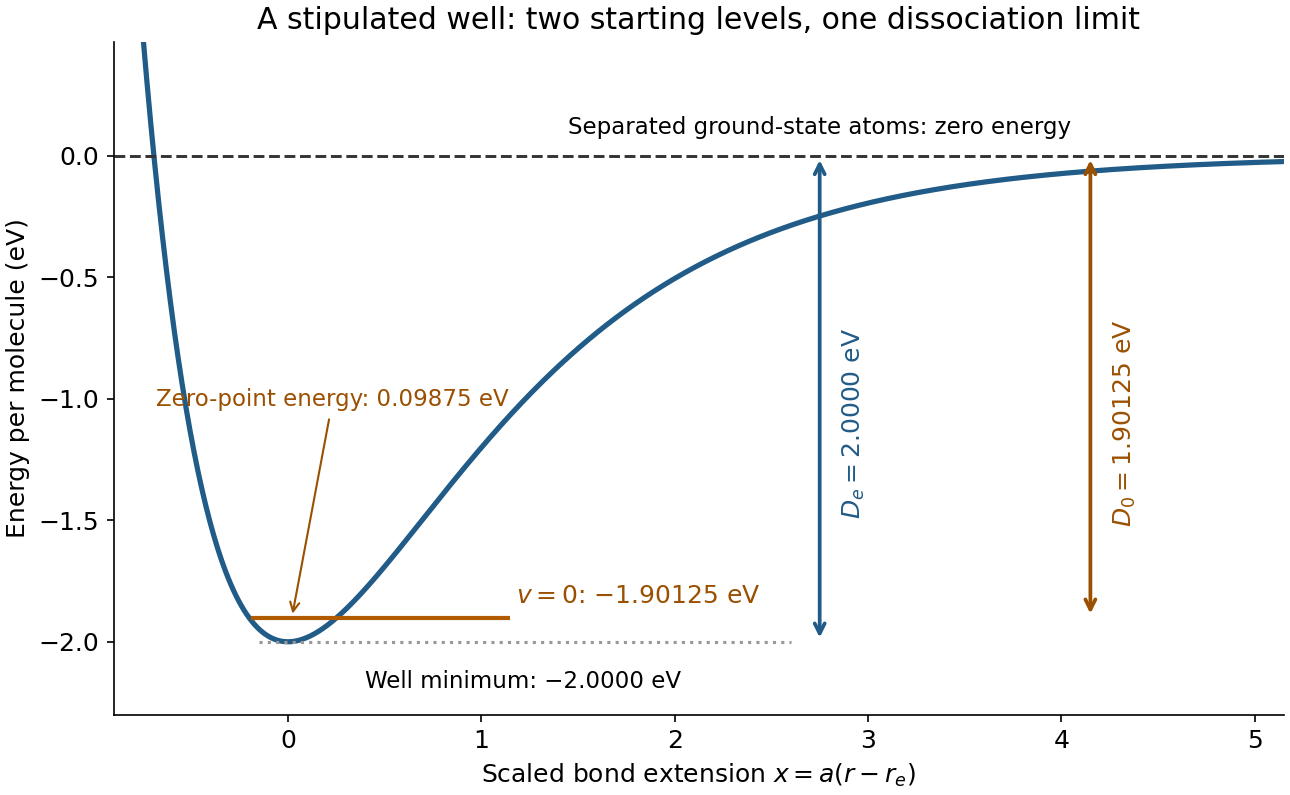
Bond potential-well depth and ground-state dissociation energy reach the same separated-atom limit from different starting energies
. Original stipulated Morse potential with and . The horizontal coordinate is ; the horizontal line is an energy eigenvalue, not a classical trajectory or a measured spectrum. Details.For a separate thermal illustration using this same stipulated , assume an ideal gas, fully active molecular rotation of the parent, negligible thermal molecular vibration, and negligible electronic excitation for all species. Each monatomic product contributes ; the diatomic molecule contributes . Thus the net increment is , with molar gas constant . At ,This last result follows from the stated thermal model, not a universal correction for every chemical bond. Frozen rotations, accessible excited states, different fragment composition, or a condensed phase change the thermal increments.
A bond-dissociation enthalpy is the molar enthalpy change for the specified homolysis at temperature , with reactant and products in specified standard states. Its usual units are . The superscript specifies standard states; it does not fix to room temperature.[ref]
Write for each species' molar thermal enthalpy increment. With an energy per parent molecule,Here is the Avogadro constant. The thermal increments include translational kinetic energy, molecular rotation, thermally excited molecular vibration and electronic states when populated, and the contribution to enthalpy. They are additional to the zero-point energies already included in . If values of standard enthalpy of formation at the same are available, Hess's law gives the same quantity as .
Units alone do not identify the convention. Multiplying either or by the Avogadro constant gives molar energy, but does not add thermal enthalpy. One electronvolt per dissociation corresponds to . A spectroscopic wavenumber represents energy , using the Planck constant and speed of light ; corresponds to .[ref]
Fundamental Physical Constants — Complete Listing by National Institute of Standards and Technology and others. SI defining constants h, c, e and Avogadro constant; conversions calculated from them
The ground-state dissociation energy starts at the lowest vibrational quantum state, with the lowest allowed rotational quantum state and the fragment states explicitly specified. For a diatomic molecule whose fragments are ground-state chemical atoms, omitting any additional rotational correction,where is the vibrational zero-point energy measured upward from the well minimum. The initial molecule already has this energy, so less additional energy is needed to reach the same final limit.[ref]
bond-dissociation energy in theoretical chemistry. definition of bond-dissociation energy in theoretical chemistry: D0 = De minus zero-point vibrational energy
For fragments that are themselves molecules, include their zero-point energies too. Define as the electronic energy difference between separately relaxed products and reactant; then, with consistent rotational conventions,Thus “subtract the parent's zero-point energy” is sufficient for atomic products but generally incomplete for molecular products. An excited final quantum state raises its channel threshold by its excitation energy; that threshold does not become the ground-product just because a detector selects it.
For a diatomic molecule, let be the electronic potential energy at bond length , with the atomic nuclei treated as fixed while finding the electronic energy. Choose zero at infinitely separated chemical atoms in the specified electronic quantum states. If the minimum occurs at , the bond potential-well depth isThe bottom of this curve describes an equilibrium bond length, not an attainable motionless vibrational quantum state. Changing the zero of potential energy shifts both endpoints equally and leaves unchanged. A quantum harmonic oscillator approximates the curve near its minimum but rises without limit, so that local approximation alone cannot supply a dissociation asymptote. A Morse potential supplies both a minimum and a finite separated-fragment limit.[ref]
dissociation energy. definition: subscripts e and 0 distinguish the potential-energy minimum and ground state
If the two honest quantum state ensembles have the same density operator, their independently prepared blocks are perfectly hiding. A dishonest sender can instead send one half of a purification of a density operator and retain the other. The Hughston–Jozsa–Wootters theorem allows a measurement of the retained system to prepare either honest ensemble after commitment. If verification checks only the declared states, either opening is then accepted with the honest probabilities. This gives a concrete failure of binding while preserving perfect hiding.
Cited passages: Biology 2e, §5.2, Tonicity in Living Systems and Figure 5.13: membrane withdrawal under hypertonic conditions; Biology 2e, §5.2, Tonicity in Living Systems, Figure 5.13: wall support and plasmolysis.
Cited passages: Biology 2e, §24.1, Cell Structure and Function: chitin and glucans; Biology 2e, §24.1, Cell Structure and Function: structural wall polysaccharides.
Biology 2e by Mary Ann Clark and others 22.2 Structure of Prokaryotes: Bacteria and Archaea by  Codex 0 2026-10-13
Cited passages: Biology 2e, §22.2, Figure 22.13 and The Cell Wall of Prokaryotes: wall-free bacteria and archaeal differences; Biology 2e, §22.2, Figure 22.16: inner membrane, peptidoglycan and outer membrane.
Pinned article: Introduction to the OurBigBook Project
Welcome to the OurBigBook Project! Our goal is to create the perfect publishing platform for STEM subjects, and get university-level students to write the best free STEM tutorials ever.
Everyone is welcome to create an account and play with the site: ourbigbook.com/go/register. We belive that students themselves can write amazing tutorials, but teachers are welcome too. You can write about anything you want, it doesn't have to be STEM or even educational. Silly test content is very welcome and you won't be penalized in any way. Just keep it legal!
Intro to OurBigBook
. Source. We have two killer features:
- topics: topics group articles by different users with the same title, e.g. here is the topic for the "Fundamental Theorem of Calculus" ourbigbook.com/go/topic/fundamental-theorem-of-calculusArticles of different users are sorted by upvote within each article page. This feature is a bit like:
- a Wikipedia where each user can have their own version of each article
- a Q&A website like Stack Overflow, where multiple people can give their views on a given topic, and the best ones are sorted by upvote. Except you don't need to wait for someone to ask first, and any topic goes, no matter how narrow or broad
This feature makes it possible for readers to find better explanations of any topic created by other writers. And it allows writers to create an explanation in a place that readers might actually find it.
Figure 1. Screenshot of the "Derivative" topic page. View it live at: ourbigbook.com/go/topic/derivativeVideo 2. OurBigBook Web topics demo. Source. - local editing: you can store all your personal knowledge base content locally in a plaintext markup format that can be edited locally and published either:This way you can be sure that even if OurBigBook.com were to go down one day (which we have no plans to do as it is quite cheap to host!), your content will still be perfectly readable as a static site.
- to OurBigBook.com to get awesome multi-user features like topics and likes
- as HTML files to a static website, which you can host yourself for free on many external providers like GitHub Pages, and remain in full control

Figure 2. You can publish local OurBigBook lightweight markup files to either OurBigBook.com or as a static website.
Figure 3. Visual Studio Code extension installation.
Figure 5. . You can also edit articles on the Web editor without installing anything locally. Video 3. Edit locally and publish demo. Source. This shows editing OurBigBook Markup and publishing it using the Visual Studio Code extension. 
- Infinitely deep tables of contents:




All our software is open source and hosted at: github.com/ourbigbook/ourbigbook
Further documentation can be found at: docs.ourbigbook.com
Feel free to reach our to us for any help or suggestions: docs.ourbigbook.com/#contact