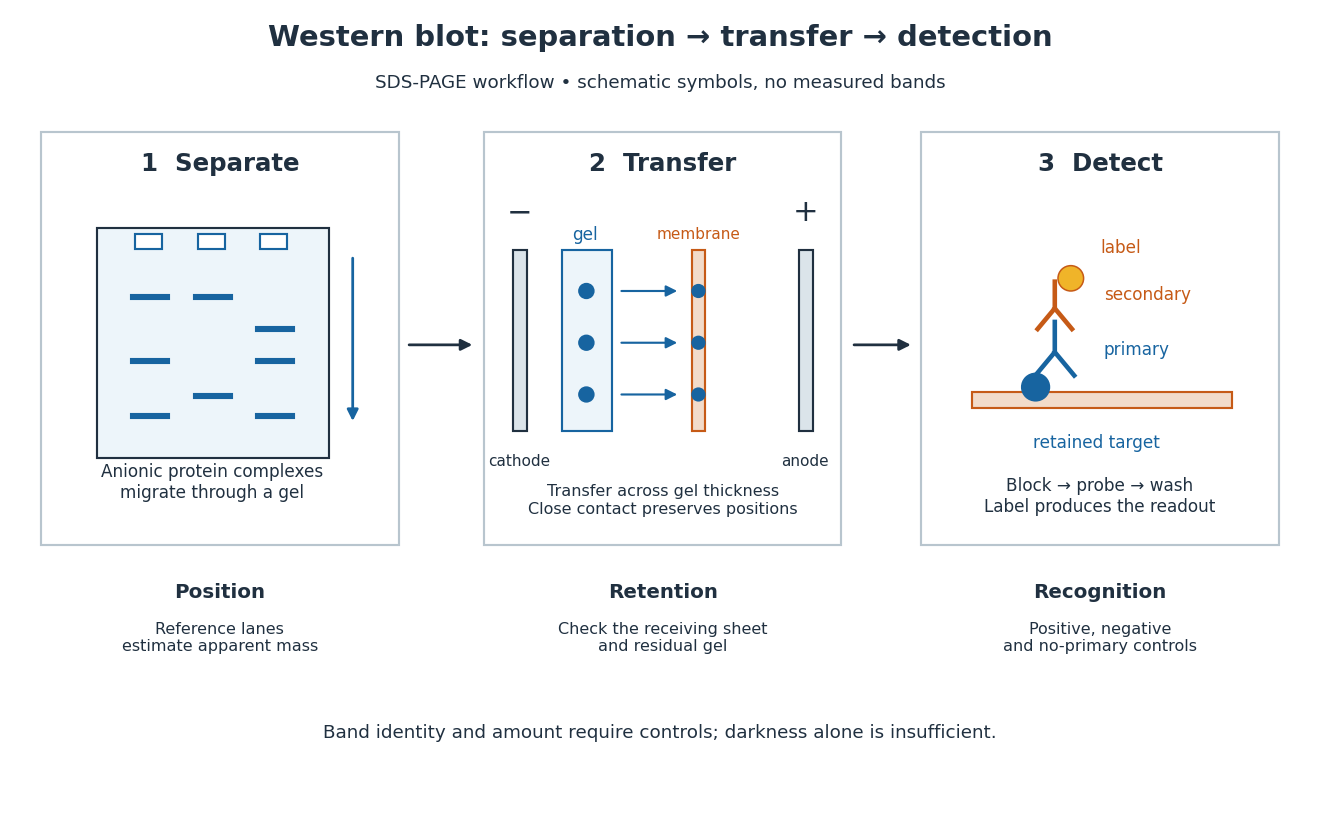
A Western blot detects selected proteins after their separation and transfer to a membrane, using antibodies. In the yeast cross-species complementation experiment, detection helps distinguish failed protein production from failure of an expressed protein to restore growth.
The useful idea is to preserve where proteins migrated in gel electrophoresis, then ask which positions retain an antibody. Western blot separation, Western blot transfer and Western blot antibody detection answer different questions. A band is evidence of retained label at a position; Western blot band interpretation requires Western blot controls before assigning identity or comparing abundance.
Articles by others on the same topic


Western blot is a widely used analytical technique in molecular biology and biochemistry to detect and quantify specific proteins in a sample. The process involves several key steps: 1. **Sample Preparation**: Proteins are extracted from cells or tissues and denatured, usually by heating and adding a reducing agent, to ensure that they unfold and are separated by size.