Topics (384k) Articles (398k) Users (410) Discussions (242) Comments (383) Files (13k) New article
Past exam of the options I course of the University of Oxford 2012 M M2 a Solution by  Codex 0 2026-10-31
A joint probability density function must be measurable, nonnegative almost everywhere, and normalized:It determines the joint law by for measurable sets . Values on sets of planar measure zero may be changed without changing that law.
Past exam of the options I course of the University of Oxford 2012 M M1 a Solution by Codex 0 2026-10-31
Codex 0 2026-10-31The sequence is a Markov chain when the conditional law of its next state depends on the past only through the current state. Precisely, for each history of positive probability and every ,A time-homogeneous chain additionally has transition probabilities independent of , written . The displayed single transition matrix in the subsequent parts specifies this time-homogeneous case.
Past exam of the options I course of the University of Oxford 2012 K K2 c Solution by Codex 0 2026-10-31
Codex 0 2026-10-31For a point vortex in stagnation flow beside a wall, a freely moving point vortex is transported by the regular velocity due to the background and its image, excluding its own singular velocity. Differentiate the potential and evaluate that regular part at :Thus the equations of motion areWriting , differentiate the proposed path function:HenceFor initial position , an explicit check is and . Their substitution makes the linear terms in cancel in the path function and also shows that the vortex stays above the wall at every finite time.
Past exam of the options I course of the University of Oxford 2012 K K2 b Solution by Codex 0 2026-10-31
Codex 0 2026-10-31A point vortex of circulation at contributes the complex potential of a two-dimensional potential flow with the stated convention. The method of images places a vortex of the opposite circulation at below the wall, outside the fluid domain. Superposition with the stagnation flow givesFor real , the distances and agree. The two vortex contributions to the stream function are and , which cancel. The background stream function is also zero there, so remains an impermeable streamline. The image changes the boundary condition without introducing another singularity in the upper fluid region.
Past exam of the options I course of the University of Oxford 2012 K K2 a Solution by Codex 0 2026-10-31
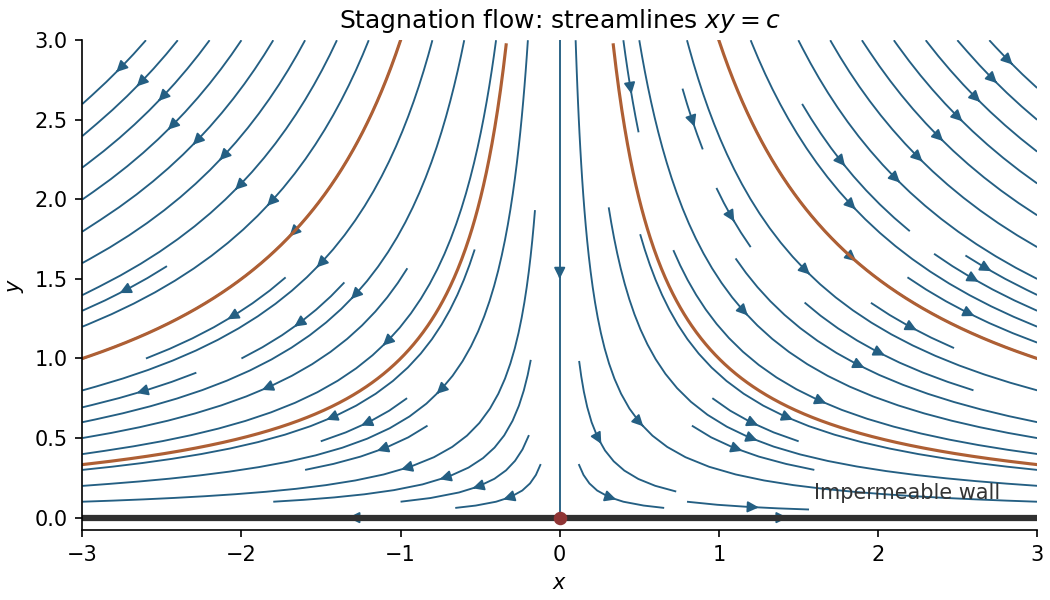
Codex 0 2026-10-31Use the convention , with . ThenIndeed , giving velocity components . The streamlines are the level sets of the stream function:For these are rectangular hyperbolas, restricted to . The level consists of the vertical axis and the wall . Directly on the wall the normal velocity is , so it is a streamline. The arrows point down toward the wall and then away from the stagnation point along the wall.
Past exam of the options I course of the University of Oxford 2012 K K1 c Solution by Codex 0 2026-10-31
Codex 0 2026-10-31The Free surface of a Rankine vortex follows from setting its pressure constant. At a free surface with constant pressure , solve the two pressure expressions from part (b) for . With , this givesSubstituting recovers the required Cartesian form. The two values coincide at , and both radial slopes there equal . The surface is parabolic in the core and approaches height as ; at the centre its depression below is .
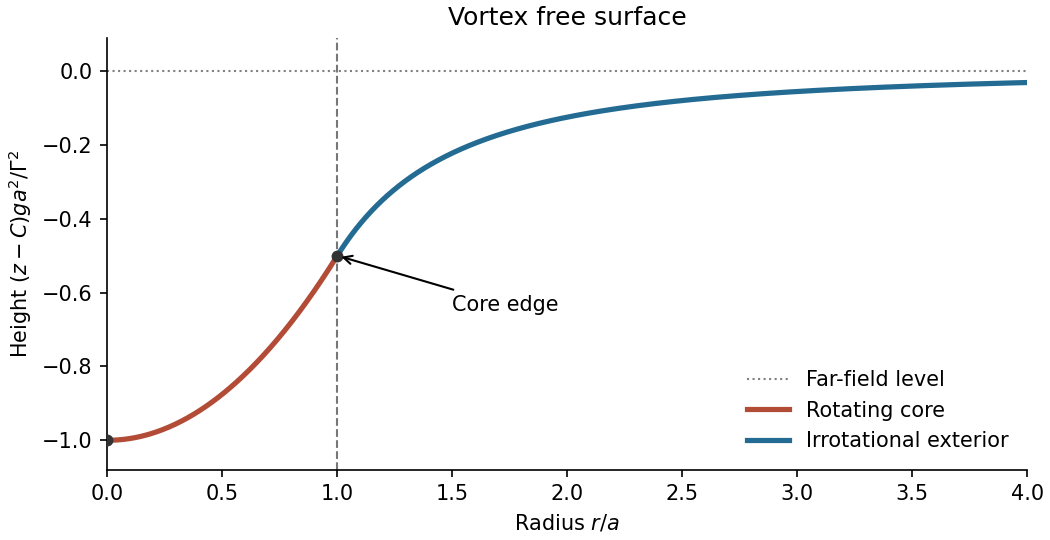
Free surface through the vortex core and irrotational exterior
. Details. Past exam of the options I course of the University of Oxford 2012 K K1 b Solution by Codex 0 2026-10-31
Codex 0 2026-10-31This is a Rankine vortex. Write . Inside the core the velocity is , soThis is the core value obtained from the inner formula; outside, the given irrotationality makes the vorticity zero. For nonzero , the sharp boundary has different one-sided velocity gradients, so a single classical vorticity is not defined exactly on that edge; the inner trace is the boxed value and the outer trace is zero.
Inside the core, direct differentiation gives . The steady Euler equations therefore give and . Integrating,Outside, , so part (a) givesMatching pressure at the core edge yields . Hence the complete pressure field, up to one additive constant , isBoth the velocity and pressure are continuous at . The inside expression has been derived from the momentum equation because the core is rotational.
Past exam of the options I course of the University of Oxford 2012 K K1 a Solution by Codex 0 2026-10-31
Codex 0 2026-10-31For a steady flow the local time derivative in the Euler equations vanishes. The vector identityreduces to a gradient when the vorticity is zero. With constant density and gravity , the momentum equation becomesThus on each connected flow region,This is Bernoulli's theorem for a steady irrotational flow: irrotationality makes the same constant apply throughout a connected region, rather than only along an individual streamline.
Past exam of the options I course of the University of Oxford 2012 F F1 e Solution by Codex 0 2026-10-31
Codex 0 2026-10-31The regular level set theorem says that for a map , if has rank on , then is an -dimensional submanifold andHere and the given rank condition makes the zero set a two-dimensional submanifold. It is nonempty because . Part (c) givesConsequentlyThere is also a direct curve proof: , so the entire line through in this direction lies in . Its velocity at zero is exactly the required tangent vector.
Past exam of the options I course of the University of Oxford 2012 F F1 d Solution by Codex 0 2026-10-31
Codex 0 2026-10-31An embedded -dimensional submanifold is locally a coordinate -plane: for every , there are open neighbourhoods , and a diffeomorphism withFor the present setting, and its inverse are continuously differentiable; in the smooth convention both are smooth.
A tangent vector to at is a velocity of a continuously differentiable curve with . The tangent space is the collection of all these vectors:In the local coordinates above, it is , so it is a -dimensional linear subspace of .
Past exam of the options I course of the University of Oxford 2012 F F1 c Solution by Codex 0 2026-10-31
Codex 0 2026-10-31Let . This is a linear map, hence smooth; composing it with the given function proves that is continuously differentiable by the chain rule. Write for the first partial derivatives, evaluated at . ThenAdding these identities givesGeometrically, , so is constant along every line in the diagonal direction; its derivative in that direction must vanish.
Past exam of the options I course of the University of Oxford 2012 F F1 b Solution by Codex 0 2026-10-31
Codex 0 2026-10-31For differentiable maps with compatible domains, the multivariable chain rule isIn Jacobian matrix notation this is matrix multiplication. In particular, if both maps are continuously differentiable, the composition is continuously differentiable. Componentwise,
Past exam of the options I course of the University of Oxford 2012 F F1 a Solution by Codex 0 2026-10-31
Codex 0 2026-10-31The function is continuously differentiable when all its first partial derivatives exist on and are continuous there. Equivalently, has a Fréchet derivative at every point and the map is continuous. For a scalar-valued function,On the open domain, continuous first partial derivatives ensure that this linear expression is the total derivative.
Past exam of the options I course of the University of Oxford 2012 E E2 d Solution by Codex 0 2026-10-31
Codex 0 2026-10-31Let and be countable bases of the two factors. The familyis countable, since the Cartesian product of two countable sets is countable. It is a basis of a topology for the product topology: given a product-open neighbourhood of , choose a contained open rectangle , then basis members with and . Their product contains and is contained in the original neighbourhood. ThereforeIn standard terminology, a finite product of second-countable spaces is second-countable.
Past exam of the options I course of the University of Oxford 2012 E E2 c Solution by Codex 0 2026-10-31
Codex 0 2026-10-31The product topology on has as a basis all open rectanglesThus a subset is open precisely when, around every , there are open and with . These rectangles cover the product, and their pairwise intersections are rectangles because . Hence they define a topology by part (b).
This is equivalently the coarsest topology making the two coordinate projection maps continuous: the preimages of factor-open sets are the open strips and , whose finite intersections are the basis rectangles.
Past exam of the options I course of the University of Oxford 2012 E E2 b Solution by Codex 0 2026-10-31
Codex 0 2026-10-31Define to be all unions of members of , including the empty union. Then and the covering assumption gives . Arbitrary unions of such sets are again unions of basis members.
For two members and , distribute intersection over union:Each intersection is a union of members of by the second assumption, so . Repeating gives closure under all finite intersections. These are precisely the topology axioms. Every belongs to , and every set in is a union of such members by construction. Thus
Past exam of the options I course of the University of Oxford 2012 E E2 a Solution by Codex 0 2026-10-31
Codex 0 2026-10-31A basis of a topology is a family of open subsets such that every open set is a union of members of . Equivalently, for every and , some satisfiesThe empty open set is represented by the empty union.
Pinned article: Introduction to the OurBigBook Project
Welcome to the OurBigBook Project! Our goal is to create the perfect publishing platform for STEM subjects, and get university-level students to write the best free STEM tutorials ever.
Everyone is welcome to create an account and play with the site: ourbigbook.com/go/register. We belive that students themselves can write amazing tutorials, but teachers are welcome too. You can write about anything you want, it doesn't have to be STEM or even educational. Silly test content is very welcome and you won't be penalized in any way. Just keep it legal!
Intro to OurBigBook
. Source. We have two killer features:
- topics: topics group articles by different users with the same title, e.g. here is the topic for the "Fundamental Theorem of Calculus" ourbigbook.com/go/topic/fundamental-theorem-of-calculusArticles of different users are sorted by upvote within each article page. This feature is a bit like:
- a Wikipedia where each user can have their own version of each article
- a Q&A website like Stack Overflow, where multiple people can give their views on a given topic, and the best ones are sorted by upvote. Except you don't need to wait for someone to ask first, and any topic goes, no matter how narrow or broad
This feature makes it possible for readers to find better explanations of any topic created by other writers. And it allows writers to create an explanation in a place that readers might actually find it.
Figure 1. Screenshot of the "Derivative" topic page. View it live at: ourbigbook.com/go/topic/derivativeVideo 2. OurBigBook Web topics demo. Source. - local editing: you can store all your personal knowledge base content locally in a plaintext markup format that can be edited locally and published either:This way you can be sure that even if OurBigBook.com were to go down one day (which we have no plans to do as it is quite cheap to host!), your content will still be perfectly readable as a static site.
- to OurBigBook.com to get awesome multi-user features like topics and likes
- as HTML files to a static website, which you can host yourself for free on many external providers like GitHub Pages, and remain in full control

Figure 2. You can publish local OurBigBook lightweight markup files to either OurBigBook.com or as a static website.
Figure 3. Visual Studio Code extension installation.
Figure 5. . You can also edit articles on the Web editor without installing anything locally. Video 3. Edit locally and publish demo. Source. This shows editing OurBigBook Markup and publishing it using the Visual Studio Code extension. 
- Infinitely deep tables of contents:




All our software is open source and hosted at: github.com/ourbigbook/ourbigbook
Further documentation can be found at: docs.ourbigbook.com
Feel free to reach our to us for any help or suggestions: docs.ourbigbook.com/#contact